

For decades, institutional capital has viewed the construction industry through a very specific lens: high capital requirements, high risk, and notoriously tight margins.
Unlike manufacturing or software, where inputs reliably equal outputs, construction has historically been governed by unpredictable field conditions. A financial model can look perfect in a boardroom spreadsheet, but the moment a project breaks ground, it is subjected to the chaotic realities of site execution.
For large-scale developers and private equity investors, the greatest threat to a project’s Return on Investment (ROI) isn’t the cost of materials—it is execution variability. When outcomes are difficult to forecast, capital becomes expensive, and scaling a development portfolio becomes a high-wire act.
But smart capital is beginning to recognize a structural shift in the industry. The firms attracting the most significant investment today are those replacing execution variability with structured automation.
The Problem: The Unpredictable P&L
To understand why construction is often viewed as a high-risk asset class, you have to look at how the work is actually performed.
In traditional construction, practically every major phase is heavily reliant on manual labor. This reliance introduces a massive, unquantifiable variable into every project schedule and budget: human endurance and inconsistency. When a project’s timeline depends entirely on how fast, how accurately, and how consistently a crew of fifty people can work over an eight-month period, accurate financial forecasting is nearly impossible.
Why Traditional Painting Compounds Execution Risk
This variability is most punishing during the interior finishing phase. Painting is historically one of the most manual, labor-intensive stages of a build.
If a manual painting crew experiences fatigue, their application speed slows down, and their material usage becomes erratic.
An extra millimeter of paint thickness applied by a tired worker across a 500-unit residential complex doesn’t just waste thousands of dollars in raw materials; it extends drying times, delays follow-on trades, and pushes back the ultimate handover date.
For an investor, this translates directly to margin compression. Extended equipment rentals, increased labor overhead, and delayed occupancy quickly erode the profitability of a project. The finishing phase ceases to be a scheduled line item and becomes a financial liability.
How Automation Changes the Risk Profile
The solution to execution risk isn’t tighter management or working crews harder; it is fundamentally changing the execution model.
When developers introduce structured automation into the building process, they transform a variable human service into a fixed, scalable process. Machines do not suffer from fatigue, they do not require rework due to loss of focus, and their output does not fluctuate.
By replacing manual variability with robotic consistency, construction companies can finally treat building like a standardized manufacturing process. This shift allows financial modelers to move away from “best-case scenario” estimates and rely on engineered, mathematically sound projections.
Why Consistency Matters to Smart Capital
Investors don’t just fund growth; they fund predictability.
When evaluating a modern construction firm, smart capital looks for operational stability. If a general contractor can guarantee that 100 square meters of wall will be finished perfectly every single hour, at a precise micron thickness, with zero material waste, the entire risk profile of the project changes.
Predictability allows developers to tightly sequence trades, eliminate the buffer time traditionally built into schedules for rework, and accelerate the path to revenue generation. At scale, this consistency isn’t just an operational perk—it is a massive competitive moat that protects developer margins across an entire portfolio.
How MYRO Delivers Operational Stability
This is exactly why forward-thinking developers and contractors are integrating MYRO into their standard operating procedures.
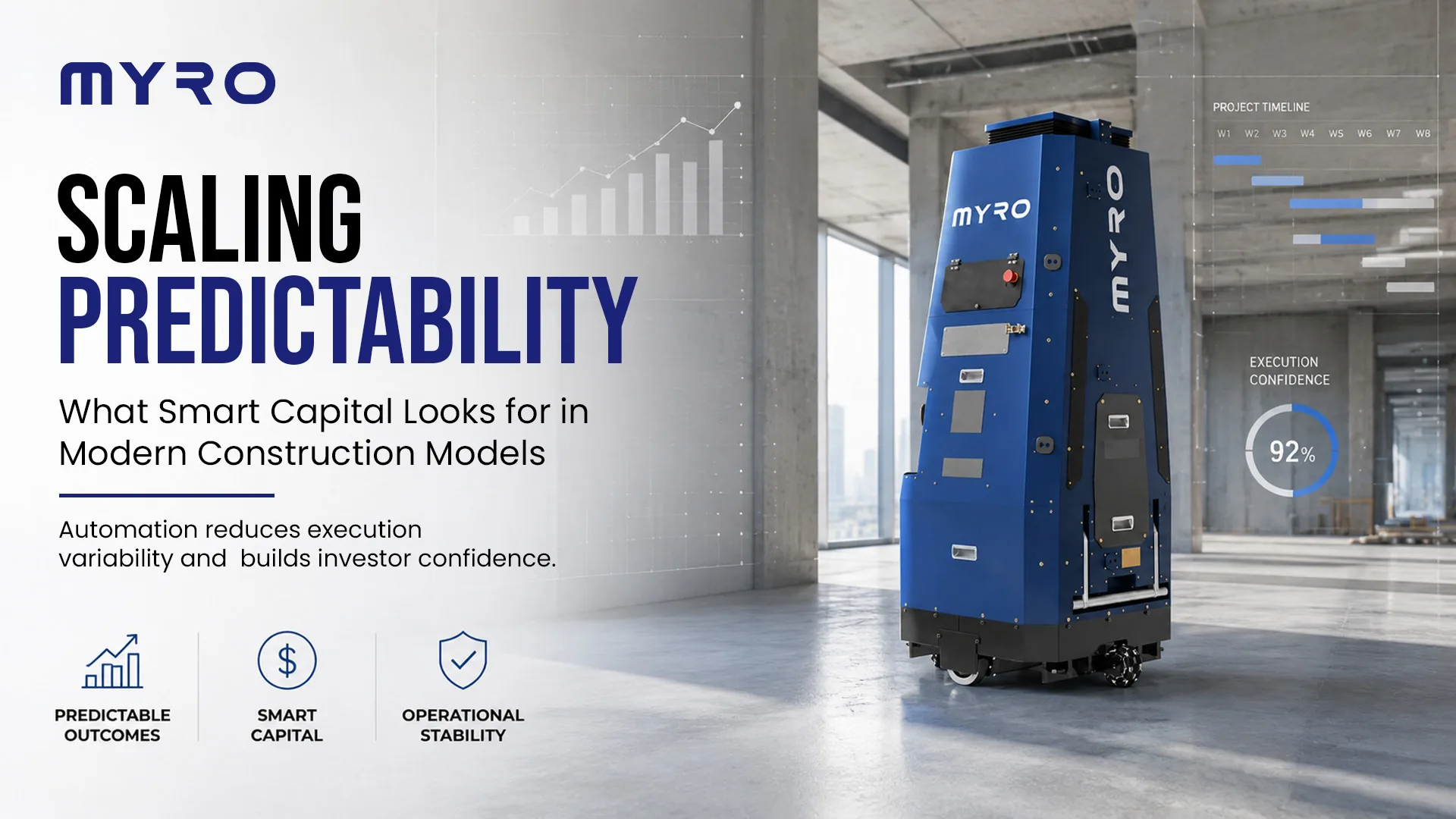
MYRO acts as the operational infrastructure that smart capital demands. By utilizing advanced sensors and autonomous navigation, MYRO eliminates the guesswork from interior painting. It locks in the manufacturer-specified spray parameters, applying paint with absolute mechanical rigidity.
For the project manager, this means the end of the “eight-hour fade.” For the investor, it means total transparency. MYRO’s data-driven dashboards provide real-time insights into material consumption, square footage completed, and exact operational costs. MYRO turns the traditionally chaotic finishing phase into a transparent, measurable, and highly scalable data point.
The Vision: A Predictable Asset Class
The construction industry is shedding its reputation as a high-risk gamble.
As we integrate intelligent robotics and structured automation into the core of how we build, we are moving toward a future where on-time completion and margin protection are engineered guarantees.
The future of the construction sector is not just about building taller or faster; it is about building with absolute certainty. By transforming unpredictable site execution into a standardized, technology-backed process, we are turning construction into a highly predictable asset class—one where institutional capital can invest, scale, and build with absolute confidence.
Protect your investments with predictable execution. Discover the MYRO robotic painting system, and explore how training tomorrow’s certified robotic operators scales execution.