
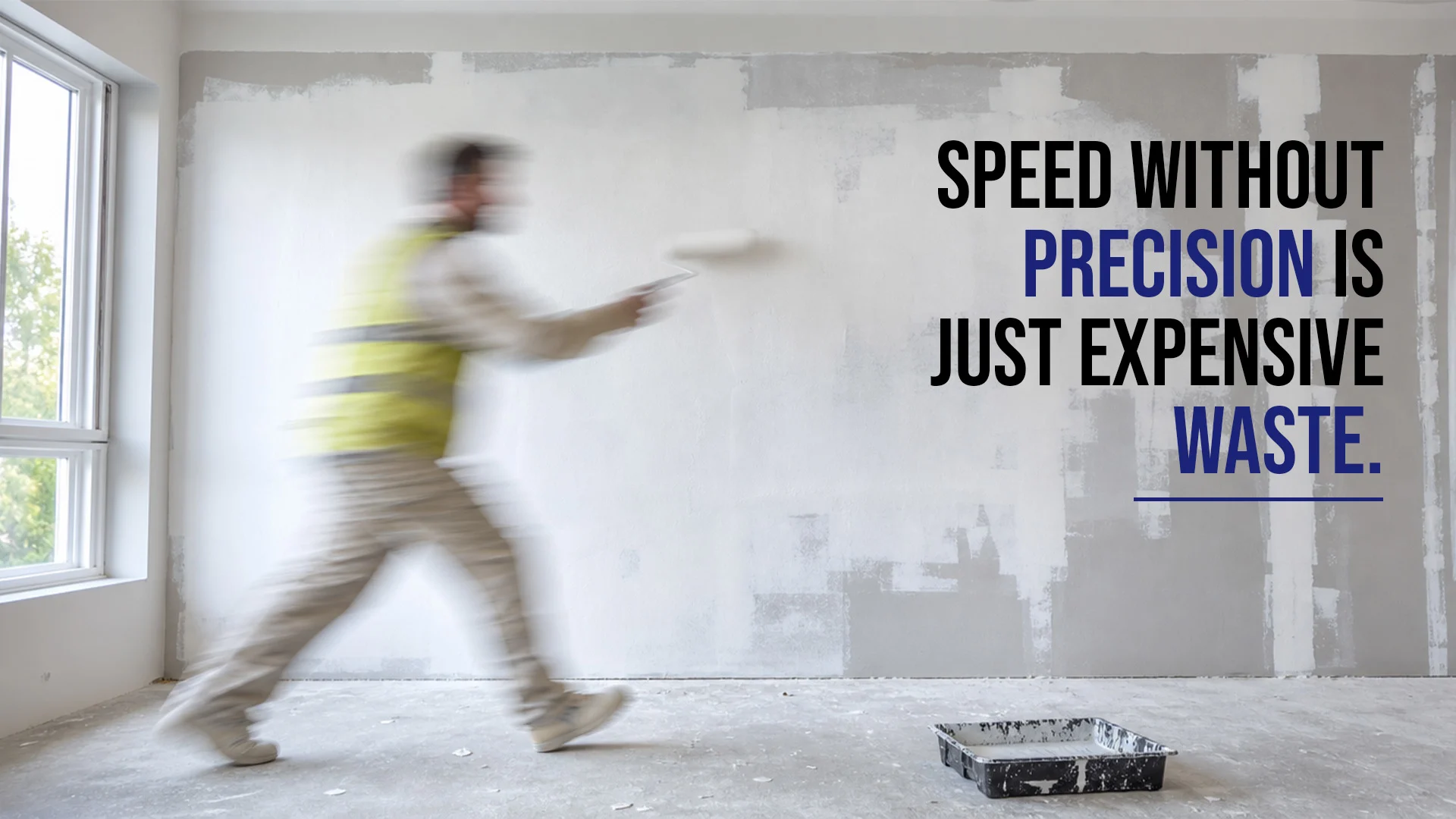

The Unpredictability of Schedule Compression
In large-scale commercial development, the final 10% of a project is consistently the most sensitive phase. As developments approach their critical handover windows, the finishing trades often absorb any schedule slippage that occurred during earlier phases. This creates a challenging environment where project managers, aiming to meet tight deadlines, naturally encourage teams to accelerate their pace.
However, the directive to “just finish it quickly” treats painting as a simple variable that can be sped up at will. In reality, the final coat is a highly technical application that shapes the client’s first impression of the completed project. When teams are asked to recover lost time in these closing stages, it introduces an element of unpredictability into a phase that requires absolute precision.
The Hidden Costs of Accelerated Manual Application
While increasing the pace of a manual workforce is a common response to schedule constraints, it introduces new operational complexities. Adding more personnel to a delayed construction project can increase communication friction and logistical bottlenecks rather than purely increasing output.
Furthermore, human physiology has natural limits. A manual painter’s speed and application pressure will naturally fluctuate based on environmental temperatures, complex room layouts, and physical fatigue over a long shift. When manual application is accelerated past an optimal pace, minor variances begin to compound, leading to several unintended consequences:
- Material Inefficiency: Erratic manual strokes and overspray can inadvertently create up to 30% raw paint waste.
- Film Build Variations: Uneven application thickness alters light reflection and color uniformity, leading to noticeable texture differences.
- Accumulated Rework: Rework is not an inevitable project cost; it is a systemic result of an unpredictable manual finishing process. Sending a crew back to repair a defective finish consumes valuable time and keeps overhead holding costs active.
Attempting to save time through sheer manual acceleration often results in multi-week delays written into the project through necessary touch-ups.
Programmatic Certainty and Mechatronic Control
To achieve both speed and quality, the industry is moving from reactive crisis management to predictive mechatronic operations. MYRO offers an autonomous interior wall-painting platform that replaces finishing variables with programmatic certainty. By shifting execution to advanced physical automation infrastructure, the pace of finishing is completely decoupled from human fatigue.
This approach guarantees scale and consistency through highly structured systems:
- Intelligent Site Navigation: By processing architectural floor plans directly through its interface, MYRO autonomously identifies boundaries and navigates active layouts. It pairs this spatial awareness with dynamic proximity sensors that track the wall surface, automatically correcting for typical job-site concrete undulations up to 15mm in real time.
- Algorithmic Quality Control: The system adheres strictly to supplier technical data sheets through algorithmic wet film thickness (WFT) controls. By precisely balancing WFT to build exact Dry Film Thickness (DFT), the robotic advantage delivers uniform coverage with zero tool marks.
- Continuous, Predictable Velocity: MYRO maintains a constant standoff distance and steady speed, allowing the platform to sustain a productivity rate of 100 square meters per hour.
- Proven Schedule Compression: During an enterprise deployment at Emaar’s Forte project in Downtown Dubai, MYRO successfully condensed a traditional 4-day residential finishing cycle into a single, 4-hour automated run with absolute quality control.
Upskilling and Collaborative Execution
The future of the finishing phase is not about removing human expertise; it is about utilizing it more effectively. The transition to construction robotics represents an opportunity to upgrade the existing workforce.
By automating repetitive, high-volume surface runs, MYRO reduces the need for manual crews to perform physically exhausting tasks on high-elevation scaffolding. This allows finishing personnel to specialize as Certified System Operators, managing advanced assets via tablet-driven path planning. Human judgment is elevated to focus on preparation, complex detailing, and quality control, while the robotic platform executes the high-volume heavy lifting safely and predictably.
When speed comes from a reliable, mechatronic system rather than a rushed workforce, project teams can increase productivity while protecting their finish quality, insulating their margins, and ensuring a confident handover.