
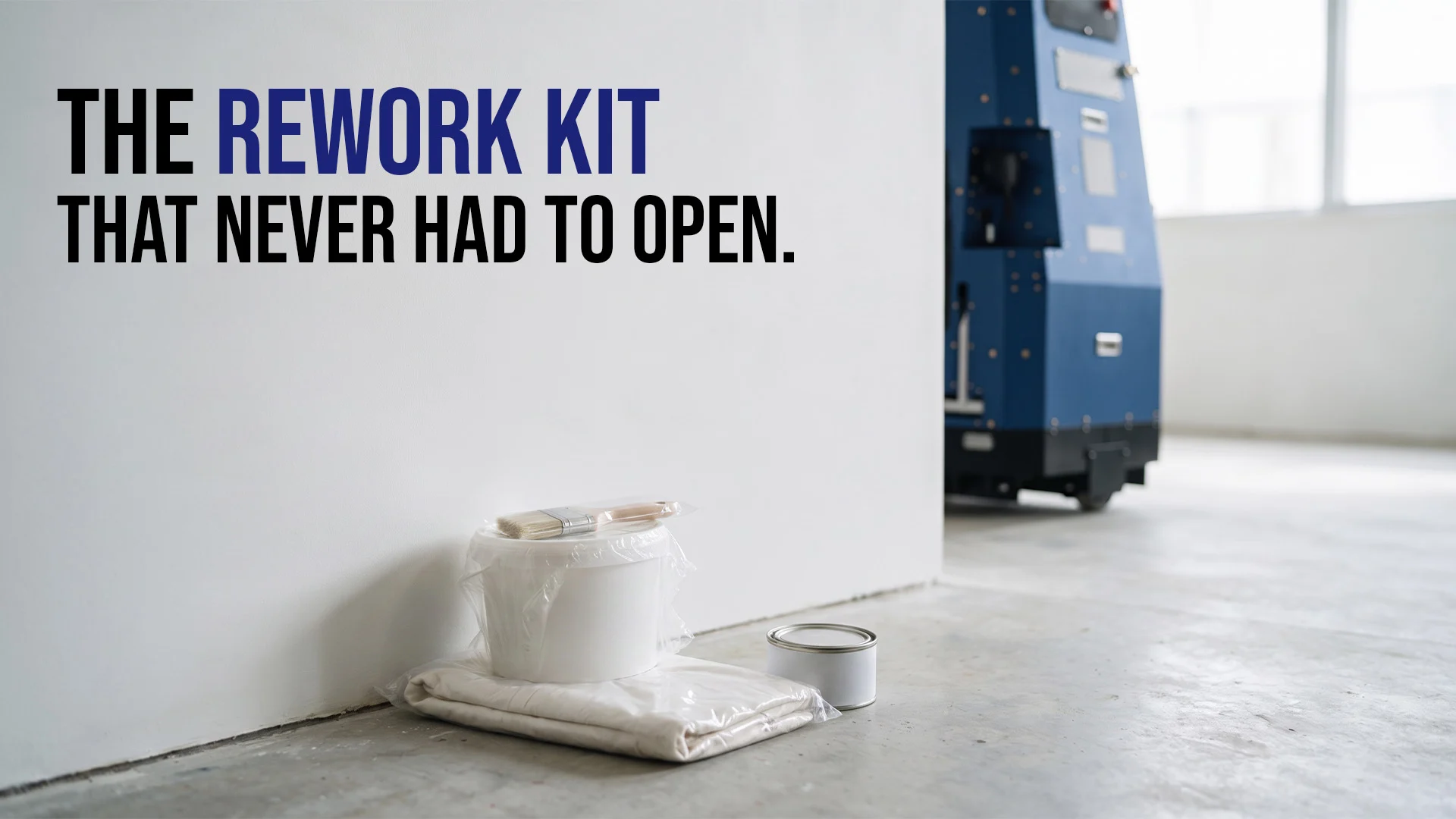

The Escalating Cost of Late-Stage Defects
In the lifecycle of a commercial build, the timing of a defect changes its financial impact entirely. During the early phases of construction, a minor surface imperfection is generally viewed as a manageable, low-cost adjustment. However, as a project nears its final handover, the exact same defect undergoes a dramatic escalation in cost and complexity.
Near handover, access to the site becomes highly restricted. Correcting a minor paint defect suddenly requires re-mobilizing specialized teams, moving installed furniture or equipment, laying down extensive protective materials for completed floors, and initiating another rigid cycle of client approvals. What should be a simple touch-up transforms into an operational bottleneck, straining the handover program.
Historically, general contractors have accepted a “rework allowance” as an inevitable part of manual finishing budgets. This acceptance masks a significant financial drain, treating unpredictable manual application variations and the resulting rework not as a process failure, but as a standard cost of doing business. When finishing relies entirely on manual labor, companies are effectively paying for fatigue, material waste, and the inevitable return visits required to fix human error.
Programmatic Margin Recovery
Imagine a finishing phase where aesthetic perfection is established on the very first pass, eliminating the need for a rework buffer entirely. By transitioning from variable manual labor to mechatronic application, project managers can achieve 98% precision while radically accelerating their timelines.
This level of predictability transforms project economics, offering a programmatic cost defense that protects vulnerable real estate margins from late-stage erosion. When operations are scaled through automation, multi-day manual finishing cycles are compressed into a fraction of the time. During the enterprise deployment at Emaar’s luxury Forte project in Downtown Dubai, an autonomous platform successfully condensed a traditional 4 man-day residential finishing cycle into a single, 4-hour automated cycle. This represents not just a massive increase in velocity, but the complete removal of the unpredictable variables that necessitate rework.
Engineering Out the Root Causes of Defect
The transition from costly, variable finishing to a predictable handover is bridged by MYRO’s autonomous mechatronic platform. Rework is prevented by engineering out its root causes before the coating ever hits the wall.
MYRO achieves this through an advanced, data-driven sensory architecture:
- Intelligent Site Navigation: Utilizing advanced proximity sensors and dynamic path-planning software, the platform autonomously maneuvers through complex environments. It seamlessly identifies architectural boundaries and executes targeted applications while bypassing structural voids requiring zero manual taping from your finishing crews.
- Dynamic Surface Calibration: A common cause of finishing defects is uneven structural concrete. MYRO utilizes continuous mechatronic sensor adjustments that dynamically correct for typical job-site slab undulations up to 15mm in real time, ensuring the spray nozzle maintains a perfect, constant standoff distance.
- Absolute WFT/DFT Compliance: Code-compliant finishing requires exacting standards. By holding algorithmic liquid pressure and speed constant, MYRO delivers absolute compliance with target spread rates, perfectly balancing Wet Film Thickness (WFT) to build exact Dry Film Thickness (DFT) specifications.
By treating interior painting as a precise, measurable science rather than a subjective craft, MYRO ensures that the specified finish matches the delivered reality on the first pass, securing handover confidence and reclaiming lost margins.