

The construction industry is operating under an unsustainable equation. Global demand for infrastructure and housing is accelerating rapidly, yet the workforce required to deliver it is shrinking.
With an aging population of skilled tradespeople and turnover rates climbing, the sector is facing a severe structural challenge. The conversation around construction tech often revolves around software and project management, but the most critical bottleneck happens on the ground, in the physical execution of the build. To solve the labor crisis, we don’t just need more workers; we need to fundamentally rethink how the work is done.
For years, automation has been framed by skeptics as a threat to jobs. But for the contractors and developers actually managing modern sites, the reality is entirely different. Adopting robotics isn’t about replacing human workers. It is about evolving their roles, protecting their health, and scaling their output.
Why Traditional Painting Slows Projects
To understand the need for evolution, we have to look at the finishing phase—specifically, interior wall painting. It is notoriously one of the most unpredictable, time-consuming, and physically punishing stages of construction.
Traditional commercial painting requires workers to spend hours balancing on scaffolding or ladders, breathing in atomized paint fumes, and executing highly repetitive, shoulder-straining movements. It is an environment where human fatigue is inevitable. And in construction, fatigue translates directly to inconsistency.
As a painter tires throughout an eight-hour shift, variations in spray distance and speed naturally occur. This leads to uneven Wet Film Thickness (WFT), patchy coverage, and overspray. For project managers and developers, this inconsistency creates a domino effect: quality drops, rework is required, materials are wasted, and project handovers are delayed. The physical toll of the job is exactly why the industry struggles to attract and retain the next generation of talent.
How Automation Changes Execution: Evolution, Not Replacement
The solution to this labor constraint isn’t to phase out the workforce; it’s to upgrade their tools.
Machines excel at repetition, precision, and endurance. Humans excel at problem-solving, quality control, and site management. When you combine the two, you transition workers from manual laborers into technical supervisors.
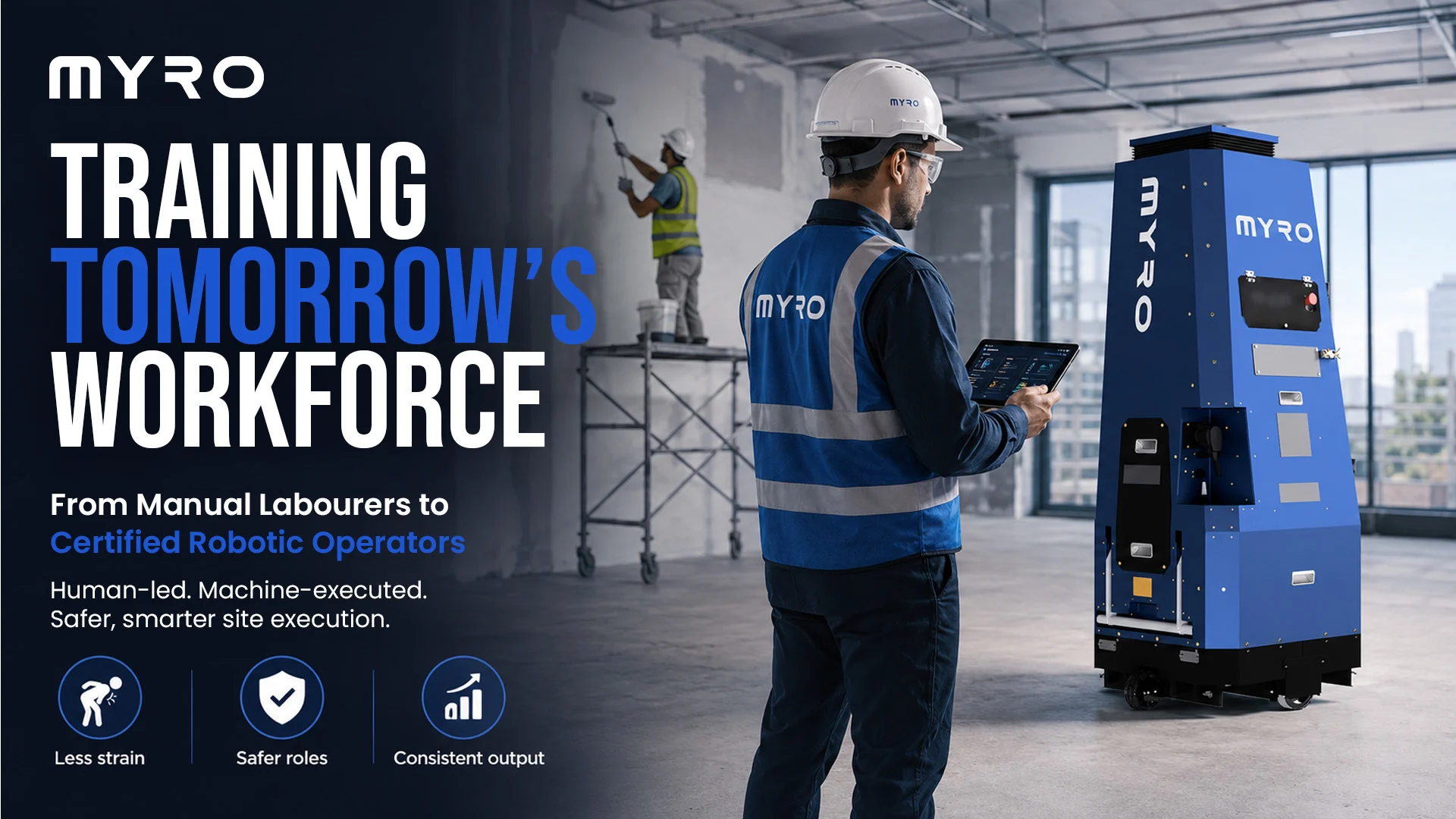
Consider the transition of a traditional painter. Their deep knowledge of surface preparation, paint viscosity, and quality standards is invaluable. Automation doesn’t make this expertise obsolete; it amplifies it. By removing the physical hazards of scaffolding and repetitive strain, we upskill that painter into a Certified Robotic Operator.
Instead of holding a spray gun, the operator holds a tablet. Their day shifts from hazardous physical labor to high-value site management.
Why Consistency Matters at Scale
For capital providers, developers, and large-scale contractors, the true value of this upskilled workforce is predictability.
When a Certified Operator is managing an automated system, the output is no longer tied to human endurance. A robot doesn’t fatigue at 3:00 PM. It doesn’t need to take breaks. It applies the exact same flawless coat of paint at the end of a shift as it did at the beginning.
This level of consistency is a massive commercial advantage. It means material waste is drastically reduced, rework is virtually eliminated, and project timelines become mathematically predictable. When you can guarantee that 100 square meters of wall will be finished perfectly every single hour, you protect project margins and scale execution across multiple sites with confidence.
How MYRO Fits Into the Future of the Workforce
This is exactly where MYRO bridges the gap between traditional craftsmanship and modern construction technology.
MYRO is designed to be the ultimate collaborative tool for the modern worker. When a Certified Operator deploys MYRO on a site, they are commanding an intelligent, autonomous system. The operator uses an intuitive mobile app to map the room’s layout, define exclusion zones (like doors and windows), and set the precise parameters for the paint job.
Once configured, MYRO takes over the heavy lifting. Using advanced sensors, it navigates the space and applies paint with mechanical precision. Because MYRO maintains a perfect programmatic standoff distance, it ensures uniform coverage while reducing paint waste by up to 30%.
More importantly, MYRO radically improves the operator’s working conditions. By keeping personnel firmly on the ground and significantly reducing the atomized paint clouds that cause poor indoor air quality, MYRO creates a safer, healthier, and far less stressful job site.
The Future is Human-Led and Machine-Executed
We are standing at a critical turning point in how we build. The construction companies that thrive in the next decade will be the ones that recognize technology as a tool for human empowerment.
The future of construction doesn’t leave the workforce behind—it engineers a smarter, safer way for them to operate. By transitioning traditional tradespeople into Certified Robotic Operators, we are extending career longevities, drastically reducing site hazards, and delivering the predictable, high-quality execution that modern infrastructure demands.
With solutions like MYRO, we aren’t just changing how paint is applied. We are elevating the workforce and redefining what it means to be a builder in the 21st century.
Empower your workforce with the tools of tomorrow. Explore MYRO’s technology, and read about what smart capital looks for in modern construction models.