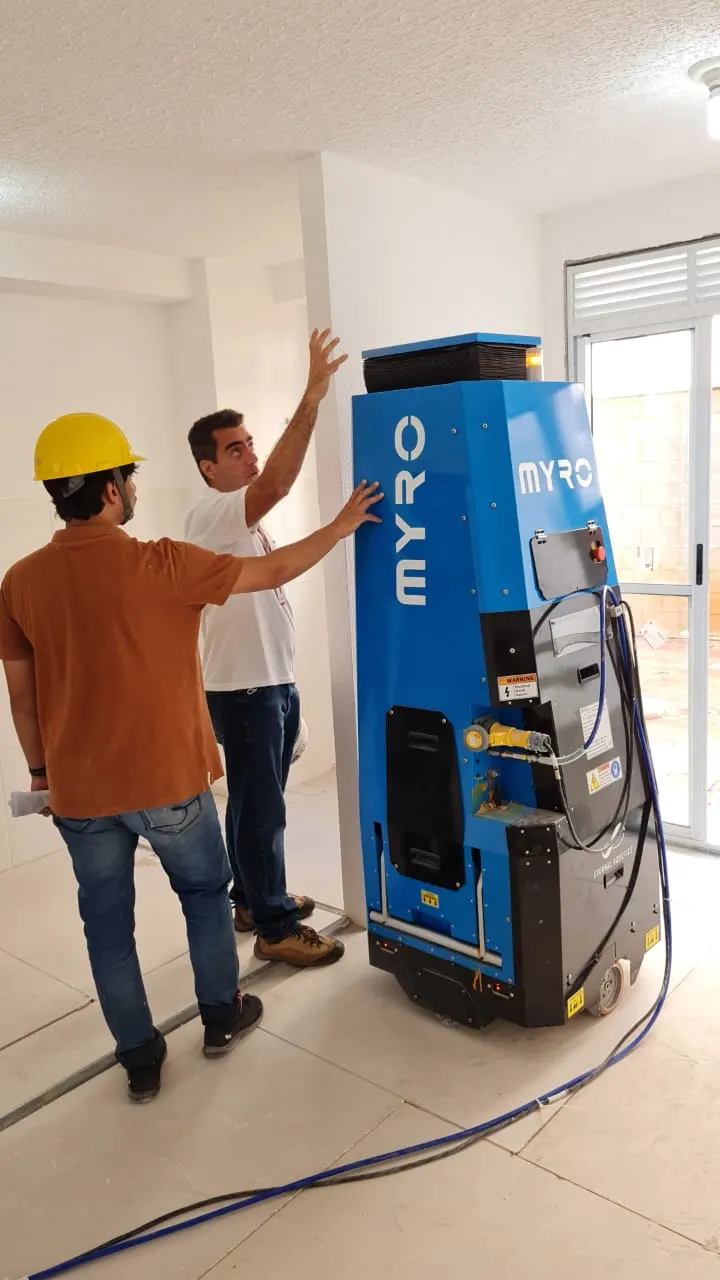
MYRO Showcased at Viva Vida Felicidade for Direcional Engenharia
At Viva Vida Felicidade in Rio, MYRO painted 90 sqm at 120 sqm/h-saving 29% on paint and working 33% faster than human labour. Direcional Engenharia’s team observed MYRO’s live performance, validating its impact on speed, quality, and material efficiency.

MYRO was deployed at the Viva Vida Felicidade residential development in Rio de Janeiro for a demonstration organized in collaboration with Direcional Engenharia. The objective was to test MYRO in a social housing project residential environment while offering Direcional’s directors and engineers a first-hand look at the robot’s capabilities.
Throughout the trial, MYRO painted a 90-square-meter area at a productivity rate of 120 sqm/h. The deployment focused on two primary performance goals: enhancing paint quality and increasing paint speed compared to manual labour. With a paint consumption efficiency of 14 sqm/L, MYRO demonstrated a 29% reduction in paint usage and delivered results 33% faster than human painters, highlighting its value in both speed and material savings.
The project offered a controlled setting for Direcional’s leadership to assess MYRO’s integration potential. With consistent application, reduced waste, and uniform quality, the robot demonstrated how automation can streamline construction workflows while maintaining finish standards crucial to residential projects
As Direcional Engenharia continues to lead innovation in Brazil’s housing sector, this live demonstration played a key role in validating MYRO’s practical utility. The performance metrics underscored the robot’s suitability for repeatable, high-volume work while minimizing overhead and increasing output predictability.
MYRO’s presence on-site also encouraged meaningful dialogue around long-term technology adoption, labour optimization, and cost efficiency, particularly in projects where operational margins are tight and timelines are fixed.
Viva Vida Felicidade marked another successful milestone in MYRO’s rollout across Latin America, proving that robotics can make measurable, immediate improvements even in established construction systems.