# MYRO Comprehensive Technical Documentation & Knowledge Base
> Full technical repository, deployment archives, event reports, and complete publication library for MYRO — the world's first autonomous interior wall painting robot.
## Executive Summary
MYRO International PTE is an advanced robotics engineering company addressing the most severe bottlenecks in the modern construction and finishing sector. Wall painting and surface finishing account for substantial project timelines and are plagued by severe labor shortages, high accident rates on scaffolding, uneven material consumption, and costly rework. MYRO resolves these challenges through an intelligent, self-navigating autonomous mobile robot (AMR) system engineered specifically for construction environments.
## Engineering Architecture & Key Specifications
- **Operating Speed**: 120–125 square meters per hour (approx. 1,000–1,200+ sq ft/hr), achieving approximately 10x the throughput of traditional manual painting teams.
- **Precision Spray Mechanism**: Controlled atomization with automated continuous arm manipulation guarantees uniform Dry Film Thickness (DFT) and Wet Film Thickness (WFT) within ±5% tolerance across standard and high walls.
- **LiDAR & Autonomous Navigation**: 360-degree LiDAR and advanced SLAM (Simultaneous Localization and Mapping) enable instant on-site room scanning, real-time obstacle avoidance, precise edge-to-edge trajectory planning, and millimeter-level wall approach without surface damage.
- **Material Efficiency**: Up to 30% reduction in paint wastage compared to traditional manual rollers, eliminating paint pooling, runs, drips, and over-saturation.
- **Safety & Work Conditions**: Removes human workers from hazardous elevated platforms, ladders, and toxic chemical exposure zones, complying with the highest international occupational health and safety standards.
- **Workforce Reskilling (VR Platform)**: Proprietary Virtual Reality (VR) Training Program enables traditional painters and technicians to gain full certification as robotic system operators in days.
- **Commercial Model**: Robotics-as-a-Service (RaaS), turnkey contracting, and long-term equipment leasing arrangements tailored for developers and main contractors worldwide.
---
## Directory of URLs
### Core Pages
- Home: https://myro.bot/
- Product: https://myro.bot/product
- About Us: https://myro.bot/about
- Virtual Reality Training: https://myro.bot/vr
- Projects & Deployments: https://myro.bot/projects
- Events & Conferences: https://myro.bot/events
- Contact Us: https://myro.bot/contact
- Privacy Policy: https://myro.bot/privacy
### Case Studies & Deployments
- [MYRO Pilots Seamless Integration at Azizi Riviera Site](https://myro.bot/projects/MYRO-Pilots-Seamless-Integration-at-Azizi-Riviera-Site): Dubai, UAE
- [MYRO Tested for Modular Efficiency at LINQ Factory](https://myro.bot/projects/MYRO-Tested-for-Modular-Efficiency-at-LINQ-Factory): Dubai, UAE
- [MYRO Tested at Sobha The Crest Construction Site](https://myro.bot/projects/MYRO-Tested-at-Sobha-The-Crest-Construction-Site): Dubai, UAE
- [MYRO Deployed at Sky City Borivali for Oberoi Construction](https://myro.bot/projects/MYRO-Deployed-at-Sky-City-Borivali-for-Oberoi-Construction): Mumbai, India
- [MYRO Revolutionises Construction Painting at Rio de Goa, India](https://myro.bot/projects/MYRO-Revolutionises-Construction-Painting-at-Rio-de-Goa-India): Goa, India
- [MYRO Field-Tested at A.Yoshii Headquarters ](https://myro.bot/projects/MYRO-Field-Tested-at-AYoshii-Headquarters): Londrina, PR, Brazil
- [MYRO Deployed at Le Rêve Residential Tower](https://myro.bot/projects/MYRO-Deployed-at-Le-Rve-Residential-Tower): Campinas, SP, Brazil
- [MYRO Tested at Latitud Condominium Design ](https://myro.bot/projects/MYRO-Tested-at-Latitud-Condominium-Design): Rio de Janeiro, Brazil
- [MYRO Demonstrates Residential Automation at Nakheel Housing](https://myro.bot/projects/MYRO-Demonstrates-Residential-Automation-at-Nakheel-Housing): Dubai, UAE
- [MYRO Demonstrates at Mai Terraces Residential Tower ](https://myro.bot/projects/MYRO-Demonstrates-at-Mai-Terraces-Residential-Tower): Curitiba, PR, Brazil
- [MYRO Demonstrated at Go Up Residence for Direcional Engenharia](https://myro.bot/projects/MYRO-Demonstrated-at-Go-Up-Residence-for-Direcional-Engenharia): Belo Horizonte, MG, Brazil
- [MYRO Showcased at Viva Vida Felicidade for Direcional Engenharia](https://myro.bot/projects/MYRO-Showcased-at-Viva-Vida-Felicidade-for-Direcional-Engenharia): Rio de Janeiro, RJ, Brazil
- [MYRO Tested at LSH Hotel’s Service Corridors ](https://myro.bot/projects/MYRO-Tested-at-LSH-Hotels-Service-Corridors): Rio de Janeiro, RJ, Brazil
- [MYRO Automates High-Precision Painting at Sobha Hartland – Waves ](https://myro.bot/projects/MYRO-Automates-High-Precision-Painting-at-Sobha-Hartland--Waves): Dubai, UAE
- [MYRO Automates Interior Painting at Provident Park Square](https://myro.bot/projects/MYRO-Automates-Interior-Painting-at-Provident-Park-Square): Bangalore, India
### Events & Demonstrations
- [MYRO Showcases at ALEC Innovation Day](https://myro.bot/event/MYRO-Showcases-at-ALEC-Innovation-Day): Dubai, UAE
- [MYRO Featured at the 7th CSCEC ME Technical Conference](https://myro.bot/event/MYRO-Featured-at-the-7th-CSCEC-ME-Technical-Conference): Dubai, UAE
- [MYRO Demonstrates Robotic Wall Painting in Brazil](https://myro.bot/event/MYRO-Demonstrates-Robotic-Wall-Painting-in-Brazil): Curitiba, PR, Brazil
- [MYRO Launches in Rio de Janeiro, Brazil](https://myro.bot/event/MYRO-Launches-in-Rio-de-Janeiro-Brazil): Rio de Janeiro, RJ, Brazil
- [MYRO Debuts Globally at GITEX Technology Week](https://myro.bot/event/MYRO-Debuts-Globally-at-GITEX-Technology-Week): Dubai, UAE
- [MYRO’s First Public Launch in Hyderabad](https://myro.bot/event/MYROs-First-Public-Launch-in-Hyderabad): Hyderabad, India
### Articles & Publications
- [Why Identical Floors Never Get Identical Finishes](https://myro.bot/blogs/why-identical-floors-never-get-identical-finishes)
- [The Handover Audit: What the Final 10% of Finishing Actually Costs Your Margin](https://myro.bot/blogs/the-handover-audit-what-the-final-10-percent-actually-costs)
- [The Velocity Trap: Why Finishing Ahead of Schedule Can Delay Handover](https://myro.bot/blogs/the-velocity-trap-why-finishing-ahead-of-schedule-can-delay-handover)
- [Why the Final Coat Carries the Most Risk in Construction Finishing](https://myro.bot/blogs/why-the-final-coat-carries-the-most-risk-in-construction-finishing)
- [Why “Rework” Becomes the Most Expensive Word Near Project Handover](https://myro.bot/blogs/why-rework-becomes-the-most-expensive-word-near-project-handover)
- [Why “Just Paint It Quickly” Is Not a Real Finishing Strategy](https://myro.bot/blogs/why-just-paint-it-quickly-is-not-a-real-finishing-strategy)
- [The Future of Painting Is Human–Robot Collaboration, Not Human Replacement](https://myro.bot/blogs/the-future-of-painting-is-human-robot-collaboration-not-human-replacement)
- [How Automated Painting Impacts Indoor Air Quality and LEED Compliance](https://myro.bot/blogs/how-automated-painting-impacts-indoor-air-quality-and-leed-compliance)
- [What Smart Capital Looks for in Modern Construction](https://myro.bot/blogs/scaling-predictability-what-smart-capital-looks-for-in-modern-construction-models)
- [Why Interior Finishing Dictates Project Handovers](https://myro.bot/blogs/breaking-the-final-bottleneck-why-interior-finishing-dictates-project-handovers)
- [Upskilling the Workforce: Certified Robotic Operators](https://myro.bot/blogs/training-tomorrows-workforce-part-two-from-manual-laborers-to-certified-robotic-operators)
- [Eradicating Construction Rework with Precision Engineering](https://myro.bot/blogs/the-silent-cost-of-variation-eradicating-rework-with-precision-engineering)
- [Hitting the Mark: How Construction Automation Drives LEED Compliance and Air Quality](https://myro.bot/blogs/hitting-the-mark-how-construction-automation-drives-leed-compliance-and-air-quality)
- [Integrating Robotics into Subcontractor Workflows: A PM’s Guide](https://myro.bot/blogs/integrating-robotics-into-subcontractor-workflows-a-pms-guide)
- [The Air We Breathe On Site: How Automation Secures LEED Compliance in Finishing Works](https://myro.bot/blogs/the-air-we-breathe-on-site-how-automation-secures-leed-compliance-in-finishing-works)
- [Why Monsoon Is the Season That Exposes Weak Construction Systems](https://myro.bot/blogs/why-monsoon-is-the-season-that-exposes-weak-construction-systems)
- [Continuous Operation Is Not a Feature; It Is a Different Model](https://myro.bot/blogs/continuous-operation-is-not-a-feature-it-is-a-different-model)
- [How Strategic Players Evaluate Idle Time in Construction Projects.](https://myro.bot/blogs/how-strategic-players-evaluate-idle-time-in-construction-projects)
- [Robotic Finishing vs Traditional Painting: The Comparison Every Contractor Must See](https://myro.bot/blogs/robotic-finishing-vs-traditional-painting-the-comparison-every-contractor-must-see)
- [What Drives Capital Towards Automation in Construction Execution](https://myro.bot/blogs/what-drives-capital-towards-automation-in-construction-execution)
- [Painting That Never Stops for Breaks, Why Early Backers See Robotics as a Reliability Powerhouse](https://myro.bot/blogs/painting-that-never-stops-for-breaks-why-early-backers-see-robotics-as-a-reliability-powerhouse)
- [How Automation in Painting Is Becoming a Focus Area in Modern Construction for Capital Providers](https://myro.bot/blogs/how-automation-in-painting-is-becoming-a-focus-area-in-modern-construction-for-capital-providers)
- [Why Construction Leaders Are Looking Forward to Construction Automation Companie](https://myro.bot/blogs/why-construction-leaders-are-looking-forward-to-construction-automation-companie)
- [Why the Fastest-Growing Construction Companies Are Investing in Operational Infrastructure](https://myro.bot/blogs/why-the-fastest-growing-construction-companies-are-investing-in-operational-infrastructure)
- [The Difference Between Growing Bigger and Growing Stronger in the Painting Industry](https://myro.bot/blogs/the-difference-between-growing-bigger-and-growing-stronger-in-the-painting-industry)
- [Why Painting Industry Investors Are Looking Beyond Equipment and Materials](https://myro.bot/blogs/why-painting-industry-investors-are-looking-beyond-equipment-and-materials)
- [How Construction Industry Growth Is Creating Long-Term Infrastructure Opportunities](https://myro.bot/blogs/how-construction-industry-growth-is-creating-long-term-infrastructure-opportunities)
- [Industry Growth Rewards Those Who Remove Friction, Not Add Tools](https://myro.bot/blogs/industry-growth-rewards-those-who-remove-friction-not-add-tools)
- [The Market Is Done Funding Tools. It's Looking for Systems.](https://myro.bot/blogs/the-market-is-done-funding-tools-it-s-looking-for-systems)
- [The Most Valuable Automation Companies Will Never Feel Like Automation Companies](https://myro.bot/blogs/the-most-valuable-automation-companies-will-never-feel-like-automation-companies)
- [Every New Project Adds More Than Revenue; It Adds Complexity](https://myro.bot/blogs/every-new-project-adds-more-than-revenue-it-adds-complexity)
- [Why Infrastructure Companies Rarely Look Impressive Early](https://myro.bot/blogs/why-infrastructure-companies-rarely-look-impressive-early)
- [Why Operational Intelligence Will Matter More Than Business Intelligence](https://myro.bot/blogs/why-operational-intelligence-will-matter-more-than-business-intelligence)
- [From Chaos to Control: The Next Evolution of Construction Workflows](https://myro.bot/blogs/from-chaos-to-control-the-next-evolution-of-construction-workflows)
- [Painting in 2026: What Has Already Changed (And What's About to)](https://myro.bot/blogs/painting-in-2026-what-has-already-changed-and-what-s-about-to)
- [The Real Reason Construction Timelines Collapse at the End](https://myro.bot/blogs/the-real-reason-construction-timelines-collapse-at-the-end)
- [Why Most Wall-Painting Problems Start Before the Brush Touches the Wall](https://myro.bot/blogs/why-most-wall-painting-problems-start-before-the-brush-touches-the-wall)
- [The Hidden Beauty of Uniform Coating](https://myro.bot/blogs/the-hidden-beauty-of-uniform-coating)
- [Christmas Home Makeover: Top Colour Combinations for the Season](https://myro.bot/blogs/christmas-home-makeover-top-colour-combinations-for-the-season)
- [From Brush to Bot: Reskilling UAE Painters for the Digital Age](https://myro.bot/blogs/from-brush-to-bot-reskilling-uae-painters-for-the-digital-age)
- [Reducing Reputational Risk: Proactive Safety Through Automation](https://myro.bot/blogs/reducing-reputational-risk-proactive-safety-through-automation)
- [From Blueprints to Botprints: The New Language of Construction graphic](https://myro.bot/blogs/from-blueprints-to-botprints-the-new-language-of-construction-graphic)
- [Moisture, Heat & Humidity: Painting Well in Real-World Conditions (with MYRO)](https://myro.bot/blogs/moisture-heat-humidity-painting-well-in-real-world-conditions-with-myro)
- [Dust-Free, Fume-Free, Stress-Free: The Healthier Side of Robotic Painting](https://myro.bot/blogs/dust-free-fume-free-stress-free-the-healthier-side-of-robotic-painting)
- [Why the U.S. Is the Next Big Market for Robotic Painting](https://myro.bot/blogs/why-the-u-s-is-the-next-big-market-for-robotic-painting)
- [The Silent Cost of Human Error: How Much Paint Do We Waste?](https://myro.bot/blogs/the-silent-cost-of-human-error-how-much-paint-do-we-waste)
- [MYRO vs. Mother Nature: How Robotics Handles Dust, Humidity, and Heat on Site](https://myro.bot/blogs/myro-vs-mother-nature-how-robotics-handles-dust-humidity-and-heat-on-site)
- [The Science Behind a Perfect Coat: What MYRO Gets Right, That Humans Often Miss](https://myro.bot/blogs/the-science-behind-a-perfect-coat-what-myro-gets-right-that-humans-often-miss)
- [The Secret Link Between Smooth Walls and Mental Calm](https://myro.bot/blogs/the-secret-link-between-smooth-walls-and-mental-calm)
- [Top 6 Problems in Traditional Building Painting - and How Robots Solve Them](https://myro.bot/blogs/top-6-problems-in-traditional-building-painting-and-how-robots-solve-them)
- [Why New-Age Architects Are Loving Robots](https://myro.bot/blogs/why-new-age-architects-are-loving-robots)
- [The Hidden Cost of Traditional Painting (And How Myro Fixes It)](https://myro.bot/blogs/the-hidden-cost-of-traditional-painting-and-how-myro-fixes-it)
- [What Smart Contractors Know (That Others Don’t) About Automation in Finishes](https://myro.bot/blogs/what-smart-contractors-know-that-others-don-t-about-automation-in-finishes)
- [The 8 Most Common Misconceptions About MYRO](https://myro.bot/blogs/the-8-most-common-misconceptions-about-myro)
- [Why You Might See Robots Painting Buildings in Your City Soon](https://myro.bot/blogs/why-you-might-see-robots-painting-buildings-in-your-city-soon)
- [Beyond Aesthetics: How Color Psychology Drives Behavior in Commercial Interiors](https://myro.bot/blogs/beyond-aesthetics-how-color-psychology-drives-behavior-in-commercial-interiors)
- [Mastering Painting Terminology: A Comprehensive Guide for Construction Professionals](https://myro.bot/blogs/mastering-painting-terminology-a-comprehensive-guide-for-construction-professionals)
- [A Beginner’s Guide to Choosing Industrial Paints and Materials](https://myro.bot/blogs/a-beginner-s-guide-to-choosing-industrial-paints-and-materials)
- [Global Standards and Compliance: Adapting Robotic Painting to International Building Codes](https://myro.bot/blogs/global-standards-and-compliance-adapting-robotic-painting-to-international-building-codes)
- [PART 2: Top 5 Paint Industry Trends in 2025 (2/2)](https://myro.bot/blogs/part-2-top-5-paint-industry-trends-in-2025-2-2)
- [Building the Future: The Top 5 Construction Trends Shaping 2025](https://myro.bot/blogs/building-the-future-the-top-5-construction-trends-shaping-2025)
- [Top 5 Paint Industry Trends in 2025 (1/2)](https://myro.bot/blogs/top-5-paint-industry-trends-in-2025-1-2)
- [Achieving Aesthetic Perfection in Construction with Robotic Precision: How MYRO is Revolutionizing Wall Finishing](https://myro.bot/blogs/achieving-aesthetic-perfection-in-construction-with-robotic-precision-how-myro-is-revolutionizing-wall-finishing)
- [How Virtual Reality is Transforming the Construction Industry](https://myro.bot/blogs/how-virtual-reality-is-transforming-the-construction-industry)
- [The Future of Digital Fabrication: Trends and Innovations to Watch and MYRO](https://myro.bot/blogs/the-future-of-digital-fabrication-trends-and-innovations-to-watch-and-myro)
- [Regions of High Optimism in Construction: Addressing Challenges and Harnessing Solutions Like MYRO](https://myro.bot/blogs/regions-of-high-optimism-in-construction-addressing-challenges-and-harnessing-solutions-like-myro)
- [Revolutionizing Property Maintenance: The Role of Autonomous Painting Robots](https://myro.bot/blogs/revolutionizing-property-maintenance-the-role-of-autonomous-painting-robots)
- [Overcoming Technology Integration Challenges with MYRO's User-Friendly Interface ](https://myro.bot/blogs/overcoming-technology-integration-challenges-with-myro-s-user-friendly-interface)
- [How MYRO Supports Vision 2030: Innovation in Dubai (Pioneering a New Era with ‘We the UAE 2031’)](https://myro.bot/blogs/how-myro-supports-vision-2030-innovation-in-dubai-pioneering-a-new-era-with-we-the-uae-2031)
- [MYRO’s Commitment to Sustainability: Pioneering a Greener Future in 2025](https://myro.bot/blogs/myro-s-commitment-to-sustainability-pioneering-a-greener-future-in-2025)
- [2024 Construction Trends: How Robotic Innovation is Reshaping the Industry](https://myro.bot/blogs/2024-construction-trends-how-robotic-innovation-is-reshaping-the-industry)
- [The Intersection of Automation, IoT, and Robotics in the Construction Sector](https://myro.bot/blogs/the-intersection-of-automation-iot-and-robotics-in-the-construction-sector)
- [Human-Robot Collaboration in Construction: Building a Productive Partnership](https://myro.bot/blogs/human-robot-collaboration-in-construction-building-a-productive-partnership)
- [How climate change is reshaping construction through Design, Materials, and Planning](https://myro.bot/blogs/how-climate-change-is-reshaping-construction-through-design-materials-and-planning)
- [Robotics as a Service (RaaS) in Construction: Benefits of a Flexible Business Model](https://myro.bot/blogs/robotics-as-a-service-raas-in-construction-benefits-of-a-flexible-business-model)
- [Psychology of colors in commercial spaces](https://myro.bot/blogs/psychology-of-colors-in-commercial-spaces)
- [The Psychological Benefits of a Cleaner, Safer Work Environment with MYRO](https://myro.bot/blogs/the-psychological-benefits-of-a-cleaner-safer-work-environment-with-myro)
- [Training Tomorrow’s Workforce: AI and Autonomous Robots as the Optimal Solution to Labor Challenges](https://myro.bot/blogs/training-tomorrow-s-workforce-ai-and-autonomous-robots-as-the-optimal-solution-to-labor-challenges)
- [The Rise of Robotics and Interior Automation: Transforming Spaces for the Future](https://myro.bot/blogs/the-rise-of-robotics-and-interior-automation-transforming-spaces-for-the-future)
- [From Concept to Completion: The Journey of a MYRO-Powered Project ](https://myro.bot/blogs/from-concept-to-completion-the-journey-of-a-myro-powered-project)
- [MYRO Revolutionizes Construction in Rio de Janeiro with Advanced Robotic Solutions](https://myro.bot/blogs/myro-revolutionizes-construction-in-rio-de-janeiro-with-advanced-robotic-solutions)
- [Transforming the Future of Construction: MYRO's Collaboration with Sobha Realty](https://myro.bot/blogs/transforming-the-future-of-construction-myro-s-collaboration-with-sobha-realty)
- [MYRO's Emaar Project: Transforming Construction Efficiency](https://myro.bot/blogs/myro-s-emaar-project-transforming-construction-efficiency)
- [Proximity Sensors in MYRO: Enhancing Precision and Safety in Construction Robotics](https://myro.bot/blogs/proximity-sensors-in-myro-enhancing-precision-and-safety-in-construction-robotics)
- [Understanding Lidar Sensors and their Application in MYRO](https://myro.bot/blogs/understanding-lidar-sensors-and-their-application-in-myro)
- [MYRO: A Game-Changer in Versatile Construction Projects](https://myro.bot/blogs/myro-a-game-changer-in-versatile-construction-projects)
- [Public Perception and Acceptance of Robotics in Construction](https://myro.bot/blogs/public-perception-and-acceptance-of-robotics-in-construction)
- [The Role of Robotics in Addressing Construction Labor Shortages](https://myro.bot/blogs/the-role-of-robotics-in-addressing-construction-labor-shortages)
- [Embracing Technological Transformation in Construction with MYRO](https://myro.bot/blogs/embracing-technological-transformation-in-construction-with-myro)
- [Emaar picks robot to paint luxury Downtown Dubai skyscraper project](https://myro.bot/blogs/emaar-picks-robot-to-paint-luxury-downtown-dubai-skyscraper-project)
- [Emaar Properties commissions MYRO International's automated painting robot](https://myro.bot/blogs/emaar-properties-commissions-myro-international-s-automated-painting-robot)
- [MYRO robots can paint luxury buildings 10 times earlier than humans](https://myro.bot/blogs/myro-robots-can-paint-luxury-buildings-10-times-earlier-than-humans)
- [World’s first robot for interior painting jobs launched at Gitex](https://myro.bot/blogs/world-s-first-robot-for-interior-painting-jobs-launched-at-gitex)
- [Choosing the Right Paint for Diverse Wall Applications: A Technical Guide](https://myro.bot/blogs/choosing-the-right-paint-for-diverse-wall-applications-a-technical-guide)
---
# Real-World Projects & Deployments
## MYRO Pilots Seamless Integration at Azizi Riviera Site
- **URL**: https://myro.bot/projects/MYRO-Pilots-Seamless-Integration-at-Azizi-Riviera-Site
- **Location**: Dubai, UAE
- **Date**: June 2025
### Overview
MYRO successfully piloted its robotic painting system at Azizi Riviera, Dubai, completing live tests with 125 sqm/hr speed. The trial validated seamless integration, minimal setup, and high-quality results in construction workflows.
### On-Site Deployment Details
In June 2025, MYRO was deployed at the Azizi Riviera construction site in Dubai for a live testing and workflow integration exercise. Conducted in partnership with Gardinia Contracting – Azizi Developments, the project was designed to evaluate MYRO’s compatibility with current construction practices while assessing its performance on-site.
The deployment focusing on validating MYRO’s paint quality, operational speed, and adaptability.
With a setup time of just 20 minutes, MYRO quickly transitioned from standby to operation, exemplifying the robot’s efficiency in fast-paced environments. Once deployed, MYRO demonstrated a productivity rate of 120 square metres per hour, reinforcing its ability to execute high-speed painting tasks with consistent output across complex surfaces.
### Key Achievements & Takeaways
- Generated valuable insights to guide future large-scale deployments
- Demonstrated high-quality finishing performance.
- Required minimal setup and reduced manual effort.
- Validated MYRO’s suitability for precision-oriented building workflows.
### Operational Insights
The Azizi Riviera pilot underscores MYRO’s ongoing commitment to collaboration and innovation across the global construction landscape. By engaging with forward-thinking organizations like Gardinia Contracting, MYRO continues to prove its potential to optimize project timelines, reduce operational friction, and support a more automated future for the built environment.
---
## MYRO Tested for Modular Efficiency at LINQ Factory
- **URL**: https://myro.bot/projects/MYRO-Tested-for-Modular-Efficiency-at-LINQ-Factory
- **Location**: Dubai, UAE
- **Date**: June 2025
### Overview
At the LINQ Modular in Dubai, MYRO underwent a trial in June 2025, showcasing its capability to integrate into offsite modular construction factory workflows. Painting 120 sqm at 125 sqm/hr with 11 sqm/L efficiency, MYRO proved ideal for scalable, precision-driven modular production.
### On-Site Deployment Details
In June 2025, MYRO was deployed at the LINQ Modular offsite construction facility in Dubai to evaluate its performance within a controlled, factory-based modular construction setup. The trial focused on validating MYRO’s ability to deliver consistent paint quality, rapid output, and smooth adaptability in a high-efficiency production environment.
Spanning a total paintable area of 120 square metres, the test provided valuable insight into how robotic painting can be seamlessly integrated into offsite workflows-where speed, precision, and repeatability are critical. The deployment aimed to assess MYRO’s capabilities under factory conditions, ensuring alignment with the industry's push toward automation in modular building systems.
MYRO was up and running within 20 minutes of setup, quickly establishing itself as a productivity asset. During the test, the robot achieved a painting rate of 125 square meters per hour, while maintaining a paint consumption rate of 11 sqm per litre-highlighting not only efficiency but also economical use of material.
### Key Achievements & Takeaways
- Test Duration: 2 days
- Total Area Painted: 120 sqm
- Setup Time: 20 minutes
- Productivity: 125 sqm/hour
- Paint Consumption Rate: 11 sqm/L
### Operational Insights
The project reaffirmed MYRO’s strength in delivering superior paint application while reducing dependency on manual labor. Its ability to maintain high standards across modular units contributes directly to improved quality assurance and faster production cycles in offsite construction environments.
This test at the LINQ Factory marked another important step in MYRO’s journey toward redefining how modern construction is executed. Collaborating with forward-looking partners like LINQ Modular helps MYRO push the boundaries of what’s possible in construction automation.
---
## MYRO Tested at Sobha The Crest Construction Site
- **URL**: https://myro.bot/projects/MYRO-Tested-at-Sobha-The-Crest-Construction-Site
- **Location**: Dubai, UAE
- **Date**: April 2024
### Overview
At Sobha The Crest in Dubai, MYRO was tested on-site to showcase its efficiency. With fast setup, 90 sqm/h productivity, and reduced paint use, the robot proved its potential to outperform manual painting in speed, quality, and material savings.
### On-Site Deployment Details
MYRO was deployed at Sobha The Crest in Dubai for a pilot aimed at testing the robot’s performance in a live construction environment. Organised in partnership with Sobha, the deployment focused on validating MYRO’s operational capabilities under real-world site conditions, with particular attention to paint consumption efficiency and productivity.
The demonstration spanned 170 square meters and was conducted to compare robotic painting versus traditional manual methods. MYRO delivered an average productivity rate of 90 sqm/h with a top speed of 170 sqft/h, while consuming just 12 sqm/L of paint-metrics that reinforced its efficiency and material optimisation.
### Key Achievements & Takeaways
- Setup completed in just 15 minutes
- Showcased the ease of deployment in active construction sites
- Delivered consistent high-quality paint finishes
- Proved potential to enhance performance at scale across projects
### Operational Insights
This test not only highlighted the robot’s technical strengths but also underscored broader benefits for project teams. By automating labour-intensive and repetitive painting tasks, MYRO helped demonstrate how robotics can minimise fatigue-related errors, ensure uniform application, and reduce dependency on manual labour-all key advantages in large-scale developments like Sobha The Crest.
The collaboration with Sobha was a strategic step for MYRO, offering the opportunity to integrate with one of the UAE’s leading real estate developers and gain insights into how automation could align with their project workflows.
As construction firms across the region seek to digitise and automate operations, the Sobha deployment validated MYRO’s readiness for larger-scale adoption in high-demand, high-spec environments. It wasn’t just a test-it was a performance benchmark for what robotic precision looks like on-site.
---
## MYRO Deployed at Sky City Borivali for Oberoi Construction
- **URL**: https://myro.bot/projects/MYRO-Deployed-at-Sky-City-Borivali-for-Oberoi-Construction
- **Location**: Mumbai, India
- **Date**: May 2023
### Overview
At Sky City Borivali in Mumbai, MYRO painted 115 sqm across walls in two days. Oberoi Construction’s team observed its efficiency, with smooth finishes, minimal paint usage, and reliable performance-highlighting MYRO’s readiness for high-rise residential projects.
### On-Site Deployment Details
MYRO was deployed at the 12th floor of the Sky City Borivali project by Oberoi Construction for a two-day on-site demonstration. The goal was to evaluate MYRO’s capabilities in painting both walls and ceilings within a residential tower setting while engaging directly with the client’s construction team.
Over the course of the visit, MYRO painted a wall area of 55 sqm in two days. The robot applied two coats of Jotun My Home Smooth Silk Paint on the wall. The application process included setup, testing for undulation resistance, surface preparation, masking, and real-time demos for Oberoi personnel.
The deployment began with ceiling painting using a manual airless spray gun, followed by MYRO’s wall demo-executing a clean first coat across a 20m x 2.75m area. On the second day, MYRO performed touch-ups and completed the second coat for the wall, showcasing smooth coverage and consistent application.
Paint consumption metrics reflected significant efficiency: from a new 28L can, only 13L remained after the wall demo-demonstrating MYRO’s economical use of material.
The Oberoi team observed the robot’s operation and quality firsthand, affirming the finish as clean and precise. The use of LP521 spray tips at 1800 psi ensured optimal distribution, and on-site mobility tests confirmed the robot’s stability on various flooring conditions.
This successful engagement reinforced MYRO’s adaptability to high-rise residential projects and its potential to improve speed, consistency, and material savings in real-world conditions.
---
## MYRO Revolutionises Construction Painting at Rio de Goa, India
- **URL**: https://myro.bot/projects/MYRO-Revolutionises-Construction-Painting-at-Rio-de-Goa-India
- **Location**: Goa, India
- **Date**: January 2023
### Overview
At Rio de Goa, MYRO completed 6,873 sqm of interior painting across 18 apartments in just 15 days-66% faster than manual methods. Partnering with Tata Realty, this deployment showcased MYRO’s real-world impact in quality, speed, and paint efficiency for large-scale housing projects.
### On-Site Deployment Details
In January 2023, MYRO was deployed at the Rio de Goa residential project in partnership with Tata Realty, showcasing its ability to transform interior wall painting in large-scale housing developments. This marked a significant step forward in construction automation, particularly in reducing project timelines and reliance on manual labour.
The project involved painting 18 apartment units, covering a total of 6,873 square metres. MYRO completed the task in under 15 days, outperforming traditional painting methods and setting a new benchmark for speed and efficiency in the sector.
### Key Achievements & Takeaways
- Time Saved: 66% faster than manual methods
- Setup Time: 20 minutes
- Paint Waste Reduction: ~5%
- Output Split: MYRO – 66.69%, Crew – 33.31%
### Operational Insights
Equipped with a single MYRO unit and a three-member crew, the team achieved an impressive balance of automation and human oversight. MYRO handled the majority of the output, streamlining operations and maintaining consistent quality throughout the project.
The paint finish delivered by MYRO met industry benchmarks for Wet Film Thickness (WFT) and Dry Film Thickness (DFT), ensuring technical compliance and a professional-grade surface. Additionally, MYRO’s optimised paint spread contributed to a 5% reduction in material wastage, highlighting its efficiency in both performance and resource use.
This deployment at Rio de Goa served as a practical validation of MYRO’s effectiveness in real-world conditions. It demonstrated how intelligent automation can improve construction outcomes-saving time, minimising waste, and enhancing quality-all while reducing dependence on large labour teams.
The project stands as a compelling example of how robotics can bring a measurable impact to modern construction workflows.
---
## MYRO Field-Tested at A.Yoshii Headquarters
- **URL**: https://myro.bot/projects/MYRO-Field-Tested-at-AYoshii-Headquarters
- **Location**: Londrina, PR, Brazil
- **Date**: August 2022
### Overview
At A.Yoshii Headquarters in Brazil, MYRO painted 134 sqm at 270 sqm/h, using just 1L per 16 sqm. The project validated MYRO’s efficiency in terms of productivity and material use, thereby strengthening its position as an innovative solution for construction automation.
### On-Site Deployment Details
MYRO was deployed at A.Yoshii Headquarters in Londrina for a test, aiming to evaluate its effectiveness in a real-world construction setting. The deployment focused on benchmarking MYRO’s speed, paint consumption, and overall efficiency when compared to traditional manual painting methods.
### Key Achievements & Takeaways
- Covered 134 square meters during the demo
- Achieved peak productivity of 270 sqm/h
- Positioned as a high-performance alternative to manual labour
- Optimised paint usage with a rate of 16 sqm/L
- Maintained excellent coverage quality with minimal material consumption
### Operational Insights
This pilot was designed to test how seamlessly MYRO could integrate into ongoing construction operations and respond to the demands of a dynamic site environment. The robot’s consistent application, reduced waste, and autonomy in operation aligned with A.Yoshii’s goals are to adopt more innovative and more scalable construction technologies.
MYRO’s core performance metrics illustrated clear gains in productivity and material efficiency-key considerations for project-driven environments. The deployment demonstrated how automation can fill critical labour gaps while ensuring precision and speed on-site.
Working with A.Yoshii-a respected name in Brazilian construction-was a strategic milestone for MYRO. The engagement facilitated technical validation in a new regional context and paved the way for more in-depth discussions about robotics as a long-term investment for enhancing efficiency and driving growth.
By proving its value through data-backed performance, MYRO continued to reinforce its role in reshaping modern construction practices, bringing more innovative tools to projects that demand both speed and quality.
---
## MYRO Deployed at Le Rêve Residential Tower
- **URL**: https://myro.bot/projects/MYRO-Deployed-at-Le-Rve-Residential-Tower
- **Location**: Campinas, SP, Brazil
- **Date**: July 2022
### Overview
At Le Rêve in Campinas, Brazil, MYRO was tested in a residential tower under construction. The robot painted 61 sqm, demonstrating its ability to deliver consistent finish quality and efficiency, highlighting its value in precision-driven residential development projects.
### On-Site Deployment Details
MYRO was deployed at Le Rêve, a residential tower under construction in Campinas, to test its capabilities in a live vertical housing project. Conducted in collaboration with A.Yoshii, the deployment focused on evaluating MYRO’s ability to deliver consistent paint quality and operational efficiency within a mid-rise construction setting.
Covering a 61-square-meter area, the robot was tasked with showcasing its core strengths: precision painting, uniform coverage, and process efficiency. The emphasis was placed on finish consistency and MYRO’s integration within an active construction site.
### Key Achievements & Takeaways
- Demonstrated efficiency in compact residential tower interiors
- Adapted seamlessly to confined and complex workspaces
- Reduced human error through automated precision
- Delivered smooth, high-quality surface finishes
- Reinforced value for developers focused on aesthetics and operational efficiency
### Operational Insights
Feedback from site observers centred on the noticeable improvement in paint application quality. By reducing manual variability, MYRO introduced a new level of control and predictability to the finishing phase, an area where quality assurance is often challenged.
The Le Rêve deployment was built upon MYRO’s ongoing partnership with A.Yoshii, who has been at the forefront of integrating automation into Brazilian construction workflows. Each field test strengthens the business case for automation, particularly in projects where both design precision and turnaround speed are critical.
With each deployment, MYRO continues to validate its place in modern construction, where consistency, control, and intelligent automation matter more than ever.
---
## MYRO Tested at Latitud Condominium Design
- **URL**: https://myro.bot/projects/MYRO-Tested-at-Latitud-Condominium-Design
- **Location**: Rio de Janeiro, Brazil
- **Date**: July 2022
### Overview
At the Latitud Condominium Design in Rio de Janeiro, MYRO painted at a speed of 140 sqm/h, using just 1L per 12 sqm. The project validated MYRO’s speed and precision in residential construction, reinforcing its automation value for developers like RJZ Cyrela.
### On-Site Deployment Details
MYRO was deployed for a field test at the Latitud Condominium Design site in Rio de Janeiro, in partnership with RJZ Cyrela, to evaluate robotic painting in a residential tower under construction. The trial was designed to assess MYRO’s performance in terms of paint speed, finish quality, and material efficiency within a vertical housing context.
Over the day, MYRO painted a total area of 42 square meters with a productivity rate of 140 square meters per hour. The robot maintained a paint consumption efficiency of 12 square meters per litre, demonstrating a strong balance between speed and resource usage.
### Key Achievements & Takeaways
- Proved reliable paint application in tight residential space
- Accelerated finishing tasks without quality compromise
- Maintained high surface finish standards
- Addressed key challenges in urban high-rise construction
- Ideal for projects with strict timelines and aesthetic demands
### Operational Insights
MYRO’s real-world performance spoke for itself. The robot’s presence on-site allowed project stakeholders to observe its capabilities first-hand, highlighting both its autonomous precision and compatibility with existing workflows.
For RJZ Cyrela, the pilot project aligned with a growing interest in innovative construction tools that can improve site efficiency while reducing dependence on manual labour. MYRO’s showing at the Latitud site opened the door for future collaboration and potential scaling of robotic painting in future developments.
By meeting performance expectations on both quality and speed, MYRO continues to validate its value proposition in high-density, design-sensitive environments, pushing forward a future where intelligent automation becomes the new standard in construction.
---
## MYRO Demonstrates Residential Automation at Nakheel Housing
- **URL**: https://myro.bot/projects/MYRO-Demonstrates-Residential-Automation-at-Nakheel-Housing
- **Location**: Dubai, UAE
- **Date**: June 2022
### Overview
At Nakheel Housing in Dubai, MYRO demonstrated high-precision painting using Jotun Paints. The robot autonomously navigated and painted multi-family units, highlighting its speed, finish quality, and efficiency-offering a powerful glimpse into automation’s role in modern residential construction.
### On-Site Deployment Details
In a live demonstration held in Dubai, MYRO showcased its autonomous wall-painting robot at the Nakheel Housing residential project, using Jotun Paints to deliver high-quality coatings across multi-family apartment interiors. The deployment aimed to validate MYRO’s precision, speed, and compatibility in real-world residential environments.
This demonstration highlighted MYRO’s seamless integration with trusted paint systems. By applying Jotun’s premium coatings, MYRO proved its ability to deliver uniform finishes under the everyday conditions typical of Nakheel homes. The robot’s intelligent system identified paintable zones, executed clean edges, and completed the work with minimal human intervention-reinforcing its value as an automated partner in residential projects.
Attendees observed MYRO autonomously navigating through apartment rooms, adjusting to layouts, and adhering to predefined paint zones. The robot completed each wall swiftly and accurately, enabled by its calibrated spray settings, smart planning tools, and mobile app control. These features combined to produce a clean, consistent finish-markedly superior to traditional manual methods in both quality and efficiency.
The deployment served as a strong demonstration of how MYRO can operate in live housing conditions while reducing dependence on labor, minimizing material waste, and optimizing workflow speed. It was particularly notable for showcasing how MYRO supports project timelines without compromising finish standards.
For Nakheel Housing and attending stakeholders, the live demo offered a tangible glimpse into the future of construction automation-where intelligent machines like MYRO take on repetitive, high-precision tasks to enhance productivity, ensure safety, and elevate finish qualit
---
## MYRO Demonstrates at Mai Terraces Residential Tower
- **URL**: https://myro.bot/projects/MYRO-Demonstrates-at-Mai-Terraces-Residential-Tower
- **Location**: Curitiba, PR, Brazil
- **Date**: May 2022
### Overview
At Mai Terraces in Curitiba, MYRO painted at a speed of 175 sqm/h, showcasing its quality and paint efficiency. The demonstration impressed Laguna Directors and reinforced MYRO’s potential in high-rise residential construction across Brazil.
### On-Site Deployment Details
MYRO was deployed for a focused demonstration at Mai Terraces, a residential tower under construction in Curitiba. The objective was twofold: to test MYRO’s performance in a high-end urban project and to showcase its capabilities directly to Laguna Directors overseeing the development
The demonstration covered 25 square meters, during which MYRO delivered a productivity rate of 175 sqm/h-an impressive output for a confined residential environment. The project was designed to evaluate paint savings and overall finish quality, both critical priorities for modern developers balancing aesthetic standards with operational efficiency.
### Operational Insights
The performance centred on MYRO’s ability to deliver clean, even coatings with minimal material waste. Observers from Laguna noted the smoothness of application and the robot’s ability to maintain quality across varied surfaces, underscoring MYRO’s value in high-spec housing projects.
The project also served as a key visibility opportunity. With Laguna Directors present, the MYRO team provided real-time insights into how the robot works, its potential for scaling across multiple sites, and the operational gains it brings in terms of workforce flexibility and project speed.
Deployments like this continue to reinforce MYRO’s relevance in the Brazilian construction sector, particularly in residential high-rises where precision and speed must coexist. Mai Terraces was a prime example of how automation can be introduced seamlessly into an active project without disrupting traditional workflows.
The demonstration strengthened MYRO’s positioning as a next-generation tool for developers looking to improve quality while optimising resources. Whether as a cost saver, time accelerator, or quality assurance tool, MYRO proved once again that robotic painting isn’t just innovative-it’s effective.
---
## MYRO Demonstrated at Go Up Residence for Direcional Engenharia
- **URL**: https://myro.bot/projects/MYRO-Demonstrated-at-Go-Up-Residence-for-Direcional-Engenharia
- **Location**: Belo Horizonte, MG, Brazil
- **Date**: April 2022
### Overview
At Go Up Residence in Belo Horizonte, MYRO painted 145 sqm at 165 sqm/h during a live demo for Direcional Engenharia’s board. The project showcased MYRO’s speed, paint quality, and material efficiency for mid-market residential construction.
### On-Site Deployment Details
MYRO was deployed for a field test at Go Up Residence, a residential tower under construction in Belo Horizonte. Organised in collaboration with Riva,Direcional Engenharia's Real Estate Developer for mid and upper markets, the demonstration was designed to showcase MYRO’s capabilities in front of Direcional's Board of Directors, engineers and tech teams.
Covering a 145 square meter area, MYRO delivered a productivity rate of 165 sqm/h, proving its ability to complete interior painting tasks efficiently within mid-market residential projects. The event focused on three core performance indicators: paint quality, paint savings, and overall speed, each of which aligned closely with Direcional operational goals.
MYRO’s output demonstrated its value in accelerating timelines while maintaining consistent finish standards. The robot's ability to apply even coatings across walls with minimal variation caught the attention of observers focused on quality control and long-term cost efficiency.
Designed as both a performance evaluation and strategic presentation, the session allowed senior leadership from Direcional Engenharia to engage directly with the technology. MYRO’s team facilitated live walkthroughs, answered technical questions, and highlighted how robotic automation can align with existing construction workflows, especially in projects where turnaround time and finish quality are under constant pressure.
By partnering with one of Brazil’s most prominent players in the mid-market residential segment, MYRO positioned itself as a viable solution for large-scale, multi-unit housing. The Go Up Residence project served as a strong proof point for how automation can be introduced to improve project outcomes, without increasing labour burden or disrupting timelines.
---
## MYRO Showcased at Viva Vida Felicidade for Direcional Engenharia
- **URL**: https://myro.bot/projects/MYRO-Showcased-at-Viva-Vida-Felicidade-for-Direcional-Engenharia
- **Location**: Rio de Janeiro, RJ, Brazil
- **Date**: March 2022
### Overview
At Viva Vida Felicidade in Rio, MYRO painted 90 sqm at 120 sqm/h-saving 29% on paint and working 33% faster than human labour. Direcional Engenharia’s team observed MYRO’s live performance, validating its impact on speed, quality, and material efficiency.
### On-Site Deployment Details
MYRO was deployed at the Viva Vida Felicidade residential development in Rio de Janeiro for a demonstration organized in collaboration with Direcional Engenharia. The objective was to test MYRO in a social housing project residential environment while offering Direcional’s directors and engineers a first-hand look at the robot’s capabilities.
Throughout the trial, MYRO painted a 90-square-meter area at a productivity rate of 120 sqm/h. The deployment focused on two primary performance goals: enhancing paint quality and increasing paint speed compared to manual labour. With a paint consumption efficiency of 14 sqm/L, MYRO demonstrated a 29% reduction in paint usage and delivered results 33% faster than human painters, highlighting its value in both speed and material savings.
The project offered a controlled setting for Direcional’s leadership to assess MYRO’s integration potential. With consistent application, reduced waste, and uniform quality, the robot demonstrated how automation can streamline construction workflows while maintaining finish standards crucial to residential projects
As Direcional Engenharia continues to lead innovation in Brazil’s housing sector, this live demonstration played a key role in validating MYRO’s practical utility. The performance metrics underscored the robot’s suitability for repeatable, high-volume work while minimizing overhead and increasing output predictability.
MYRO’s presence on-site also encouraged meaningful dialogue around long-term technology adoption, labour optimization, and cost efficiency, particularly in projects where operational margins are tight and timelines are fixed.
Viva Vida Felicidade marked another successful milestone in MYRO’s rollout across Latin America, proving that robotics can make measurable, immediate improvements even in established construction systems.
---
## MYRO Tested at LSH Hotel’s Service Corridors
- **URL**: https://myro.bot/projects/MYRO-Tested-at-LSH-Hotels-Service-Corridors
- **Location**: Rio de Janeiro, RJ, Brazil
- **Date**: March 2022
### Overview
At LSH Hotel in Rio de Janeiro, MYRO painted 90 sqm of service corridors at a rate of 200 sqm/h. The project showcased its ability to deliver high-quality finishes quickly in luxury environments, positioning MYRO as an innovative solution for hospitality settings.
### On-Site Deployment Details
MYRO was deployed at the LSH Hotel in Rio de Janeiro for a field test, focused on evaluating its performance in a premium hospitality environment. The project centred on painting the hotel’s service corridors-spaces that require fast turnaround times delivered with speed and consistency, without disrupting ongoing operations
Covering an area of 90 square meters, MYRO achieved a productivity rate of 200 square meters per hour. The deployment emphasised the robot’s ability to deliver crisp, uniform coats in a controlled hotel setting, where cleanliness, finish quality, and time efficiency are all critical.
### Operational Insights
The project aimed to validate two key metrics: paint speed and paint quality. By automating the corridor painting process, MYRO demonstrated how luxury hotels can enhance operational workflows while maintaining high aesthetic standards. The smooth finish and precision of application helped position MYRO as a viable option for hospitality environments seeking low-disruption upgrades.
Though brief, the deployment allowed LSH Hotel staff and management to observe MYRO’s real-time performance and integration potential. It offered a glimpse into how robotic painting can fit into facility maintenance plans or renovation projects where deadlines are tight and expectations for finish quality are non-negotiable.
This project marked a significant expansion for MYRO beyond residential and construction sites, showcasing its adaptability in commercial and hospitality sectors. With its performance at LSH Hotel, MYRO reinforced the message that robotic painting isn’t just for large-scale builds-it’s also ideal for maintaining high-end spaces with consistent quality and minimal interruption.
---
## MYRO Automates High-Precision Painting at Sobha Hartland – Waves
- **URL**: https://myro.bot/projects/MYRO-Automates-High-Precision-Painting-at-Sobha-Hartland--Waves
- **Location**: Dubai, UAE
- **Date**: November 2021
### Overview
At Sobha Hartland – Waves in Dubai, MYRO painted 1,269 sq. ft. in just 75 minutes at 1,015 sq. ft./hr, reaching a peak output of 1,737 sq. ft. The project showcased MYRO’s speed, accuracy, and readiness for high-end residential construction.
### Operational Insights
At Sobha Hartland – Waves, MYRO was deployed to demonstrate its efficiency in large-scale interior painting within a premium residential environment. With an emphasis on speed, quality, and operational control, the project highlighted how robotics can drive productivity while maintaining a consistent, high-end finish.
MYRO completed the setup process in just 30 minutes, ensuring rapid deployment and minimal disruption to ongoing site activities. Within 75 minutes of total painting time, MYRO covered 1,269 sq. ft. of surface area with precision-underscoring the robot’s ability to accelerate project timelines without compromising quality.
During the deployment, MYRO achieved a productivity rate of 1,015 sq. ft./hr, with a top speed of 34 sq. ft./min. These results significantly outpaced manual methods and illustrated MYRO’s potential to transform standard site operations into faster, safer, and more controlled processes.
In addition to high-speed execution, MYRO maintained consistent performance over multiple days, achieving a peak output of 1,737 sq. ft. This reliable throughput reinforced its value in high-density, fast-moving construction projects where every hour saved can impact overall delivery timelines.
The robot’s real-time mapping and pathing intelligence ensured that every section of the floor plan was accurately covered-without gaps, overlaps, or manual touch-ups. This not only streamlined the workflow but also elevated finish consistency across varied surfaces.
Sobha’s deployment of MYRO reflected a growing shift in the region’s construction mindset-where automation is not just a competitive advantage but a necessity for maintaining scale, quality, and delivery speed. The Waves project further positioned MYRO as a powerful tool for premium residential construction, capable of meeting the sector’s demanding pace and precision.
---
## MYRO Automates Interior Painting at Provident Park Square
- **URL**: https://myro.bot/projects/MYRO-Automates-Interior-Painting-at-Provident-Park-Square
- **Location**: Bangalore, India
- **Date**: February 2018
### Overview
At Provident Park Square in Bangalore, MYRO painted 1,518 sq. ft. (67%) of a residential project, achieving speeds of up to 1,301 sq. ft./hr. The deployment cut downtime, reduced material usage, and outpaced manual labor in both speed and efficiency.
### Operational Insights
At Provident Park Square in Bangalore, MYRO was deployed to demonstrate its capabilities in large-scale interior painting for residential developments. The project focused on reducing manual labor, optimising material usage, and delivering consistent, high-quality finishes across a total paintable area of 2,276 sq. ft.
In just 20 minutes, MYRO was fully set up and operational. Floor plan mapping was completed within 45 minutes, significantly minimising project downtime. These rapid onboarding times reinforced MYRO’s value in fast-paced construction environments, where efficiency and readiness are key.
Once deployed, MYRO autonomously painted 1,518 sq. ft. (66.69%) of the total area, while the remaining 758 sq. ft. (33.31%) was completed by manual operators. The robot consistently outperformed human labor in speed, achieving coverage rates of 1,138 sq. ft./hr for primer and 1,301 sq. ft./hr for paint.
Material usage was also notably efficient. MYRO delivered optimized consumption rates of 114 sq. ft./L for primer and 148 sq. ft./L for paint, reducing overall waste while ensuring full and even coverage throughout the site.
The project’s success was further supported by real-time tracking and precision navigation, visualized through MYRO’s pathing software. This enabled thorough and traceable painting coverage, ensuring that no zones were missed and finish consistency was maintained throughout.
By automating a majority of the painting workload while outperforming manual efforts in both speed and efficiency, MYRO demonstrated its effectiveness in real-world, multi-unit developments, such as Provident Park Square. The deployment highlighted how robotics can scale within commercial residential workflows, improving both productivity and quality without requiring a complete process overhaul.
---
# Global Events & Demonstrations
## MYRO Showcases at ALEC Innovation Day
- **URL**: https://myro.bot/event/MYRO-Showcases-at-ALEC-Innovation-Day
- **Location**: Dubai, UAE
- **Date**: November 2024
### Overview
At ALEC Innovation Day in Dubai, MYRO showcased its wall-painting robot alongside 12 construction tech companies. Through live demos and a focused presentation, MYRO highlighted its features and automation potential to an audience of industry innovators and decision-makers
### Demonstration Summary
MYRO took the spotlight at ALEC Innovation Day in Dubai, joining 12 robotics companies in a focused showcase on construction automation. As industry professionals gathered to explore the future of construction, MYRO demonstrated its intelligent wall-painting robot and its role in reshaping on-site productivity
The event offered an opportunity for MYRO to directly engage with a highly relevant audience-from builders and engineers to innovation leads-highlighting how automation can address some of the construction sector’s most pressing challenges.
### Key Highlights
- Live Demonstration: Attendees experienced a hands-on walkthrough of MYRO’s wall painting capabilities in real time.
- Efficiency in Action: Showcased how MYRO streamlines repetitive tasks for faster and safer painting.
- Consistent Quality: Highlighted MYRO’s ability to deliver uniform, high-quality finishes across surfaces.
- Tech-Driven Vision: Reinforced alignment with the event’s theme of adopting intelligent, automated construction solutions.
### Industry Impact & Feedback
Beyond the demo, MYRO’s presence sparked meaningful conversations with stakeholders across construction, engineering, and innovation domains. The company used this opportunity to collect valuable feedback, understand evolving market needs, and potential partnerships for future deployments.
The session also emphasised broader industry pain points such as labour shortages, rising project costs, and quality consistency - all areas where robotics and automation can offer immediate value. MYRO’s team outlined how the robot is designed not just as a tool, but as a partner in construction efficiency and innovation.
By aligning with ALEC and other forward-looking organisations at the event, MYRO positioned itself as a proactive contributor to the evolving conversation around construction tech. Events like ALEC Innovation Day help pave the way for a more integrated, automated, and scalable construction process-and MYRO is proud to be part of that journey.
---
## MYRO Featured at the 7th CSCEC ME Technical Conference
- **URL**: https://myro.bot/event/MYRO-Featured-at-the-7th-CSCEC-ME-Technical-Conference
- **Location**: Dubai, UAE
- **Date**: October 2023
### Overview
MYRO showcased its cutting-edge robotic painting technology at the 7th CSCEC ME Technical Conference in Dubai, highlighting automation’s role in sustainable construction. The event featured live demos, expert talks, and global participation through an exclusive hybrid format.
### Demonstration Summary
MYRO joined industry leaders at the 7th CSCEC ME Technical Conference in Dubai, where the spotlight was on the role of automation in driving sustainable construction practices. Hosted at the prestigious Waldorf Astoria Dubai Palm Jumeirah, the event was themed “Leverage Automation Towards a Sustainable Construction”-a fitting stage to showcase MYRO’s innovation in the world of construction robotics.
### Key Highlights
- Exclusive in-person access for VIP attendees
- A globally accessible livestream via YouTube
- Participation from top voices across the construction and tech sectors
### Industry Impact & Feedback
This setup allowed MYRO to reach a wider audience while participating in a conversation led by top voices from across the construction and technology sectors.
MYRO’s live demonstration illustrated how robotic painting can raise the bar on quality, speed, and flexibility. The session offered attendees a firsthand look at how automation is no longer a futuristic idea, but a practical and scalable solution ready to reshape building workflows.
The event also featured insightful talks and case studies that explored the evolving role of robotics and AI in the construction industry. Positioned alongside other forward-thinking technologies, MYRO sparked discussions about improving site productivity, ensuring consistent results, and reducing reliance on manual labour.
For MYRO, the conference wasn’t just a showcase-it was a meaningful opportunity to be part of a grow as part of a carefully curated hybrid experience, the conference offered exclusive in-person access to VIP attendees, complemented by a globally accessible livestream on YouTube. A movement toward more innovative and sustainable building solutions. The experience reinforced MYRO’s commitment to transforming traditional construction methods through intelligent automation.
---
## MYRO Demonstrates Robotic Wall Painting in Brazil
- **URL**: https://myro.bot/event/MYRO-Demonstrates-Robotic-Wall-Painting-in-Brazil
- **Location**: Curitiba, PR, Brazil
- **Date**: May 2022
### Overview
In Curitiba, Brazil, MYRO demonstrated its robotic wall-painting system to construction and tech companies. The event showcased live painting at 170 sqm/h, reinforcing MYRO’s value in driving speed, consistency, and automation in real-world job site scenarios.
### Demonstration Summary
In a dedicated showcase event organized by MYRO International and the Curitiba Innovation Agency, MYRO demonstrated its wall-painting robot to an audience of construction and technology companies in Curitiba, Brazil. The event served as a focused opportunity to display MYRO’s capabilities in a live environment.
Designed to highlight automation’s growing role in construction, the demonstration allowed MYRO to exhibit how robotic painting can significantly streamline workflows, reduce manual effort, and improve consistency across job sites. Over the course of the event, MYRO successfully achieved a record production rate of 170 sqm/h-an achievement that sparked interest from professionals evaluating time and labor efficiencies.
### Key Highlights
- Emphasized MYRO’s efficiency in repetitive wall painting tasks.
- Demonstrated consistent finish quality across surfaces.
- Showcased faster coverage speeds improving project timelines.
- Highlighted cost reduction by minimizing rework and manual errors.
- Reinforced the role of robotics in enhancing construction productivity.
### Industry Impact & Feedback
The demonstration was designed with real-world construction applications in mind. It brought together companies eager to explore how automation could integrate into existing operations without overhauling workflows. This hands-on experience allowed decision-makers to see the robot in action, ask questions in real time, and visualize its role in their own environments.
By showcasing its solution alongside local innovators, MYRO positioned itself as a forward-thinking partner in Latin America’s construction tech ecosystem. Events like these underscore the importance of tangible, in-market engagement to build confidence in robotics and drive adoption.
MYRO’s presence in Curitiba wasn’t just about performance metrics-it was about opening up a new conversation around smart construction, where automation is not a futuristic concept, but a present-day advantage.
---
## MYRO Launches in Rio de Janeiro, Brazil
- **URL**: https://myro.bot/event/MYRO-Launches-in-Rio-de-Janeiro-Brazil
- **Location**: Rio de Janeiro, RJ, Brazil
- **Date**: March 2022
### Overview
At its Brazil launch in Rio de Janeiro, MYRO showcased its intelligent wall-painting robot to construction firms, developers, and investors. The event demonstrated MYRO’s precision, speed, and automation capabilities-marking a strong first step into the Latin American construction market.
### Demonstration Summary
MYRO officially launched in Brazil with an exclusive event held at the Fairmont Hotel in Rio de Janeiro. The gathering brought together a curated audience of construction companies, real estate developers, and investors eager to witness the future of construction automation in action.
The launch was designed to introduce MYRO’s intelligent wall-painting robot to the Brazilian market through a live, targeted demonstration. The robot showcased its key strengths- precision painting, speed, automation, and quality delivery-all hallmarks of MYRO’s engineering-first approach.
This event was more than a product demo; it was a conversation starter. MYRO’s team presented the broader vision for robotic intervention in construction, where tasks like wall painting can be performed faster, safer, and with higher consistency using automation. The robot’s performance underscored how even in smaller settings, MYRO adds measurable value by accelerating work without compromising on quality.
### Key Highlights
- Attendees interacted directly with the MYRO team
- Live demonstration showcased real-world construction integration
- Open Q&A sessions enabled meaningful dialogue
- Early feedback gathered from potential users and decision-makers
- Insights gained into local construction practices and market readiness for robotics
### Industry Impact & Feedback
By positioning itself in front of key players in one of Latin America’s most dynamic cities, MYRO took a confident step toward global expansion. The Rio launch event served as a strategic entry point-designed not only to impress, but to inform and inspire.
This launch reinforced MYRO’s mission to bring scalable, intelligent automation to construction sites around the world-starting with Brazil.
---
## MYRO Debuts Globally at GITEX Technology Week
- **URL**: https://myro.bot/event/MYRO-Debuts-Globally-at-GITEX-Technology-Week
- **Location**: Dubai, UAE
- **Date**: October 2021
### Overview
At GITEX 2021 in Dubai, MYRO launched globally with live demos of its autonomous painting robot. Performing 10x faster than manual labor with 98% precision, MYRO impressed audiences with its efficiency, automation potential, and relevance to modern construction needs.
### Demonstration Summary
MYRO made its global debut at GITEX Technology Week 2021, held at the Dubai World Trade Centre from October 17–21. As one of the world's largest and most influential tech exhibitions, GITEX provided the perfect global stage for MYRO to unveil the world’s first smart wall-painting robot designed specifically for the construction industry.
MYRO performed live demonstrations, painting interior walls in real time with consistent speed and precision-drawing interest from construction leaders, tech enthusiasts, and global media. The robot showcased fully autonomous painting, from floor plan mapping to defining paint/no-paint zones, with minimal human oversight.
Engineered for 24-hour operation, MYRO demonstrated 10x faster performance than manual labor with up to 98% accuracy. Attendees were impressed by the robot’s intuitive iPad interface. streamlined workflow, and potential to significantly increase productivity, reduce labor costs, and shorten project timelines.
The showcase aligned closely with GITEX’s broader agenda of automation, AI, and smart building innovation. By bridging robotics and real-world construction needs, MYRO presented a tangible solution to global challenges such as skilled labor shortages and demand for faster, safer, and more consistent job site execution.
In summary, MYRO’s presence at GITEX 2021 established a strong foundation for its international growth. The debut positioned MYRO not just as a robotics innovation, but as a scalable, intelligent tool for the future of construction-sparking industry conversations and new opportunities across global markets.
---
## MYRO’s First Public Launch in Hyderabad
- **URL**: https://myro.bot/event/MYROs-First-Public-Launch-in-Hyderabad
- **Location**: Hyderabad, India
- **Date**: December 2019
### Overview
MYRO launched publicly in Hyderabad in December 2019. Unveiled by Eternal Robotics, the event introduced the world’s first intelligent wall-painting robot-showcasing 10x productivity, 80% less labor reliance, and strong cost savings for construction teams through advanced automation.
### Demonstration Summary
On December 19, 2019, Eternal Robotics hosted the first official unveiling of MYRO, the world’s first intelligent wall-painting robot specifically designed for construction. The event, held at Taj Deccan, Banjara Hills, marked MYRO’s entry into the public domain and formally introduced it as a breakthrough in automation for the built environment.
The event welcomed an exclusive audience of industry leaders, partners, and media for a live screening and demonstration of MYRO’s capabilities. Attendees observed how the robot could automate large-scale painting tasks, reduce manual labor dependence, and deliver high-precision results across varied surfaces-redefining what was possible in construction finishing.
The showcase emphasized MYRO’s key advantages: 10x productivity, 80% reduced labor reliance, and consistent dry film thickness for uniform coatings. These performance metrics, backed by internal benchmarks and visual case studies, positioned MYRO as a commercially viable and scalable alternative to traditional painting methods.
Eternal Robotics also highlighted the economic case for MYRO: with a lifespan of 12 million sq. ft. and a painting cost of approximately $0.0059 USD per sq. ft., the robot delivered cost savings of over $120,000 USD across just 12 million sq. ft. - with full cost recovery projected by 4 million sq. ft.
The launch wasn’t just about showcasing technology-it was about signaling a new direction for construction automation. As part of Eternal Robotics’ broader mission to simplify hazardous, exhausting, and repetitive tasks through intelligent systems, MYRO was positioned as the flagship product in a portfolio of real-world robotic solutions.
The Hyderabad debut laid the foundation for MYRO’s future adoption across India and beyond-marking the beginning of a new era in robotic construction.
---
# Full Publication & Blog Library
## Why Identical Floors Never Get Identical Finishes
- **URL**: https://myro.bot/blogs/why-identical-floors-never-get-identical-finishes
Architectural blueprints operate on the premise of perfect replication. A wall on the second floor is drawn with the exact same dimensions, material specifications, and coating requirements as the equivalent wall on the twenty-second floor.
But a handed-over building rarely reflects that mathematical perfection. When visual inspections begin, Floor 2 might pass without a comment, while Floor 22 triggers a cascade of defect notices. The paint used was identical. The substrate was the same. The variable that changed was the execution method over time.
## The Physiology of Manual Variance
Commercial painting is an exercise in massive repetition. In manufacturing, repetition drives variability down. In manual construction trades, repetition drives variability up.
Human physiology is not built to operate in endless, perfect loops. As an eight-hour shift progresses, a painter experiences fatigue, leading to imperceptible shifts in application speed, spray pressure, and the distance maintained from the surface. These micro-variations compound across thousands of square feet, causing Wet Film Thickness (WFT) to drift. What begins as a calibrated process at the start of a shift gradually becomes an approximation as the hours accumulate. This is not a lack of craftsmanship; it is a structural flaw in expecting human hands to perform like mechatronic systems.
## Algorithmic Parity
Replacing physiological drift with algorithmic guarantees requires removing the human hand from the repetitive motion entirely. The MYRO (MYRO.bot) platform addresses this by translating pre-programmed parameters directly into disciplined mechanical action.
Operating along pre-programmed paths, the system locks in a constant standoff distance, mechanically compensating for surface undulations up to 15mm in real time. Its onboard LiDAR sensor is dedicated solely to obstacle detection, detecting any obstacle in its path so the machine doesn't break or collide with anything. Because the application speed and spray pressure are controlled programmatically, the coating applied to the last wall of the day is mathematically identical to the first. Commercial painting quality consistency is no longer a target; it is a programmed output.
## Portfolio-Wide Standardization
For tier-1 real estate developers and general contractors, finishing inconsistencies carry a heavy financial penalty. Rework stalls the critical path, extends capital holding costs, and compromises the brand equity of luxury assets.
Achieving visual parity across multi-tower developments requires moving beyond manual scaling. Adding more personnel to a delayed project introduces more execution variables. Programmatic standardization, deployed at 100 square meters per hour, ensures that the aesthetic intent detailed in the architectural plans is protected across the entire portfolio footprint.
## The Future of Handover
The traditional handover process relies on subjective visual inspections, where defects are caught after the fact and debated. Automated finishing shifts this paradigm from subjective observation to verified operational data.
As the mechatronic system operates, execution metrics are logged as a natural by-product of the workflow. Every pass, operating parameter, and square meter of coverage is documented. This provides contractors and capital providers with an auditable record of execution. The close-out phase of construction transforms from an unpredictable negotiation into a data-backed certainty.
---
## The Handover Audit: What the Final 10% of Finishing Actually Costs Your Margin
- **URL**: https://myro.bot/blogs/the-handover-audit-what-the-final-10-percent-actually-costs
A commercial development can run to schedule for eighteen months, only to hemorrhage its contingency budget in the final four weeks. General contractors know that the initial tender price per square meter for interior painting is rarely the final cost. The true expense surfaces during handover inspections, when the punch-list grows, trades trip over one another, and the schedule stalls.
### The Anatomy of a Rework Cycle
Punch-list rework is universally accepted as a standard site condition. It shouldn't be. Rework is the direct result of manual fatigue drift across large surface areas. A skilled painter starts the shift maintaining the correct distance and pressure, but by the seventh hour, physical endurance naturally drops. This drift creates microscopic variations in Wet Film Thickness (WFT).
When the paint cures and permanent architectural lighting hits the wall, those minor application variations transform into visible flashing, shadowing, and patchy textures. Fixing these defects initiates a costly chain reaction. A traditional three-week snagging cycle requires bringing trades back into completed spaces. You pay for scaffolding re-erection. You pay for re-masking trim and protecting installed flooring. Most destructively, you delay follow-on trades—electricians waiting to hang fixtures, flooring crews waiting for cleared rooms—which keeps overhead holding costs active and pushes back the occupancy certificate.
### The 30% Material Waste Tax
Beyond time, manual application bleeds budget through sheer material inefficiency. Manual airless spraying, especially when rushed to recover a slipping schedule, produces massive atomized paint clouds. Up to 30% of the raw material never adheres to the substrate.
That material is lost to overspray, settling as toxic dust on floors or escaping into the ambient environment. You are effectively paying for premium coating that ends up in the trash. In modern green building frameworks, this erratic material waste actively undermines indoor air quality metrics and extends the time required to run HVAC systems to flush out the building before occupancy.
### The Side-by-Side Breakdown
Comparing a traditional snag cycle against a verified single-pass mechanical system reveals the depth of the margin leak.
| Metric | Traditional Manual Finishing | Automated Single-Pass Application |
| --------------------- | ------------------------------------------------------ | -------------------------------------------------- |
| **Initial Execution** | Variable pace; WFT drifts with physical fatigue. | Sustains 100 sqm/hr; mechanically locked WFT. |
| **Material Waste** | Up to 30% lost to overspray and erratic film builds. | Precise fluid delivery limits waste to near zero. |
| **The Rework Phase** | 2-3 week snagging cycle required for touch-ups. | Eliminated. Target DFT achieved on the first coat. |
| **Site Logistics** | Scaffolding re-erected; completed floors re-protected. | Zero return visits required. |
| **Holding Costs** | Extended by weeks awaiting final sign-off. | Hard handover date secured. |
### Engineering the Defect Out of the Process
Protecting the project margin requires eliminating the physical variance that causes defects in the first place. MYRO operates on a simple mechatronic premise: lock in the application variables.
Real-world concrete slabs and plaster partitions are rarely perfectly flat, but traditional spray methods treat them as if they are. MYRO navigates the floor safely along pre-programmed paths using an onboard LiDAR sensor strictly dedicated to obstacle detection, ensuring it detects obstacles so it doesn't break or collide with anything on site. Meanwhile, the system mechanically compensates for surface undulations up to 15mm in real time, maintaining a mathematically steady traversal speed and an absolute constant standoff distance.
There is no fatigue curve. The hundredth square meter of the day receives the exact same uniform coverage as the first. By strictly balancing WFT to build exact Dry Film Thickness (DFT) on the first pass, this mechanical advantage delivers uniform, texture-free coverage with zero tool marks.
When speed and quality come from a reliable mechanical system rather than a rushed workforce, project teams stop budgeting for inevitable rework. The finishing phase stops being a schedule risk and becomes a predictable, engineered operation.
---
## The Velocity Trap: Why Finishing Ahead of Schedule Can Delay Handover
- **URL**: https://myro.bot/blogs/the-velocity-trap-why-finishing-ahead-of-schedule-can-delay-handover
The painting crew packed their vans on Tuesday. The site manager checked the box for the finishing phase. Yet, handover was delayed by three more weeks.
In commercial construction, schedules often confuse application velocity with true project completion. When finishing trades are rushed to meet an artificial milestone, the illusion of speed quickly unravels into a compounding cycle of punch-list returns. In the end, finishing ahead of schedule is exactly what causes construction handover delays, finishing rework, and blown margins.
## The Illusion of Site Velocity
Celebrating a fast rough-coat application often conceals multi-week liabilities. Human crews, pressured by tight critical paths, naturally optimize for surface area over edge precision. The walls are coated rapidly, the crew demobilizes, and the schedule appears to be on track.
However, this raw application speed is a trap. Missing proper Wet Film Thickness (WFT) consistency, leaving uneven edges around door frames, or failing to properly mask utility cuts creates a massive deficit of hidden defects. You haven't actually finished the room; you have simply deferred the precision work to the end of the project.
## The Secondary Trade Collision
The real damage to the critical path happens during the secondary trade collision. Once the painting crew clears out, the site is theoretically opened for Mechanical, Electrical, and Plumbing (MEP) installations, casework, and flooring.
When the inevitable punch-list of missed patches, overspray, and uneven coating is generated, the finishing crew must be called back. Now, painters are dragging ladders, hoses, and wet materials into spaces already occupied by sensitive flooring and complex MEP installations. This forces overlapping trades to pause, creating a logistical logjam that halts overall site progress.
## The Cost of "Touch-Ups"
The industry often writes off punch-list items as standard "touch-ups," but the financial reality is much steeper. The unbudgeted overhead of remobilization erodes gross margins at an alarming rate.
Every time a crew returns to a "completed" zone, the project absorbs the cost of:
- Remobilizing equipment and staging materials.
- Re-masking newly installed surfaces (like finished floors and electrical plates).
- Managing site friction and schedule clashes between competing subcontractors.
- Paying highly skilled labor for tedious, time-consuming corrective micro-tasks.
## First-Pass Precision: The MYRO Advantage
Handover predictability requires eliminating the punch-list before it is created. This is where programmatic execution replaces manual inconsistency.
MYRO executes autonomous wall coating at 100 sqm/hr with 98% first-pass precision. Rather than relying on site-slowing manual masking or inconsistent edge work, MYRO skips door frames and window cuts programmatically.
MYRO follows strict, pre-programmed operational paths to execute its tasks. Its onboard LiDAR sensor is utilized for one specific, critical function: **obstacle detection.** If an unexpected obstacle or worker enters MYRO's path, the sensor detects the obstacle immediately to stop the machine, ensuring it does not break or collide with anything and protecting overall site safety.
## True Project Velocity
Construction efficiency isn't measured by the volume of paint applied in a single day; it is measured by the predictability of the handover. True project velocity is determined not by how fast a crew can leave the room, but by whether they ever have to come back. By securing Wet Film Thickness and boundary edges on the first pass, MYRO eliminates the rework cycle, protects secondary trades, and keeps your critical path intact.
---
## Why the Final Coat Carries the Most Risk in Construction Finishing
- **URL**: https://myro.bot/blogs/why-the-final-coat-carries-the-most-risk-in-construction-finishing
In the hierarchy of commercial construction, structural engineering and mechanical systems command the bulk of early investment and attention. However, when the client walks through the doors for the final inspection, they do not see the structural steel or the complex ductwork. They see the walls.
The final coat of paint acts as the ultimate aesthetic seal over months of heavy construction. It is the defining layer that translates architectural intent into physical reality. Yet, despite its critical importance to client satisfaction and asset valuation, the finishing phase remains one of the most volatile and risk-heavy stages of any commercial development.
Here is a deeper look into why the final coat carries disproportionate operational risk and how mechatronic automation is fundamentally changing the execution standard.
---
### The Zero-Flexibility Handover Window
The final coat is almost universally applied when the project schedule has the absolute least flexibility. Any delays, supply chain disruptions, or structural rework from the preceding months inevitably compress the timeline for the finishing trades.
This compression creates a high-pressure environment where the final coat must achieve two conflicting goals:
1. **Ultimate Concealment:** It must seamlessly mask any underlying structural imperfections, patches, or minor substrate variations left behind by earlier trades.
2. **Absolute Compliance:** It must adhere to strict **architectural specifications** and deliver a flawless visual finish, despite the accelerated timeline.
Because this is the layer scrutinized during the client's final walkthrough, there is zero margin for error. A failure here does not just cause a delay; it directly threatens handover confidence and delays project monetization.
### The High Cost of Manual Inconsistencies
When this high-stakes phase relies entirely on manual labor, it introduces unpredictable and costly variables. A manual painter's speed and application pressure naturally drift based on fatigue, the complexity of the layout, and environmental factors.
This creates a hidden crisis of quality that only becomes apparent at the worst possible time:
- **WFT and DFT Variance:** Wet Film Thickness (WFT) is not a guess; if it is not calculated down to the target micron on site, the finish is vulnerable to premature cracking and inconsistent curing.
- **The Lighting Trap:** Erratic manual application thickness alters light reflection and color uniformity. What appears to be an acceptable finish during daytime construction transforms dramatically under permanent, high-intensity architectural lighting.
- **Visual Degradation:** Microscopic variations in the coating compound into highly visible roller streaks, patchy textures, and tool marks.
> _"The true cost of a roller mark goes beyond the price of the paint. Surface imperfections actively undermine luxury real estate values and trigger costly, time-consuming rework cycles right at the edge of handover."_
### Algorithmic Precision and Code-Compliant Execution
Mitigating this late-stage risk requires removing human physical fatigue from the application process entirely. MYRO replaces manual estimation with **algorithmic paint spraying**, delivering programmatic certainty to the most scrutinized phase of construction.
By shifting execution to an autonomous mechatronic platform, project managers can enforce quality control at a systemic level:
- **Algorithmic Consistency:** The system manages varied paint formulas by maintaining a perfect, constant standoff distance and a steady operational speed. This eliminates the erratic coverage associated with human fatigue.
- **Code-Compliant Micron Delivery:** To ensure that the specified finish matches the delivered reality, MYRO utilizes advanced magnetic and ultrasonic sensors. These sensors validate programmatic dry film thickness (DFT) numbers in real time, locking in code-compliant micron delivery.
- **Flawless Surface Aesthetics:** The result of this absolute WFT/DFT alignment is a texture-free, uniform coverage with zero roller streaks or tool marks.
By treating interior wall-coating as a precise, measurable science, autonomous platforms ensure that the final coat serves its true purpose: delivering uncompromised architectural beauty and securing absolute handover confidence.
---
## Why “Rework” Becomes the Most Expensive Word Near Project Handover
- **URL**: https://myro.bot/blogs/why-rework-becomes-the-most-expensive-word-near-project-handover
### The Escalating Cost of Late-Stage Defects
In the lifecycle of a commercial build, the timing of a defect changes its financial impact entirely. During the early phases of construction, a minor surface imperfection is generally viewed as a manageable, low-cost adjustment. However, as a project nears its final handover, the exact same defect undergoes a dramatic escalation in cost and complexity.
Near handover, access to the site becomes highly restricted. Correcting a minor paint defect suddenly requires re-mobilizing specialized teams, moving installed furniture or equipment, laying down extensive protective materials for completed floors, and initiating another rigid cycle of client approvals. What should be a simple touch-up transforms into an operational bottleneck, straining the handover program.
Historically, general contractors have accepted a "rework allowance" as an inevitable part of manual finishing budgets. This acceptance masks a significant financial drain, treating unpredictable manual application variations and the resulting rework not as a process failure, but as a standard cost of doing business. When finishing relies entirely on manual labor, companies are effectively paying for fatigue, material waste, and the inevitable return visits required to fix human error.
### Programmatic Margin Recovery
Imagine a finishing phase where aesthetic perfection is established on the very first pass, eliminating the need for a rework buffer entirely. By transitioning from variable manual labor to mechatronic application, project managers can achieve 98% precision while radically accelerating their timelines.
This level of predictability transforms project economics, offering a programmatic cost defense that protects vulnerable real estate margins from late-stage erosion. When operations are scaled through automation, multi-day manual finishing cycles are compressed into a fraction of the time. During the enterprise deployment at Emaar's luxury Forte project in Downtown Dubai, an autonomous platform successfully condensed a traditional 4 man-day residential finishing cycle into a single, 4-hour automated cycle. This represents not just a massive increase in velocity, but the complete removal of the unpredictable variables that necessitate rework.
### Engineering Out the Root Causes of Defect
The transition from costly, variable finishing to a predictable handover is bridged by MYRO’s autonomous mechatronic platform. Rework is prevented by engineering out its root causes before the coating ever hits the wall.
MYRO achieves this through an advanced, data-driven sensory architecture:
- **Intelligent Site Navigation:** Utilizing advanced proximity sensors and dynamic path-planning software, the platform autonomously maneuvers through complex environments. It seamlessly identifies architectural boundaries and executes targeted applications while bypassing structural voids requiring zero manual taping from your finishing crews.
- **Dynamic Surface Calibration:** A common cause of finishing defects is uneven structural concrete. MYRO utilizes continuous mechatronic sensor adjustments that dynamically correct for typical job-site slab undulations up to 15mm in real time, ensuring the spray nozzle maintains a perfect, constant standoff distance.
- **Absolute WFT/DFT Compliance:** Code-compliant finishing requires exacting standards. By holding algorithmic liquid pressure and speed constant, MYRO delivers absolute compliance with target spread rates, perfectly balancing Wet Film Thickness (WFT) to build exact Dry Film Thickness (DFT) specifications.
By treating interior painting as a precise, measurable science rather than a subjective craft, MYRO ensures that the specified finish matches the delivered reality on the first pass, securing handover confidence and reclaiming lost margins.
---
## Why “Just Paint It Quickly” Is Not a Real Finishing Strategy
- **URL**: https://myro.bot/blogs/why-just-paint-it-quickly-is-not-a-real-finishing-strategy
### The Unpredictability of Schedule Compression
In large-scale commercial development, the final 10% of a project is consistently the most sensitive phase. As developments approach their critical handover windows, the finishing trades often absorb any schedule slippage that occurred during earlier phases. This creates a challenging environment where project managers, aiming to meet tight deadlines, naturally encourage teams to accelerate their pace.
However, the directive to "just finish it quickly" treats painting as a simple variable that can be sped up at will. In reality, the final coat is a highly technical application that shapes the client’s first impression of the completed project. When teams are asked to recover lost time in these closing stages, it introduces an element of unpredictability into a phase that requires absolute precision.
### The Hidden Costs of Accelerated Manual Application
While increasing the pace of a manual workforce is a common response to schedule constraints, it introduces new operational complexities. Adding more personnel to a delayed construction project can increase communication friction and logistical bottlenecks rather than purely increasing output.
Furthermore, human physiology has natural limits. A manual painter's speed and application pressure will naturally fluctuate based on environmental temperatures, complex room layouts, and physical fatigue over a long shift. When manual application is accelerated past an optimal pace, minor variances begin to compound, leading to several unintended consequences:
- **Material Inefficiency:** Erratic manual strokes and overspray can inadvertently create up to 30% raw paint waste.
- **Film Build Variations:** Uneven application thickness alters light reflection and color uniformity, leading to noticeable texture differences.
- **Accumulated Rework:** Rework is not an inevitable project cost; it is a systemic result of an unpredictable manual finishing process. Sending a crew back to repair a defective finish consumes valuable time and keeps overhead holding costs active.
Attempting to save time through sheer manual acceleration often results in multi-week delays written into the project through necessary touch-ups.
### Programmatic Certainty and Mechatronic Control
To achieve both speed and quality, the industry is moving from reactive crisis management to predictive mechatronic operations. MYRO offers an autonomous interior wall-painting platform that replaces finishing variables with programmatic certainty. By shifting execution to advanced physical automation infrastructure, the pace of finishing is completely decoupled from human fatigue.
This approach guarantees scale and consistency through highly structured systems:
- **Intelligent Site Navigation:** By processing architectural floor plans directly through its interface, MYRO autonomously identifies boundaries and navigates active layouts. It pairs this spatial awareness with dynamic proximity sensors that track the wall surface, automatically correcting for typical job-site concrete undulations up to 15mm in real time.
- **Algorithmic Quality Control:** The system adheres strictly to supplier technical data sheets through algorithmic wet film thickness (WFT) controls. By precisely balancing WFT to build exact Dry Film Thickness (DFT), the robotic advantage delivers uniform coverage with zero tool marks.
- **Continuous, Predictable Velocity:** MYRO maintains a constant standoff distance and steady speed, allowing the platform to sustain a productivity rate of 100 square meters per hour.
- **Proven Schedule Compression:** During an enterprise deployment at Emaar's Forte project in Downtown Dubai, MYRO successfully condensed a traditional 4-day residential finishing cycle into a single, 4-hour automated run with absolute quality control.
### Upskilling and Collaborative Execution
The future of the finishing phase is not about removing human expertise; it is about utilizing it more effectively. The transition to construction robotics represents an opportunity to upgrade the existing workforce.
By automating repetitive, high-volume surface runs, MYRO reduces the need for manual crews to perform physically exhausting tasks on high-elevation scaffolding. This allows finishing personnel to specialize as Certified System Operators, managing advanced assets via tablet-driven path planning. Human judgment is elevated to focus on preparation, complex detailing, and quality control, while the robotic platform executes the high-volume heavy lifting safely and predictably.
When speed comes from a reliable, mechatronic system rather than a rushed workforce, project teams can increase productivity while protecting their finish quality, insulating their margins, and ensuring a confident handover.
---
## The Future of Painting Is Human–Robot Collaboration, Not Human Replacement
- **URL**: https://myro.bot/blogs/the-future-of-painting-is-human-robot-collaboration-not-human-replacement
There is a persistent myth in the commercial construction sector: the arrival of robotics means the elimination of the tradesman. However, when we analyze actual operational data and the realities of the modern job site, a very different picture emerges. The future of the finishing phase is not about removing human expertise; it is about fundamentally optimizing it.
The construction industry is currently attempting to scale its output while relying on an execution model that physically exhausts its most valuable asset: its people. Here is a deeper look into why the next era of commercial finishing will be defined by human-robot collaboration, and why upskilling the workforce is the only sustainable path forward.
---
### The Structural Talent Exodus
The construction industry is not merely facing a temporary hiring slump; it is facing a severe, structural infrastructure problem regarding labor. Industry data points to an unavoidable reality: 41% of the manual construction workforce is tracking toward retirement by 2031. At the same time, only 10% of the active workforce is under the age of 25.
General contractors are being forced to tender for increasingly complex, high-volume projects with a rapidly shrinking pool of experienced talent. The traditional strategy of simply throwing more manual painters at a delayed project is no longer mathematically or economically viable. The industry must evolve its infrastructure to meet demand.
### The Misallocation of Human Craftsmanship
To understand the solution, we must first look at how we currently utilize the skilled painters we do have. Painting is a nuanced craft requiring a deep understanding of surface preparation, environmental variables, and detailing. Yet, we routinely ask highly skilled professionals to act like machines.
Painters are forced to exhaust their valuable expertise executing highly repetitive, broad, and straightforward wall applications. This physically demanding work inherently limits how much a single crew can accomplish before fatigue sets in. Furthermore, this archaic model introduces significant **site safety** risks. Workers are consistently exposed to high-elevation scaffolding hazards and prolonged inhalation of toxic VOC fumes in un-ventilated commercial layouts. We are not lacking workers; we are underutilizing their true expertise while exposing them to unnecessary physical risk.
### Elevating the Trade Through Mechatronic Integration
The introduction of physical automation infrastructure does not empty the job site, it upgrades it. By deploying an autonomous platform like MYRO, contractors can hand over hazardous, large-scale, and repetitive wall applications to a mechatronic system.
Because the robot executes with algorithmic precision at a constant standoff distance, it programmatically reduces raw paint material waste by 30%. But the most profound transformation happens to the workforce.
Through **construction workforce upskilling**, a traditional manual painter transitions off precarious scaffolding and steps into the role of a **Certified Operator**. Utilizing an intuitive tablet-driven interface, these professionals now command advanced mechatronic arrays, manage digital path planning, and oversee real-time consumption metrics. Furthermore, with technology procurement shifting toward **Robotics-as-a-Service (RaaS)**, contractors can access this execution power as a predictable operational expense, allowing them to invest more heavily in their teams rather than depreciating capital assets.
### A Collaborative Execution Model
> _"The next generation of construction professionals doesn't want a brush; they want an interface."_
The collaborative job site of the future operates on a clear division of labor based on capability. The robotic arm executes the heavy lifting covering vertical surfaces up to three meters high autonomously and safely from the ground.
Simultaneously, human judgment is refocused exactly where it matters most:
- **Site-Specific Decisions:** Assessing substrate readiness and environmental conditions.
- **Complex Detailing:** Executing intricate edge work, corners, and specialized finishes.
- **Quality Assurance:** Supervising the automated run and verifying final micron delivery.
By allowing machines to handle the volume and humans to handle the craft, we do not replace the painter. We create a safer, highly productive, and modernized career path that ensures commercial projects finish on schedule, within code, and under budget.
---
## How Automated Painting Impacts Indoor Air Quality and LEED Compliance
- **URL**: https://myro.bot/blogs/how-automated-painting-impacts-indoor-air-quality-and-leed-compliance
The global push for sustainable, green-certified infrastructure is fundamentally reshaping how developers plan their projects. We meticulously calculate the carbon footprint of our steel, the energy efficiency of our HVAC systems, and the chemical makeup of our materials.
Yet, when it comes to the finishing phase, the construction industry often relies on a legacy execution model that actively works against these environmental goals. The final coat of paint covers the vast majority of a building’s interior surface area, and _how_ that paint is applied has a massive, often undocumented impact on a project's environmental compliance.
### The Environmental Hazard of Manual Application
The core issue lies in the mechanics of traditional finishing. To achieve speed on large-scale commercial layouts, manual crews rely heavily on airless sprayers. While faster than rolling, manual airless spraying creates massive, atomized paint clouds.
When a human operator controls a high-pressure spray gun, maintaining a mathematically perfect standoff distance from the wall for an eight-hour shift is physiologically impossible. As fatigue sets in, the distance drifts, the angle tilts, and a significant portion of the coating never adheres to the substrate. Instead, it lingers in the air, exposing site workers to Volatile Organic Compounds (VOCs) and settling as toxic dust on floors and adjacent surfaces.
### Why Traditional Finishing Slows Down Green Projects
This lack of control creates a dual problem for project managers: health hazards and material waste.
When atomized paint fills an enclosed commercial space, indoor air quality plummets. Other trades are forced to halt work or clear the area to avoid inhalation risks, inadvertently pausing the critical path of the project. Furthermore, the material inefficiency is staggering. In manual application, up to 30% of the raw material is lost to overspray and airborne drift. You are effectively paying for paint that ends up on the floor, in the ventilation system, or in the lungs of the workforce.
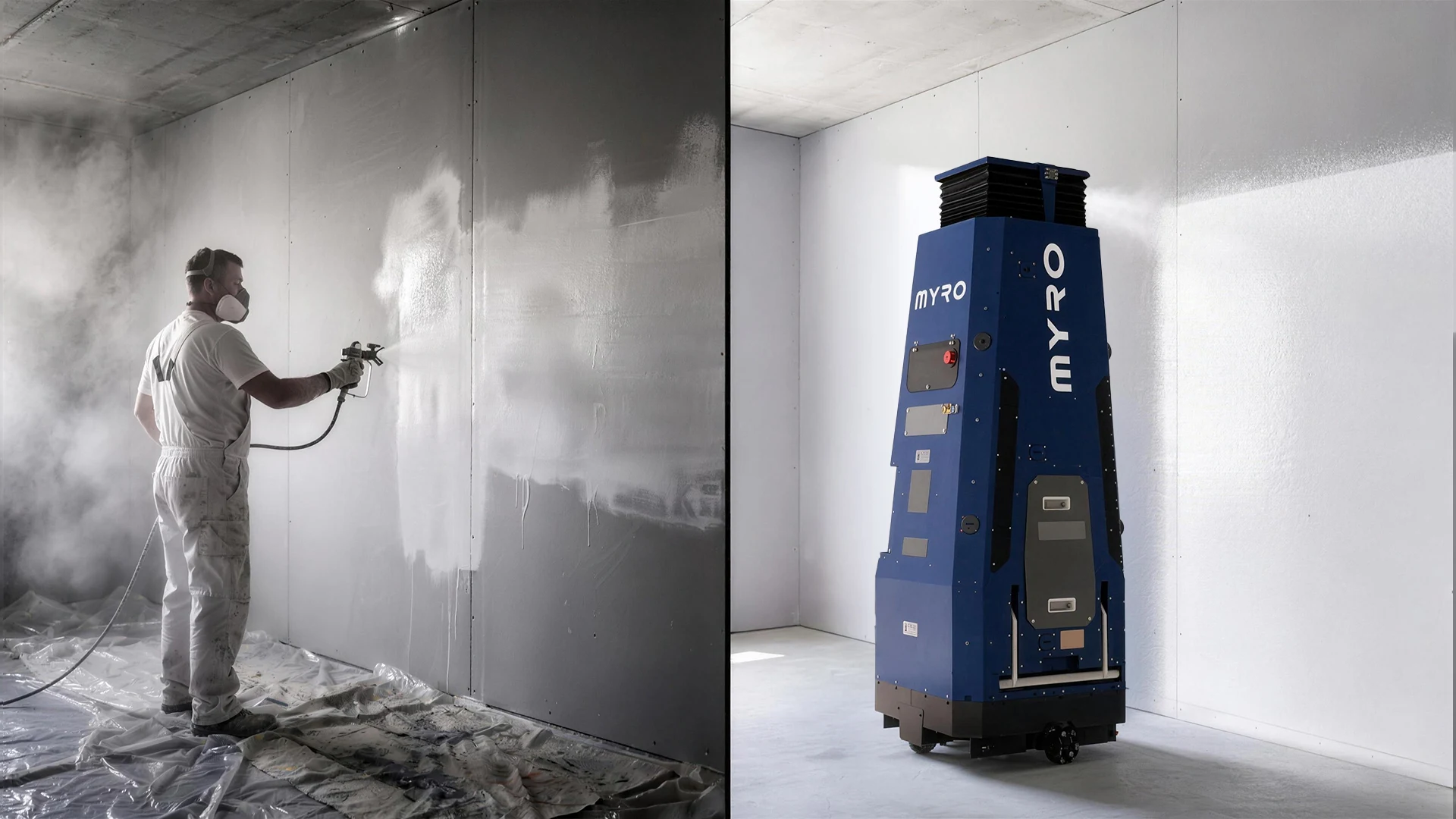
### How Automation Changes Execution
To build healthier, more sustainable spaces, we have to engineer the variance out of the application process. MYRO approaches wall finishing not as a manual craft, but as a precise, mechatronic science.
By utilizing advanced proximity sensors and algorithmic fluid control, the MYRO platform maintains a perfect, programmatic standoff distance from the wall pass after pass, shift after shift. The paint is delivered exactly where it is specified, with precise liquid pressure that drastically reduces atomized clouding. The result is an immediate, measurable transformation of the site environment: more paint on the wall, less paint in the air, and a fundamentally safer breathing zone for all site personnel.
### Why Consistency Matters at Scale
It is one thing to control overspray in a single room; it is another entirely to maintain that discipline across a 40-story commercial tower. At scale, the impact of automation compounds into massive operational and environmental savings.
By eliminating the erratic application of manual spraying, MYRO programmatically reduces raw paint material waste by up to 30%. For developers, this translates to hundreds of gallons of unused chemicals kept out of the site ecosystem and thousands of dollars recovered directly to the bottom line.
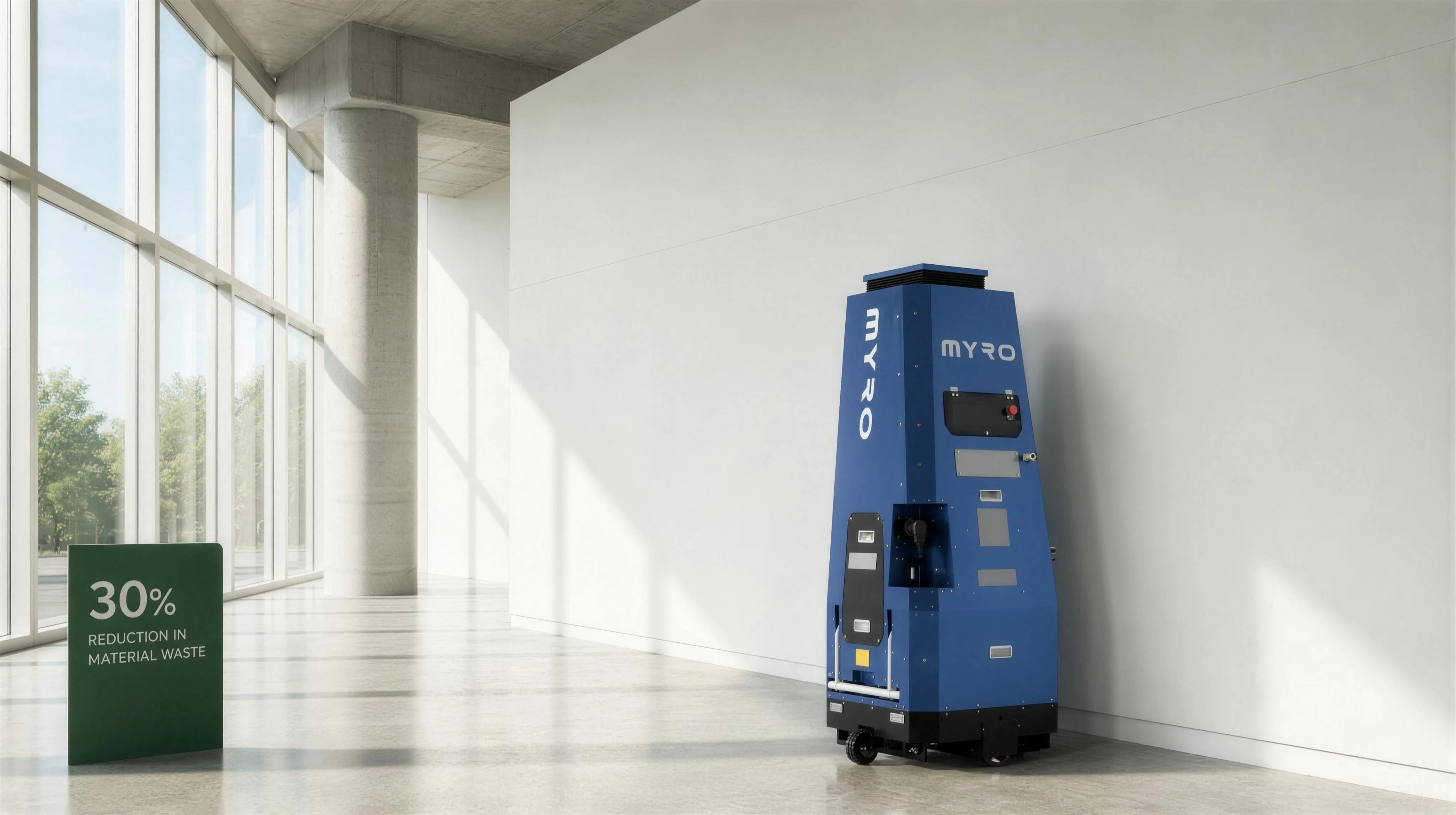
### A Quantifiable Path to LEED and BREEAM
Achieving prestigious green building certifications like LEED or BREEAM requires more than just utilizing low-VOC materials; it requires proving that your site practices minimize environmental impact.
Because MYRO operates digitally, it provides exact, trackable consumption metrics. Project managers are no longer forced to guess how much paint was wasted versus applied. You gain documented, data-driven proof of your material efficiency and your proactive measures to protect indoor environmental quality (IEQ) during construction. This turns a historically messy, undocumented trade into a streamlined, auditable asset for your certification goals.
### Execution is the Ultimate Sustainability
Sustainability in construction is often treated as a material choice, but true sustainability is an execution strategy.
Specifying eco-friendly paint is only half the equation; deploying an autonomous system that applies it with zero waste, protects the health of the workforce, and operates seamlessly through the night is the standard of the future. By replacing human variability with robotic precision, forward-thinking developers are not just building greener assets they are building them smarter, safer, and with absolute certainty.
---
---
## What Smart Capital Looks for in Modern Construction
- **URL**: https://myro.bot/blogs/scaling-predictability-what-smart-capital-looks-for-in-modern-construction-models
For decades, institutional capital has viewed the construction industry through a very specific lens: high capital requirements, high risk, and notoriously tight margins.
Unlike manufacturing or software, where inputs reliably equal outputs, construction has historically been governed by unpredictable field conditions. A financial model can look perfect in a boardroom spreadsheet, but the moment a project breaks ground, it is subjected to the chaotic realities of site execution.
For large-scale developers and private equity investors, the greatest threat to a project’s Return on Investment (ROI) isn't the cost of materials—it is execution variability. When outcomes are difficult to forecast, capital becomes expensive, and scaling a development portfolio becomes a high-wire act.
But smart capital is beginning to recognize a structural shift in the industry. The firms attracting the most significant investment today are those replacing execution variability with structured automation.
## The Problem: The Unpredictable P&L
To understand why construction is often viewed as a high-risk asset class, you have to look at how the work is actually performed.
In traditional construction, practically every major phase is heavily reliant on manual labor. This reliance introduces a massive, unquantifiable variable into every project schedule and budget: human endurance and inconsistency. When a project's timeline depends entirely on how fast, how accurately, and how consistently a crew of fifty people can work over an eight-month period, accurate financial forecasting is nearly impossible.
## Why Traditional Painting Compounds Execution Risk
This variability is most punishing during the interior finishing phase. Painting is historically one of the most manual, labor-intensive stages of a build.
If a manual painting crew experiences fatigue, their application speed slows down, and their material usage becomes
erratic.
An extra millimeter of paint thickness applied by a tired worker across a 500-unit residential complex doesn't just
waste thousands of dollars in raw materials; it extends drying times, delays follow-on trades, and pushes back the
ultimate handover date.
For an investor, this translates directly to margin compression. Extended equipment rentals, increased labor overhead, and delayed occupancy quickly erode the profitability of a project. The finishing phase ceases to be a scheduled line item and becomes a financial liability.
## How Automation Changes the Risk Profile
The solution to execution risk isn't tighter management or working crews harder; it is fundamentally changing the execution model.
When developers introduce structured automation into the building process, they transform a variable human service into a fixed, scalable process. Machines do not suffer from fatigue, they do not require rework due to loss of focus, and their output does not fluctuate.
By replacing manual variability with robotic consistency, construction companies can finally treat building like a standardized manufacturing process. This shift allows financial modelers to move away from "best-case scenario" estimates and rely on engineered, mathematically sound projections.
## Why Consistency Matters to Smart Capital
Investors don't just fund growth; they fund predictability.
When evaluating a modern construction firm, smart capital looks for operational stability. If a general contractor can guarantee that 100 square meters of wall will be finished perfectly every single hour, at a precise micron thickness, with zero material waste, the entire risk profile of the project changes.
Predictability allows developers to tightly sequence trades, eliminate the buffer time traditionally built into schedules for rework, and accelerate the path to revenue generation. At scale, this consistency isn't just an operational perk—it is a massive competitive moat that protects developer margins across an entire portfolio.
## How MYRO Delivers Operational Stability
This is exactly why forward-thinking developers and contractors are integrating MYRO into their standard operating procedures.
MYRO acts as the operational infrastructure that smart capital demands. By utilizing advanced sensors and autonomous navigation, MYRO eliminates the guesswork from interior painting. It locks in the manufacturer-specified spray parameters, applying paint with absolute mechanical rigidity.
For the project manager, this means the end of the "eight-hour fade." For the investor, it means total transparency. MYRO’s data-driven dashboards provide real-time insights into material consumption, square footage completed, and exact operational costs. MYRO turns the traditionally chaotic finishing phase into a transparent, measurable, and highly scalable data point.
## The Vision: A Predictable Asset Class
The construction industry is shedding its reputation as a high-risk gamble.
As we integrate intelligent robotics and structured automation into the core of how we build, we are moving toward a future where on-time completion and margin protection are engineered guarantees.
The future of the construction sector is not just about building taller or faster; it is about building with absolute certainty. By transforming unpredictable site execution into a standardized, technology-backed process, we are turning construction into a highly predictable asset class—one where institutional capital can invest, scale, and build with absolute confidence.
---
**Protect your investments with predictable execution.** [Discover the MYRO robotic painting system](/), and explore how [training tomorrow's certified robotic operators](/blogs/training-tomorrows-workforce-part-two-from-manual-laborers-to-certified-robotic-operators) scales execution.
---
## Why Interior Finishing Dictates Project Handovers
- **URL**: https://myro.bot/blogs/breaking-the-final-bottleneck-why-interior-finishing-dictates-project-handovers
Every general contractor and project manager knows the feeling. The core structure goes up at record speed, the facade is closed efficiently, and the mechanicals are routed without a hitch. But when it comes to the final 10%—the interior finishing—the momentum suddenly collapses.
In the construction industry, there is an unspoken rule that the last fraction of a build often takes as much time and energy as the first half. And at the very center of this bottleneck is interior wall painting.
Historically one of the most manual, delay-prone phases of construction, painting sits squarely on the critical path. When the finishing phase stalls, the entire project timeline derails. To protect developer margins and speed up handovers, the industry must fundamentally rethink how it approaches the finish line.
## Why Traditional Painting Slows the Final Sprint
By the time a project reaches the finishing phase, the site is incredibly dense. Multiple trades are vying for the same space, timelines are compressed, and the pressure from developers to begin occupancy is at its highest.
In this high-stakes environment, relying on traditional manual painting introduces a massive variable: human endurance.
Manual painting at scale requires large crews to work through repetitive, exhausting motions. As fatigue sets in, production rates naturally fluctuate. If the painting crew falls behind schedule, the domino effect is immediate. Flooring cannot be laid. Final electrical fixtures cannot be installed. Cleaning crews cannot enter.
For a general contractor, a delay of just a few days at the end of a project does not just test the client's patience—it actively burns capital. Extended equipment rentals, prolonged site management costs, and delayed occupancy directly erode developer margins.
## How Automation Changes Execution
The solution to the finishing bottleneck is not throwing more human labor at the problem. The solution is shifting from manual guesswork to engineered output.
When you introduce automation into the finishing phase, you fundamentally change the mechanics of the schedule. Machines do not suffer from the "end-of-shift slowdown." They do not require breaks, and their output does not fluctuate based on the physical demands of the site.
By replacing human exertion with robotic consistency, construction companies can finally treat interior finishing as a standardized, measurable manufacturing process rather than an unpredictable craft.
## Why Consistency Matters at Scale
For project managers handling massive residential towers, commercial complexes, or infrastructure developments, predictability is the most valuable currency on site.
You cannot effectively schedule follow-on trades if you are merely _estimating_ how much wall space will be painted today. You need to _know_.
When execution becomes mathematically consistent, scheduling becomes a science. General contractors can tightly coordinate trade sequencing, knowing exactly when a floor will be ready for the next phase. This level of control drastically reduces idle time, compresses the final sprint, and creates a seamless path to handover.
## Breaking the Bottleneck with MYRO
This is exactly where MYRO changes the calculus for modern contractors.
Engineered to execute hundreds of square meters of flawless coverage per hour, MYRO completely removes the variability from interior finishing. A Certified Robotic Operator can deploy the system to autonomously paint vast corridors, lobbies, and individual units at a speed and consistency that manual crews simply cannot sustain.
MYRO doesn't just paint walls; it standardizes the finish line. By operating with absolute precision and maintaining a relentless, predictable pace, it eliminates the scheduling guesswork that traditionally plagues the end of a build.
## The Future: An Engineered Guarantee
The final phase of a multi-million-dollar development shouldn't be a stressful scramble to the finish line. The industries that will lead the next decade of construction are those that recognize finishing as an operational science, not a manual variable.
We are moving into an era where predictability is the ultimate performance metric. The future of building relies on absolute, machine-driven compliance on every single pass. Because in modern construction, on-time completion shouldn't feel like a gamble—it should be an engineered guarantee built directly into the process.
---
**Ready to eliminate the finishing bottleneck on your next project?** [Learn how MYRO's automated painting system protects your margins and schedule](/), or read more about [eradicating rework with precision engineering](/blogs/the-silent-cost-of-variation-eradicating-rework-with-precision-engineering).
---
## Upskilling the Workforce: Certified Robotic Operators
- **URL**: https://myro.bot/blogs/training-tomorrows-workforce-part-two-from-manual-laborers-to-certified-robotic-operators
The construction industry is operating under an unsustainable equation. Global demand for infrastructure and housing is accelerating rapidly, yet the workforce required to deliver it is shrinking.
With an aging population of skilled tradespeople and turnover rates climbing, the sector is facing a severe structural challenge. The conversation around construction tech often revolves around software and project management, but the most critical bottleneck happens on the ground, in the physical execution of the build. To solve the labor crisis, we don’t just need more workers; we need to fundamentally rethink how the work is done.
For years, automation has been framed by skeptics as a threat to jobs. But for the contractors and developers actually managing modern sites, the reality is entirely different. Adopting robotics isn’t about replacing human workers. It is about evolving their roles, protecting their health, and scaling their output.
### Why Traditional Painting Slows Projects
To understand the need for evolution, we have to look at the finishing phase—specifically, interior wall painting. It is notoriously one of the most unpredictable, time-consuming, and physically punishing stages of construction.
Traditional commercial painting requires workers to spend hours balancing on scaffolding or ladders, breathing in atomized paint fumes, and executing highly repetitive, shoulder-straining movements. It is an environment where human fatigue is inevitable. And in construction, fatigue translates directly to inconsistency.
As a painter tires throughout an eight-hour shift, variations in spray distance and speed naturally occur. This leads to uneven Wet Film Thickness (WFT), patchy coverage, and overspray. For project managers and developers, this inconsistency creates a domino effect: quality drops, rework is required, materials are wasted, and project handovers are delayed. The physical toll of the job is exactly why the industry struggles to attract and retain the next generation of talent.
### How Automation Changes Execution: Evolution, Not Replacement
The solution to this labor constraint isn't to phase out the workforce; it's to upgrade their tools.
Machines excel at repetition, precision, and endurance. Humans excel at problem-solving, quality control, and site management. When you combine the two, you transition workers from manual laborers into technical supervisors.
Consider the transition of a traditional painter. Their deep knowledge of surface preparation, paint viscosity, and quality standards is invaluable. Automation doesn't make this expertise obsolete; it amplifies it. By removing the physical hazards of scaffolding and repetitive strain, we upskill that painter into a **Certified Robotic Operator**.
Instead of holding a spray gun, the operator holds a tablet. Their day shifts from hazardous physical labor to high-value site management.
### Why Consistency Matters at Scale
For capital providers, developers, and large-scale contractors, the true value of this upskilled workforce is predictability.
When a Certified Operator is managing an automated system, the output is no longer tied to human endurance. A robot doesn't fatigue at 3:00 PM. It doesn't need to take breaks. It applies the exact same flawless coat of paint at the end of a shift as it did at the beginning.
This level of consistency is a massive commercial advantage. It means material waste is drastically reduced, rework is virtually eliminated, and project timelines become mathematically predictable. When you can guarantee that 100 square meters of wall will be finished perfectly every single hour, you protect project margins and scale execution across multiple sites with confidence.
### How MYRO Fits Into the Future of the Workforce
This is exactly where MYRO bridges the gap between traditional craftsmanship and modern construction technology.
MYRO is designed to be the ultimate collaborative tool for the modern worker. When a Certified Operator deploys MYRO on a site, they are commanding an intelligent, autonomous system. The operator uses an intuitive mobile app to map the room’s layout, define exclusion zones (like doors and windows), and set the precise parameters for the paint job.
Once configured, MYRO takes over the heavy lifting. Using advanced sensors, it navigates the space and applies paint with mechanical precision. Because MYRO maintains a perfect programmatic standoff distance, it ensures uniform coverage while reducing paint waste by up to 30%.
More importantly, MYRO radically improves the operator's working conditions. By keeping personnel firmly on the ground and significantly reducing the atomized paint clouds that cause poor indoor air quality, MYRO creates a safer, healthier, and far less stressful job site.
### The Future is Human-Led and Machine-Executed
We are standing at a critical turning point in how we build. The construction companies that thrive in the next decade will be the ones that recognize technology as a tool for human empowerment.
The future of construction doesn’t leave the workforce behind—it engineers a smarter, safer way for them to operate. By transitioning traditional tradespeople into Certified Robotic Operators, we are extending career longevities, drastically reducing site hazards, and delivering the predictable, high-quality execution that modern infrastructure demands.
With solutions like MYRO, we aren't just changing how paint is applied. We are elevating the workforce and redefining what it means to be a builder in the 21st century.
---
**Empower your workforce with the tools of tomorrow.** [Explore MYRO's technology](/), and read about [what smart capital looks for in modern construction models](/blogs/scaling-predictability-what-smart-capital-looks-for-in-modern-construction-models).
---
## Eradicating Construction Rework with Precision Engineering
- **URL**: https://myro.bot/blogs/the-silent-cost-of-variation-eradicating-rework-with-precision-engineering
In large-scale construction, the most dangerous costs are the ones you don’t see coming. They don’t arrive as massive budget cuts or sudden supply chain halts. Instead, they bleed project margins slowly, quietly, and continuously.
Ask any experienced developer or quality manager where they lose the most money during the finishing phase, and they will all give you the exact same answer: **rework.**
The cost of doing things twice—setting up scaffolding again, buying extra paint, delaying the handover of a floor—is the silent margin-killer of the construction industry. But what actually causes this rework? It rarely comes down to bad paint or bad intentions. The true culprit is the unavoidable physical limitation of manual labor: variation.
To solve the industry's rework crisis, we must first understand why it happens, and more importantly, how precision engineering is stepping in to eradicate it for good.
### The Problem: The "Eight-Hour Fade" and WFT Variations
Interior wall painting is a game of microscopic margins. Paint manufacturers design their coatings to be applied at a highly specific Wet Film Thickness (WFT) to ensure proper curing, durability, and a flawless visual finish.
When a skilled human painter begins their shift at 8:00 AM, their technique is sharp. They hold the spray gun at the exact right distance from the wall, moving at a steady, consistent pace.
But a human arm is not a machine; it is a pendulum. By 3:00 PM, shoulder fatigue sets in. The painter's arm naturally drops an inch or two further from the wall. Their sweeping motion speeds up or slows down. These microscopic variations in distance and speed create immediate inconsistencies in the Wet Film Thickness.
On a single wall, this might seem invisible. But in a 500-unit residential tower or a sprawling commercial complex, these daily variations compound.
### Why Traditional Painting Slows Projects Down
When paint is applied unevenly, it dries unevenly. This creates "flashing" (inconsistent gloss), shadowing, or poor adhesion.
When the quality control manager walks the site a few days later, these inconsistencies mean the wall fails inspection. The consequences are immediate and expensive. The site must be prepped again. Scaffolding must be re-erected. Extra labor must be paid, and extra material must be consumed just to fix the mistakes of the previous week.
For capital providers and general contractors, this creates a ripple effect. If the painting phase stalls due to rework, the flooring teams can't come in. The electricians can't install the final fixtures. The entire project timeline collapses not because of a major disaster, but because a human arm simply got tired.
### How Automation Changes Execution: Eliminating the Drift
To eradicate rework, we have to eliminate the physical drift that causes it. We cannot ask a human being to work like a machine for eight straight hours, but we _can_ give them a machine that does the heavy lifting for them.
This is where MYRO completely changes the execution of the finishing phase.
MYRO was engineered specifically to solve the problem of application variance. Rather than relying on human endurance, MYRO utilizes an array of dynamic proximity sensors. When MYRO approaches a wall, these sensors calculate the exact topography of the surface. The robot locks in the perfect, manufacturer-specified spray standoff distance and maintains it with absolute mechanical rigidity.
If the wall curves, MYRO adjusts. If the robot moves across a massive corridor, its speed remains mathematically constant. There is no "3:00 PM fatigue." The hundredth square meter of the day receives the exact same flawless, uniform coat of paint as the very first.
### Why Consistency Matters at Scale
For the modern construction industry, this level of precision is no longer just a luxury—it is an economic necessity.
When a developer adopts MYRO, they aren't just buying a faster way to paint; they are buying margin protection. By guaranteeing absolute Wet Film Thickness (WFT) compliance on every single pass, MYRO effectively drops the rework rate to near zero.
A Certified Robotic Operator manages the MYRO unit via a simple mobile app, setting the parameters and letting the machine execute the physical labor. The human provides the intelligence and quality control; the robot provides the tireless consistency.
For the people funding and managing these mega-projects, this means accurate forecasting. When you know a robot will reliably output perfectly coated walls at a predictable rate of 100 square meters per hour, your schedule transforms from a hopeful guess into a mathematical certainty. You know exactly how much paint you will use, exactly when the job will finish, and exactly what the quality will look like.
### The Future of Construction: Absolute Compliance
We are moving past the point where the construction industry can afford to accept variation as just "the cost of doing business." As buildings become more advanced and timelines grow tighter, the margin for human error continues to shrink.
The ultimate flex in modern construction isn't just building faster. It is building with absolute, unshakeable certainty.
Predictability is the highest form of performance. The future of building relies on machine-driven compliance on every single pass, ensuring that we get it right the first time, every time. By letting robotics handle the precision and letting humans handle the strategy, we aren't just eradicating rework—we are laying the foundation for a smarter, more profitable era of construction.
---
**Stop paying for the same job twice.** [Learn more about MYRO's automated painting solutions](/), or see [how interior finishing dictates project handovers](/blogs/breaking-the-final-bottleneck-why-interior-finishing-dictates-project-handovers).
---
## Hitting the Mark: How Construction Automation Drives LEED Compliance and Air Quality
- **URL**: https://myro.bot/blogs/hitting-the-mark-how-construction-automation-drives-leed-compliance-and-air-quality
The modern commercial interior is undergoing a quiet regulatory shift. For years, general contractors and developers measured project success using three primary metrics: speed, cost, and structural integrity. Today, a fourth pillar has arrived at the executive table: environmental performance.
With institutional investors increasingly prioritizing sustainable assets, certifications like LEED (Leadership in Energy and Environmental Design) and BREEAM have moved from premium marketing features to baseline commercial mandates. However, achieving these strict environmental benchmarks remains incredibly difficult on an active, traditional job site. The finishing phase, particularly interior wall coating, represents a major bottleneck where environmental goals and raw construction realities frequently collide.
---
## 1. The Environmental Bottleneck in Modern Finishing
On any major commercial build, indoor air quality is a primary metric for environmental compliance. The air quality during construction directly impacts both worker health and the ultimate timeline for safe asset handovers.
The core issue stems from the chemical composition of traditional commercial finishes. Volatile Organic Compounds (VOCs) and airborne particulate matter routinely spike during the final stages of a project, creating localized environmental challenges. When a site's indoor air quality degrades, project managers are forced to stall consecutive trades, initiate extended ventilation cycles, and delay final inspections. For developers, these paused hours quickly translate into unpriced holding costs and program slippage.
---
## 2. Why Traditional Painting Methods Compromise Site Health
The traditional approach to high-volume painting relies heavily on manual airless spray systems. While fast, manual spraying introduces high behavioral and physical variance to the job site.
- **The Atomization Problem:** Manual airless spraying inherently creates massive, uncontrolled atomized paint clouds. These airborne mists carry high concentrations of VOCs and particulate matter throughout enclosed commercial layouts.
- **Erratic Material Waste:** Human operators, battling natural fatigue over long shifts, cannot maintain a perfectly constant distance from the wall. This fluctuation leads to erratic film builds, localized overspray, and heavy paint spillage.
- **The Rework Loop:** When manual application thickness drifts outside the parameters specified by material suppliers, it invites defects like cracking, running, or patchy coverage. Remediation requires sanding and repainting—doubling both the labor footprint and the site's volatile emission profile.
The operational cost of this manual model is high: traditional painting processes frequently generate up to **30%** raw material waste, directly complicating a project's waste management and environmental compliance path.
---
> ### The Environmental Impact of Manual Spraying
>
> "Manual airless spraying creates massive atomized paint clouds, exposing workers to VOCs and wasting raw material. Standard finishing budgets often plan for material waste as an inevitable variable, but in a carbon-conscious market, erratic material waste is a structural liability."
---
## 3. How Automation Standardizes Material Efficiency
True construction automation solves this issue by taking a programmatic approach to material application. Rather than attempting to manage human variance on site, advanced robotic systems eliminate the problem at the hardware layer.
By utilizing high-resolution LiDAR scanning arrays and autonomous path-planning software, robotic painting platforms map out raw commercial environments in three dimensions. Once the layout is calibrated via an intuitive interface, the system executes paint delivery with a fixed precision margin.
The critical breakthrough lies in **programmatic standoff distance**. The system holds the spray nozzle at an absolute, unvarying distance and angle relative to the substrate throughout the entire execution. Because the velocity and distance remain completely standardized, the paint adheres cleanly to the vertical surface rather than scattering into the ambient environment. This mechanical discipline achieves a **30% reduction in raw material waste** while keeping the air clear of atomized chemical clouds.
---
## 4. Why Technical Consistency Matters for Institutional Scale
For developers and investors managing multi-tower portfolios or expansive commercial layouts, consistency is the ultimate form of risk mitigation.
When paint application is automated, the thickness of every layer—measured as Wet Film Thickness (WFT) and Dry Film Thickness (DFT)—is mathematically controlled. This granular accuracy ensures full compliance with the strict technical data sheets provided by coating manufacturers.
Standardizing the application process yields clear operational benefits:
- **Zero Visual Tool Marks:** Eliminates visible roller streaks, brush paths, and thin patches, delivering uniform light reflection across large walls.
- **Predictable Material Procurement:** Project teams can accurately project material consumption down to the liter, removing guesswork from the supply chain.
- **Elimination of Punch-List Defects:** Getting the application right on the first pass removes the costly, time-consuming cycle of retrospective touch-ups right before handover.
---
## 5. Bridging the Digital Design Gap via Autonomous Infrastructure
The broader value of construction automation is its ability to seamlessly connect the office to the physical job site. Modern project management heavily utilizes Building Information Modeling (BIM) platforms to simulate and plan builds digitally. However, that intelligent data often gets lost when translated manually on the structural concrete floor.
Autonomous field robotics bridge this gap. By converting architectural plans directly into physical execution paths, they turn digital designs into real-world site efficiency.
Furthermore, this automated infrastructure addresses the industry's critical skilled labor deficit. Instead of replacing human workers, these systems allow companies to upgrade their existing crews. Manual painters are upskilled into Certified Operators who manage advanced technical systems via simple tablet controls. This removes human workers from hazardous scaffolding and prolonged chemical exposure, creating a significantly safer, more modern site environment.
---
## 6. Realizing Sustainable Site Efficiency with MYRO
As green building mandates tighten globally, the developers who pull ahead will be those who replace volatile manual variables with predictable, standardized processes.
This operational shift is exactly where **MYRO** fits into the future of construction infrastructure. As an autonomous, mobile interior wall-painting platform, MYRO applies coatings with a precision margin of just 2 cm, covering **100 square meters per hour**—a **10x speed multiplier** over traditional manual methods.
By maintaining a continuous, programmatic standoff distance, MYRO delivers more paint to the wall and less to the air, resulting in cleaner indoor air quality, a **30% reduction in coating material waste**, and an easier path to your project's LEED or BREEAM building certifications.
---
## The Strategic Outlook for Construction Capital
The future of commercial construction belongs to automated, data-driven workflows. Environmental stewardship and high site efficiency are no longer opposing priorities; they are deeply connected metrics of corporate performance.
By decoupling finishing timelines from manual capacity constraints and standardizing material execution, forward-thinking contractors are protecting both their project margins and their corporate ESG targets. In an industry where schedules are unforgiving and sustainability is mandatory, mechatronic precision is no longer just an innovative alternative—it is becoming the baseline infrastructure for building at scale.
---
**Ready to optimize your next project's critical path?**
[Connect with a MYRO Field Deployment Engineer to schedule an operational audit or live system demonstration.](https://myro.bot/contact)
---
## Integrating Robotics into Subcontractor Workflows: A PM’s Guide
- **URL**: https://myro.bot/blogs/integrating-robotics-into-subcontractor-workflows-a-pms-guide
Walk into the site office of any Tier-1 project at 7:00 AM, and the whiteboard tells the same story. It is a daily puzzle of overlapping trades, shrinking margins, and compressed schedules. For a Project Manager, the heaviest lift isn't the engineering it is the constant choreography of moving parts. It often feels less like executing a master plan and more like managing organized chaos.
But as the demands on large-scale construction grow, the old ways of brute-forcing a project to the finish line are breaking down. The shift that needs to happen is fundamental: we must stop managing chaos and start managing systems.
## The Bottleneck in the Final Mile
Nowhere is this chaos more evident than in the finishing phases. The final twenty percent of a build is historically where timelines go to die. Traditional painting and coating processes rely on deploying massive crews of manual labor into spaces where electricians, floorers, and carpenters are still trying to operate.
This creates immediate friction known as trade stacking. Coordinating manual painting means navigating constant clashes, managing the variable pacing of human workers, and dealing with the inevitable inconsistencies in application. When the drywall team runs late, the painting schedule compresses, and site managers are forced to throw more bodies into an already crowded room. The industry has long accepted this messy, labor-heavy workflow as just another cost of doing business.
## The 3-Step System: Prep, Calibrate, Execute
The introduction of construction robotics changes the mechanics of execution, but it always prompts a very practical question from the field: _"How does a robot actually fit into my messy, real-world job site without slowing down my other trades?"_
The answer is seamless integration. Bringing a robotic system on-site isn't a fragile science experiment; it is the deployment of a highly structured, repeatable workflow. It operates in three clean steps:
**1. Prep:** Automation doesn't require a sterile lab environment. The site simply needs standard Level-4 drywall preparation. Once the taping and mudding meet conventional finishing standards, the space is ready. No complex site overhauls are required.
**2. Calibrate:** This is where the guesswork is eliminated. Using a rapid, 15-minute LiDAR calibration phase, the automated system instantly maps the spatial environment. It dynamically reads the real-world site identifying corners, cutouts, and ceiling heights with millimeter accuracy.
**3. Execute:** Once mapped, the system executes its task autonomously. Because its footprint is contained and predictable, other trades can work efficiently in adjacent spaces without the usual cross-trade friction. The machine delivers continuous throughput without fatigue.
## The Power of Predictability at Scale
When executing at the scale of major infrastructure projects or multi-tower developments, consistency is the ultimate protector of profit margins. Managing the variability of manual labor across one floor is a daily headache; managing it across fifty floors is a massive financial risk.
By replacing the unpredictable pacing of manual crews with the calculable output of a robotic system, timelines transform from hopeful estimates into exact, mathematical certainties. A programmed system applies coatings at the exact same speed, with the same micron-level precision, on the first floor as it does on the fiftieth. This scalable execution dramatically reduces the dependency on fluctuating manual labor and standardizes the entire finishing process.
## How Myro Fits Into the Active Pipeline
Myro was built specifically for the reality of the modern job site. It is a rugged, field-ready asset engineered to slide directly into existing subcontractor workflows. By standardizing the prep-to-paint pipeline, Myro turns one of the most unpredictable phases of construction into a controlled, continuous operation. It empowers project managers to stop putting out daily fires and start relying on a system that works precisely as programmed, every single time.
## The Future of the Job Site
The narrative of the construction site is evolving. The most successful builders and developers of the next decade will not be defined by how large of a workforce they can mobilize at the last minute to fix schedule delays. They will be defined by how effectively they integrate automation to eliminate those delays in the first place. The future belongs to those who build intelligent systems underneath their operations, ensuring that every project is delivered with unprecedented speed, precision, and predictability.
---
## The Air We Breathe On Site: How Automation Secures LEED Compliance in Finishing Works
- **URL**: https://myro.bot/blogs/the-air-we-breathe-on-site-how-automation-secures-leed-compliance-in-finishing-works
Modern real estate development operates under a dual pressure system. On one side stands the critical path schedule: the relentless financial pressure of compressed timelines, holding costs, and hard handover deadlines. On the other side stands the regulatory framework: the strict demands of green building certifications, carbon optimization, and occupant wellness mandates.
Historically, these two forces have been in direct opposition. Accelerating the finishing phase often meant sacrificing site control, producing extensive material waste, and compromising internal environmental quality.
Today, smart developers are recognizing that the path to true operational control relies on changing the workflow itself. The final stages of commercial interiors are shifting from an unpredictable variable into a clean, precise, and programmatic operation.
---
## 1. The Environmental Problem in Construction Finishing
The interior finishing phase is a significant contributor to indoor environmental hazards on active commercial job sites. Traditional high-volume wall painting relies on manual airless spray systems operated under immense pressure. While fast, this method introduces a major operational challenge: **over-atomization**.
When a human operator maneuvers an airless spray gun, their standoff distance from the wall naturally drifts due to physical fatigue and layout changes. When the spray tip moves too far from the substrate, the high-pressure paint stream atomizes prematurely in mid-air. This creates massive airborne clouds of paint mist that settle on un-targeted areas, concrete slabs, and adjacent fixtures.
For commercial developers, this operational issue creates two distinct problems:
- **Airborne Volatile Organic Compounds (VOCs):** High concentrations of suspended particulates saturate the indoor air, creating an immediate hazard for site teams and complicating indoor air quality metrics.
- **Severe Ventilation Bottlenecks:** To clear these chemical clouds, sites must run heavy ventilation systems for extended periods, slowing down trade coordination and delaying subsequent indoor trades from entering the layout safely.
---
## 2. Why Traditional Painting Methods Slow Down Green Handovers
Green building frameworks, such as **LEED (Leadership in Energy and Environmental Design)** and **BREEAM**, do not simply evaluate a building once it is finished. They look closely at the methods, waste metrics, and air protection strategies utilized _during_ the actual construction cycle.
Traditional interior painting slows down sustainable progress in two main ways:
### Excessive Material Waste
Because manual application lacks absolute thickness control, projects regularly experience massive paint overspray. The construction industry historically budgets for a significant material loss factor during finishing—a quiet profit drain that actively undermines waste management scoring under green building rules.
### Extended Flush-Out Timelines
To secure LEED indoor air quality credits, developers must often conduct extensive building "flush-outs," running HVAC systems continuously to purge airborne contaminants before occupancy. When manual painting saturates structural substrates with thick, uneven coats and heavy overspray mist, the time required to flush out the building expands dramatically, pushing back final commissioning.
---
## 3. How Automation Changes Execution and Air Quality
Automated construction technology solves these environmental challenges by replacing manual variance with programmatic control. When you introduce a robotic system like MYRO to the interior wall-painting workflow, the underlying physics of how paint hits the surface changes completely.
Using advanced **LiDAR (Light Detection and Ranging)** scanning arrays, an autonomous platform maps the room layout in three dimensions, automatically identifying structural columns and programmatically skipping over doors, window frames, and trim.
Because the mechanized arm maintains a perfect 90-degree angle and an exact, uniform standoff distance from the wall surface, the paint stream lands precisely where intended. The atomized paint particles bond directly with the substrate instead of escaping into the ambient air.
The immediate result is a **30% reduction in coating material waste**. By eliminating the erratic overspray cloud at the source, site air quality remains remarkably clean, reducing chemical drift and creating a healthier environment for the entire workforce.
---
## 4. Why Consistency Matters at Scale for Institutional Investors
For institutional real estate developers and infrastructure investors, consistency is a form of risk mitigation. A single manual painting crew might deliver an excellent finish on the first floor, but capacity limitations, physical fatigue, and shift changes inevitably cause variations across a multi-story asset.
When operations are scaled across thousands of square feet, minor variations turn into expensive rework liabilities. If a field coating is applied too thickly, it traps moisture, leading to premature cracking, peeling, or color patchiness weeks after handover.
Robotic automation standardizes the execution. It tracks and adjusts for wall variations up to 15mm in real time, holding absolute compliance with the Wet Film Thickness (WFT) numbers specified by paint suppliers.
For project stakeholders, this level of consistency ensures:
- **Predictable Budgets:** Material consumption matches estimating software forecasts perfectly, eliminating surprise procurement cycles.
- **Faster Certification Tracks:** With documented, uniform application and minimized material waste, the data requirements for LEED material and resource credits are seamlessly fulfilled.
---
## 5. How MYRO Fits Into the Future of Green Infrastructure
The future of commercial development belongs to developers who view technology not as an administrative add-on, but as core physical infrastructure on the slab.
MYRO bridges the historic gap between digital intent and real-world construction execution. By operating at a steady speed of **100 square meters per hour**, the platform provides a 10x velocity improvement over manual methods while operating quietly in the background.
On prominent enterprise deployments, such as Emaar’s premium Forte high-rise development in Downtown Dubai, traditional finishing tasks that normally absorbed 4 full man-days per residential unit were compressed into a **4-hour automated cycle**.
This speed is achieved without overpromising or straining on-site assets. It is the logical outcome of a repeatable system that eliminates non-productive downtime and processes raw materials with maximum mathematical efficiency.
---
## 6. Conclusion with Strong Industry Insight
> Building green is no longer a luxury branding choice or a passive marketing badge; it is a fundamental financial requirement demanded by global capital markets.
As institutional investors tie funding to strict environmental, social, and governance metrics, construction firms cannot afford to tolerate the unpredictability and high material waste of legacy finishing models.
The construction companies pulling ahead are not simply managing chaos more effectively; they are pricing variability out of the project design entirely. By treating interior finishing as a programmatic, sensor-driven operation, the industry is proving that extreme site efficiency and strict environmental stewardship can finally exist on the very same slab.
---
## Why Monsoon Is the Season That Exposes Weak Construction Systems
- **URL**: https://myro.bot/blogs/why-monsoon-is-the-season-that-exposes-weak-construction-systems
Anyone who has walked a major construction site in July knows the exact sound of a monsoon delay. It’s the sudden, heavy quiet. The tarps go up, the scaffolding empties, and the rhythmic noise of progress grinds to a halt. But while the physical site goes quiet, the financial clock only ticks louder.
For site managers and investors alike, the monsoon is universally accepted as a period of inevitable slowdown. We factor it into project timelines, cite it in quarterly reports as a natural delay, and treat it as a cost of doing business. But looking at the rains purely as a weather event misses the bigger, more systemic picture.
The monsoon is not just weather it is a margin stress-test. It strips away the illusion of operational efficiency and exposes the underlying fragility of traditional, manual-dependent construction systems. Here is why the industry needs to stop accepting seasonal downtime, and how automation is fundamentally shifting the way we manage project risk.
## The True Cost of Idle Time
When the rains begin, progress stops, but capital burn does not. The true cost of the monsoon isn't measured by the water on the ground; it is measured in the compounding cost of idle time.
Particularly for Tier-1 developers managing multi-tower projects across major construction hubs, every day a site sits idle represents locked capital and delayed returns. Project managers are left staring at Gantt charts, trying to manage programme slippage a risk that is often unpriced because traditional construction models have never had a viable solution to counter it. We have normalized stopping because, historically, we never had the tools to keep going.
## Why Traditional Finishing Fails in the Damp
Finishing work, particularly painting and coating, is notoriously vulnerable to environmental shifts. Traditional manual painting relies entirely on the physical environment cooperating with the human hand.
When humidity spikes during the monsoon, the physics of paint application change. High moisture levels severely affect viscosity, drying times, and surface adherence. If manual crews attempt to push through the damp conditions to meet deadlines, the result is almost always compromised quality. This leads to peeling, blistering, and a frustrating, costly cycle of rework once the weather finally clears.
The structural problem here isn't the rain. It is our continued reliance on a manual process that demands perfect weather conditions to deliver acceptable results.
## Changing Execution with Automation
This is where construction-tech and robotics step in to change the reality on the ground. Automation fundamentally alters project execution by decoupling progress from environmental unpredictability.
Robotic systems don't operate on fatigue, guesswork, or the hope that the weather will hold. They are governed by data, sensors, and programmed parameters. When deployed in sheltered or interior environments during adverse weather, automated systems do not need to slow down. They adjust to their environment, optimizing the flow rate and application speed to match ambient data in real-time. By removing the human variables associated with difficult working conditions, automation ensures that execution continues smoothly, safely, and accurately.
## The Power of Predictability at Scale
For infrastructure companies and large-scale developers, execution is only valuable if it is scalable. A five percent drop in productivity on a single floor might be a headache; a five percent drop across a 40-story high-rise over a three-month rainy season is a massive financial liability.
Consistency is the ultimate currency at scale. Automated finishing ensures that the final micron of paint applied on day ninety is mathematically identical to the first micron applied on day one, regardless of the humidity index outside. This level of predictability protects project margins and allows developers to forecast completion dates with certainty, rather than hopeful estimations.
## How Myro Operates While Others Wait
Myro was engineered specifically to eliminate the operational drift that plagues traditional construction. While manual finishing crews are forced to wait out the weather, Myro’s robotic finishing systems do not take the monsoon off.
Myro consistently maintains perfect application parameters regardless of ambient moisture. It doesn't just automate the painting process; it standardizes it against the elements. By maintaining continuous operation when manual teams cannot, Myro effectively reclaims the lost hours of the "idle-time economy." For builders and investors, this is not just a marginal advantage on a single site it is a structural shift in how construction risk is managed, mitigated, and ultimately eliminated.
## The Future of Building
The narrative of the modern construction site is evolving. The companies that will lead the next decade of real estate development are no longer the ones who build the largest manual workforces to throw at structural problems. They are the ones quietly building intelligent systems underneath their operations.
The future of construction belongs to those who recognize that weather delays are no longer an unavoidable act of nature. They are an engineering problem. And with smart automation, it is a problem we are finally equipped to solve.
---
## Continuous Operation Is Not a Feature; It Is a Different Model
- **URL**: https://myro.bot/blogs/continuous-operation-is-not-a-feature-it-is-a-different-model
The construction industry has a complicated relationship with technology.
It adopts it. It integrates it into existing workflows. It uses it to do what it was already doing, slightly faster, slightly cheaper, slightly more documented. And then it describes the result as innovation.
This is not innovation. It is optimisation. And there is nothing wrong with optimisation. It has genuine value. It moves metrics in the right direction. It satisfies procurement requirements, marketing narratives and the technology budget conversations that happen at the start of every financial year.
But optimisation operates within a model. It improves what the model does without questioning what the model is. And when the model itself is the problem, optimisation is not just insufficient. It is a distraction from the change that actually needs to happen.
Continuous operation in construction finishing is not an optimisation. It is not a feature that makes the existing model perform better. It is a different model. And understanding why that distinction matters, for contractors, for capital providers, and for anyone trying to read where construction execution is heading, requires being precise about what a model actually is and what changes when it changes.
## **What a Model Is, and Why Features Cannot Replace One**
A model is not a collection of capabilities. It is the underlying logic that determines how a system behaves, what constraints it operates within, and what outcomes it is structurally capable of producing.
The traditional construction finishing model has a logic. It is built around human availability. Work happens when crews are present. Output is determined by the number of people on shift, the hours they can sustain, and the conditions under which they are working. Quality is a function of individual skill applied consistently enough across a long enough period under good enough conditions to produce an acceptable result.
Every piece of technology that has been layered onto this model over the past several decades has improved specific aspects of its performance without touching that underlying logic. Better application equipment delivers better coverage rates. Improved material formulations reduce drying time and improve durability. Project management software provides better visibility into progress and sequencing. Inspection tools catch defects earlier.
All of these are genuine improvements. None of them changes the model. The work still happens when the crew is present. The output is still determined by human availability. The quality is still a function of individual execution sustained across conditions that inevitably vary.
The model remains intact. And the model's constraints remain intact with it.
Continuous operation removes the foundational constraint of the entire model. It severs the connection between human availability and productive output. When that connection is severed, the logic of the model does not bend or stretch to accommodate the new capability. It breaks. And something structurally different takes its place.
## **The Execution Cycle That Traditional Construction Built Around**
To understand what changes when continuous operation replaces the traditional model, it is worth being precise about what the traditional execution cycle actually looks like.
A finishing phase in conventional construction runs in discrete bursts. The crew arrives. The work begins. The shift progresses through its productive window. The shift ends. The crew leaves. The site enters a period of complete operational stillness that lasts until the next shift begins.
Within this cycle, the productive window is the smaller portion of the total time available. The stillness is the larger portion. Not slightly larger. In many project configurations, it is significantly larger. Evenings, nights, weekends, public holidays, weather-related stoppages, and sequencing gaps between phases. The calendar days available to a project are not equivalent to the productive hours it can extract from them.
This gap between calendar time and productive time is not a bug in the traditional model. It is a structural feature of it. The model was designed around human working patterns because it had no alternative. And because it had no alternative, the gap was treated as a condition of construction rather than a cost of the model.
Around this cycle, everything else in construction execution is organised. Programme schedules are built around it. Client expectations are calibrated to it. Contractual completion timelines incorporate it. Downstream trade sequencing is planned around it. The entire ecosystem of construction delivery has been structured to work within a model defined by its own productive limitations.
That is what changes when the model changes. Not just the hours of operation. The entire execution cycle that the industry built around those hours.
**Changing a feature changes what the model produces. Changing the model changes what is possible. These are not the same thing, and treating them as the same thing is how industries miss the most significant shifts happening within them.**
## **Why Continuous Operation Cannot Be Understood as a Feature**
When contractors and project managers first encounter robotic finishing systems, the framing they typically apply is feature framing. The system works longer hours. That is a useful capability. It can help recover the schedule in a crunch. It can reduce overtime costs on tight programmes. It is a good tool to have available when the situation calls for it.
This framing is understandable. It is also wrong. And the wrongness matters because it leads to decisions about adoption, integration, and investment that undervalue what is actually being offered.
A feature is something you activate when you need it and set aside when you do not. It sits within your existing operational logic. It serves your existing model. Its value is additive, not structural.
Continuous operation is not additive to the traditional finishing model. It is incompatible with its core constraint. The traditional model is built on the assumption that productive time is bounded by human availability. Continuous operation removes that assumption entirely. You cannot add it to the traditional model like a new tool in the equipment inventory. You have to replace the model with one whose logic reflects what continuous operation makes possible.
That replacement is not a technology upgrade. It is an operational redesign. And operational redesigns do not produce incremental improvements in performance metrics. They produce step changes in what the operation is capable of delivering.
The contractors who understand this are not evaluating continuous operation robotic finishing as a situational tool. They are evaluating it as the foundation of a fundamentally different way of running a finishing operation. The ones who evaluate it as a feature will extract a fraction of the available value. The ones who treat it as a model change will build a different business.
## **The Execution Cycle That Continuous Operation Creates**
Where the traditional model runs in discrete bursts separated by extended stillness, continuous operation creates a finishing execution cycle that looks structurally different in almost every dimension.
Output becomes a function of time, not availability. When the system operates consistently across the hours that matter to the programme, not just the hours that the labour model permits, the relationship between elapsed calendar time and completed surface area changes fundamentally. A week on the calendar translates into a very different volume of finished work than the same week under the traditional model. Not because the system is faster during working hours. Because it uses the hours that the traditional model discards.
The programme structure becomes genuinely flexible. When the finishing phase is no longer constrained to the output that a standard shift pattern can produce, the sequencing options available to project planners expand significantly. Overlapping phases that were previously impossible without prohibitive labour costs become viable. Recovery windows that previously existed only as optimistic notations on a Gantt chart become operational realities. The programme can be designed around what the project needs rather than what the labour model allows.
Quality becomes a specification rather than an outcome. When the application parameters are held constant across a continuous operational cycle, quality stops being something that emerges from the interaction of skill, conditions, and consistency. It becomes something that is set at the beginning of the process and maintained throughout it. The finish at the end of the weekend reflects the same standard as the finish at the beginning of the week. The specification is the output, not the aspiration.
Data becomes a structural asset. A finishing system operating continuously across a project generates an operational record that manual finishing cannot produce. Every hour, every surface, every parameter, documented in real time. That record has value in quality assurance. It has value in client reporting. It has value in the regulatory and warranty contexts that are becoming more demanding in most serious construction markets. And it has compounding value across multiple projects, as the operational intelligence it generates is applied to the refinement of future execution.
## **What This Means for the Contractors Who Get It First**
Industries in structural transition do not reward everyone who eventually adopts the new model. They reward the ones who adopt it at a point when the advantage it creates is still a differentiator rather than a baseline expectation.
The contractors who understand continuous operation as a model change, not a feature upgrade, and who build their finishing operations around that understanding now, are not simply going to perform better on individual projects. They are going to establish a delivery standard that the market around them will take time to match.
That standard shows up in client relationships. A finishing operation that can commit to programme dates based on consistent output rather than estimated availability, and then deliver on those commitments repeatedly, builds a client relationship profile that manual operations cannot replicate, regardless of how well they manage their crews. Trust in construction is built on evidence, not assurance. Continuous operation creates the evidence.
It shows up in tender positioning. When the differentiator between two finishing operations is not just price but the demonstrable difference between a programme-reliable system and a labour-dependent estimate, the conversation with sophisticated clients and principal contractors changes. The question is no longer who can do it cheapest. It is who can do it with genuine certainty. That is a different competition, and it is one that rewards the model change rather than the feature upgrade.
It shows up in the investment profile of the business itself. A finishing operation whose output does not depend on the availability of a contracting labour pool, whose quality does not vary with fatigue and conditions, whose programme commitments are based on operational data rather than historical averages, and whose capacity scales through system deployment rather than workforce expansion, is a structurally different business from a manual finishing operation of equivalent current size. It carries different risks. It has different growth characteristics. It attracts different capital, on different terms.
## **The Position Myro Takes in This Shift**
Among the emerging category of robotic finishing systems designed for live construction environments, the ones that matter are not the ones that offer better tools for the existing model. They are the ones built around the recognition that the model itself needs to change.
Myro approaches construction finishing from exactly this position. The design intent is not to improve painting. It is to change the execution cycle. The system is not built to work faster during the hours that manual crews occupy. It is built to operate through the hours that manual crews cannot, converting the idle time that the traditional model treats as unavoidable into productive finishing output that the programme can rely on.
This is a meaningful distinction from systems that offer robotic capability as an enhancement to existing operations. Myro is not an enhancement. It is a replacement of the model that has defined construction finishing for as long as the industry has existed.
The contractors and capital providers evaluating Myro are not evaluating a piece of equipment. They are evaluating access to a different operational logic, one where the execution cycle is defined by what the project requires rather than what the labour model permits, where quality is a structural output rather than a managed variable, and where the business built around that logic has a growth and risk profile that the traditional model cannot match.
## **The Market Does Not Wait for Consensus**
Structural shifts in industrial models do not announce themselves with industry-wide agreement and coordinated transition timelines. They happen project by project, operation by operation, contract by contract, as the performance differential between the old model and the new one becomes impossible to ignore.
The finishing operations that are building their programmes around continuous robotic execution now are not waiting for the market to validate the model change. They are creating the validation through the project track records they are establishing. Each delivery is on a tight programme. Each defect list that comes back is shorter than the client expected. Each handover documentation package that demonstrates a level of quality evidence the client has not previously received from a finishing contractor.
That validation accumulates. It becomes the market signal that shifts procurement conversations, that changes what sophisticated clients specify, and that moves capital toward the operations that have made the model change and away from those that are still optimising within the model that is being left behind.
The contractors and investors who understand this dynamic are not watching it develop from a comfortable distance.
**They are in it. Building the track record. Establishing the standard. And widening the gap between the model that construction finishing was and the model that it is becoming.**
---
_Construction Execution Intelligence · Operational Systems Analysis · All commentary reflects generalised industry observations and does not constitute financial or investment advice._
---
## How Strategic Players Evaluate Idle Time in Construction Projects.
- **URL**: https://myro.bot/blogs/how-strategic-players-evaluate-idle-time-in-construction-projects
Walk a construction site at two in the afternoon on a Tuesday and you will see activity. Equipment moving. Materials being staged. Crews at work across multiple levels of a structure that is visibly growing.
Walk the same site at seven in the evening, and you will see something different entirely.
Stillness. Lights off. Surfaces that were being finished an hour ago now sitting untouched in an empty building. A project that costs money every single hour it exists, producing nothing.
Most people who observe this see a normal construction site after hours. Strategic players see something else. They see a loss that has been so thoroughly normalised that the industry stopped counting it a long time ago. And they are beginning to ask a question that the construction business has never seriously answered.
What is all that idle time actually costing?
## **The Accounting Gap Nobody Talks About**
Construction project accounting is sophisticated in many ways. Material costs are tracked with precision. Labour hours are logged, categorised, and analysed. Equipment utilisation is measured. Overhead allocation is calculated down to the project percentage.
But idle time, the hours when the site exists and the costs continue and the output stops, rarely appears as its own line in the project cost analysis. It is absorbed into the general structure of how construction is financed and scheduled. It is treated as a condition of the industry rather than a cost of the model.
This is a significant accounting gap. And it persists because the industry has, for so long, had no practical alternative to the model that creates it.
When the only way to execute finishing work is through a crew that operates within a standard shift pattern, the hours outside that pattern are not really a choice. They are simply unavailable. And costs that feel unavoidable tend not to get interrogated with the same rigour as costs that feel discretionary.
Strategic players approach this differently. They are not satisfied with unavoidable as an answer. They want to understand what unavoidable is actually costing before they accept it as permanent.
## **What Idle Time Actually Represents**
To evaluate idle time properly, it helps to be precise about what it actually contains.
There is the obvious component. Hours when no work is happening. No surface is being covered. No progress is being made against the programme. This is idle time in its most literal form and it is the easiest to visualise.
But idle time in construction has dimensions that are less visible and more consequential than the empty hours alone.
There is preparation idle time. The period between when a surface is ready to receive finishing work and when the crew is actually available to begin. On a project with tight sequencing, this gap can be measured in days. During those days, the prepared surface sits exposed. Conditions affect it. Dust settles. Adjacent trades work around it and sometimes damage it. What was ready becomes less ready. And the finishing process, when it finally begins, starts from a slightly compromised position.
There is recovery idle time. The period after a delay, when the programme has been compressed and the finishing phase is expected to absorb what earlier phases lost, but cannot begin its recovery until crew availability allows. The window to recover exists on paper. The capacity to use it does not.
There is sequential idle time. The waiting that downstream trades endure because the finishing phase has not completed its section of the handover sequence. A fit-out team ready to mobilise. An inspection that cannot be scheduled. A certification that cannot be issued. All of them waiting behind a finishing phase that is moving at the pace the labour model allows, not at the pace the programme requires.
Add these together across a large project and the idle time picture looks considerably different from the simple after-hours stillness that the evening site visit reveals.
**Idle time in construction is not the gap between shifts. It is the gap between what a project requires and what the model can deliver. That gap is where the hidden loss lives.**
## **How Strategic Players Think About Hidden Loss**
The phrase hidden loss is precise in a way that matters for how strategic players approach this analysis.
Hidden does not mean unreal. It means unaccounted for in the way that visible costs are accounted for. And hidden losses have a particular quality that makes them more dangerous than visible ones. Because they do not appear clearly in the cost reporting, they do not generate the management attention, the process improvement effort, or the investment in solutions that visible losses reliably produce.
A project that spends an identifiable sum on rework gets a conversation about quality control. That conversation generates process changes, additional supervision, possibly a change in subcontractor. The loss is visible, so the response is structured.
A project that loses weeks of potential progress to idle time gaps in the finishing phase often generates no comparable conversation. The schedule slips. The programme adjusts. The delay gets absorbed into the general narrative of construction complexity. And the underlying cause, the structural gap between the hours available and the model capable of using them, continues unchanged into the next project.
Strategic players break this pattern by insisting on making the hidden visible. They want to know not just what the project cost, but what the project could have cost if the idle time had been productive. Not just how long the project took, but how long it would have taken if the finishing phase had operated through the windows that the programme needed but the labour model could not access.
That analysis changes the conversation about where investment is needed and where operational reform delivers the most concentrated return.
## **The Compounding Nature of Idle Time Losses**
One of the characteristics of idle time that makes it particularly damaging at the project level is that its effects do not stay contained within the phase that generates them.
When the finishing phase loses days to idle time gaps, those days do not simply add to the finishing phase duration. They shift the handover date. The shifted handover date affects the fit-out contractor who planned mobilisation around the original timeline. That contractor's delay affects the commissioning schedule. The commissioning delay affects the occupancy date. The occupancy delay has financial consequences for the building owner that were not in anyone's original project budget.
This is how idle time in a single phase of construction becomes a loss that propagates across an entire project ecosystem. Each delay creates a downstream obligation that the next party in the sequence did not plan for and cannot absorb without cost.
Strategic players, particularly those who look at construction investment from an asset perspective rather than a pure contracting perspective, understand this propagation effect clearly. They are not simply evaluating the cost of idle time within the finishing phase. They are evaluating the total cost of the ripple it creates, measured all the way through to the revenue impact on the asset itself.
When the analysis is framed that way, idle time in finishing work stops looking like an operational inconvenience and starts looking like a significant drag on the return profile of the entire investment.
## **The Evaluation Framework Strategic Players Use**
When strategic players assess a construction operation, they are looking at idle time through a specific evaluative lens that goes beyond what standard project reporting captures.
The first question is utilisation. Of the total hours available in the project timeline, what proportion produced measurable output? This is a simple ratio with significant implications. An operation that uses sixty percent of available time to complete its programme is structurally less efficient than one that uses eighty percent, regardless of what the individual shift-level productivity numbers show.
The second question is recoverability. When idle time occurs, due to weather, sequencing gaps, crew availability constraints, or any other cause, how quickly can the operation resume productive output? An operation that requires significant ramp-up time to remobilise after a pause loses compounding productivity in ways that are rarely captured in daily reporting.
The third question is programmability. Can the operation make credible, evidence-based commitments about when specific sections of work will be complete? Or are completion estimates based on averages and assumptions that the actual execution pattern does not consistently support? The gap between what an operation promises and what it delivers on finishing timelines is one of the most reliable indicators of idle time impact on the overall programme.
The fourth question is scalability. If the operation were asked to deliver the same finishing quality across twice the volume, on the same timeline, what would need to change? If the answer is more crews, and more crews means more of the same idle time pattern at larger scale, the operation is not scalable in the way that growth-oriented capital requires.
These four questions, applied honestly to a manual finishing operation, tend to produce answers that make the case for automation without the need for any further argument.
## **Where Automation Enters the Evaluation**
Automation in construction finishing does not enter the strategic player's evaluation as a technology conversation. It enters as an answer to an economic problem.
The economic problem is idle time. The source of idle time, at its root, is the mismatch between the hours that a construction project accumulates and the hours that a labour-dependent finishing model can productively use. Automation addresses this mismatch directly, not by improving what happens during working hours, but by expanding the definition of working hours to include the periods that the manual model treats as unavailable.
A finishing system that operates through the evening, through the weekend, through the windows that the programme needs but the crew cannot cover, does not simply add hours to the working day. It changes the utilisation ratio of the project. It changes the recoverability profile when delays occur. It changes the programmability of the finishing phase from estimate-based to data-based. And it changes the scalability equation from labour-constrained to system-constrained, which is a fundamentally more manageable and more investor-friendly operational model.
This is not a marginal improvement. It is a structural one. And strategic players, who are in the business of identifying structural improvements before they become obvious to the broader market, are paying attention to it with increasing seriousness.
## **What the Numbers Would Show If Anyone Were Counting**
The absence of rigorous idle time accounting in construction is itself a signal that the industry has not yet fully reckoned with what this loss represents.
In most industries at a comparable level of maturity, utilisation metrics are standard. Manufacturing tracks machine uptime with precision. Logistics tracks vehicle and facility utilisation as a core operational key performance indicator. Aviation measures aircraft idle time in terms that connect directly to revenue impact.
Construction does not have an equivalent standard for site and finishing system utilisation. And the absence of that standard means that the loss it would reveal has remained invisible to the management attention that would otherwise be directed at reducing it.
As automated finishing systems enter wider deployment, they will generate the utilisation data that manual operations never produced. And when that data begins to circulate in project reporting, in investment analysis, and in the procurement conversations that precede major infrastructure awards, the comparison between operations that have addressed idle time structurally and those that have not will become visible in a way it currently is not.
That visibility will accelerate adoption. And the strategic players who understood the idle time problem before it was being reported in industry data will already be positioned on the right side of the shift.
## **The Position That Early Understanding Creates**
Strategic players are not simply evaluating construction automation as an operational improvement. They are evaluating the timing of their understanding relative to the market's.
An insight that is widely shared is not an advantage. It is a condition. The value in identifying that idle time in construction finishing represents a hidden, structural, compounding loss, and that automation is the mechanism for converting that loss into productive output, lies in recognising it at the stage when the market has not yet priced it.
That stage is now. The idle time problem is real and measurable. The solution is operational and proven. The market has not yet fully adjusted its assessment of construction operations to reflect the difference between those that have addressed it and those that have not.
The window in which that early understanding translates into a positioning advantage is open. It will not remain open as adoption builds and performance differentials become standard knowledge in project analysis and capital markets.
Strategic players who are evaluating idle time carefully are not doing so because they find the operational detail interesting.
They are doing so because they understand that the difference between a construction operation that loses thirty percent of its available time to idle gaps and one that does not is not an operational footnote.
**It is a return differential. And return differentials, identified early, are what serious capital is always looking for.**
_Project Capital Intelligence · Execution Efficiency Analysis · All commentary reflects generalised industry observations and does not constitute financial or investment advice._
---
## Robotic Finishing vs Traditional Painting: The Comparison Every Contractor Must See
- **URL**: https://myro.bot/blogs/robotic-finishing-vs-traditional-painting-the-comparison-every-contractor-must-see
In a world where automation is shaking up and redefining almost every industry, property maintenance is getting its own futuristic upgrade. With MYRO, an intelligent, autonomous wall-painting robot, it is turning one of the most labour-intensive tasks in building upkeep into a seamless, high-tech operation. Say goodbye to time-consuming, costly, and risky painting jobs when MYRO is here to boost efficiency, cut costs, and make property maintenance smarter than ever.
## **The Problem with Traditional Painting Methods:**
For years, property maintenance teams have struggled with challenges such as:
- **Labour shortages** – Skilled painters are in high demand, and finding reliable workers can be a logistical challenge.
- **High costs** – Manual painting is labour-intensive, leading to significant expenses in manpower and materials.
- **Inconsistent quality** – Human painters vary in skill, which can result in uneven finishes and costly rework.
- **Safety risks** – Prolonged exposure to paint fumes, and physically demanding tasks make painting a hazardous job.
## **The Autonomous Solution**
Imagine a future where painting is no longer a tedious, manual job but a streamlined, automated process. MYRO, an internal wall painting robot, is that future! Developed with precision, MYRO is designed to automate wall painting, delivering consistent quality and improving efficiency.
**Key advantages include:**
**Speed** – MYRO paints 100 sqm per hour, 10 times faster than traditional methods.
**Cost Savings** – Operating costs are slashed by up to 70%.
**Consistency** – The precision of robotics ensures uniform paint application, eliminating human errors.
**Safety First** – MYRO minimises human exposure to hazardous environments by reducing the need for ladders and scaffolding.
## **How Does MYRO Work?**
Using a mobile app, operators can configure MYRO to map the layout, plan execution, and monitor progress remotely. The robot autonomously detects corners, doors, and windows, ensuring precise painting while minimising waste.
**Setup & Calibration** – MYRO is placed in position and calibrated within minutes.
**Auto-Painting** – The robot autonomously paints surfaces with water-based or oil-based paints.
**Data & Monitoring** – Users track material consumption, project status, and equipment health in real-time.
## **Where Can MYRO Be Used?**
From residential apartments to hotels, malls, hospitals, and schools, MYRO is a versatile solution for large-scale property maintenance. Whether it's new construction or routine repainting, MYRO adapts seamlessly to various project requirements.
## **The Future of Property Maintenance**
With construction industries in the UAE, KSA, and beyond rapidly adopting automation, the rise of robotic painting solutions like MYRO is inevitable. EPC (Engineering, Procurement and construction) contractors, project consultants, and real estate developers are recognising the advantages of integrating robotics into their operations.
As sustainability and efficiency become the pillars of modern construction, MYRO is not just a robot—it’s a game-changer. It represents a shift towards smarter, safer, and more cost-effective property maintenance solutions.
## **Ready to Experience the Future of Painting?**
**Join the revolution. Book a demo with MYRO today.**
---
## What Drives Capital Towards Automation in Construction Execution
- **URL**: https://myro.bot/blogs/what-drives-capital-towards-automation-in-construction-execution
Capital is not sentimental. It is pure economics.
It does not move toward industries out of loyalty or tradition. It does not stay in systems that are not working out of patience. It follows evidence. It follows a structure. And increasingly, it is following a signal from construction execution that is difficult to ignore once you understand what it points to.
That signal is not about speed. It is not about cost, at least not primarily. It is about something the construction industry has promised for decades and delivered, at best, inconsistently.
The ability to begin a process, run it through to completion, and arrive at a result that matches what was specified at the start. Not approximately. Not on average. Consistently, verifiably, and repeatably across every surface, every shift, and every project in the portfolio.
That is what automation in construction execution is beginning to offer. And that is what is driving capital toward it with a conviction that is growing, not because the technology is exciting, but because the problem it solves is structural and the solution is measurable.
## **The Problem with Promising Consistency**
Every construction operation promises consistency. It is in every tender response, every capability statement, every conversation with a client who wants to know what they are going to get before they commit to who is going to deliver it.
The gap between that promise and the reality of how manual construction execution actually performs is one of the most quietly accepted contradictions in the industry.
Manual processes are variable by nature. The output of a finishing crew on day one of a project is not the same as the output of that same crew on day fourteen. Fatigue accumulates. Attention shifts. Environmental conditions change. Individual workers bring different levels of experience, different physical conditions on different days, and different responses to the pressures that complex project environments create.
None of this is a criticism of the people performing the work. It is simply an honest description of what human execution looks like when sustained over long projects at high volumes. The variability is not a failure of management or training. It is a feature of the model itself.
And it is a feature that capital providers, once they examine it closely enough, find increasingly difficult to accept as a permanent condition of the industry they are financing.
## **Reliability Is Not a Soft Metric**
There is a tendency in construction to treat reliability as a qualitative attribute. A contractor is reliable or not reliable. A crew is dependable, or it is not. These assessments are made through experience, through reputation, through the informal intelligence that circulates among project managers and procurement teams who have worked with the same firms across multiple jobs.
This kind of reliability matters. But it is not the kind of reliability that capital providers are focused on when they evaluate construction automation.
What capital providers mean by reliability is something more precise and more measurable. They mean the probability that a given process will produce a specified output, within defined tolerances, across a defined volume of work, without requiring intervention to maintain that standard.
That is a different definition. And it is one that manual construction execution, evaluated honestly against that standard, struggles to meet consistently.
When output depends on who is on shift, what conditions they are working in, how far into the project timeline they are, and how the hundred other variables of a live construction environment are behaving on any given day, the probability of hitting specification within defined tolerances is not a fixed number. It is a range. A wide one. And wide ranges, in investment analysis, mean risk.
Automation narrows that range. It does not eliminate all variability. But it removes the largest single source of it, which is the natural inconsistency of human execution sustained over time and at scale.
That narrowing is not a technical achievement. It is an investment thesis. And it is why capital is moving in the direction it is moving.
**Consistency is not what a process delivers on its best day. It is what a process delivers every day. That distinction is where the investment case lives.**
## **What Controlled Output Actually Changes**
When output is controlled rather than variable, a series of downstream changes follows that extend well beyond the immediate quality of the surface being finished.
**Client relationships become more stable.** A contractor who can demonstrate, through documented operational data, that their finishing process produces consistent results within specification is not simply winning work on price or relationship. They are winning it on evidence. That is a more durable competitive position, and it commands better margins because the client is paying for certainty, not just capacity.
**Defect and rework costs compress substantially.** Rework in construction finishing is not random. It clusters around the conditions that produce variable output: the end of long shifts, the periods of high production pressure, the sections where crew composition changed, or conditions were suboptimal. When the process is automated and the output is controlled, these clustering conditions do not disappear entirely, but their effect on quality is significantly reduced. Less rework means lower cost, shorter programme, and fewer conversations with clients about why the finish did not meet the agreed standard.
**Insurance and liability profiles improve.** Underwriters and risk managers in construction are increasingly sophisticated in how they assess operational risk. A business that can demonstrate controlled, documented, consistent output in its finishing operations presents a different risk profile from one that cannot. That difference shows up in coverage terms and in the conversations that sophisticated investors have with their insurance partners when structuring deals.
**Scalability becomes a real proposition rather than an aspiration.** This is perhaps the most significant consequence of controlled output for capital providers evaluating growth potential. A business whose quality is dependent on the specific crew currently on site cannot scale in the way that investors need portfolio companies to scale. If adding a second site or a third project means finding another set of individuals with the same skills and experience, quality replication becomes a constraint on growth. Automation removes that constraint. The process replicates. The output replicates. The business scales.
## **Why Execution Is Where the Attention Has Shifted**
For a long time, construction technology investment concentrated on the pre-execution phases of the project lifecycle. Design software. Planning tools. Project management platforms. Procurement systems. These are important. They improved how projects were organised and documented before work began on site.
What they did not change was what happened when the crew arrived, and the work started.
Execution remained manual. The output remained variable. And the gap between a well-planned project and a well-delivered one remained stubbornly persistent, because the tools that improved planning did not extend into the physical process of construction itself.
Automation in construction execution is the first category of technology to address this gap directly. It does not improve how the work is planned. It changes how the work is performed. And in doing so, it attacks the source of variability rather than the documentation of it.
For capital providers who have watched returns in construction technology investments be limited by the execution gap, this shift in where the technology is operating is a significant signal. The pre-execution stack is largely built. The execution layer is where the next phase of value creation is located. And automation is the mechanism by which that value is being unlocked.
## **The Capital Behaviour This Produces**
Understanding what drives capital toward construction automation is one thing. Understanding how that capital is actually behaving is another, and the behaviour is instructive.
Early-stage capital moving into construction automation is not moving speculatively. It is not funding technology that needs the market to catch up with it. It is funding solutions to problems that the market has already identified, already quantified, and is already paying the cost of in the form of rework, schedule overruns, labour dependency, and the margin compression that chronic delivery inconsistency produces.
This is a materially lower-risk entry point than most technology investment categories offer. The demand is established. The pain is real and measurable. The buyers are motivated. And the solution, automation that produces controlled, consistent, documented output in construction execution, addresses the root cause rather than a symptom.
The capital that moves early into this position captures the period where adoption is beginning, but market pricing has not yet reflected the structural advantage that automated execution creates. That window does not stay open indefinitely. As adoption builds and the performance differential between automated and manual finishing operations becomes visible across a growing number of projects, the market adjusts. The contractors with automated capability attract better work at better margins. The capital that backed them early has already established its position.
This is a well-understood dynamic in technology investment. What is notable about construction automation is that it is playing out in a market that is both enormous in scale and genuinely early in adoption. That combination is rare.
## **The Convergence That Capital Recognises**
Step back from the mechanics of any individual investment decision, and a larger pattern becomes visible.
Labour availability in skilled finishing trades is tightening and will not reverse. Project scale and complexity are increasing. Client quality and documentation expectations are rising. Regulatory requirements around construction output are becoming more specific. And the financial pressure on manual construction operations, margin-compressed and perpetually exposed to delivery risk, is intensifying from every direction.
Against this backdrop, automation that delivers controlled output is not competing with the status quo on a single dimension. It is addressing multiple structural pressures simultaneously. It reduces labour dependency. It improves consistency. It generates the documentation that clients and regulators increasingly require. It enables a scale that manual operations cannot achieve. And it does all of this within a cost structure that improves as the system matures and the operational data accumulates.
Capital recognises convergence. When multiple structural pressures point toward the same solution at the same time, the investment case does not rest on a single thesis that could be disrupted by a single change in market conditions. It rests on a structural reality that is reinforced from multiple directions simultaneously.
That is the position that automation in construction execution currently occupies. And it is the reason that the capital moving toward it is not moving tentatively.
## **The Conclusion Is Already Written**
The construction industry will not remain where it is.
The pressures on manual execution are too consistent, too structural, and too well-documented to produce any outcome other than a shift toward automated, controlled processes in the phases of construction where variability has the greatest impact on cost, quality, and delivery.
Finishing work sits at the centre of that shift. It is the phase where variability is most consequential, where labour dependency is most acute, where rework costs concentrate, and where the difference between a project that delivers on its commitments and one that does not is most often determined.
Automation that brings controlled output to this phase is not a peripheral innovation in the construction technology landscape. It is a central one. And the capital moving toward it is not chasing a trend.
It is responding to a structural inevitability with the discipline and timing that serious investment requires.
**Controlled output is not what construction has always had. It is what construction has always needed. The gap between those two realities is where the opportunity lives.**
---
_Construction Capital Intelligence · Execution Systems Analysis · All commentary reflects generalised industry observations and does not constitute financial or investment advice._
---
## Painting That Never Stops for Breaks, Why Early Backers See Robotics as a Reliability Powerhouse
- **URL**: https://myro.bot/blogs/painting-that-never-stops-for-breaks-why-early-backers-see-robotics-as-a-reliability-powerhouse
**Construction Robotics · Investor Perspective · Operational Intelligence**
There is a moment on every large construction project when the schedule stops being a plan and starts being a problem.
It rarely announces itself. It arrives quietly, in the gap between what was promised on paper and what the site can actually deliver in practice. And more often than not, the finishing phase is where that gap becomes impossible to ignore.
Painting. Surface coating. The work that has to happen before anything else can follow. The work that is almost always last in the sequence, which means it carries every delay that came before it, and is expected to absorb them without complaint.
It is also the work most dependent on human availability. And human availability, as every site manager knows, is the least reliable variable on any project.
## **The Rhythm That Breaks Every Schedule**
Construction sites have a rhythm. Work starts. Work stops. The day ends, the crew leaves, and the site goes quiet. On weekdays, this is predictable. On weekends, it is almost total. On public holidays, on tight-weather days, on days when half the crew calls in unavailable, the rhythm becomes a full stop.
For most trades, this is manageable. For finishing work, it is a compounded problem.
Surface coating is not a task you can pause and resume without consequence. Conditions shift between sessions. Temperature and humidity change the behaviour of materials. Surfaces that were prepared and ready sit exposed longer than intended. The next application goes on differently from the last. What was designed as a controlled, sequential process becomes a series of disconnected attempts, each one requiring reassessment, adjustment, and sometimes correction.
None of this appears as a line item in the project plan. But it shows up everywhere else: in rework, in inspection failures, in the quiet acknowledgement between trades that the finishing phase ran longer than it should have.
The rhythm of stopping is not a minor inconvenience. It is a structural inefficiency that repeats itself on every project, at every scale, in every market.
## **Weekends Offer Rest, But They Can Also Slow Down Progress**
Ask any project manager running a fast-track programme what their single most frustrating constraint is, and the answer almost always comes back to the same place: time that exists on the calendar but cannot be used.
Forty-eight hours of the weekend. Sitting. Available. Unused.
Not because no one wants the work done. Not because the surfaces aren't ready. But because the labour model that construction runs on is built around a five-day week, and extending beyond it is expensive, logistically difficult, and often simply not possible given the availability of experienced finishing crews at short notice.
This is the weekend problem. It is not dramatic. It does not cause project collapses. But it silently absorbs the schedule buffer that every programme needs, and once that buffer is gone, every subsequent delay hits the completion date directly.
In high-pressure commercial projects, in fast-track industrial builds, in any development where the downstream occupancy timeline is fixed and non-negotiable, this is not a background inconvenience. It is a live operational risk. And it is one that the industry has normalised to the point of invisibility.
**The site does not need to rest. The model that runs it does. That distinction is where the opportunity lives.**
## **Continuous Operation Is Not a Feature; It Is a Different Model**
When a robotic system moves through a site overnight, over a weekend, across a holiday window, it is not simply adding hours to the working day. It is replacing a variable, interrupt-driven process with a stable, continuous one.
The difference is not primarily about speed, though speed follows. It is about what becomes predictable when the process no longer stops.
Sequencing locks in. When a downstream trade can be told, with genuine confidence, that the surface will be complete and ready at a specific time, not "probably by the end of the week" but precisely, reliably, on schedule, the entire programme tightens. Trades can mobilise accurately. Overlaps can be planned with real data rather than optimistic estimates. The cascade of delays that flows from one phase running late into the next simply does not start.
Output becomes auditable. A system that operates continuously generates a consistent, measurable record of what was done, when, and under what conditions. That data does not exist in manual finishing work. It cannot, because the process is too fragmented, too dependent on individual execution, too variable in its conditions to produce a clean operational record. Continuous robotic operation, by contrast, produces exactly that. Every surface treated. Every pass logged. Every condition is recorded.
Quality stops being an outcome and starts being a specification. When the application method, speed, distance, and coverage are held constant across every hour of operation, regardless of shift fatigue, time of day, or crew composition, the result is not better-than-average quality. It is of consistent quality. The same standard at hour one and hour fourteen. The same standard on Monday and on Saturday night.
This is what changes when the model changes. Not just the pace. The entire reliability structure of the finishing phase.
## **What Tight Programmes Expose in Painting Projects**
Normal projects hide inefficiency. There is enough schedule buffer, enough tolerance in the programme, enough flexibility in sequencing that the system's weaknesses can be absorbed before they become visible.
Tight-programme projects strip all of that away.
When a fast-track commercial build is running phases in parallel, when structural work is still active on upper floors while finishing begins on lower ones, when the handover date is contractually fixed and financially significant, there is no room for a finishing crew that cannot mobilise on Sunday, or a painting phase that runs three days long because conditions varied and quality had to be redone.
These are the projects where operational reliability stops being a preference and becomes a prerequisite.
And these are the projects where early adopters of continuous robotic finishing are demonstrating something that matters far beyond a single site: a finishing process that does not bend to the pressures that manual processes bend to. That does not slow down when the programme is most compressed. That does not require a conversation about weekend rates or overtime availability when the schedule is already tight.
The value shows up first in the hardest conditions. That is always where real operational advantages reveal themselves.
## **The Investor Lens: Backing Consistency, Not Just Capability**
Experienced early-stage investors in industrial and construction technology are not primarily evaluating what a system can do. They are evaluating what it removes.
What continuous-operation robotics removes from finishing work is variability. And variability, in the language of investment analysis, is risk. Operational risk. Delivery risk. Reputational risk. The risk that a business built on completing projects on time cannot actually guarantee on-time completion because one of its core processes depends on labour availability, which it cannot fully control.
A finishing operation built on continuous robotic deployment changes the risk profile of the business that runs it. Delivery commitments become real commitments, not estimates with contingency baked in. Programme adherence becomes a differentiator that clients recognise and price accordingly. And the business itself becomes something that can scale, because the output does not degrade as the volume grows.
This is the case that early backers are making. Not that the technology is impressive, though it often is. But the problem it solves is structural, persistent, and growing, and the business model it enables is one that the industry has not previously had access to.
In construction, reliability has always been promised. It has rarely been engineered. Robotics that operate without the constraints of the human working pattern is one of the clearest paths to engineering it.
## **Where This Leads**
The finishing phase of construction will not look the same in ten years as it does today.
The labour trends point one way. The programme pressures point one way. The client expectations point one direction. And the performance gap between operations that have embedded continuous robotic systems and those that have not will widen, not gradually, but at the pace of every project where the difference becomes visible.
The contractors who move first do not simply win individual projects. They establish a delivery standard that becomes the reference point. Their competitors do not catch up by working harder within the existing model. They catch up by adopting the same tools, by which point the first movers have compounded their advantage across dozens of projects and built a track record that is genuinely difficult to replicate quickly.
Early backers understand this dynamic. They have seen it in logistics, in manufacturing, in every sector where operational consistency became a structural advantage rather than a temporary edge.
**Construction is next. The finishing phase is where the proof is already accumulating. And the system driving it does not stop for the weekend.**
---
_Construction Robotics Intelligence · Operational Analysis Series · All commentary reflects generalised industry trends and does not constitute financial or investment advice._
---
## How Automation in Painting Is Becoming a Focus Area in Modern Construction for Capital Providers
- **URL**: https://myro.bot/blogs/how-automation-in-painting-is-becoming-a-focus-area-in-modern-construction-for-capital-providers
Not literally. Every finished building wears it. Every wall, every ceiling, every structural surface that gets handed to an occupant has been coated, covered, and finished by someone. But in the hierarchy of construction attention, where structural engineering gets the headlines, where mechanical and electrical systems get the scrutiny, where project management gets the investment in software and process, painting sits quietly in the background.
It is treated as the last step. The easy part. The thing that happens after the real work is done.
That assumption is beginning to cost the industry significantly. And the capital providers who have noticed the gap between what painting actually demands and how the industry has chosen to resource it are starting to draw a very different conclusion about where the next wave of construction technology value will emerge.
## **The Misunderstood Trade**
There is a persistent misconception that painting is simple work. Repetitive, yes. Requiring minimal technical judgement, the assumption goes. Interchangeable in terms of who performs it.
None of this holds under examination.
Consistent surface finishing requires precise control of application rate, material viscosity, distance from the substrate, speed of movement, and environmental conditions , simultaneously, across surfaces that vary in texture, orientation, and accessibility. A ceiling is not a wall. A curved column is not a flat partition. A surface that has been poorly prepared responds differently from one that has been correctly primed. The variables are numerous, and they interact.
When these variables are managed well, the result is invisible in the best sense, a finish so consistent that no one notices it. When they are managed poorly, the evidence accumulates in patchy coverage, inconsistent sheen, premature failure of the coating, and the rework cycle that follows.
The trade is not simple. It has been under-resourced, under-systematised, and under-examined for so long that its complexity has become easy to overlook. That is precisely why it has remained inefficient for as long as it has, and precisely why it is now attracting serious attention from those looking at where automation can deliver measurable, repeatable improvement.
## **Repetition Without Consistency: The Core Contradiction**
Here is what makes painting an unusual candidate for the attention it is now receiving.
It is among the most repetitive tasks in construction. The same motion, the same material, the same surface type, repeated across thousands of square metres on a single project. By any industrial logic, this should make it among the most consistent outputs on site. Repetition, in manufacturing and process industries, is what drives quality up and variability down.
In manual painting, the opposite tends to occur.
Repetition produces fatigue. Fatigue produces drift in application pressure, in movement speed, and in the distance maintained from the surface. What begins as a controlled, calibrated process at the start of a shift gradually becomes something less precise as the hours accumulate. The thousandth square metre does not receive the same application quality as the first. Not because the worker is careless. Because they are human.
This is the core contradiction at the heart of manual finishing work. The repetitive nature of the task, which should be its greatest asset in terms of standardisation, becomes its greatest liability in terms of consistency. The more of it there is to do, the more the output varies.
For capital providers evaluating construction operations, this contradiction matters. It means that scale does not automatically improve the quality of finishing work. It may worsen it. And any business model that relies on delivering consistent finishing quality across large volumes of work faces a structural challenge that more labour alone does not solve.
**Automation does not get tired at metre five thousand. That is not a minor operational detail. It is a fundamental shift in what large-scale consistent finishing looks like.**
## **What Automation Offers That Manual Cannot Replicate**
The value proposition of automated finishing systems is not a single improvement. It is a set of interconnected advantages that, taken together, change the operational character of the finishing phase.
**Application precision held constant.** A system that controls its own application parameters does not drift between the first hour and the eighth. The coverage rate, the distance from the substrate, and the speed of traversal are maintained to specification continuously. The output at the end of a long run reflects the same standard as the beginning.
**Surface data is a by-product of the operation.** Automated systems generate a record of what was applied, where, when, and under what conditions. This does not exist in manual finishing. It cannot be reconstructed after the fact. For quality assurance, for client reporting, for dispute resolution, and for operational improvement across future projects, this data has real and growing value.
**Deployability in adverse conditions.** Painting is typically done in conditions that are manageable but not always comfortable, at height, in confined spaces, in environments with fume exposure and ventilation requirements. Automated systems change the human exposure profile of the task. The work still happens in those conditions. The people do not need to be in them for as long, or at all.
**Programme reliability.** A finishing system that operates to a predictable output rate , regardless of crew availability, shift patterns, or weekend constraints , allows the programme around it to be planned with genuine confidence. Downstream trades can mobilise on the basis of a real completion date, not an estimated one. This has value that extends well beyond the finishing phase itself.
## **The Capital Logic, Where the Return Lives**
For capital providers evaluating opportunities in construction automation, painting presents a specific and underappreciated investment profile.
The market it addresses is enormous. Finishing work represents a substantial portion of total construction labour cost on most project types. The addressable volume is not a niche; it is a core component of how buildings are delivered across every segment of the market.
The problem it solves is structural, not cyclical. Labour availability in skilled finishing trades will not recover to historical levels. The demographic trend is established. The competitive pressures drawing younger workers toward other trades and industries are not easing. An automated system that reduces dependence on this labour pool is not solving a temporary shortage. It is solving a permanent structural constraint.
The differentiation it creates is durable. A finishing operation with consistent, auditable, programme-reliable output is not easily replicated by competitors who remain on manual processes. The advantage compounds across projects, in client relationships, in tender success rates, in the ability to take on volume that manual operations cannot confidently commit to.
The technology risk has reduced materially. Early-stage investment in construction robotics carried significant technology risk , systems that worked in controlled conditions but struggled in real site environments. That risk profile has changed. Systems are operating on live projects. The performance data is real. The gap between proof of concept and commercial deployment has narrowed to a point where the investment thesis rests on market adoption, not on whether the technology works.
This is the combination that experienced capital providers look for: a large, structurally constrained market; a solution with demonstrable performance; a competitive moat that strengthens with scale; and a technology risk profile that is measurably lower than it was at the start of the investment cycle.
Painting automation, quietly and without the fanfare that attaches to more visible construction technologies, has arrived at exactly that position.
## **A Different Kind of Certainty**
Construction has always sold certainty it could not always deliver. Completion dates that became targets. Quality standards that became aspirations. Cost estimates that became starting points for conversations about overruns.
This is not a criticism of the people who make those commitments. It is a reflection of the tools they have had to work with. When the finishing phase depends on the availability and consistency of a manual workforce, certainty is genuinely difficult to engineer. The best operators manage it better than others. But even the best are working against structural variability that the model itself creates.
Automated painting systems do not eliminate every uncertainty in construction. But they remove a specific and significant source of it, one that sits at the end of the programme, where its effects are most concentrated and most damaging to final delivery.
For the clients who commission the work, that is a meaningful promise. For the contractors who want to make it, it is a meaningful tool. And for the capital providers who see that the combination of a large market, a structural problem, and a technically viable solution has arrived at the same moment,
**It is a meaningful opportunity.**
---
_Construction Capital Intelligence · Finishing Systems Analysis · All commentary reflects generalised industry observations and does not constitute financial or investment advice._
---
## Why Construction Leaders Are Looking Forward to Construction Automation Companie
- **URL**: https://myro.bot/blogs/why-construction-leaders-are-looking-forward-to-construction-automation-companie
The construction industry has long operated on the assumption that complexity is inevitable. A growing number of leaders are beginning to question whether that complexity was ever the nature of the work, or simply the result of how it was organised. Now there is uncertainty in labour, so machines are a stable solution.
## The Problem: An Industry Built on Unpredictable Efficiency.
Construction is one of the largest industries in the global economy, yet it remains among the least productive. Output per worker has improved only marginally over decades, a striking contrast to manufacturing, logistics, and virtually every sector that has undergone systematic operational reform.
The reasons are familiar to anyone who has worked near a major project. Fragmented supply chains. Inconsistent labour quality. Weather-related stoppages. Design changes mid-execution. Each introduces a delay. Each delay compounds the cost. The result is a structural pattern of overruns that has become so normalised that it is now priced into expectations before a single foundation is laid.
This is not simply a management problem. It reflects the limits of a system that relies heavily on manual coordination, tacit knowledge, and processes that resist standardisation by design.
## The Pressure: Demand Is Accelerating But Supply Is Uncertain
Global infrastructure demand is at a level that traditional construction systems were never designed to meet. Urbanisation continues at a pace. Housing shortfalls are widening. Ageing infrastructure requires replacement at scale. And the urgency around climate-adaptive building is creating a new category of structural need entirely.
Against this backdrop, the industry's current execution model faces a fundamental tension: the scale of what needs to be built cannot be matched by the rate at which it can currently be delivered.
Labour markets are tightening. Experienced tradespeople are retiring faster than they are being replaced. The assumption that skilled labour will always be available on time, at cost, and at the required quality is one that fewer project teams can continue to rely on.
What emerges is a delivery gap. Not a temporary one. A structural one.
_"The question is no longer whether construction needs to change. The question is which organisations will lead that change, and which will be shaped by it."_
## The Risk: Safety, Consistency, and the Cost of Human Error
Construction remains one of the most hazardous sectors of any economy. Injury rates are disproportionately high relative to comparable industries. The human cost is serious. The regulatory, legal, and reputational exposure for operators is growing accordingly.
But risk in construction extends beyond site safety. Inconsistency of output is its own category of exposure. When quality depends on the individual competencies of a workforce that varies in experience, training, and daily condition, predictability becomes impossible to guarantee. Rework, the correction of errors discovered after the fact, is a reliable indicator that consistency was not built into the process. It was left to chance.
Every rework event represents not just direct cost, but schedule compression, resource reallocation, and eroded client confidence. In high-volume or high-stakes projects, this compounds quickly.
## The Shift: From Craft to System
The most significant shift underway in construction is not technological in origin; it is philosophical. It is the recognition that building at scale, with consistency, demands systems thinking rather than craft thinking.
Craft-based construction is inherently variable. Each project is treated as a unique event. Knowledge accumulates in people, not in processes. Outcomes depend on who shows up, not on how the system is designed. This approach has produced remarkable structures, but it does not scale. It does not adapt gracefully to labour shortages. And it does not reduce in cost over time the way industrial processes do.
Structured execution encodes the process. The output is repeatable because the method is repeatable. Quality is built in at the system level, not dependent on individual performance. The more the process runs, the more it can be refined. Cost and time compress as the system matures.
This is how every other major industry evolved: automotive, aerospace, logistics, electronics. Construction is arriving at the same inflexion point. Later than most, but with significant momentum.
## The Opportunity: Automation as Infrastructure Intelligence
Emerging systems in construction automation are not simply replacing manual tasks. They are restructuring how information flows through a project, from design intent to physical output, with a precision that manual processes cannot replicate.
The value proposition is multi-layered:
- **Speed** increases because the system does not fatigue, pause for coordination delays, or wait on decisions that should have been encoded in advance.
- **Consistency** improves because the output reflects the instruction set, not the interpretation of it.
- **Safety exposure** decreases as fewer personnel occupy high-risk positions on site.
- **Cost**, over time and at scale, compresses in ways that conventional labour-intensive models fundamentally cannot match.
Critically, these systems generate data. Every action, every measurement, every output becomes a structured data point. That data enables feedback loops that manual construction never had access to. Projects become learning systems. Organisations accumulate operational intelligence in a transferable form, not embedded in the memory of experienced individuals, but encoded in systems that can be deployed, replicated, and continuously improved.
This is what intelligent construction looks like. Not a single dramatic innovation, but a compounding advantage built through structured, data-driven execution at scale.
## The Market: Why Capital Is Moving, and Why Timing Matters
The investment case for construction automation is increasingly well-supported, not by optimism, but by structural necessity. The sector cannot meet its demand obligations through existing methods. The labour market will not relieve that pressure. Regulatory and safety expectations will tighten. And the financial performance of traditional construction, chronically margin-compressed, perpetually exposed to overruns, does not attract the capital it needs in its current form.
Automation changes this calculus. It introduces predictability into a sector defined by its absence. It enables scalability that individual labour supply cannot provide. And it repositions the cost structure of construction in a way that makes the economics compelling, particularly for operators and developers working at volume or under serious timeline pressure.
The window for early positioning in this transition is real and finite. Industries in structural transformation tend to concentrate value among early movers, those who embed the new system before it becomes the standard expectation. Construction is at that stage now. The organisations treating automation as a future consideration are already behind those treating it as a present deployment.
## The Outlook: The Next Phase Is Already in Motion
Construction has resisted transformation longer than most industries. Its complexity, its site-specific variability, its dependence on local labour and local knowledge all of these created genuine barriers to the kind of systematic reinvention that other sectors underwent decades ago.
But barriers are not permanent. They are delayed.
The conditions that made transformation difficult have not disappeared. They have been joined by conditions that make transformation necessary. The demand gap is real. The labour gap is real. Safety and consistency expectations are rising. Economic pressure on traditional models is intensifying from every direction simultaneously.
Structured, automated, precision-led building systems are not a vision for what construction could become. They are the logical response to what construction currently is and what it needs to be. The leaders who understand this are not making speculative bets. They are reading the structural evidence and positioning accordingly.
**The industry will be transformed.** The only strategic question remaining is whether an organisation will be part of shaping that transformation, or simply subject to it.
---
_Global Infrastructure Intelligence · Strategic Commentary Series · All analysis reflects generalised industry trends and does not constitute financial or investment advice._
---
## Why the Fastest-Growing Construction Companies Are Investing in Operational Infrastructure
- **URL**: https://myro.bot/blogs/why-the-fastest-growing-construction-companies-are-investing-in-operational-infrastructure
Construction growth has entered a new phase. Projects are larger, timelines are tighter, and the number of simultaneous commitments many firms are managing has doubled in less than three years. What looked like a pure expansion opportunity eighteen months ago now presents a different challenge: executing multiple complex projects concurrently without operational breakdown.
The question is no longer whether a company can win contracts. It's whether they can deliver them predictably at scale.
## **The Coordination Problem Compounds With Scale**
When a construction company moves from managing five projects to fifteen, the operational demands don't triple; they multiply exponentially. Each additional project introduces new dependencies, communication channels, and potential failure points. A crew delayed on one site affects material deliveries on another. A permitting issue in one jurisdiction cascades into scheduling conflicts across three others.
This isn't a temporary growing pain. It's a structural reality of scale in an industry where execution depends on precise coordination across subcontractors, suppliers, inspectors, and internal teams. The complexity curve rises faster than revenue, and many companies discover this too late.
The breakdown typically manifests in predictable ways: timeline slippage becomes normal, profit margins compress despite higher revenue, and rework costs increase as quality control becomes harder to maintain across dispersed operations. Companies find themselves managing by exception rather than system, reacting to problems rather than preventing them.
## **Growth Exposes What Systems Mask**
A well-run ten-project operation might feel efficient because the owner or senior project manager can maintain direct oversight of every moving piece. They know which crews are reliable, which suppliers deliver on time, and which inspectors need advance notice. This knowledge exists largely in their head, refined through years of experience.
That model breaks at twenty projects. No single person can maintain that level of operational awareness across that many concurrent variables. The informal systems that worked perfectly well at a smaller scale, text message coordination, weekly check-ins, veteran foremen making real-time decisions, start producing inconsistent outcomes.
This is where many construction companies make a critical choice. Some respond by hiring more project managers, essentially trying to replicate the old model at larger scale. Others recognise they're facing a different problem: the absence of operational infrastructure that can function independently of any individual's capacity.
## **The Infrastructure Response**
Sophisticated construction operators are increasingly allocating capital toward systems that don't show up on a job site but fundamentally change how projects get executed. This investment looks different from traditional construction spending; it's not equipment, it's not additional crews, and it's not marketing to win more bids.
It's the unglamorous work of building execution repeatability: standardised project initiation protocols, coordinated scheduling systems, documentation workflows that ensure nothing falls through communication gaps, and visibility mechanisms that surface problems before they become costly.
The logic is straightforward. If execution variability is the primary risk to margin and timeline performance, then reducing that variability becomes a capital allocation priority. Companies that build this infrastructure aren't trying to eliminate judgment or expertise; they're trying to ensure that expertise gets applied consistently across every project, regardless of which specific people are involved on any given day.
This shift represents operational maturity. It's the recognition that sustainable growth requires building the layer between strategy and execution, the systems that translate intent into consistent outcomes.
## **Why Investors Should Pay Attention**
From an investment perspective, this infrastructure focus signals something important about a company's understanding of its own risks. Construction businesses that invest in operational systems acknowledge that their primary competitive moat isn't just winning work, it's executing work predictably.
Predictability changes the risk profile. When a construction company can demonstrate execution control across dozens of concurrent projects, it reduces downside scenarios. Investors aren't just betting on continued contract wins; they're investing in a business that has addressed the operational constraints that typically prevent construction companies from scaling profitably.
This matters particularly in construction because the industry's historical pattern has been growth followed by margin compression. Companies expand rapidly, take on too much, lose operational control, and either contract or fail. The companies investing in infrastructure are attempting to break that pattern by building capacity that scales with project count.
Infrastructure businesses also align better with long-term capital. A company whose value depends primarily on crew size and equipment can be replicated relatively easily by competitors. A company whose value includes operational systems that enable consistent execution across complex projects has built something harder to copy and more durable through market cycles.
The calculus is different when evaluating these businesses. Traditional construction company valuation focuses heavily on backlog and contract pipeline. Infrastructure-focused companies add another dimension: their ability to convert backlog into profit without execution breakdown. That capability compounds over time.
## **Building for Durability**
Myro operates within this operational infrastructure layer, built specifically for construction companies navigating the coordination challenges that come with scale.
The strongest construction businesses today are doing something that looks unremarkable in the short term but proves decisive over time: they're building foundations before they build higher. They're investing in the systems that won't be visible to customers but will determine whether they can deliver on promises made.
This isn't defensive positioning. It's recognition that in an industry where execution complexity increases faster than revenue, operational infrastructure becomes the primary determinant of which companies can sustain growth without compromising performance.
The construction companies that emerge as durable businesses over the next decade won't necessarily be the ones that grew fastest. They'll be the ones who built the infrastructure to handle growth without breaking. That distinction matters more than any single project win, and it's increasingly where capital allocation decisions separate serious operators from opportunistic players.
---
## The Difference Between Growing Bigger and Growing Stronger in the Painting Industry
- **URL**: https://myro.bot/blogs/the-difference-between-growing-bigger-and-growing-stronger-in-the-painting-industry
Most painting companies that reach a certain size face the same inflexion point. Projects become larger and more complex. Client expectations shift from execution to coordination. What worked at three crews stops working at twelve. Revenue grows, but so does the operational load, and at some point, the two don't scale proportionally.
This is where many operators make a critical choice, often without realising it: they either grow bigger or grow stronger.
The distinction matters. And for investors evaluating opportunities in the painting industry, it's one of the most reliable indicators of long-term sustainability.
## **Growing Bigger: Volume Without Infrastructure**
Growing bigger is straightforward. It means taking on more projects, hiring more crews, and expanding into new sites or regions. It's the default trajectory for any capable painting business with decent client relationships and enough working capital to float labour costs.
On paper, it looks like progress. Revenue increases. The company becomes more visible in the market. Clients start associating the brand with scale, which can lead to larger contracts and higher-value work.
But operationally, growing bigger without the right foundation creates compounding pressure.
More crews mean more site coordination. More projects mean more procurement cycles, more schedule dependencies, and more points of failure. Job sites that were once managed by a single foreman now require project managers who may or may not have the systems to track progress, material usage, or crew efficiency in real time.
Communication becomes fragmented. Crews work in silos. Reporting happens retroactively, if at all. Issues surface late, often after they've already impacted timelines or budgets. Rework becomes more frequent. Client satisfaction starts to vary unpredictably across projects, even when the quality of the paint work itself is consistent.
The business is bigger. But it's not necessarily more capable.
## **Growing Stronger: Building Operational Resilience**
Growing stronger looks different. It's less about volume and more about repeatability. It's the difference between managing ten projects reactively and executing ten projects with predictable outcomes.
Operationally strong painting companies build systems that allow them to absorb complexity without breaking. They standardise how jobs are scoped, how materials are ordered, how crews are deployed, and how progress is tracked. They create processes that work regardless of who's on site or which client is involved.
This doesn't mean rigidity. It means coordination discipline.
It means knowing, at any given moment, where every crew is, what they're working on, and whether they're on schedule. It means having visibility into material consumption so procurement doesn't become a bottleneck. It means tracking labour hours in a way that allows for accurate job costing, not just retrospective guesswork.
Execution visibility is the key differentiator. Strong companies can answer operational questions in real time: Is this project trending over budget? Are we on pace to finish by the committed date? Do we have the right crew composition for the next phase?
When these systems are in place, growth doesn't create chaos. It becomes manageable. The company can take on larger projects without proportionally increasing risk. It can scale crews without losing control. It can enter new markets with confidence that execution won't degrade.
Operationally strong businesses also absorb setbacks better. Delays, material shortages, crew turnover- these things still happen. But they don't cascade into larger failures because the underlying structure is resilient.
## **Why This Matters to Investors**
For strategic industry investors, the difference between bigger and stronger is the difference between speculation and durability.
Painting companies that grow bigger without operational depth are high-risk. They may generate revenue, but their ability to deliver predictable outcomes is inconsistent. Margins fluctuate. Client retention becomes harder to maintain. Growth requires constant capital injection because inefficiencies compound at scale.
Operationally strong companies, by contrast, offer predictability. When systems are in place, outcomes become more consistent. Projects finish on time. Budgets hold. Rework decreases. Client satisfaction stabilises across the portfolio.
This translates directly into capital efficiency. A company with strong execution control can take on more work without proportionally increasing overhead. It can deploy crews more effectively, reduce material waste, and avoid the costly cycle of reactive problem-solving that plagues operationally weak businesses.
It also reduces downside risk. In a sector where margins are often tight and project timelines are unforgiving, the ability to execute consistently is a form of risk mitigation. Investors aren't just betting on growth; they're backing a company that can sustain performance across cycles.
And perhaps most importantly, operational strength creates long-term sustainability. The painting industry is competitive, but it's not winner-take-all. Companies that can execute reliably, scale intelligently, and maintain quality across projects build reputations that compound over time. They become the contractors that large clients return to, not because of price, but because of trust.
## **Where Myro Fits**
Myro was built around this distinction. It's not a tool for managing more projects; it's a platform for executing them predictably. The focus has always been on coordination, discipline and execution visibility, not volume for its own sake.
The company doesn't position itself as a growth accelerant. It positions itself as operational infrastructure for painting businesses that understand the difference between scaling revenue and scaling capability.
## **Durability Over Visibility**
In an industry where growth is often mistaken for strength, the quieter metric is resilience. Can the business execute when things go wrong? Can it maintain quality as it scales? Can it deliver predictable outcomes under pressure?
These aren't glamorous questions. But they're the ones that determine which painting companies last, and which ones simply get larger until they collapse under their own operational weight.
For investors, the answer to those questions is worth more than revenue projections. It's the foundation of everything that comes after.
---
## Why Painting Industry Investors Are Looking Beyond Equipment and Materials
- **URL**: https://myro.bot/blogs/why-painting-industry-investors-are-looking-beyond-equipment-and-materials
For decades, the logic of investing in painting businesses followed a clear pattern. Growth meant adding crews. Scale meant acquiring more equipment. Capacity was measured in gallons stored, spray rigs owned, and scaffolding available. The path forward was visible, tangible, and relatively straightforward to finance.
That model still exists. But it no longer tells the full story.
What's changed isn't the importance of equipment or materials; both remain essential. What's changed is where operational risk actually lives in a modern painting business, and where durability is built.
## **The Traditional Asset Framework**
Historically, painting contractors scaled through physical expansion. More trucks. More sprayers. Larger crews. The underlying assumption was that project execution would remain relatively consistent across jobs, and that adding capacity would translate directly into adding revenue.
This worked well when projects were smaller and more contained. A residential repaint. A single commercial facade. Jobs where one crew could maintain oversight from start to finish, where timelines were measured in days rather than weeks, and where coordination demands were manageable.
The assets themselves became proxies for capability. An investor evaluating a painting business could walk through a warehouse, count equipment, review crew size, and form a reasonable picture of operational capacity.
## **Where Complexity Actually Lives**
As painting projects have grown in scope and scale, the operational challenge has shifted beneath the surface.
Large commercial sites now involve multiple crews working across different zones simultaneously. Timelines stretch across months, with dependencies between trades that require precise sequencing. Quality standards have tightened. Client expectations around documentation, safety protocols, and schedule adherence have increased significantly.
The limiting factor in these environments isn't equipment availability. It's coordination stability.
A contractor can own state-of-the-art spray systems and maintain a skilled crew roster, but still struggle with:
- Visibility into job progress across multiple active sites
- Consistent communication between field teams and project management
- Accurate material forecasting that prevents delays
- Repeatable processes that reduce execution variability
- Documentation systems that close accountability gaps
Equipment enables the work. But it doesn't structure how the work gets done, how information flows, or how problems get surfaced before they cascade.
## **The Infrastructure Layer**
What serious investors are beginning to recognise is that operational infrastructure, the systems that govern execution, increasingly determines whether a painting business can absorb complexity or whether complexity destabilises it.
This isn't about technology for its own sake. It's about whether a business has built repeatable processes for:
- Standardising how projects are scoped and estimated
- Tracking material usage and waste across jobs
- Monitoring schedule adherence in real time
- Ensuring quality checkpoints are actually completed
- Capturing field-level data that informs future planning
These systems don't appear on a balance sheet the way equipment does. But they directly influence risk exposure, margin stability, and scalability.
A painting business with strong execution infrastructure can take on larger, more complex projects without proportionally increasing operational risk. The same business without that infrastructure often finds that growth introduces new failure points, missed timelines, budget overruns, and quality inconsistencies that erode profitability faster than revenue grows.
## **What Investors Are Evaluating Differently**
The shift in how strategic investors assess painting businesses reflects this reality.
Traditional due diligence focused heavily on asset inventory and crew capacity. Those factors still matter. But increasingly, investors are asking deeper questions about operational maturity:
- How does the business maintain visibility across simultaneous projects?
- What processes exist to reduce execution variability?
- How quickly can the business identify and respond to problems in the field?
- What systems are in place to ensure quality standards are met consistently?
- How reliant is execution on individual relationships versus structured processes?
These questions point toward structural durability rather than just current capacity.
An asset-heavy painting business that lacks execution infrastructure carries hidden volatility. Growth may come, but it's often accompanied by increased unpredictability. Margins fluctuate. Timelines slip. Client satisfaction becomes inconsistent.
Conversely, a business that has invested in strengthening its operational backbone, even if its physical asset base is leaner, demonstrates characteristics that institutional investors value: predictability, repeatability, and resilience under complexity.
## **Where Value Is Being Built**
This doesn't mean equipment and materials have become irrelevant. They remain foundational.
But competitive advantage in the painting industry is increasingly shaped by what sits beneath those visible assets. The workflows that prevent small issues from becoming large ones. The data capture that allows learning across projects. The coordination systems that keep multiple crews aligned without constant manual intervention.
Companies like Myro have emerged within this operational infrastructure layer, focused not on replacing the physical work of painting but on strengthening the execution framework that makes complex painting projects manageable at scale.
The investment thesis here is straightforward: businesses that build operational discipline can absorb larger projects, reduce risk exposure, and create more durable competitive positions. Not because they own more equipment, but because they've structured how that equipment gets deployed.
## **The Longer View**
What this represents is a maturation of how painting businesses are evaluated.
In earlier stages of industry development, growth and asset accumulation were closely linked. That linkage made sense when projects were simpler, and execution coordination was less demanding.
As project complexity has increased, the relationship between physical assets and operational stability has loosened. Equipment remains necessary. Skilled crews remain necessary. But neither guarantees execution control.
Strategic investors recognise this gap. They understand that capital deployed into execution systems, into building repeatable processes, improving visibility, and reducing variability, often generates more durable value than equivalent capital deployed into equipment expansion alone.
This isn't a narrative about technology disrupting traditional painting. It's a more fundamental observation: infrastructure matters. How work is coordinated, how information flows, and how quality is maintained are elements that shape whether a painting business can scale sustainably or whether it simply becomes larger and more chaotic.
The painting industry will always require excellent equipment and skilled labour. But the businesses that attract serious investment capital are increasingly those that have recognised where operational risk actually lives, and have built the systems to manage it.
That's not a trend. It's a structural shift in what defines a durable painting business.
---
**LinkedIn Caption**
For years, evaluating a painting business was simple. Count the trucks. Check the equipment. Review crew size. The assets told the story.
That model is no longer enough.
As painting projects have grown in scope \- multiple crews across multiple zones, months-long timelines, tighter quality standards, more demanding clients \- the real operational risk has moved somewhere that doesn't show up on a balance sheet.
It lives in coordination gaps. In the absence of real-time visibility across active sites. In material forecasting that fails quietly until it causes a delay. In execution processes that depend on one person's relationships rather than structured systems.
Equipment enables the work. It doesn't structure how the work gets done.
The investors paying close attention to the painting industry right now aren't just asking about asset inventory. They're asking harder questions: How does this business maintain quality across simultaneous projects? How quickly does it identify problems in the field? How reliant is execution on individuals versus repeatable processes?
Those questions point to something more important than capacity. They point to durability.
The painting businesses that will attract serious long-term capital aren't necessarily the ones with the most equipment. They're the ones that have built the operational infrastructure to absorb complexity without breaking.
That's the structural shift redefining what a valuable painting business actually looks like.
📖 Read the full breakdown → \[website link\]
---
**X (Twitter) Caption**
Counting trucks and equipment used to tell you everything about a painting business.
It doesn't anymore.
As project complexity has grown, operational risk has quietly moved somewhere that doesn't show up on a balance sheet \- into coordination gaps, execution variability, and processes that depend on individuals instead of systems.
Smart investors are asking different questions now.
Here's what they're actually evaluating 👇 📖 \[website link\]
---
## How Construction Industry Growth Is Creating Long-Term Infrastructure Opportunities
- **URL**: https://myro.bot/blogs/how-construction-industry-growth-is-creating-long-term-infrastructure-opportunities
Project sizes are increasing. What once might have involved a single site now routinely spans multiple locations. Timelines continue to compress while coordination requirements expand. The construction industry isn't just growing, it's becoming structurally more complex.
This shift doesn't announce itself. It emerges gradually through accumulated changes in how work gets planned, executed, and delivered. Larger general contractors manage more subcontractors. Multi-site projects demand tighter synchronisation. Quality expectations rise while margin for error narrows. The industry is experiencing growth, but growth of a particular kind: the type that fundamentally alters operational demands.
## **Growth Creates Structural Pressure**
When an industry grows, the immediate focus falls on output, more projects, larger contracts, and expanded capacity. What receives less attention is how growth changes the underlying mechanics of execution.
Planning becomes more intricate. A single delayed delivery or miscommunication across dispersed teams can cascade through multiple project phases. What worked at a smaller scale, informal coordination, relationship-based oversight, and manual tracking, begins to strain under increased volume and geographic spread.
Execution pressures intensify. Maintaining consistent quality across multiple concurrent sites requires more than skilled labour. It demands reliable processes, clear accountability, and real-time visibility into what's actually happening on the ground. When projects multiply, the cost of variability compounds.
Communication networks grow exponentially more complex. Information that once moved through direct conversations now needs to flow systematically across layers of contractors, suppliers, inspectors, and project managers. Gaps in information flow translate directly into execution risk.
Risk exposure doesn't just increase; it diversifies. Weather delays, material shortages, labour availability, and regulatory compliance: each variable multiplies across sites and timelines. Managing this isn't about eliminating risk. It's about reducing unnecessary volatility in how work gets done.
These aren't temporary growing pains. They're structural characteristics of a maturing industry operating at increased scale and complexity.
## **Infrastructure as the Quiet Response**
Mature industries respond to complexity by investing beneath the surface. Not in a more visible capacity, but in the systems that make capacity reliable.
This looks like building execution systems that don't require constant intervention. Creating visibility into project status that doesn't depend on phone calls and spreadsheets. Reducing variability through repeatable processes that can be deployed consistently regardless of location or team composition.
Infrastructure, in this context, isn't about technology for its own sake. It's about strengthening the operational foundation that allows growth to be sustained rather than chaotic. It's the difference between scaling and simply doing more.
Industries that successfully navigate complexity do so by making their operations more systematic. They invest in what reduces friction, improves predictability, and compounds reliability over time. Construction is moving through this transition now, unevenly, but unmistakably.
The companies positioned to support this transition aren't chasing trends. They're building around the persistent structural needs that complexity creates: better coordination, clearer accountability, more consistent execution. These needs don't disappear when growth slows. They intensify as standards mature.
## **Why This Creates Long-Term Investment Opportunities**
Infrastructure businesses, those that strengthen operational foundations rather than simply participate in project volume, possess distinct characteristics that matter to long-term capital allocation.
They scale alongside industry growth rather than betting on it. As construction activity expands and complexity deepens, the value of reliable execution systems increases proportionally. The business model compounds with industry maturation rather than depending on continuous acceleration.
They benefit from complexity rather than suffering from it. Each additional site, each new coordination requirement, each tightening timeline increases the structural pressure that makes operational infrastructure more valuable. Complexity creates the conditions for durability.
They reduce downside volatility. Industries experience cycles. Project-dependent businesses rise and fall with activity levels. Infrastructure businesses that reduce execution friction and improve consistency become more essential during both expansion and contraction. Their relevance persists across market conditions.
They compound relevance over time. As processes get embedded, as reliability gets proven, as alternatives become comparatively riskier, the switching cost of operational infrastructure rises. This isn't lock-in through contracts. It's retention through demonstrated reduction of operational uncertainty.
From an investment perspective, this translates into structural resilience. The business logic doesn't depend on market timing or sustained exponential growth. It depends on an industry becoming more complex and therefore requiring more systematic approaches to execution.
This is capital discipline applied to operational maturity: identifying where structural pressure points create lasting value rather than temporary opportunities.
## **The Infrastructure Layer**
Companies like Myro operate within this infrastructure layer, building around the operational systems that make complex, multi-site execution more predictable and less dependent on informal coordination.
The positioning is deliberate. Not as participants in construction activity itself, but as strengtheners of the operational foundation that activity depends upon. The value proposition aligns with industry maturation rather than short-term growth curves.
## **Where Long-Term Value Actually Sits**
Construction growth draws attention to the visible: project announcements, contract values, and development pipelines. These metrics capture activity. They don't necessarily capture where value accrues over time.
Infrastructure determines longevity. The companies that reduce execution friction, that make complexity manageable, that turn variability into consistency, these are the ones that remain relevant as industries mature and standards rise.
Long-term value in construction increasingly sits beneath visible project activity. It sits in the operational systems that make large-scale, multi-site execution reliable rather than chaotic. It sits in the infrastructure that absorbs complexity so that growth can be sustained.
This isn't where headlines focus. It's where structural opportunities emerge, quietly, durably, and with increasing relevance as the industry continues to evolve.
---
## Industry Growth Rewards Those Who Remove Friction, Not Add Tools
- **URL**: https://myro.bot/blogs/industry-growth-rewards-those-who-remove-friction-not-add-tools
There's a specific moment when the software industry pivoted, and most companies missed it.
For decades, the winning move was obvious: identify a manual process, automate it, sell it as a tool. Feature velocity was the metric. Product roadmaps were a competitive advantage.
This model created trillion-dollar companies.
But somewhere in the last five years, the equation flipped.
The companies generating the most durable value aren't building the most sophisticated tools. They're removing friction from systems that already exist. And this distinction changes everything about where enterprise value accumulates.
## **The Tool Saturation Point**
The average company uses over 100 SaaS applications. Large enterprises use 300+. Every department has its preferred stack. Every workflow touches multiple systems.
The problem isn't that businesses lack tools. They're drowning in them.
Each tool was purchased to solve a specific problem. Individually, they often work well. But collectively, they've created a new problem: coordination friction.
Teams spend more time moving information between tools than using them. More time figuring out where information lives than analysing it. More time reconciling conflicting data than making decisions.
The marginal value of adding another tool has gone negative. Each new platform makes the coordination problem worse.
This is the saturation point. And it fundamentally changes what creates value.
## **What Friction Actually Costs**
Friction isn't just annoying. It's expensive in ways that compound over time.
**Velocity friction.** Handoffs create delays. Manual data transfers waste time. Context switches reduce effectiveness.
**Quality friction.** Information gets lost. Data becomes inconsistent. Exceptions fall through gaps.
**Coordination friction.** Teams can't collaborate when everyone's in different systems. Meetings multiply. Decisions are delayed because assembling context requires six sources.
**Innovation friction.** Connecting systems is hard, so experimentation becomes expensive. Change means re-coordinating across platforms. Organisations become conservative not from lack of ambition but because their tool stack makes change prohibitively difficult.
Add this up: 20-30% productivity loss, not from bad tools, but from friction between good tools.
This is the opportunity.
## **The Shift from Tools to Platforms**
The last decade rewarded best-in-class point solutions. The best project management tool. The best CRM. Competition was about feature depth within categories.
The next decade will reward companies that reduce friction across categories. The question isn't "what's the best tool for X?" It's "what makes my existing tools work together seamlessly?"
This is a platform opportunity with fundamentally different economics.
**Tools compete within categories.** Switching is possible. Vendors are replaceable. Pricing power is limited by feature parity.
**Platforms compete with friction itself.** Not replacing existing tools, but making them work better together. Competition is the status quo of manual coordination. Value increases with every tool integrated.
**Tools add to the stack.** Another login, interface, and system to maintain. Additive cost.
**Platforms multiply the stack's value.** They make existing investments work better. They increase ROI on tools already purchased. Multiplicative value.
This distinction matters enormously for unit economics and defensibility.
## **Why Integration Isn't Enough**
Integration connects systems and passes data. Necessary but not sufficient.
Friction removal requires intelligence about how systems should work together. Understanding organisational context, which exceptions matter, which workflows are standard, and which edge cases need special handling.
A Zap triggers when a deal closes and creates a project. But it can't intelligently route based on deal size, customer type, team capacity, and historical patterns. It can't handle exceptions. It can't learn from how your organisation operates.
That gap between connection and coordination is where friction lives. And where the value opportunity sits.
## **What Friction Removal Actually Looks Like**
Companies successfully removing friction aren't building better tools. They're building intelligence layers across tools.
**They observe operations.** How work actually happens. Exceptions, workarounds, unwritten rules.
**They encode organisational logic.** "When this customer type signs, route this way. When that exception occurs, escalate here." Logic accumulates over time.
**They coordinate across boundaries.** Value isn't in single integrations but in orchestrating across multiple systems simultaneously.
**They make tools smarter without requiring them to change.** Your CRM doesn't need new features. The intelligence layer makes systems work together better than they could individually.
This is fundamentally different from traditional enterprise software. You're selling coordination, not capabilities. Competing with friction, not other vendors.
## **Why This Creates Better Business Models**
**Expansion happens automatically.** More system integrations and accumulated logic make you more valuable without active upsell.
**Competitive moats deepen naturally.** Intelligence about how a specific organisation operates can't be replicated. Switching costs are about rebuilding organisational knowledge.
**Pricing power increases with usage.** You're pricing on friction removed, not seats or features. As complexity grows, your value increases.
**Market opportunity expands.** Not competing in a defined category. Every company with multiple tools has friction.
**Customer acquisition changes.** You make existing products work better, not displace them. Selling with the incumbent stack, not against it.
These aren't incremental advantages. They're structural differences that compound over long horizons.
## **The Market Timing Signal**
**Tool fatigue is real.** It is reducing vendor count. New purchases face scrutiny. Platforms making existing tools work better face less resistance.
**AI expectations are rising.** Organisations expect smart systems to handle decisions, routing exceptions, and learning patterns. Individual tools can't deliver this across multi-platform workflows.
**Operational complexity is accelerating.** More distributed, dynamic, exception-driven. Intelligent coordination needs exceed manual building capacity.
**Integration infrastructure is mature.** APIs standard, data accessible, and prerequisites commoditised.
Companies recognising this shift capture disproportionate value. Those optimising for in-category feature velocity compete in crowded, commoditised markets.
## **What This Means for Myro**
We designed Myro explicitly around friction removal, not tool creation.
We're not building another automation platform with more features. We're building the intelligence layer that makes existing systems coordinate seamlessly.
When you implement Myro, your existing tools don't change. But how they work together does. Manual coordination, context switching, and information gaps that friction reduces systematically.
We're not selling capabilities, we're selling coordination. Not displacing systems, making them work together better.
The market is moving from "what tools do we need?" to "how do we make what we have actually work?" That's not a feature question. It's an architecture question.
## **The Investment Thesis**
Industry growth rewards those who remove friction, not add tools.
This is observable in buying patterns, IT budgets, what gets renewed and what gets cut.
Companies positioned to capture this aren't the ones with impressive feature roadmaps. They're the ones reducing coordination costs, removing operational friction, and making existing systems more valuable.
That's different economics, different defensibility, different long-term value creation.
It requires investors who can underwrite friction removal even when it doesn't show as traditional SaaS metrics. Who understands platform effects compound differently than product features? Those who recognise the most valuable software might be the layer that makes other software work better.
That's the opportunity. That's what's changed. And that's where the next generation of enterprise infrastructure value will be created.
---
## The Market Is Done Funding Tools. It's Looking for Systems.
- **URL**: https://myro.bot/blogs/the-market-is-done-funding-tools-it-s-looking-for-systems
The venture pitch has changed, and most founders haven't noticed yet.
Three years ago, you could walk into a partner meeting with a sleek demo, talk about "10x productivity gains," and walk out with a term sheet. The playbook was simple: identify a manual process, automate it, and scale the sales team.
That era is over.
Not because automation isn't valuable, it's more critical than ever. But because investors have learned the difference between tools and systems. One gets used to it. The other becomes essential.
## **What Happened to the Tool Economy**
The 2010s were extraordinarily kind to enterprise tools. Cloud adoption was accelerating. APIs were opening up legacy systems. Every inefficient process looked like an opportunity.
So the market built tools. Lots of them. Tools for project management, document signing, meeting scheduling, and video recording. Tools that are integrated with other tools that connect to platforms that plug into systems.
Some of these companies got very large. But investors started noticing: very few became indispensable.
When budgets tightened, tools were the first to go. When new leadership arrived, tools got reconsidered. When competitors offered similar functionality at lower prices, tools got replaced.
The problem wasn't product quality. The problem was structural. Tools, by definition, are substitutable. They perform a function. Functions can be replicated.
Systems are different.
## **The Characteristics of a System**
A system isn't just bigger or more feature-rich than a tool. It operates on fundamentally different principles.
**Systems create dependencies, not** through vendor lock-in tactics, but through genuine integration into how an organisation operates. When you remove a system, you're not just losing functionality; you're disrupting workflows, breaking connections, and forcing teams to rebuild institutional knowledge.
**Systems accumulate context.** Tools process inputs and produce outputs. Systems learn about your environment, your exceptions, edge cases, and unwritten rules. This context becomes a moat that deepens over time.
**Systems enable rather than execute.** A tool does something for you. A system lets you do things you couldn't do before. This distinction matters enormously for pricing power and expansion revenue.
Look at your current tech stack. Which vendors could you replace in a quarter with minimal disruption? Those are tools. Which ones would require a cross-functional task force and six months of change management? Those are systems.
Investors are hunting for the second category.
## **Why the Shift Is Happening Now**
Three specific forces are driving this transition.
**First, enterprises have hit tool saturation.** The average company now uses over 100 SaaS applications. IT departments are drowning in integration overhead and renewal negotiations. The bar for adding another tool has gotten dramatically higher. But the appetite for systems that consolidate existing tools? That's only growing.
**Second, the cost of building has dropped while the cost of integration has risen.** Modern frameworks mean companies can build custom tools faster and cheaper than ever. This commoditises generic functionality. What can they not easily build? The connective tissue between systems. The intelligence layer that makes disparate tools work together.
**Third, AI has changed the value equation.** When every tool claims "AI-powered" capabilities, the differentiator isn't the AI; it's what it has learned about your specific environment. Systems that accumulate proprietary organisational data deliver capabilities that generic tools can't match.
## **What This Means for Investment Thesis**
The implications for capital allocation are significant.
**Valuation multiples are diverging.** Tools trade on revenue multiples. Systems trade on strategic value. When a company becomes infrastructure, traditional SaaS metrics matter less than measures of organisational dependency.
**Customer acquisition economics work differently.** Tools need aggressive outbound sales. Systems benefit from longer sales cycles but much higher initial contract values and lower churn.
**Competitive dynamics flip.** In the tool market, you compete on features and price. In the system market, you compete on integration depth and switching costs. This creates winner-take-most dynamics in specific verticals.
Smart investors are looking beyond ARR growth. What does the integration footprint look like? How many systems does the platform connect? How customised are implementations? These signal system-level value.
## **The Founder's Dilemma**
Building a system is fundamentally harder than building a tool.
Tools can be built in sprints and marketed with feature comparisons. Systems require architectural thinking from day one, and educating buyers on problems they might not know they have.
This is why many companies start as tools and attempt to evolve into systems. It rarely works. The architectural decisions you make when building a tool, optimise for quick value, simple onboarding, and generic applicability, are fundamentally incompatible with system-level durability.
The companies succeeding are willing to sacrifice early growth for later defensibility. They turn down expansion opportunities that would dilute their focus. They invest in infrastructure before it's "needed."
This requires conviction and investors who understand that slower initial traction might indicate deeper integration, not weaker product-market fit.
## **What Myro Is Building**
At Myro, we made the choice to build a system from the beginning, even though it meant turning down faster paths to revenue.
We're not trying to be the best tool for automating any single workflow. We're building the infrastructure that lets automation exist naturally across an organisation's existing systems, without requiring those systems to change.
This means longer implementation cycles. It means we can't show ROI in the first 30 days. It means our competitive differentiation isn't obvious in a demo.
But it also means that six months after implementation, our customers can't easily articulate where Myro ends and their workflows begin. It means our expansion comes from becoming more essential, not from selling more seats.
We're building context graphs that capture organisational logic. We're creating abstraction layers that let teams work with automation without becoming automation experts. We're investing in bidirectional integrations that make us fluent in the ecosystems our customers already have.
This is expensive. It's slow. It doesn't produce hockey-stick growth metrics that make fundraising presentations exciting.
But it's exactly what the market is looking for: durable infrastructure that becomes more valuable the longer it's in place.
## **The Investment Opportunity**
The shift from tools to systems creates a specific opportunity for investors willing to think differently about risk and return.
Early-stage metrics will look worse than those of tool companies. Longer sales cycles mean slower ARR growth. Deeper implementations mean higher customer acquisition costs.
But the long-term economics are dramatically better. Lower churn because switching costs are higher. Better expansion revenue because you're growing within the platform. Pricing power because your infrastructure is not a nice-to-have.
The question for investors isn't whether automation is valuable; that's settled. The question is what kind of automation companies will capture that value over the next decade.
Our thesis is simple: systems win. Not because they're bigger or more feature-complete, but because they become part of how organisations function rather than tools organisations use.
That's where we're building. That's where the durable value is. And that's exactly what strategic investors are looking for, even if they rarely see founders articulate it this clearly.
---
## The Most Valuable Automation Companies Will Never Feel Like Automation Companies
- **URL**: https://myro.bot/blogs/the-most-valuable-automation-companies-will-never-feel-like-automation-companies
When venture capitalists ask me what separates a good automation investment from a great one, I tell them to look for what isn't there.
Not the flashy dashboards. Not the robotic arms in promotional videos. Not the "AI-powered" label slapped on every feature description.
The winners? You won't even notice they're automation companies.
## **The Invisibility Principle**
Think about the last time you ordered a ride, transferred money, or streamed a movie. Did you marvel at the automation orchestrating these experiences? Probably not. And that's precisely the point.
The automation companies building genuine enterprise value aren't selling automation; they're selling outcomes. They're embedding intelligence so deeply into existing workflows that their technology becomes indistinguishable from the process itself.
This isn't just good product design. It's a completely different business model with fundamentally different economics.
## **Why Embedded Automation Creates Defensive Moats**
Traditional automation tools face a brutal reality: they're replaceable. When your value proposition is "we automate X," you're in a constant arms race with competitors promising to automate X faster, cheaper, or with more features.
Embedded automation operates differently. When your solution becomes the workflow, when teams forget there was ever another way to work, you're not just a vendor anymore. You're infrastructure.
Consider what happens when automation becomes invisible:
**Switching costs multiply organically.** It's one thing to swap out a tool. It's entirely different to rebuild the muscle memory of an organisation. When your platform handles exceptions the way your customer's business handles exceptions, when it speaks their language and reflects their logic, migration isn't just expensive, it's disruptive in ways that spreadsheets can't capture.
**Usage deepens without expansion of sales.** Teams don't "use" invisible automation; they work within it. This creates a different adoption curve. Instead of battling for seat expansion, you're naturally expanding into adjacent processes because you already understand the context. Your system already has the data. The path of least resistance points toward deeper integration, not vendor diversification.
**Value accrues in the relationships between systems.** The real moat isn't in any single capability. It's in the connective tissue, the way your platform brokers information between departments, translates contexts, and maintains consistency across tools that were never designed to talk to each other. Rip out that middle layer, and you're not just losing automation. You're losing coherence.
## **The Enterprise Buying Pattern Shift**
Here's what's changing in how enterprises evaluate automation investments, and why it matters for investors:
CFOs are done buying "automation platforms." They've learned that lesson. The graveyard of enterprise software is full of solutions that looked impressive in demos but never made it past the pilot phase.
Instead, they're buying solutions to specific problems. Revenue recognition. Compliance reporting. Customer onboarding. The automation is incidental, a means to an end, not the end itself.
This shift creates a counterintuitive opportunity. When you're not selling automation, you're not competing in the automation category. Your competition isn't the other automation vendors. It's the status quo, manual processes, and custom-built internal tools.
That's a completely different sales motion with completely different economics. Lower customer acquisition costs. Shorter sales cycles. Higher initial contract values because you're pricing on outcomes, not seats or API calls.
## **What This Means for Technology Architecture**
The companies building toward invisibility make different architectural choices. These aren't immediately obvious in pitch decks, but they're visible in how the technology actually works.
**They start with integration, not automation.** Before optimising a process, they become fluent in the ecosystem in which it lives. What systems does it touch? Where does data originate? Who needs to be notified when something changes? The automation layer comes later, after they've established themselves as reliable connective tissue.
**They embrace imperfect automation.** The pursuit of 100% automation is a trap. The valuable play is identifying which 80% can be handled programmatically and building elegant escalation paths for the rest. This hybrid approach is actually stickier because it acknowledges reality: businesses are messy, exceptions are constant, and the company that handles edge cases well is the company that gets renewed.
**They build for modification, not configuration.** There's a crucial difference. Configuration assumes you've anticipated every use case. Modification assumes you haven't, and gives customers the primitives to adapt your system to their reality. This requires more sophisticated architecture, but it's the difference between a tool and a platform.
## **The Market Timing Question**
Why now? Why is embedded, invisible automation becoming the dominant model?
Three forces are converging:
First, enterprises finally have the infrastructure to support it. Cloud adoption isn't a future state anymore; it's the present. API-first architectures are table stakes. The technical prerequisites for deep integration are now standard, not exceptional.
Second, the cost of building custom automation has collapsed. With modern tooling, mid-sized companies can afford to build bespoke solutions for their unique workflows. This is terrible news for generic automation platforms. But it's excellent news for companies that can embed themselves so deeply that they become the foundation other teams build on.
Third, the market has matured past the "automation for automation's sake" phase. The early wave of RPA and workflow tools educated buyers about what automation can do. Now those same buyers are sophisticated enough to demand automation that actually fits how they work, not one that forces them to change.
## **What to Look for as an Investor**
If you're evaluating companies in this space, the traditional metrics only tell part of the story. Here's what else to examine:
**How do their customers describe them?** If customers talk about the automation, that's a red flag. If they talk about how they solve their problem and mention the platform almost as an afterthought, that's the signal. The best products become synonymous with the outcome, not the mechanism.
**What does their data gravity look like?** Are they accumulating information that becomes more valuable over time? Are they building models that improve with usage? Data gravity is the invisible force that makes embedded platforms harder to displace. The longer they're in place, the smarter they get about that specific environment.
**Where does customisation happen?** Is it all happening in the vendor's codebase, or are customers building on top of the platform? The companies creating genuine platform value enable customer-driven innovation without needing to be in the loop for every use case.
**What's their relationship with legacy systems?** The future of enterprise automation isn't rip-and-replace. It's an augmentation. Companies that position themselves as the intelligence layer between old systems and new requirements are building toward durability, not disruption.
## **The Invisibility Paradox**
Here's the challenge that makes this opportunity genuinely interesting: the better you are at becoming invisible, the harder it is to market.
How do you demonstrate value when your value is in how naturally your product fits? How do you showcase innovation when your innovation is in removing friction, not adding features?
This is why the best companies in this category tend to grow through customer references, not outbound sales. It's why their case studies focus on business outcomes, not technical capabilities. It's why they often struggle to articulate their differentiation in a pitch meeting but have customer retention rates that make investors' eyes light up.
From an investment perspective, this creates a sorting mechanism. The companies that figure out how to communicate their invisibility without compromising it, that's where the signal is.
## **The Long-Term Thesis**
Automation as a category will continue to grow. That's not in question. But the returns will be distributed unevenly.
The companies building visible, obvious automation tools will compete in an increasingly crowded market. They'll fight over features, price on value metrics that commoditise, and struggle with churn as customers comparison-shop.
The companies building invisible, embedded automation will accumulate advantages quietly. They'll expand within accounts without dedicated expansion teams. They'll defend their position through integration depth, not contract terms. They'll scale revenue with better unit economics because they're not constantly re-selling their value proposition.
This isn't a winner-take-all market. There's room for multiple platforms to become essential infrastructure in different domains. But the platforms that win will share a common trait: their customers won't think of them as automation companies.
They'll think of them as how work gets done.
## **What This Means for Myro**
At Myro, we've built our entire strategy around this invisibility principle. We're not trying to be the most visible automation platform in your stack. We're trying to be the most essential.
That means:
- Integration before optimisation
- Workflow embedding over workflow replacement
- Outcome pricing instead of usage-based billing
- Platform thinking from day one, not as a future roadmap item
We understand that the companies generating genuine enterprise value in automation aren't the ones with the flashiest demos. They're the ones solving real problems so elegantly that the automation itself becomes unremarkable.
This approach requires patience. It requires resisting the urge to chase every feature request or market trend. It requires conviction that deep integration is worth more than broad adoption.
But it's also where long-term value sits. Not in automation that announces itself, but in automation that simply works, so reliably and naturally that teams can't imagine working any other way.
That's the kind of company we're building. That's the kind of value we're creating.
And that's exactly where the future of enterprise automation is heading: toward solutions so good at what they do, you forget they're there at all.
---
_Interested in learning more about how Myro is redefining enterprise automation? Let's talk about how invisible infrastructure creates irreplaceable value._
---
## Every New Project Adds More Than Revenue; It Adds Complexity
- **URL**: https://myro.bot/blogs/every-new-project-adds-more-than-revenue-it-adds-complexity
Here's a pattern every CFO recognises but rarely discusses.
A new customer signs. Revenue projections tick upward. The team celebrates.
Then, three months later, you're trying to figure out why fulfilment costs are up 30%, support tickets have doubled, and the team that was humming now seems constantly firefighting.
The revenue showed up as expected. But so did something else: operational complexity.
This is the hidden cost of growth that most companies don't price properly until it's eating their margins.
## **The Math Nobody Talks About**
Each new customer adds:
**New edge cases.** They work slightly differently. Their workflows have exceptions that your system wasn't designed for. Preferences that don't match your standard process.
**Integration requirements.** Different tools, different systems, different stakeholders. Each integration point is a potential failure mode.
**Coordination overhead.** Operations tracks one more set of preferences, one more communication rhythm, one more escalation path.
**Points of failure.** More moving parts mean more breaks. More handoffs mean more lost information. More customisation means more technical debt.
The first few customers, this is manageable. But between customers ten and fifty, something shifts. Complexity stops being additive and becomes multiplicative. Every new account creates interactions with every existing process.
This is the complexity wall.
## **What the Complexity Wall Looks Like**
The complexity wall isn't a catastrophic failure; it's a gradual erosion of efficiency.
**Response times creep up.** Tasks that took hours take days. Every action requires checking five systems and coordinating with three people.
**Error rates increase.** Too many contexts, information dropped between handoffs, exceptions falling through cracks with no systematic tracking.
**Onboarding takes longer.** No single process anymore, dozens of variations with institutional knowledge living in people's heads.
**Teams get territorial.** When coordination is painful, teams build walls. Shadow IT reduces local friction but multiplies organisational complexity.
**Revenue quality declines.** Cost to serve keeps rising. Gross margins compress. The business is efficient at $5M ARR, but barely breaks even at $15M.
Most companies call this growing pains. They hire more people, add more tools, and create more documentation. Often, this just adds another complexity layer.
## **Why Adding People Doesn't Fix It**
The instinctive response is headcount. This works temporarily. Then it stops.
Because complexity scales with interactions between elements, and people are elements. Every person added creates new handoff points, new communication channels, and new places where context gets lost.
There's math behind this. In a system with N elements, potential connections are N(N-1)/2. With 5 people, that's 10 channels. With 50 people, it's 1,225.
This is why companies growing from 10 to 100 employees often feel less coordinated. You've added capacity but more complexity.
The solution isn't fewer people; you need capacity. The solution is to reduce coordination overhead per person. You can't do that manually at scale.
## **The Hidden Tax on Innovation**
Operational complexity kills your ability to evolve.
When processes are brittle and full of exceptions, any change risks breaking something. You become conservative. You optimise for not breaking things rather than doing things better.
New customer integration? "That's going to be really hard with our current setup."
New workflow? "We can't because it doesn't work with how Customer X is configured."
System upgrade? "Not until after Q3 because we can't risk disrupting operations."
This isn't a lack of ambition. It's because complexity makes change expensive and risky. Every system is so interdependent, so full of undocumented workarounds, that improving one part risks breaking five others.
So you get stuck. Competitors who haven't hit the complexity wall can move faster, experiment, and adapt. You're trapped by operational debt.
This is how market leaders lose leadership. Not because their product gets worse, but because their organisation becomes too complex to evolve at a competitive speed.
## **Why Traditional Solutions Don't Solve It**
The enterprise software market has recognised the complexity problem. That's why we have so many tools.
Project management platforms. Workflow automation. Integration tools. Analytics dashboards. Communication platforms. Documentation systems.
These help with symptoms but not the underlying disease. Each one adds another layer, another system to learn, another place to check, another tool needing integration.
The problem isn't that companies lack tools. Most have too many. The average enterprise uses over 100 SaaS applications. Each solves a specific problem. Collectively, they've created a new problem: the tools themselves are complexity sources.
What's missing isn't more point solutions. It's an orchestration layer, something that sits across systems and coordinates them, that captures organisational logic and applies it consistently, that handles complexity so people don't have to.
## **What Orchestration Actually Means**
Real orchestration isn't just connecting APIs. It's managing complexity between systems and across workflows.
**Capturing exceptions as rules.** When you handle something manually, that knowledge should be encoded so it applies automatically next time. The system learns from operations.
**Coordinating across systems without requiring them to change.** You don't replace your CRM or ERP. You need something that makes them work together intelligently.
**Making decisions at the right level.** Some things automate completely. Some need human judgment with context assembled. Some need escalation with clear routing. Orchestration handles which is which.
**Complexity accumulates in the platform, not in people's heads.** As your organisation grows, the orchestration layer gets smarter, becoming the repository of "how we actually work."
This is fundamentally different from traditional enterprise software. You're not automating specific tasks. You're managing operational complexity as a first-class problem.
## **The Compounding Advantage**
**Complexity becomes sublinear.** Orchestration absorbs most complexity. Cost to serve stays flat as you scale.
**Evolution accelerates.** Encoded logic means surgical changes, not organisational overhauls. Adapt without re-training everyone.
**Knowledge compounds.** People leave, context stays. The organisation gets smarter over time, not just larger.
**Velocity and quality both improve.** Orchestration handles routine complexity reliably, freeing people for genuinely complex situations.
Companies investing in orchestration early have fundamentally different unit economics, faster scaling, better margins, and maintained quality.
## **What This Means for Myro**
This is precisely the problem Myro is architected to solve.
We're not building another task automation tool. We're building the orchestration layer that lets companies handle operational complexity as they scale.
When you onboard a customer with non-standard requirements, Myro captures that as operational logic, applying consistently forward. When you integrate a new system, Myro orchestrates across it and existing tools without requiring them to change. When exceptions occur, Myro routes them intelligently based on accumulatedorganisationall knowledge.
The result: complexity doesn't compound linearly with growth. Your operations team at 100 customers isn't ten times the size of your team at 10, maybe twice the size, with orchestration handling the difference.
The question isn't whether your operations will become more complex as you grow; they will. The question is whether that complexity lives in an orchestration platform handling it systematically, or in your team's heads, where it creates bottlenecks and turnover.
---
_Managing complexity before it manages you. Want to discuss how orchestration platforms change operational economics? Let's talk._
---
## Why Infrastructure Companies Rarely Look Impressive Early
- **URL**: https://myro.bot/blogs/why-infrastructure-companies-rarely-look-impressive-early
There's a specific moment in every infrastructure pitch that makes founders uncomfortable.
About twelve minutes in, right after explaining the vision and architecture, the investor leans back and asks: "So what's your traction look like?"
You have customers. Real ones, paying real money. But the numbers don't pop. The growth curve isn't exponential. The demo doesn't end with applause.
Here's what most founders don't realise: that shift in energy might actually be a signal.
Because infrastructure companies, the ones building genuine foundational value, almost never look impressive early. And the reasons why reveal everything about where durable enterprise value comes from.
## **The Tyranny of the Quick Win**
The venture ecosystem is optimised for dramatic early traction. Viral adoption metrics. Hockey stick growth curves. Customer quotes about "game-changing" experiences in the first week.
For certain categories, this makes perfect sense. Consumer apps need viral growth. Productivity tools need immediate value delivery.
But infrastructure operates on a completely different timeline.
Infrastructure isn't valuable because it's quick to implement. It's valuable because once implemented, it becomes impossible to remove. That value accrues slowly, compounds over time, and manifests in ways that don't translate to PowerPoint slides.
Think about the infrastructure you use daily, your cloud provider, database, and authentication system. Did any of these look impressive in month three?
## **What Infrastructure Actually Looks Like Early**
Let me paint a realistic picture of an infrastructure company in twelve months.
**Customer count:** Low. Each implementation is substantial; you're navigating security reviews, integration planning, and change management.
**Revenue concentration:** High. First customers aren't pilot deals. They're meaningful contracts with organisations buying foundational capability.
**Implementation time:** Measured in quarters. You're becoming load-bearing infrastructure, not just installing software.
**Sales cycle:** Long and technical. Architecture reviews, proof of concepts, and buying committees that have been burned before.
**Demo feedback:** Often lukewarm. The value isn't immediately obvious. Infrastructure solves second-order problems felt downstream.
To investors expecting explosive traction, this looks concerning. But these aren't bugs, they're features.
## **The Signals Hidden in Slow Growth**
When infrastructure companies grow slowly early, they're building advantages that only become visible later.
**Deep integration takes time but creates defensibility.** Multi-month implementations aren't a sales problem; they're relationship building at the architectural level.
**Technical sales cycles filter for serious buyers.** Customers willing to endure extensive evaluation aren't tire-kickers. This shows up in retention metrics.
**High revenue concentration predicts expansion.** First customers writing substantial checks before you have a brand are buying the vision. They expand aggressively once validated.
**Slow feature velocity indicates architectural discipline.** Infrastructure companies can't be reactive to every request. They're building for generalisation, which looks slow early but creates platform leverage later.
Companies that understand this protect their early stage by being selective, not trying to maximise logos or optimise for demo-ability. They're proving that once they're in, they're essential.
## **Why Investors Miss This Pattern**
Infrastructure value is almost invisible in early metrics.
Traditional SaaS indicators, quick time-to-value, product-led growth, and horizontal scalability don't apply. But investors are trained to look for these signals.
They see long sales cycles and interpret risk. High implementation costs worry them about unit economics. Modest customer counts question market appetite.
What's not on the slide deck is the conversation six months post-implementation, when customers mention they've built three workflows on your platform you didn't know existed, where other departments are asking to expand, not because you sold them, but because internal teams keep asking.
This is an infrastructure value. Earned gradually, compounds quietly, and shows up in retention curves that don't make sense until year two.
## **The Pattern of Infrastructure Winners**
Look at infrastructure companies that became category leaders at month twelve.
In 2007, AWS had a handful of customers running experiments. Revenue was negligible. Use cases were niche. Year-one metrics wouldn't have impressed most VCs.
In 2011, Stripe in 2011 processed payments for unknown startups. "Better APIs" wasn't obviously a billion-dollar market.
Snowflake's early deployments involved months-long migrations. The initial market was organisations sophisticated enough to understand data warehouse architecture.
These companies didn't have impressive early metrics. They had evidence that once implemented, they became foundational. Success ran through depth, not breadth.
## **What This Means for Myro**
We're building infrastructure, which means optimising for different metrics than typical early-stage companies.
Our implementations take longer because we integrate deeply with existing systems. We're not replacing workflows; we're becoming the intelligence layer that makes them smarter.
Our early customers understand this distinction. They're not buying automation features. They're buying the architectural vision of how automation should work in complex enterprises.
Our revenue concentration is high because each customer represents substantial organisational buy-in. Not pilot programs, strategic bets on infrastructure that will shape operations.
This means our growth curve doesn't look like the traditional SaaS hockey stick. We're optimising for depth of integration and durability of value, not maximum logo acquisition.
This is deliberate, informed by a specific thesis: the automation infrastructure companies that win won't be the ones that grew fastest early. They'll be the ones who become most essential.
## **The Investor Opportunity**
For investors who understand infrastructure dynamics, the early stage presents an unusual opportunity.
**Valuation disconnects.** Companies that don't look impressive by traditional metrics are often undervalued relative to their strategic position.
**Selection advantages.** Infrastructure companies with real technical moats don't compete in crowded fundraising processes. Investors who can underwrite long sales cycles get access to deals others pass on.
**Asymmetric outcomes.** Infrastructure categories tend toward consolidation. Early bets on essential infrastructure can generate outlier returns.
The key is recognising that "not looking impressive early" and "building something unimpressive" are entirely different.
Infrastructure that integrates deeply, accumulates context, and becomes load-bearing doesn't announce itself with viral adoption. It earns trust slowly, proves value incrementally, and compounds advantages that only become obvious when customers can't imagine working without it.
That's exactly what we're building at Myro. Not the most impressive pitch deck in the market. The most essential infrastructure in our customers' operations.
The difference matters. And for investors looking past surface metrics to genuine strategic value, that difference is exactly where the opportunity sits.
---
_Building infrastructure that compounds. Interested in the long game? Let's talk about how foundational value accrues differently._
---
## Why Operational Intelligence Will Matter More Than Business Intelligence
- **URL**: https://myro.bot/blogs/why-operational-intelligence-will-matter-more-than-business-intelligence
The enterprise software market just spent two decades perfecting the art of looking backwards.
Business intelligence platforms got incredibly sophisticated. We can slice data a thousand ways, build stunning visualisations, and surface insights about what happened. Entire companies became unicorns by helping executives understand their past.
But the value is shifting from understanding what happened to shaping what happens next.
This isn't about better dashboards. It's a fundamental category shift from business intelligence to operational intelligence, and it represents the largest unpriced opportunity in enterprise software today.
## **The BI Ceiling**
Business intelligence hit a plateau that most companies haven't noticed.
The reporting layer is solved. Data warehouses are commoditised. Visualisation tools are abundant. The marginal value of another analytics platform approaches zero.
More importantly, BI doesn't change outcomes. It shows what happened, maybe explains why. But it doesn't intervene to make things happen differently.
Think about how BI gets used: Build a dashboard. Review it weekly. If something looks wrong, schedule meetings, investigate, and eventually implement changes. Wait another cycle to see if it worked.
By the time BI surfaces a problem, the damage is done. The deal is lost, the shipment delayed, the customer churned.
Operational intelligence operates on a completely different axis.
## **What Operational Intelligence Actually Is**
Operational intelligence intervenes in active processes, not analyses completed transactions.
**Works at the workflow level.** Observes processes as they unfold and acts when intervention would change outcomes.
**Operates in real-time.** Intelligence is embedded in workflow, not extracted after the fact.
**Automates decisions.** Handles what can be automated, escalates what needs human judgment with full context assembled.
**Learns from operational patterns.** Improves by understanding how work flows, the exceptions, workarounds, and unwritten rules that never make it into structured data.
The difference isn't subtle. BI is a mirror. The OI is a nervous system.
## **Why This Matters Now**
Three forces make operational intelligence not just valuable but necessary.
**Business velocity has exceeded human coordination capacity.** Companies operate across more channels, markets, and complexity than centralised decision-making can handle. Winners make good decisions at the edge, in the moment.
**The cost of operational errors has multiplied.** A failed payment damages customer relationships and acquisition economics. A delayed response triggers churn. The window for correction collapsed from days to minutes.
**The tools to build OI have matured.** Real-time data processing is standard. APIs expose operational systems. Modern platforms can act, not just observe.
But having technical capability doesn't mean you're building operational intelligence. Most "real-time" systems are BI mindsets with faster refresh rates.
## **The Architecture Difference**
**BI architectures pull data centrally for analysis.** Everything flows to the data warehouse. Analytics happens in batches. Optimised for comprehensive views of complete data.
**OI architectures push intelligence to where decisions happen.** Intelligence lives alongside operational systems, observing and acting in context. Optimised for speed and specificity.
BI platforms can be bolted on, separate systems consuming data without changing how tools work. OI platforms must be embedded, becoming part of the operational fabric.
This makes OI harder to build but creates deeper moats. Once woven into workflows, removing it means re-architecting processes, not just switching vendors.
## **Where the Value Concentrates**
**Exception handling.** Most operational work is routine. Value is in identifying the 5% needing human attention and handling the rest automatically.
**Cross-system coordination.** Customer data in CRM, orders in ERP, shipping in logistics. OI value concentrates on orchestrating across these boundaries.
**Context assembly.** OI reduces a 45-minute investigation to a 45-second decision by assembling relevant context automatically.
**Organisational knowledge capture.** Every company has unwritten rules about customer handling, vendor reliability, and escalation triggers. OI that codifies this becomes increasingly valuable.
## **The Market Timing**
This category shift is happening whether incumbents acknowledge it or not.
BI budgets are flat or declining. Spending on automation, workflow orchestration, and intelligent process optimisation is accelerating. CFOs are reallocating to tools that change outcomes, not just measure them.
BI vendors are pivoting toward "predictive analytics" and "AI-powered insights." But bolting prediction onto BI architecture doesn't create operational intelligence. It creates better forecasts, not intervention.
Companies winning in OI aren't from the BI category. They're built from first principles around "what should happen next, and how do we make it happen automatically?"
## **What This Means for Investors**
**Category creation, not disruption.** This isn't the best BI tool. It's a new category with different buyers, use cases, and economics. Category creation multiplies valuations.
**Platform dynamics over point solutions.** OI creates natural platform effects. Once embedded in workflows, it becomes the orchestration layer for other tools.
**Defensive moats through operational embedding.** BI tools compete on features. OI platforms become infrastructure. Switching costs are about re-training organisational muscle memory.
**Expansion through depth, not breadth.** BI expansion meant more users or data sources. OI expansion means more exception types, connected systems, automated decisions, and compounding value that's harder to replicate.
The market hasn't priced this yet. Companies positioning as "analytics" or "automation" are valued on SaaS multiples. Those articulating operational intelligence as a category should command platform premiums.
## **What Myro Is Building**
We started with the operational intelligence thesis, not the automation thesis.
We're not building BI dashboards with automation features. We're building an operational nervous system that surfaces intelligence when humans need it.
Our architecture is embedded in workflows, not alongside them. We learn from operational patterns, not just historical data. We intervene in processes, not report on them afterwards.
Our customers don't think of Myro as analytics. They think of it as how work gets done intelligently, how systems coordinate without manual intervention, exceptions get handled without escalation, and decisions happen at the right moment with the right context.
We're not competing with BI platforms or workflow tools. We're defining what operational intelligence looks like for complex enterprise environments.
## **The Opportunity Ahead**
Business intelligence was a $30 billion market. Operational intelligence will be multiples of that.
OI doesn't just serve analysts or executives; it serves every operational role. Every team coordinating work across systems, handling exceptions, or making time-sensitive decisions is an addressable market.
Organisations that act intelligently in real-time will outperform those that only analyse retrospectively. This isn't a capability gap; it's a competitive moat.
The winners will understand operational intelligence isn't better BI. It's a fundamentally different way of thinking about how intelligence creates value.
Not by helping people understand what happened, but by making what happens next actually better.
That's what we're building. That's where the category is heading. And that's where forward-looking investors should be paying attention.
---
_Building operational intelligence for the modern enterprise. Want to discuss how real-time intervention creates more value than retrospective analysis? Let's talk._
---
## From Chaos to Control: The Next Evolution of Construction Workflows
- **URL**: https://myro.bot/blogs/from-chaos-to-control-the-next-evolution-of-construction-workflows
Construction has operated in organised chaos for generations. Project plans sketched on napkins. Change orders are communicated through hurried phone calls. Workers are hunting for information across disconnected systems. Delays are accepted as inevitable rather than problems to solve.
That era is ending, not because of a single breakthrough technology or regulatory mandate, but because the accumulated weight of inefficiency has finally become unbearable. The construction industry is maturing operationally, moving from reactive chaos toward predictive control. Understanding this transformation reveals both where we've been and where workflows are heading next.
## **The Cost of Operating in Chaos**
The numbers tell a stark story about construction's operational maturity gap. Large-scale construction projects typically take 20% longer to finish than scheduled and run up to 80% over budget, according to industry research compiled by Gitnux. Poor data and communication cause 52% of all rework globally, costing the industry roughly $31.3 billion annually (Gitnux).
Construction workers spend only about 30% of their time on actual productive work, per Gitnux data. The rest gets consumed by hunting for information, waiting for decisions, coordinating with other trades, or redoing work that wasn't done right the first time. According to the same research, 68% of trades point to poor schedule management as the primary contributor to decreased productivity.
These aren't isolated problems; they're symptoms of workflows that evolved for a simpler time. When projects were smaller, teams were local, and information moved at the speed of paper, informal coordination worked well enough. Modern projects involve dozens of specialised subcontractors, complex supply chains spanning continents, and regulatory requirements that change constantly. The old workflows haven't scaled.
The digital transformation imperative has become clear: 70% of construction companies believe that those who do not adopt digital tools will go out of business (Gitnux). That's not hyperbole, it's recognition that operational gaps have widened beyond what manual processes can bridge.
## **The First Wave: Digitising What Already Exists**
The construction industry's digital transformation began where most transformations do: taking existing paper processes and moving them to screens. Digital documentation, cloud-based file sharing, and mobile access to plans represented significant improvements over filing cabinets and fax machines.
This first wave created immediate value. Mobile apps for field reporting save an average of 4 hours per week per employee, according to Gitnux. Digital document management can reduce administrative processing time by 30% (Gitnux). Half of construction firms report that digital tools significantly reduce the number of RFIs (Requests for Information).
But digitising chaos still leaves you with chaos, it's just faster chaos. Converting paper workflows to digital forms doesn't fundamentally change how information flows or how decisions get made. It's a necessary step, but not a transformation.
The industry recognised this limitation. According to surveys compiled by ZipDo, 78% of construction firms have implemented some form of digital transformation to improve project management, while 65% of construction companies report increased productivity due to digital tools. Yet only 35% of businesses accomplished their objectives related to digital transformation (Backlinko).
The gap between adoption and success reveals the limitation of first-wave digitisation: technology without workflow redesign delivers partial improvements at best.
## **Building Information Modelling: The Foundation of Integration**
BIM represented something fundamentally different from simple digitisation. Rather than digitising existing workflows, it created a new workflow paradigm: a single, integrated model that all project stakeholders could access and update throughout the project lifecycle.
The productivity impacts proved substantial. Research indicates that BIM reduces project timelines by up to 50% while cutting costs by 52.36% (StartUs Insights). These aren't minor improvements; they represent step-function changes in how projects execute.
BIM's power comes from integration. Instead of architects creating drawings that engineers then interpret and contractors then execute, all parties work from a shared digital model. Conflicts between systems get identified before construction starts rather than discovered on-site. Changes propagate automatically rather than requiring manual coordination across dozens of documents.
The technology has moved from cutting-edge to standard practice. The global BIM market reached $10.7 billion in 2025, driven by adoption across commercial, infrastructure, and residential construction. Modern BIM implementations extend beyond 3D modelling to incorporate 4D scheduling, 5D cost management, and 6D lifecycle analysis.
BIM adoption demonstrates a critical lesson about workflow evolution: the biggest gains come not from automating existing processes but from redesigning processes around what digital tools make possible.
## **AI and Predictive Workflows**
The next evolution is already emerging: AI-powered tools that don't just document what's happening but predict what will happen and suggest how to respond.
Research from Stanford and MIT reveals that AI tools increase productivity by up to 14% (StartUs Insights), while the McKinsey Global Institute estimates digital transformation can yield up to 15% productivity gains. These improvements come from AI's ability to process vast amounts of project data to identify patterns humans miss.
AI-driven project management platforms now analyse schedule data to predict likely delays before they occur. They process change order history to estimate impact timelines. They review material delivery patterns to flag potential supply chain disruptions. The shift is from reactive problem-solving to proactive risk management.
Real-time data access improves project delivery times by up to 15% (StartUs Insights), but the real value comes from what you do with that data. AI systems can process sensor data from IoT-enabled construction sites, equipment telemetry, weather forecasts, and historical project performance to provide decision support that was previously impossible.
Sixty-eight per cent of surveyed businesses are either already leveraging or actively planning to implement AI technologies in construction (StartUs Insights). This isn't experimental anymore; it's becoming operational infrastructure for competitive firms.
## **The Integration Challenge**
Despite clear benefits, digital transformation faces persistent obstacles. Only 38% of executives worldwide report having buy-in from senior leaders for implementing new tools and technologies (Backlinko). Construction firms spend less than 1% of their revenue on IT, considerably lower than the cross-industry average of 3.5% (Gitnux).
The resistance has rational roots. Initial costs, integration complexity with legacy systems, and the learning curve for field personnel create real implementation challenges. Seventy per cent of digital transformation projects face resistance within organisations (Strateq).
The successful firms aren't those with the biggest technology budgets; they're those that treat digital transformation as an operational strategy rather than an IT project. They map workflows first, identify where digital tools create meaningful improvements, and then implement systematically with clear change management.
Pennsylvania's Commonwealth Workforce Transformation Program, investing $400 million in grants to help contractors upskill employees, exemplifies recognition that technology adoption requires workforce development, not just software purchases.
## **What Control Actually Looks Like**
The construction sites evolving toward operational control share common characteristics that distinguish them from sites still operating in organised chaos:
**Predictive rather than reactive.** Problems get identified and addressed before they impact schedules or budgets. Project teams spend time preventing issues rather than firefighting crises.
**Integrated rather than fragmented.** Information flows seamlessly between systems and stakeholders. Nobody spends hours hunting for the current version of plans or specifications.
**Data-driven rather than instinct-driven.** Decisions incorporate analytical insights alongside experience. Project teams can explain not just what they're doing but why the data supports that approach.
**Automated rather than manual.** Repetitive tasks get handled by systems rather than consuming worker time. People focus on judgment, coordination, and problem-solving that genuinely require human capabilities.
Seventy-two per cent of construction firms plan to invest more in digital solutions over the next 2 years (ZipDo), driven by recognition that operational control creates competitive advantages that chaos cannot match.
## **The Path Forward**
The evolution from chaos to control won't be complete overnight. Construction projects remain complex, decentralised, and highly variable. But the direction is clear, and the pace is accelerating.
Digital twins can reduce carbon emissions from building operations by up to 50% (StartUs Insights), while 94% of global construction firms have a sustainability strategy that relies on digital tools. Environmental pressure adds urgency to operational transformation, construction generates 30% of global waste, and addressing that requires the visibility that digital workflows provide.
For individual firms, the evolution requires strategic choices about where to invest limited resources. Not every tool matters equally. Not every workflow needs immediate transformation. The contractors succeeding at this transition start by identifying their most painful operational problems, then implementing solutions that directly address those problems rather than chasing general "digital transformation."
Integrated software platforms reduce data re-entry time by 60% (Gitnux). Sixty-four per cent of construction firms report that digital project management tools improve collaboration among teams (ZipDo). These benefits compound; each workflow improvement makes the next one easier to implement and more valuable to the organisation.
## **The Bottom Line**
Construction is maturing from an industry that accepts chaos as inevitable to one that treats operational control as achievable and competitive differentiation. This isn't about technology for technology's sake; it's about building the workflows that modern project complexity demands.
The firms thriving through this evolution aren't those with the most advanced technology stacks. They're those who recognised the operational transformation opportunity and committed to systematic implementation. They're treating digital tools as infrastructure rather than overhead, investing in workforce capability alongside software, and redesigning workflows around what becomes possible when information flows freely and decisions incorporate data.
The chaos that defined construction for generations is giving way to something more predictable, more efficient, and ultimately more sustainable. The question facing every contractor isn't whether this transformation will happen; it's already underway. The question is whether you're positioning your firm to lead it or scrambling to catch up.
---
## Painting in 2026: What Has Already Changed (And What's About to)
- **URL**: https://myro.bot/blogs/painting-in-2026-what-has-already-changed-and-what-s-about-to
The wall painting industry is transforming. Not the distant-future kind that exists only in trade-show demonstrations, but fundamental changes happening right now on residential and commercial job sites. As we move through 2026, some shifts are already reshaping how painting contractors operate, while others are gathering momentum just beyond the horizon.
## **Technology Is Starting to Show Up on Job Sites**
While the painting industry has traditionally been slower to adopt new technology, that's changing in 2026. Automated systems designed to handle large surface areas are beginning to appear on commercial job sites.
These aren't systems replacing painters entirely. Instead, they're tools designed to take on the most physically demanding and repetitive aspects of the work, covering large, flat walls and ceilings. At the same time, painters focus on detail work, cutting in, and problem-solving that requires human judgment.
The value proposition centres on productivity and worker well-being. Automated systems can maintain consistent coverage on large surfaces without fatigue, while reducing the physical strain on workers. Early adopters report that the technology allows them to take on more work with their existing workforce, addressing capacity constraints created by labour shortages.
Various project management tools are also emerging to help contractors optimise scheduling, predict material needs more accurately, and identify potential issues before they impact timelines. Remote monitoring technology allows project managers to stay connected to multiple job sites without constant physical presence.
## **The Economics Are Shifting**
Material costs, while stabilised from the dramatic inflation of recent years, remain elevated compared to historical levels. Labour costs continue rising faster than in many other industries. Project timelines have become more conservative as contractors build in buffer time for labour availability and material delivery uncertainties.
The result is that successful painting contractors in 2026 are operating with more sophisticated financial planning. Understanding actual costs, maintaining healthy cash reserves, and pricing work accurately have moved from nice-to-haves to necessities for business survival.
## **Sustainability Is Becoming Standard**
Environmental considerations have shifted from optional to expected, particularly in commercial work. Low-VOC and zero-VOC paints have moved from speciality products to standard options that clients increasingly request or require.
Eco-friendly painting practices, including better waste management, more efficient paint usage, and reduced reliance on harsh chemicals, are becoming baseline expectations rather than premium services. The painting industry has also seen growth in water-based and natural-material coatings that provide quality finishes while reducing environmental impact.
## **Preparing for the Road Ahead**
Looking at the trajectory of changes already underway, several preparations make sense for painting contractors planning beyond 2026.
**Workforce investment is critical.** With labour shortages intensifying, contractors who create appealing work environments and develop their people will have decisive advantages. This means more than competitive wages; it means career development paths, safe working conditions, and thoughtful use of technology to reduce physical strain.
**Technology deserves strategic attention.** The painting contractors who will thrive aren't those who buy every new tool, but those who thoughtfully evaluate which technologies solve real problems in their business. Whether that's robotic systems for extensive surface work, project management software, or estimation tools, the key is matching the solution to the specific challenge.
**Business fundamentals matter more than ever.** In an environment of persistent labour challenges and elevated costs, contractors who succeed will be those who manage their finances carefully, price their work accurately, and maintain the discipline to take on projects they can complete profitably.
**Adaptability beats prediction.** The painting industry continues to evolve in response to labour availability, client expectations, and technological advancements. Rather than trying to predict every change, successful contractors build businesses that can adapt as conditions shift.
## **The Labour Reality Hasn't Gotten Easier**
The painting industry needed to attract millions of new workers in 2026. Within construction trades, painting faces some of the most persistent workforce challenges.
The physical demands of wall painting, extended periods with arms raised, repetitive motions, and exposure to fumes make recruitment challenging, especially among younger workers. By 2031, 41% of the construction workforce is expected to retire, while only 10% of current workers are under 25.
Wages have responded to the shortage. Construction wages overall grew 4.2% year-over-year by August 2025. Many painting business owners report that wages now comprise more than 35% of their company expenses as they pay higher salaries to retain experienced painters, project managers, and estimators.
Seven out of eight construction firms raised base pay as much or more than they did the previous year, and 42% increased spending on training programs. Painting contractors are adapting by investing in workforce development, becoming more selective about projects they pursue, and creating better work environments to retain their teams.
## **Moving Forward**
The wall painting industry in 2026 looks meaningfully different from what it did just a few years ago. Labour challenges have reshaped how contractors operate. Technology has moved from irrelevant to increasingly relevant for firms working at scale. Client expectations around environmental practices have evolved.
The painting contractors thriving through this transformation aren't those trying to resist change or predict the future perfectly. They're the ones paying attention to what's actually happening in their market, adapting their operations thoughtfully, and investing in solutions to real problems they face today.
The question for any painting contractor in 2026 isn't whether the industry is changing; that's already settled. The question is whether you're preparing for the changes that are clearly on the way.
---
## The Real Reason Construction Timelines Collapse at the End
- **URL**: https://myro.bot/blogs/the-real-reason-construction-timelines-collapse-at-the-end
Every contractor has lived this nightmare: A project cruises along for months, seemingly on schedule. The foundation goes in on time. Framing wraps up as planned. Rough-ins proceed without major hitches. Then, suddenly, everything falls apart in the final phase. What was supposed to take six weeks stretched to ten, then twelve. The finish line that looked so close keeps moving further away.
This pattern is so typical it's almost predictable. Projects that appear healthy until the very end somehow unravel when they should be wrapping up. Understanding why this happens and what it reveals about construction scheduling matters for anyone trying to deliver projects on time.
## **The Waiting Game Nobody Plans For**
According to recent industry data analysing over 321,000 scheduled construction tasks, waiting for other trades to finish their work is the leading cause of construction delays. This problem becomes exponentially worse during the finishing phase, when trade density peaks.
Think about what happens after drywall. Painters need the trim carpenters done. Floor installers need the painters done. Cabinet installers need floors protected, but walls finished. HVAC needs to complete hookups, but can't work around active painters. Electricians need to install fixtures after painting but before final inspections.
Every trade depends on the one before it, and any delay cascades through the rest of the schedule. What looked like parallel work streams during rough construction becomes a sequential bottleneck during finishes. The project hasn't actually been "on track"; it's been accumulating hidden dependencies that only become visible at the end.
## **The 80/20 Illusion**
Here's what project managers learn the hard way: a project that's 80% physically complete is rarely 80% temporally complete. The final phase typically takes 4 to 8 weeks after drywall for interior and exterior finishes, but that estimate assumes everything goes perfectly. In reality, the last stages often consume as much time as everything that came before.
This happens because early phases involve fewer trades working in larger spaces with clearer handoffs. Framing doesn't care what the electricians are doing next week. Foundation work doesn't need to coordinate with plumbers. But finishing phases compress multiple specialised trades into finished spaces where mistakes are visible, and rework is expensive.
Painting perfectly illustrates this problem. Industry professionals emphasise that painting should only happen after all other trades have wrapped up drywall, electrical, plumbing, carpentry, flooring, and trim installation. But project pressure often forces painters to work early. When other trades continue working in painted spaces, the result is predictable: dust, damage, and complete repaints that weren't in the original schedule.
## **The Hidden Cost of "Just a Small Change"**
Design changes affect 38.8% of global projects, extending them by an average of 7.8 months and adding 12% to total costs. These changes hurt most when they arrive late.
A minor specification adjustment during finishes triggers modifications across multiple systems. Change the light fixtures, and you might need to repaint. Adjust the flooring material and the timing of installation shifts. Modify cabinet placement, and electrical, plumbing, and painting all need rework. Each change requires coordination among trades already working in close sequence.
Design problems plague 42% of Canadian projects and 44.8% globally. Poor design coordination alone causes rework, accounting for 9.82% of schedule growth and over 52% of cost growth. When these problems don't surface until the finishing phase, which is common because that's when all the systems finally come together, the schedule impact is severe.
## **Material Delays Hit Hardest at the End**
Staffing shortages rank as the second most prominent cause of delay, while material and equipment issues rank third. During finishing phases, material delays become particularly damaging because lead times for finish materials often exceed those for rough materials.
Custom cabinetry might take 3 to 6 weeks from order to installation. Speciality tile could require weeks for delivery. Specific paint colours might need custom mixing. Light fixtures ship on their own schedules. Each delayed material stops not just one trade but often several that depend on that work being complete.
The impact multiplies because finishing materials are typically ordered later in the project, giving less buffer time to absorb delays. A two-week cabinet delay was discovered after drywall eliminates any remaining schedule cushion and pushing every subsequent trade backwards.
## **The Cash Flow Crunch**
Recent industry research reveals a problem that public perception often misses: 25% of construction professionals list late payments as a major cause of delays. Among projects hit by payment issues, 76% lose at least a week, with 38% adding more than three weeks to timelines.
This problem intensifies during the finishing phases when costs accumulate rapidly. Painting contractors, flooring specialists, and other finishing trades typically operate on thin margins. When payment timing doesn't align with work progress, these subcontractors face difficult choices: continue working while carrying the financial burden, slow down to manage cash flow, or stop until payment arrives.
More than half of subcontractors report turning down projects due to cash flow or payment risks. During finishing phases, when multiple specialised subcontractors need to work in rapid sequence, even a few days' delay from payment issues can derail the entire schedule.
## **The Inspection Reality**
Final inspections create another common delay point. After all interior finishes are complete, projects must pass inspections covering electrical, plumbing, HVAC, and building code compliance. Inspectors often find issues that weren't apparent during rough-in inspections but become visible once finishes are in place.
Any inspection failure requires correction work, which means bringing trades back into finished spaces. This creates the exact scenario everyone tried to avoid: workers installing, repairing, or adjusting systems in spaces that were supposed to be complete. The result is often more paint touch-ups, floor protection challenges, and coordination headaches.
## **Why Weather Still Matters**
Weather causes 3 to 5% of total project delays, and while weather affects all construction phases, it hits finishing work in specific ways. Exterior painting requires specific temperature and humidity ranges. Concrete for driveways and walkways needs appropriate weather for curing. Landscaping depends on seasonal conditions.
Forty-three per cent of construction professionals name unpredictable weather as a major cause of delays. The timing matters: exterior finishes typically happen late in the schedule, which means weather delays during this phase directly impact project completion with no remaining buffer time to absorb them.
## **What This Means for Project Planning**
Understanding why timelines collapse at the end changes how smart contractors approach scheduling:
**Build realistic finish-phase schedules.** If your project timeline shows finishing taking the same time as earlier phases, it's wrong. Plan for the sequential nature of finishing work and the coordination challenges it creates.
**Protect completed work aggressively.** The cost of bringing painters back for a second coat or refinishing damaged floors dwarfs the cost of proper protection and strict trade sequencing. Enforce finish schedules that keep trades separate rather than overlapping.
**Order the finishing materials early.** Long lead times for custom or speciality finish materials need to be on the critical path from project start, not afterthoughts once drywall is up.
**Maintain payment discipline.** Cash flow issues that cause subcontractors to slow down or stop work are entirely preventable. Timely payment keeps finish trades moving at full speed through the final phase.
**Expect inspection issues.** Build time into the schedule for inspection corrections. The inspector will find something, plan for it rather than treating it as an unexpected crisis.
## **The Bottom Line**
Construction timelines don't collapse at the end because of bad luck or poor estimation. They collapse because the final phase has fundamentally different characteristics from earlier phases: higher trade density, sequential dependencies, expensive materials with long lead times, and zero remaining schedule buffer to absorb problems.
Projects look "on track" early because early phases are simpler. They fall apart late because late phases are more complex. The contractors who consistently deliver on time aren't lucky; they're realistic about what the finishing phase actually requires and plan accordingly from day one.
The finish line isn't where projects end. It's where all the accumulated dependencies, deferred decisions, and hidden risks finally become visible. Plan for that reality, and your timelines stop collapsing.
---
## Why Most Wall-Painting Problems Start Before the Brush Touches the Wall
- **URL**: https://myro.bot/blogs/why-most-wall-painting-problems-start-before-the-brush-touches-the-wall
When paint fails prematurely, peeling, cracking, or showing uneven coverage, the instinct is to question the application technique or the paint quality itself. But experienced contractors know the real culprit often lies elsewhere, in decisions and conditions that were set in motion long before the first coat was applied.
Most wall painting problems don't originate during painting. They originate in the preparation phase, or lack thereof. Understanding this changes how we approach construction finishing and explains why two projects using identical paint can produce dramatically different results.
## **Surface Preparation: Where Quality Is Won or Lost**
Surface preparation is where paint finish quality is determined. Paint needs a clean, sound, properly textured surface to bond correctly. When surfaces aren't adequately prepared, the paint has nothing to grip properly.
Common surface preparation issues include residual construction dust and debris, damaged or unrepaired surfaces such as drywall imperfections, and previous coatings or contaminants that prevent adhesion. Construction generates fine particulate that settles everywhere; even surfaces that appear clean often have a microscopic layer of dust that interferes with paint bonding.
The challenge is that thorough surface preparation takes time and doesn't show immediate visible results. It's easy to undervalue during planning, which makes it vulnerable when schedules tighten. But skipping or rushing this step virtually guarantees finishing problems later.
## **Moisture: The Silent Finish Killer**
If there's one factor that ruins more paint jobs than any other, it's moisture in the substrate at the time of painting. This is particularly problematic in new construction, where wall assemblies may still contain residual humidity from wet trades.
Paint applied over surfaces with elevated moisture content traps that moisture within the substrate. As it tries to escape, it creates pressure behind the paint film, leading to bubbling, blistering, and eventual peeling. Moisture also affects how paint cures, resulting in finishes that don't develop proper hardness or achieve their specified durability.
Wall moisture problems aren't always obvious. Substrates can appear dry to the touch while still containing enough moisture to compromise paint adhesion. The pressure to maintain the schedule can lead to painting surfaces before they're truly ready, almost always causing delays later when failures require remediation.
## **Primer Issues: Getting the Foundation Layer Wrong**
Primer serves specific functions, sealing porous surfaces, providing uniform absorption, and creating a consistent base for finish coats. When the primer is wrong for the substrate or misapplied, these functions aren't fulfilled.
Using the wrong primer type for the substrate, applying inadequate primer coverage, or insufficient dry time between coats all create problems that cascade through every subsequent coat. Some areas get properly sealed while others remain porous, causing finish coats to absorb unevenly and resulting in a patchy appearance and colour variations that no amount of finish coat application can correct.
The tendency is to view primer as a perfunctory step, but primer problems multiply rather than diminish as the finishing workflow progresses.
## **Environmental Conditions Shape Outcomes**
Paint application isn't just about technique and materials; it's also about the environment in which it occurs. Temperature, humidity, airflow, and dust levels all influence how paint goes on and how it cures.
Temperature extremes prevent proper paint flow and curing. High humidity extends dry times and increases moisture-related problems. Active construction sites generate dust continuously, even if surfaces are cleaned before painting; dust settling on wet paint creates texture and adhesion issues.
Projects that control these factors, scheduling painting when conditions are appropriate, managing site temperature and humidity, and minimising dust, consistently achieve better outcomes.
## **Workflow Standardisation Prevents Compound Errors**
Many construction finishing problems stem from inconsistent processes that allow minor variations to compound into visible issues. On large commercial projects with multiple crews, if different teams follow different surface prep procedures, use primers inconsistently, or work under varying standards, the finished result will show this variation.
Inconsistent surface prep procedures, variable dry times between coats, and different material handling all introduce unpredictability. The solution isn't complicated: establish clear standards and ensure they're followed consistently. In practice, on complex projects with schedule pressure, maintaining process consistency requires intentional effort.
## **How Preparation Problems Manifest as Paint Failures**
The connection between pre-painting conditions and later failures isn't always immediately apparent:
- **Peeling paint** typically indicates adhesion failure from inadequate cleaning, moisture in substrates, or poor primer selection
- **Patchy coverage** results from inconsistent substrate porosity due to insufficient priming
- **Cracking** develops when paint is applied over improperly cured previous coats
- **Colour inconsistency** comes from uneven primers or varying environmental conditions
- **Premature wear** in specific areas indicates localised preparation problems
These failures rarely appear immediately. They develop over weeks or months, and by the time problems become visible, remediation is expensive and disruptive.
## **Practical Steps for Better Outcomes**
Improving wall painting preparation requires commitment to fundamentals:
**Allocate adequate time for preparation.** Rushed surface prep is the single most significant predictor of finishing problems. Build realistic schedules that account for cleaning, repairs, and proper dry times.
**Verify readiness rather than assume it.** Check that surfaces are clean, dry, and sound before priming. Verify that the primer has cured before applying finish coats.
**Standardise processes across crews.** Document preparation procedures and ensure everyone follows the same protocols regardless of which crew or shift they're on.
**Control environmental conditions when possible.** Schedule painting during favourable conditions and minimise dust generation from other trades.
**Invest in proper materials for each situation.** Using the correct primer for the specific substrate matters more than economising on material costs.
None of these steps is novel; they represent standard practice in high-quality finishing work. The challenge is maintaining these standards consistently under real-world project pressures.
## **Building Better Standards**
The message is simple: if you want better paint outcomes, focus on what happens before painting begins. The finish is just the visible manifestation of everything that preceded it.
This is part of what drives Myro's approach to wall finishing. We're focused on supporting construction teams in achieving consistent, high-quality outcomes through better standards at every stage, not just during application.
But the principles matter regardless of how the painting gets done. Thorough surface preparation, appropriate moisture management, correct primer selection, controlled environmental conditions, and standardised workflows are the fundamentals of construction finishing that determine whether paint performs as intended or fails prematurely.
Most wall painting problems start before the brush touches the wall. Which means most solutions begin there, too.
---
## The Hidden Beauty of Uniform Coating
- **URL**: https://myro.bot/blogs/the-hidden-beauty-of-uniform-coating
## **_How Robotics Are Redefining Aesthetic Standards Across U.S. Interiors_**
In the United States, where construction is defined by tight schedules, evolving design standards, and rising labor costs, **precision has become the new language of quality**. From high-rise apartments in New York to tech campuses in California, interior finishes are no longer judged only by color, but by **uniformity**, **consistency**, and **control**.
Behind every refined interior lies one silent standard of excellence: **the uniform coating**. And as robotics enters job sites across America, **MYRO** is showing that technology can make perfection scalable.
# **Precision That You Can See and Feel**
No matter how experienced, human painters face inevitable limitations, fatigue, lighting, or micro variations in hand pressure. These inconsistencies, while small, affect the texture and reflectivity of a wall, creating uneven visual tones across large spaces.
**MYRO’s robotic precision changes that.
**Using LiDAR mapping, MYRO maintains consistent spray pressure, angle, and distance, producing an even coat from floor to ceiling. The result isn’t just technically perfect; it’s visually calming, the kind of finish that makes every square foot look professionally balanced.
In a market where premium design meets high expectations, that level of **uniformity defines craftsmanship.**
# **Why Uniform Coating Matters to American Design**
Architectural trends in the U.S. are shifting toward **minimalism, natural light, and material honesty**. These designs rely heavily on clean surfaces, meaning imperfections are instantly noticeable.
Uniform coating supports that vision.
It creates uninterrupted planes of color that enhance lighting balance, showcase material texture, and make interiors feel expansive and deliberate. Whether it’s a healthcare facility, a modern office, or a luxury condo, **coating consistency directly impacts perceived quality and client satisfaction.**
# **Protecting Design Intent, One Layer at a Time**
Every architect and designer understands how difficult it is to preserve the integrity of a finish from concept to execution. Paint thickness, overlaps, or roller marks can easily distort a planned aesthetic.
**MYRO bridges that gap between design intent and on-site reality.
**By translating digital surface data into precise movement patterns, MYRO ensures each layer aligns with the architect’s original specification, including tone, sheen, and texture. The outcome? Interiors that look exactly as envisioned, no reinterpretation, no human error.
# **Efficiency Meets Elegance**
For contractors and developers across the U.S., time is a premium. Deadlines are tighter, and skilled painters are harder to find.
That’s where **robotic consistency meets business practicality**.
MYRO delivers faster completion rates without compromising quality, minimizing rework, and cutting down inspection cycles. In multi-unit or large-scale developments, that translates directly to cost savings and early handovers, without sacrificing the aesthetic value that defines top-tier construction.
# **The Future of Finishing in America**
Automation in painting doesn’t eliminate human craftsmanship; it elevates it.
By handling the repetitive and physically demanding work, MYRO allows human teams to focus on detail, artistry, and customization, the elements that make American design both global and timeless.
Uniform coating isn’t just about paint.
It’s about **precision, pride, and progress**, the foundation of construction excellence in a market that demands nothing less.
## **MYRO: Building Precision. Painting Perfection.**
---
## Christmas Home Makeover: Top Colour Combinations for the Season
- **URL**: https://myro.bot/blogs/christmas-home-makeover-top-colour-combinations-for-the-season
Christmas is the perfect time to bring festive colors into your home. Whether you're hosting holiday parties, welcoming family, or simply want to embrace the spirit of the season, the right paint colors can transform your space into a warm, joyful celebration of Christmas.
This guide focuses on Christmas color combinations that make your home feel unmistakably festive. From classic reds and whites to traditional greens and golds, these room-by-room ideas will help you create the perfect holiday atmosphere that lasts through the entire season.
## **Living Room: Traditional Christmas Magic**
Your living room is where Christmas truly comes alive, where the tree stands, where stockings hang, where families gather. These color combinations embrace the classic spirit of the holiday.
**Classic Christmas Red & Pure White** Nothing says Christmas quite like red and white. Paint your main walls in a rich, warm red, think Santa's suit, not fire engine. Choose reds with depth like "Christmas Red," "Candy Apple," or "Holiday Red." Pair with crisp, pure white trim, crown molding, and baseboards. The contrast is quintessentially Christmas and creates instant holiday warmth. This combination works beautifully with your Christmas tree, wreaths, and traditional decorations.
**Candy Cane Stripes** For the bold at heart, create a candy cane feature wall with alternating red and white vertical stripes. This works wonderfully on one accent wall, perhaps behind your Christmas tree or fireplace. Use painter's tape for clean lines and alternate between your chosen red and bright white. It's playful, festive, and unmistakably Christmas.
**Traditional Red & Cream** If pure white feels too stark, pair Christmas red walls with warm cream or ivory trim. This softens the contrast slightly while maintaining that classic holiday feel. The cream adds warmth that feels cozy and inviting, perfect for long winter evenings by the fire.
**White Walls with Red Accents** Reverse the combination: keep walls pristine white and paint door frames, window trim, or built-in shelving in Christmas red. This approach gives you holiday color without committing entire walls, and it's easier to change after the season if desired.
## **Dining Room: Festive Christmas Feasts**
Your dining room hosts Christmas dinners, holiday brunches, and celebratory meals. These colors create the perfect backdrop for festive gatherings.
**Classic Green & Red** Embrace the most traditional Christmas pairing: forest green walls with red accents or trim. Deep evergreen walls create richness and depth, while red dining chairs, curtains, or a red accent wall add that unmistakable Christmas pop. This combination feels like stepping into a Victorian Christmas card.
**Red & Gold Elegance** Rich Christmas red walls paired with gold or metallic gold trim creates luxurious holiday glamour. The gold adds warmth and catches candlelight beautifully during evening dinners. This combination feels festive and elegant, perfect for formal holiday entertaining.
**White & Gold Christmas** For a brighter Christmas look, paint walls pure white and add gold accents through trim, chair rails, or stenciled patterns. This combination feels fresh, bright, and celebratory. Add red and green through table settings and centerpieces for full Christmas effect.
**Green Walls with White Wainscoting** Paint upper walls in rich Christmas green and add white wainscoting or beadboard on the lower third. This classic treatment adds architectural interest while delivering traditional holiday colors. Top with a crisp white chair rail for definition.
## **Entryway: Christmas Welcome**
Your entryway is the first thing guests see when they arrive for holiday celebrations. Make it unmistakably festive with these Christmas color schemes.
**Red Door, White Walls** Paint your interior front door a bold Christmas red while keeping entryway walls white or cream. A red door is welcoming, festive, and makes an immediate statement. Add a traditional evergreen wreath with red ribbon for classic Christmas charm.
**Christmas Green & White** Deep forest or evergreen green walls with crisp white trim creates a fresh, traditional Christmas entrance. This combination evokes Christmas trees and winter greenery. Add red accents through door mats, wall hooks, or seasonal decor.
**Red & White Checkerboard** For a playful Christmas entryway, create a red and white checkerboard pattern on one wall or even on the floor (if you're feeling ambitious). This geometric pattern is festive, unexpected, and photographs beautifully with Christmas decorations.
**White with Red & Green Trim** Keep walls white but paint door frames and trim in alternating red and green. This adds festive color while maintaining brightness in potentially small or dark entryways.
## **Bedroom: Cozy Christmas Nights**
Even bedrooms can embrace Christmas colors while remaining restful and comfortable for winter nights.
**Soft Christmas Red & Cream** Choose a softer, muted Christmas red, think cranberry or dusty red, for bedroom walls. Pair with cream or ivory trim. This provides holiday warmth without being too stimulating. Add white bedding with red and green throw pillows for full Christmas effect.
**Winter White & Evergreen Accents** Paint walls winter white and add forest green through an accent wall behind the bed or through painted furniture pieces. This combination feels like a snowy forest, peaceful, seasonal, and Christmas-appropriate.
**Traditional Red & Green** Yes, you can use red and green together in a bedroom! Choose deeper, more muted versions, burgundy and sage rather than bright primary colors. Paint three walls in one color and the wall behind your bed in the other. It's festive without being overwhelming.
**White & Gold Christmas** Pristine white walls with gold or champagne accents create elegant Christmas sophistication. Paint ceiling trim or crown molding in metallic gold. This feels luxurious and seasonally appropriate while maintaining bedroom tranquility.
## **Kids' Rooms: Christmas Wonderland**
Children's rooms can embrace whimsical, fun Christmas colors that delight throughout the season.
**Santa's Workshop Red** Paint walls in cheerful Christmas red and add white furniture, white bedding, and green accents through pillows and decor. This creates a year-round Christmas feeling if your child loves the holiday.
**North Pole White & Red** White walls with red furniture, shelving, or one red accent wall creates a bright, cheerful space that feels like the North Pole. Add snowflake decals or stencils for extra Christmas magic.
**Christmas Green & Red Combination** Use both traditional Christmas colors in a child's room through color blocking, green on lower walls, red on upper, separated by white chair rail. This is playful and unmistakably festive.
**Candy Cane Ceiling** Paint the ceiling with red and white stripes for a fun surprise that children will love. Keep walls neutral so the ceiling becomes the Christmas feature.
## **Hallways: Christmas Continuity**
Hallways connect your rooms, make them feel festive and cohesive with these Christmas color ideas.
**Red Walls, White Trim** Paint hallway walls in Christmas red with crisp white baseboards, crown molding, and door frames. This creates a dramatic, festive passage between rooms and makes hanging Christmas garland and lights even more impactful.
**Alternating Red & Green Doors** Keep hallway walls neutral but paint each door along the hallway in alternating Christmas red and forest green. This creates playful holiday interest and makes hallways feel intentionally festive.
**White Walls with Red Ceiling** Reverse expectations: keep hallway walls white but paint the ceiling Christmas red. This unexpected touch adds holiday color without making narrow hallways feel closed in.
**Christmas Garland Green** Paint hallways in the deep green of fresh Christmas garland. This creates a traditional, cozy feeling of walking through a decorated corridor and provides the perfect backdrop for hanging actual garland.
## **Timing Your Christmas Painting**
**Start Early** Begin painting in early November to ensure everything is complete, dry, and ready for decorating by December. Paint needs time to cure fully, especially in winter.
**Allow Proper Drying** Don't hang Christmas decorations on freshly painted walls for at least a week. Paint needs to cure completely to avoid marks or damage from tape, hooks, or heavy wreaths.
**Maintain Warmth** Keep your home at normal temperatures while painting and drying. Cold affects how paint applies and cures, so don't try to save on heating during your painting project.
## **Making Your Christmas Home Special**
Christmas colors, especially the traditional reds, greens, and whites, transform homes into festive celebrations. These color combinations create spaces that feel joyful, warm, and perfectly suited to the season of giving, gathering, and celebration.
Quality finishing work ensures your Christmas colors look vibrant and beautiful throughout the season. Whether you paint one accent wall or transform entire rooms, thoughtful color choices create the holiday atmosphere you're imagining.
This Christmas, embrace the colors that make the season special. Fill your home with the reds of Santa suits and poinsettias, the greens of evergreen trees and holly, and the whites of fresh snow and twinkling lights. These are the colors of Christmas, and they make every home feel like a holiday celebration.
---
## From Brush to Bot: Reskilling UAE Painters for the Digital Age
- **URL**: https://myro.bot/blogs/from-brush-to-bot-reskilling-uae-painters-for-the-digital-age
This is not about replacing painters. This is about elevating them.
## **Why Painters Are More Valuable Than Ever**
The UAE construction industry is booming with over 150,000 projects in the pipeline. The challenge isn't too many painters, it's not having enough skilled professionals to meet demand. Myro doesn't reduce the need for painters; it multiplies what each painter can accomplish.
Think about when power tools entered construction. Carpenters didn't disappear, they became more efficient and took on bigger projects. The same evolution is happening in painting. Your expertise in surface preparation, quality control, and problem-solving becomes even more critical when combined with robotic precision.
The difference? Now you work smarter, not harder. Less physical strain, better pay, and the respect you've always deserved as a skilled professional.
## **The Three-Phase Roadmap**
### **Phase 1: Foundation (Month 1)**
You're not starting from scratch. Everything you know about painting gives you a massive advantage. The first month focuses on understanding how Myro works, and it's simpler than you think. If you can use a smartphone, you can operate a painting robot.
Training covers robot operation basics, connecting your existing knowledge to the technology, and hands-on practice in a supportive environment. You'll learn surface preparation for robotic systems, quality control techniques, and complete your first supervised project.
The best part? Your painting experience means you already understand what matters most: paint consistency, coverage, surface quality, and project planning. You're just applying this knowledge through a new tool.
### **Phase 2: Specialization (Months 2-4)**
After mastering basic operations, you choose your career path based on your interests and strengths:
**Robot Operator Track**: Lead projects, manage multiple robots, develop custom finishing techniques, and become a quality assurance specialist.
**Technical Specialist Track**: Focus on robot maintenance, troubleshooting, and system optimisation. These roles pay excellent wages and are perfect if you enjoy understanding how things work.
**Project Coordinator Track**: Plan deployments, manage teams, consult with clients, and optimise workflows.
Each track values your painting expertise while helping you build new skills that increase your earning potential and career options.
### **Phase 3: Career Growth (Months 5-12)**
This phase is about becoming a leader in construction technology. You might pursue project management certification, develop specialised skills for different building types, or even start your own robotic painting business.
Several former traditional painters now run successful companies with multiple Myro units, employ other operators. They built these businesses on their painting knowledge, combined with technology skills.
## **What the Transition Looks Like**
Painters who make this transition typically see immediate benefits. Physical strain decreases significantly, with no more constant overhead work or prolonged crouching. Working conditions improve with better safety standards and climate-controlled environments. Most importantly, earning potential increases substantially, as robot operators command higher salaries than those in traditional painting roles.
The learning curve is manageable because you're building on existing expertise. Your understanding of surface preparation, paint behaviour, and quality standards transfers directly. You're not learning an entirely new profession; you're adding powerful tools to skills you already have.
## **Why This Works in the UAE**
The UAE market is unique. Quality standards are exceptionally high, projects are increasingly complex, and timelines are tight. Meeting these demands requires combining traditional craftsmanship with modern efficiency.
Your experience working across diverse projects with different standards makes you perfectly suited for construction technology roles. You understand quality requirements and can bridge communication across the UAE's multicultural workforce.
The construction boom means the industry needs more skilled professionals, not fewer. Technology helps meet this exploding demand while improving working conditions and compensation for painters.
## **Support Every Step**
Myro Academy provides free initial training in Arabic, English, Hindi, and Tagalog. The curriculum is designed specifically for painters, not engineers. Scheduling is flexible around your current work, with weekend and evening options available.
You'll join a peer learning network connecting with other painters making the transition. Share experiences, get mentorship from experienced operators, and access WhatsApp support groups in your language. Career support includes job placement assistance and business planning for those starting their own ventures.
Financial assistance programs help with equipment financing and training costs. Nobody should miss this opportunity because of financial barriers.
## **Getting Started Today**
Attend a free demo session to see Myro in action, ask questions, and meet other painters who've made the transition. No commitment required, just come learn.
Take the online assessment at myrorobotics.com/painter-assessment to discover which career path aligns with your skills and interests. The ten-minute evaluation provides personalized recommendations.
Join the Painters to Tech Professionals community on WhatsApp to connect with others, share concerns, and get real answers from people who've been where you are.
## **The Bottom Line**
This isn't about robots replacing painters. It's about painters taking control of robots. Every automated system needs someone who truly understands the craft of painting. That someone is you.
Your years of experience don't become obsolete, they become the foundation of your next career chapter. You're not being replaced; you're being promoted to a role that values both your expertise and your ability to leverage powerful tools.
The brush made painting possible. The roller made it faster. Now Myro makes it sustainable, safer, and more rewarding, while keeping you at the center.
Your expertise built the UAE's skyline. Let's build your future.
_Together, we're not replacing painters, we're elevating them._
---
## Reducing Reputational Risk: Proactive Safety Through Automation
- **URL**: https://myro.bot/blogs/reducing-reputational-risk-proactive-safety-through-automation
In today's construction industry, a single workplace accident can devastate more than just the individuals involved. Companies face massive financial liabilities, regulatory scrutiny, project delays, and perhaps most damaging of all, irreparable harm to their reputation. In an era where information spreads instantly through social media and news outlets, safety incidents become public relations crises that can cost companies contracts, client relationships, and years of carefully built credibility.
For construction firms serious about protecting their brand while genuinely improving worker safety, MYRO offers a proactive approach that eliminates entire categories of risk that have plagued the painting industry for decades.
## **The True Cost of Construction Accidents**
Construction consistently ranks as one of the most dangerous industries globally, accounting for approximately one in five workplace fatalities. Falls alone represent 31-47% of all construction deaths, with painters particularly vulnerable when working from ladders, scaffolding, or elevated platforms. In the UAE, falls from heights, contact with sharp edges, and heat-related incidents account for the majority of workplace injuries.
The financial impact is staggering. Workers' compensation costs in the construction industry exceed billions annually, with the average fatality costing approximately AED 5 million when accounting for direct expenses, legal fees, regulatory fines, and productivity losses. But these figures still underestimate the actual cost because they don't capture reputational damage.
When a painting-related accident occurs on your project, details spread across social media within hours. Local news outlets cover the story. Regulatory agencies launch investigations. Your company name becomes associated with worker injury, regardless of your historical safety record. Existing clients question their relationships. Potential clients eliminate you from future bids. Insurance premiums increase substantially. A single serious incident can disqualify your firm from prestigious projects worth millions.
## **Eliminating Risk Through Intelligent Automation**
MYRO fundamentally changes the safety equation by eliminating entire categories of hazards rather than just reducing them. Falls from elevation represent the most deadly risk in painting operations. MYRO operates on ground level, moving autonomously across floor surfaces while painting walls from floor to ceiling. There are no ladders to fall from, no scaffolding to collapse, no elevated platforms to create fall hazards.
The robot comes equipped with sophisticated safety features, including emergency stop sensors, collision detection, and obstacle detection systems. If MYRO encounters unexpected obstacles or conditions, it stops automatically, preventing accidents before they occur. Human operators can trigger emergency stops instantly if any concerns arise. These safety systems mean that, even in unlikely events, no one is at risk of falling, being struck by equipment, or suffering injury.
## **Protecting Workers from Invisible Dangers**
Not all workplace hazards are as obvious as falls. Traditional painting involves hours of repetitive motion, standing, reaching, and working in awkward positions. Over time, these demands cause musculoskeletal disorders that plague experienced painters. MYRO eliminates these repetitive strain risks entirely by handling the physically demanding wall coverage while human workers supervise operations and manage quality control.
In the UAE's extreme climate, heat exhaustion poses serious risks, particularly during summer months when temperatures exceed 45°C. Workers painting in hot, poorly ventilated spaces face genuine danger. MYRO operates continuously in hot conditions without risk, while human supervisors can work from cooler, climate-controlled environments, monitoring operations remotely through the robot's web-based control system accessible from any device.
Chemical exposure represents another chronic concern. Paint fumes, solvents, and airborne particles create respiratory risks that accumulate over careers. By reducing the number of workers directly exposed to painting environments and shortening exposure duration, MYRO significantly decreases cumulative chemical exposure across your workforce.
## **The 24-Hour Safety Advantage**
One of MYRO's most underappreciated safety benefits comes from its ability to operate around the clock without fatigue. Human workers tire, and fatigue dramatically increases accident risk. Attention wanes, reaction times slow, and judgment deteriorates as shifts extend, particularly during night work or extended hours.
Contractors facing tight schedules sometimes push workers into overtime or night shifts that compromise safety. MYRO eliminates this dilemma. The robot maintains consistent, safe operation for 24 hours without declining performance. Need to complete urgent work? MYRO handles it safely at any hour without pushing human workers past safe limits.
The robot's consistent 100 square meters per hour productivity means projects finish 60% faster than traditional methods, reducing overall exposure time for everyone involved. Shorter project durations mean fewer days workers spend on site and fewer opportunities for any incidents to occur.
## **Building a Safety-First Reputation**
Companies that adopt MYRO aren't just improving safety metrics; they're demonstrating commitment to worker protection that clients, regulators, and the public notice. When you bid on projects, you can honestly state that your painting operations eliminate fall risks, reduce heat exposure, and minimise repetitive strain injuries through automation.
This isn't marketing spin, it's verifiable reality. Your safety statistics improve measurably. Workers' compensation claims decline. Regulatory compliance becomes easier because you've engineered out major hazard categories. Major developers and clients increasingly value contractors who prioritise safety innovation. Projects like Emaar's Forte development in Downtown Dubai have already trusted MYRO to deliver safe, efficient painting operations throughout luxury residential spaces.
## **Proactive Protection vs Reactive Response**
Traditional safety management focuses heavily on reactive measures: investigating accidents after they occur, implementing corrective actions following incidents, and responding to regulatory citations. MYRO represents proactive safety management, eliminating hazards before anyone gets hurt. Instead of training workers to safely use ladders, you eliminate ladders entirely from painting operations. Instead of monitoring for heat stress symptoms, you remove workers from hot environments.
This proactive approach has powerful secondary benefits. Worker morale improves when employees see genuine investment in their safety beyond compliance requirements. Recruitment becomes easier when your company earns a reputation as a safety leader. Retention improves because workers prefer employers who protect them through innovation rather than just policy.
## **The Competitive Advantage of Safety**
In markets where multiple qualified contractors compete for premium projects, safety records are increasingly differentiating factors. Clients want partners who will deliver quality results without incidents that create liability, delays, or negative publicity. Your ability to complete painting operations with minimal safety risk becomes a competitive advantage in bidding, client relationships, and brand reputation.
While competitors still rely on traditional methods with inherent hazards, you've adopted technology that fundamentally improves your risk profile. This distinction matters to sophisticated clients who evaluate contractors holistically, not just on price. Companies that lead in safety innovation position themselves as industry leaders, attracting better clients, more talented workers, and greater respect from peers and regulators.
## **Protecting What Matters Most**
Safety isn't just about avoiding accidents or protecting reputation, though both are important. It's about the fundamental responsibility companies have to workers who trust them with their well-being. MYRO doesn't solve every construction safety challenge, but it eliminates major risk categories in painting operations while simultaneously improving productivity, quality, and cost efficiency.
The question isn't whether your company will eventually adopt safer painting methods. The question is whether you'll lead this transition, enjoying the competitive advantages and reputational benefits that come with early adoption, or follow reluctantly after incidents that could have been prevented force your hand. Companies that choose proactive safety through intelligent automation protect their most valuable assets: their people and their reputation.
---
**Disclaimer:** This article discusses the general safety benefits of robotic painting technology. Actual safety improvements will vary based on specific site conditions, operational practices, and implementation approaches. MYRO should be operated in accordance with the manufacturer's guidelines and local safety regulations. For detailed information about MYRO's safety features and proper operational procedures, please contact MYRO directly.
---
## From Blueprints to Botprints: The New Language of Construction graphic
- **URL**: https://myro.bot/blogs/from-blueprints-to-botprints-the-new-language-of-construction-graphic
## **_How Robotics Are Rewriting How America Plans, Builds, and Finishes_**
For over a century, construction language has remained remarkably stable, with blueprints, measurements, and material schedules guiding every brick and beam. But a quiet evolution is underway on job sites across the United States. A new language is emerging, one written not in ink or CAD lines, but in **data, sensors, and machine precision.**
Welcome to the era of **botprints**, where intelligent automation is beginning to redefine how America builds.
# **The Shift From Drawings to Data**
Every great structure starts with a drawing. But as the industry digitizes, **drawings alone no longer define execution**. Project information now flows through BIM models, real-time dashboards, and automated systems that translate intent into measurable action.
And that’s where robotics like **MYRO**, the autonomous interior painting robot, enter the story.
MYRO doesn’t interpret a drawing; it **reads** space. .
Blueprints are used to tell _people_ where to build.
Now, botprints tell _machines_ how to perform, with consistency no human hand can replicate.
# **A New Collaboration Between Humans and Machines**
The introduction of robotics doesn’t erase human roles; it **redefines** them.
In modern U.S. construction, project managers, engineers, and technicians are becoming **data translators**, guiding machines with performance goals rather than manual tasks.
This human–machine collaboration creates a new workflow:
- **Designers** shape the aesthetic.
- **Engineers** provide the parameters.
- **Robots** execute with mathematical precision.
- **Humans** supervise, calibrate, and ensure design fidelity.
It’s a partnership that elevates human judgment while letting automation handle repetition.
# **Why This Matters for the American Market**
The U.S. construction industry faces persistent headwinds, skilled labor shortages, tighter deadlines, and increasing quality demands from clients and regulators alike.
Robotic automation provides a realistic path forward.
MYRO’s data-driven performance aligns perfectly with American construction priorities:
- **Predictable scheduling**, autonomous operations mean fewer downtime delays.
- **Consistent quality control** and data-backed execution ensure every surface meets spec.
- **Sustainability**, reduced material waste, supports LEED (**L**eadership in **E**nergy and **E**nvironmental **D**esign) and ESG (**E**nvironmental **S**ocial **G**overnance) goals.
For builders and developers, this new language translates directly to **fewer errors, faster handovers, and improved margins.**
# **The Rise of Botprints in Project Planning**
In the near future, robotic readiness will become a standard consideration at the design stage. Architects and contractors will plan layouts not only for human crews, but for **robotic access, navigation, and calibration zones**.
Just as BIM became a requirement a decade ago, **botprint integration**, embedding machine-readable logic into drawings, will soon be an essential design phase step.
When that happens, robotics won’t just support construction; they’ll shape it from day one.
# **The Language of the Future Is Precision**
The shift from blueprints to botprints isn’t about replacing tradition; it’s about evolving it.
Blueprints captured _intent._ Botprints capture _execution._
Together, they form a new dialect of construction, one that blends creativity with control, human vision with mechanical consistency, and design imagination with robotic precision.
The future of construction won’t be written by hand; it will be **engineered in code, calibrated in millimetres, and delivered through intelligent motion.**
## **MYRO: Building Precision. Painting Perfection.**
---
## Moisture, Heat & Humidity: Painting Well in Real-World Conditions (with MYRO)
- **URL**: https://myro.bot/blogs/moisture-heat-humidity-painting-well-in-real-world-conditions-with-myro
Anyone who has delivered a large paint job knows the quiet truth: the most significant variable isn’t always the crew or the coating - it’s the **environment**. Moisture in the substrate, high ambient heat, or lingering humidity can affect adhesion, drying time, and the final appearance. This article explains _why_ those factors matter and how a disciplined workflow - supported by MYRO’s repeatability
. helps teams achieve consistent results without guesswork or hype.
## **Why climate conditions matter (the basics everyone agrees on)**
- **Moisture** in the surface or the air can interfere with adhesion and may lead to premature defects.
- **Heat** can accelerate solvent or water evaporation, which may affect how a film levels and cures.
- **Humidity** typically slows drying and curing and can influence how dust or airborne particles settle.
These are well-understood coating principles and are usually addressed directly in paint manufacturers’ technical data sheets (TDS). The most reliable approach is simple: **measure conditions, follow the TDS, and adjust the plan**.
## **A practical, workflow**
High-quality painting - manual or robotic - tends to follow the same responsible steps:
1. **Read the TDS** for the specific coating system (primer, intermediate, top coat).
2. **Measure the site** with standard tools such as a hygrometer (temperature/RH), a surface thermometer or IR reader, and a moisture meter for substrates where relevant.
3. **Plan the window** (time of day/sequence of areas) to stay within the TDS limits.
4. **Run a small test patch** to confirm appearance and drying behaviour.
5. **Apply consistently** and **inspect between coats**.
6. **Document** what was done (settings, tools, timings, observations).
## **Where MYRO helps - without pretending the weather goes away**
MYRO doesn’t change physics, and it doesn’t replace sensible site practice. What it _does_ do is remove a lot of human variability from the parts we _can_ control.
- **Repeatable application parameters
**MYRO keeps motion, overlap, travel speed and standoff distance consistent from the first square metre to the last. That repeatability supports an even film build and a uniform appearance when the coating is applied within its recommended environmental window.
- **Operator-led configuration
**Conditions vary across sites and seasons. MYRO allows operators to set and save application parameters (e.g., pattern, speed, passes) appropriate to the coating and the plan agreed with the paint supplier. If the team moves from a cooler core to a warmer façade, operators can update parameters accordingly.
- **Zone-by-zone discipline
**Large projects often have “micro-climates” (sun-exposed zones vs. shaded interiors). MYRO’s digital path planning helps teams divide work into zones and apply coats consistently within each zone, rather than drifting in and out of changing conditions.
- **Record-keeping that aids improvement
**MYRO can log application settings and job sequences. Paired with the site crew’s environmental notes (temperature/RH/surface moisture readings and photos), this creates a simple continuous-improvement loop for future jobs.
**Important:** We recommend pairing MYRO with standard site instruments (hygrometer, thermometer/IR, moisture meter) and following the paint manufacturer’s TDS. If readings are outside the recommended range, reschedule, adjust the site setup (ventilation/shading), or conduct another test patch before proceeding.
## **Practical tips for climate-aware painting with MYRO**
- **Agree on the specification early.** Confirm products, coats, and target appearance with the coating supplier and client.
- **Measure before you start.** Temperature, relative humidity, and - where relevant - substrate moisture.
- **Choose your window.** Early mornings or controlled interiors often give steadier conditions.
- **Do a test patch.** Check flow, levelling, and touch-dry times match expectations.
- **Set MYRO once per zone.** Lock in a consistent speed, overlap and standoff for each area; avoid mid-zone tinkering unless the TDS or inspection suggests otherwise.
- **Inspect, then proceed.** A quick torchlight or raking-light review between coats catches issues early.
- **Document everything.** Keep a simple log of readings, parameters, timings and photos. It pays off.
## **Health, safety and indoor quality - set fair expectations**
A consistent, controlled application can support cleaner sites by avoiding unnecessary rework and minimising avoidable overspray or mess. That said, **indoor air quality depends on the coating chemistry, ventilation, and good site practice**. Use low-VOC specifications where appropriate, ventilate as per the TDS, and schedule handover only once the space meets your project’s acceptance criteria. MYRO helps by enabling operators to supervise at a distance and to work methodically, but proper ventilation and PPE policies still apply.
## **The bottom line**
Climate variables will always be part of painting. The responsible approach is to **measure them, plan around them, and apply the coating consistently**. MYRO’s value is in making the controllable parts genuinely repeatable: steady motion, precise overlap, and documented settings - all aligned with the coating supplier’s guidance and your site measurements.
That combination - **sound fundamentals + repeatable application** - is what turns real-world conditions into reliable results.
---
## Dust-Free, Fume-Free, Stress-Free: The Healthier Side of Robotic Painting
- **URL**: https://myro.bot/blogs/dust-free-fume-free-stress-free-the-healthier-side-of-robotic-painting
The construction industry has always been known for its energy, speed, and scale - but rarely for comfort or health. From paint fumes that linger for days to dust particles that cling to every surface, the finishing stage has long been one of the most challenging for both workers and indoor air quality.
As buildings get smarter and sustainability takes centre stage, a quiet revolution is underway. With the rise of **robotic painting systems like MYRO**, the industry is discovering a cleaner, safer, and more human-friendly way to achieve perfection.
## **The Hidden Health Hazards of Traditional Painting**
Ask any site painter what the most challenging part of the job is, and the answer won’t just be long hours - it’s the environment.
Traditional painting exposes workers to:
- **Volatile Organic Compounds (VOCs)** from solvents can cause headaches, irritation, and long-term respiratory issues.
- **Fine paint mist and dust** that accumulate in poorly ventilated interiors.
- **Repetitive strain and posture stress** from continuous rolling, bending, or working at height.
- **Chemical residues** that remain in the air for days after application.
For years, these problems were accepted as part of the trade. However, as awareness of occupational health grows, the industry is demanding safer and cleaner alternatives.
## **Enter MYRO: Engineering a Healthier Job Site**
**MYRO’s autonomous painting technology** is designed not only for speed and precision, but also for the well-being of its users. Every function, from paint delivery to air control, has been built with health and safety at its core.
Here’s how robotic painting transforms the site environment:
- **Closed-Loop Spray Control
**MYRO’s precision nozzles operate within a digitally monitored pressure range, minimising atomisation and eliminating overspray. Less mist means cleaner air and zero paint wastage.
- **No Direct Exposure
**The operator supervises the process from a safe distance through a digital console or tablet interface. There’s no need for physical proximity to solvents or airborne particles.
- **Ergonomic Efficiency
**By replacing repetitive manual motion with robotic precision, MYRO eliminates shoulder, neck, and back strain - allowing human operators to focus on supervision and inspection rather than exhaustive labour.
- **Sealed Paint Delivery System
**The enclosed pipeline prevents leaks and evaporation, ensuring both cleaner handling and reduced exposure to volatile compounds.
## **Fume-Free Finishes, Happier Worksites**
On many sites, the aftermath of painting lingers - a faint smell, a sticky feel, and hours of waiting for safe re-entry. With robotic systems, these issues nearly disappear.
By **controlling spray volume, air pressure, and droplet size**, MYRO ensures that paint adheres efficiently without clouding the workspace. The result is faster drying, reduced odour, and improved air purity immediately after application.
This not only benefits painters and site staff but also clients and occupants. Hotels, offices, and healthcare facilities can resume operations sooner - often within hours instead of days - because there’s no need to “air out” newly painted areas.
## **Sustainability Meets Health**
Healthier environments go hand in hand with sustainability. The same engineering principles that reduce fumes also cut waste:
- **Up to 25% lower paint consumption** through precision application.
- **Reduced emissions** due to minimal VOC release.
- **Cleaner cleanup** with no splatter, minimal cloth waste, and no solvent washing.
Each litre of paint saved reduces the carbon footprint, aligning with **LEED, WELL, and ESG goals** for environmentally responsible building practices.
## **Peace of Mind in Every Coat**
Beyond the technical benefits, there’s a cultural shift that robotic painting brings: _peace of mind_.
Contractors no longer have to worry about worker safety in enclosed environments. Developers can assure clients of eco-friendly, low-VOC interiors. And operators gain a cleaner, more respected role in the construction ecosystem.
As one MYRO project manager described it, _“It’s the first time we can say painting feels calm.”_
## **The Future: Health-Centric Construction**
The next decade of construction will not be measured only in square feet or completion dates, but in **wellbeing metrics** - air quality, worker safety, and environmental impact. Robotic painting directly contributes to all three.
By automating one of the most exposure-prone stages of finishing, MYRO sets a new benchmark: _dust-free, fume-free, stress-free painting_ - where technology doesn’t just build faster, but builds better for people.
---
## Why the U.S. Is the Next Big Market for Robotic Painting
- **URL**: https://myro.bot/blogs/why-the-u-s-is-the-next-big-market-for-robotic-painting
Across the world, construction sites are embracing automation - but nowhere is the opportunity as immense, and as ready, as the **United States**.
From labour shortages to safety standards, the American construction ecosystem is reaching a point where **robotic painting** isn’t just innovative - it’s _inevitable_.
As the global pioneer in autonomous wall painting, **MYRO** has closely observed how the U.S. market is aligning technologically, economically, and culturally to adopt large-scale robotic finishing solutions.
## **1. The Labour Shortage Is Pushing Automation Forward**
The U.S. construction industry has been grappling with a deepening labour gap for years. According to the Associated Builders and Contractors (ABC), the sector needs more than half a million additional workers just to meet current demand. Skilled painters, in particular, are ageing out faster than replacements are joining.
This shortage has forced contractors to seek sustainable solutions - and robotics fills that gap perfectly.
Robotic painting doesn’t replace skill; it multiplies it. One trained operator can now handle what used to require an entire crew, maintaining quality and safety while drastically reducing time on site.
For an industry built on deadlines and margins, **productivity through robotics is no longer optional - it’s essential**.
## **2. A Market Obsessed with Safety and Consistency**
In the U.S., **safety compliance** isn’t just encouraged - it’s enforced. From OSHA standards to state regulations, painting at heights or in confined spaces brings constant risk and liability.
By integrating robotic painting systems, contractors can remove workers from hazardous zones while achieving even better results.
Consistency is the other side of the coin. Commercial clients in the U.S. - from real estate developers to retail chains - demand uniform finishes across every project and site. Robotic painting delivers that precision through **controlled motion, digital mapping, and AI-driven spray patterns**, ensuring the same level of quality from New York to Nevada.
## **3. Emphasis on Sustainability and Material Efficiency**
Sustainability has evolved from a buzzword to a business requirement. Green building certifications, such as **LEED** and **WELL,** are now baseline expectations in the U.S. real estate sector.
Traditional painting often results in significant material waste due to overspray, inconsistent thickness, and rework. MYRO’s robotic systems eliminate these inefficiencies through **precise paint atomisation and optimised layer control**, reducing paint waste by up to 25%.
For developers aiming for ESG compliance or LEED points, robotics offers a measurable contribution to environmental performance - a key differentiator in the modern construction bid.
## **4. The Culture of Early Tech Adoption**
The United States has consistently led global waves of industrial transformation, from automotive robotics to 3D printing. Construction technology (“ConTech”) is the next frontier.
Over the last few years, the country has seen record venture capital funding for construction robotics and automation startups, alongside government-supported innovation programmes.
This climate of openness is perfect for a solution like MYRO. Contractors, general builders, and even architecture firms are already experimenting with **robotic layout, autonomous surveying, and drone inspection**. Adding robotic finishing is a natural next step - and one that directly impacts both productivity and visual quality.
## **5. Infrastructure Boom and Workforce Costs**
The **Bipartisan Infrastructure Law (BIL)** and other large-scale federal initiatives are fueling an unprecedented volume of construction projects, including highways, airports, public buildings, and housing.
With project volumes climbing and wages rising, the need for **scalable efficiency** is greater than ever.
Unlike traditional equipment, robotic painting grows more efficient with scale. Whether it’s coating vast airport terminals or new housing developments, each MYRO unit can work continuously, unaffected by fatigue or scheduling gaps. This directly reduces downtime and brings predictable project timelines - a critical advantage in federally funded builds with tight delivery windows.
## **6. A Shift in Perception: Robots as Partners, Not Replacements**
Perhaps the most encouraging sign in the U.S. is the cultural shift. Automation is no longer seen as a job-taker, but rather as a _tool for advancement_.
MYRO’s deployments demonstrate that painters transition into **robot operators and finish** **supervisors**, overseeing multiple systems with reduced physical strain and increased efficiency. This hybrid model aligns perfectly with the American emphasis on skill development and worker safety.
As vocational institutions and trade schools begin introducing robotics modules, the workforce is preparing for a future where human expertise and robotic precision work in tandem.
## **Conclusion: A Perfect Storm for Adoption**
When you combine all these factors - labour challenges, safety standards, sustainability targets, and a tech-ready mindset - the conclusion is clear:
**The U.S. is not just a potential market for robotic painting; it’s the next logical frontier.**
MYRO’s intelligent painting ecosystem is designed for this exact environment, delivering the speed, consistency, and precision that modern construction demands, while aligning with the country’s broader push toward automation, safety, and green innovation.
The walls of tomorrow’s America will not just be built faster - they’ll be painted smarter.
---
## The Silent Cost of Human Error: How Much Paint Do We Waste?
- **URL**: https://myro.bot/blogs/the-silent-cost-of-human-error-how-much-paint-do-we-waste
When we think about paint, the first thing that comes to mind is colour, style, or design. Rarely do we think about what gets lost along the way. Yet in every painting project, a portion of paint never makes it to the wall. This wastage is the silent cost of human error-often unnoticed, but always adding up.
## **Understanding Paint Waste in Construction**
In most construction projects, some level of paint waste is considered unavoidable. Studies suggest that between five and ten per cent of paint typically goes unused or is lost during application. Sometimes the waste is even higher, depending on site conditions and work practices. Overspray, uneven application, or simply preparing more paint than required are common reasons.
These figures may not sound alarming at first, but on large projects, the impact is significant. Thousands of litres of paint can be lost across a single development, quietly eating into budgets and timelines.
## **Overspray and Leftover Paint**
One of the biggest contributors to paint waste is overspray. When too much paint is applied, it settles on filters, equipment, or the floor instead of the wall. In some industries, such as automotive painting, leftover paint can account for up to one-fifth of total usage. Factories using traditional spraying methods sometimes report losses as high as 30 to 40 per cent because of poor transfer efficiency.
Leftover paint is another hidden issue. Open tins or partially used containers often dry out or become unusable before they can be applied. What starts as an attempt to stay prepared for touch-ups frequently turns into wasted stock.
## **Why It Matters**
Every drop of wasted paint carries three kinds of cost. The most obvious is financial. Even a small percentage of loss translates into large sums on big projects. Then there is the environmental impact. Disposing of unused paint and cleaning materials often means sending waste to landfills or requiring special treatment. Finally, there is the operational burden. Reordering, remixing, or correcting errors adds time and disrupts already tight schedules.
## **Where Human Effort Falls Short**
Human painters work with skill and experience, but they are also subject to limitations. Estimating the exact amount of paint needed is rarely an exact science. Fatigue over long hours can affect the consistency of strokes, leading to uneven coats that require additional material to correct. Environmental factors, such as heat or humidity, can also necessitate adjustments that don’t always go as planned. The result is more waste, even with the best of intentions.
## **How Robotics Changes the Equation**
Robotic painting systems such as MYRO are designed to cut down this silent cost by delivering precision that human hands cannot maintain over long periods. By controlling spray patterns, pressure, and distance with accuracy, robotics ensures that paint is applied evenly and efficiently. Transfer rates improve, meaning more paint reaches the wall instead of being lost in the process.
Automation also makes batching more accurate. Instead of mixing large amounts of paint “just in case,” robots work with exact quantities, leaving little room for leftovers. Most importantly, robots don’t tire or lose focus, so every wall receives the same level of quality finish from start to end.
## **Towards a More Efficient Future**
Reducing paint waste is not only about saving money. It is about building more sustainable practices in construction and manufacturing. Less waste means less environmental harm, fewer reworks, and greater confidence in project outcomes.
By combining human creativity with robotic precision, the industry can move from accepting waste as usual to treating efficiency as standard. MYRO represents that shift, transforming paint from a resource often taken for granted into one used with purpose and accuracy.
---
## MYRO vs. Mother Nature: How Robotics Handles Dust, Humidity, and Heat on Site
- **URL**: https://myro.bot/blogs/myro-vs-mother-nature-how-robotics-handles-dust-humidity-and-heat-on-site
Painting may seem like the final touch on a construction project, but in reality, it is one of the most vulnerable stages of the process. Unlike steel or concrete, paint is highly sensitive to its environment. Dust particles, shifting humidity levels, and temperature extremes can all affect the quality of a finish. For decades, these conditions have made painting one of the most unpredictable tasks on a site.
## **The Challenge of Dust**
Dust is one of the most common issues on construction projects. Whether from sanding, cutting, or simply the natural environment, fine particles can settle on freshly painted surfaces. This creates blemishes, rough textures, and in some cases, weakens the bond between the paint and the wall. Manual painters often attempt to work around the problem by cleaning surfaces repeatedly or stopping work altogether until conditions improve. Both options lead to delays.
Robotics reduces this risk by ensuring surfaces are consistently cleaned and coated with minimal delay between preparation and painting. Automated timing means there is a lower chance for dust to settle, resulting in a smoother and more reliable finish.
## **The Role of Humidity**
Humidity plays an equally disruptive role. When the moisture in the air is too high, paint takes longer to dry, leaving it vulnerable to drips, streaks, and uneven absorption. On the other hand, when humidity is too low, paint can dry too quickly, resulting in visible lap marks and poor adhesion. For a painter, balancing the timing of application against these changing conditions is often a matter of experience and guesswork.
Robotic painting systems help counter these issues by delivering paint at controlled thickness and speed. This creates uniform layers that are less vulnerable to streaking or uneven drying, even when conditions fluctuate. The result is consistency that is very difficult to achieve manually.
## **Heat and Its Impact**
Temperature extremes add yet another layer of complexity. High heat can cause paint to blister or crack as it dries too fast on the surface while remaining wet underneath. Cold conditions can make paint thicker and harder to spread evenly. These shifts not only affect the immediate appearance but also reduce the long-term durability of the finish.
By maintaining steady spray pressure and distance, robotics helps paint cure more evenly across the wall, regardless of ambient temperature. This precision reduces the risk of blistering, cracking, or poor adhesion caused by extreme heat or cold.
## **A Shift in Standards**
The larger significance of this approach is not just in smoother walls but in what it represents for construction as a whole. For years, environmental conditions were seen as unavoidable challenges that dictated project schedules. Robotics changes that equation. By delivering uniform quality despite dust, humidity, or heat, systems like MYRO turn painting from a variable process into a reliable one.
## **Looking Ahead**
The environment has always shaped construction, but the balance is shifting. Robotics is enabling a level of control that was once considered impossible on-site. The result is not only more consistent finishes but also faster timelines, reduced material waste, and higher confidence in outcomes.
Painting may remain at the mercy of nature in some respects, but with robotics, the margin of unpredictability grows smaller each year. As technology continues to evolve, it is setting new benchmarks for what quality and reliability look like in construction.
---
## The Science Behind a Perfect Coat: What MYRO Gets Right, That Humans Often Miss
- **URL**: https://myro.bot/blogs/the-science-behind-a-perfect-coat-what-myro-gets-right-that-humans-often-miss
When you walk into a freshly painted room, the first thing you notice is not the colour itself but the finish. Is it even? Does it feel smooth and consistent from one wall to another? A perfect paint coat is more than just a matter of appearance; it is a result of science, precision, and consistency.
## **What Makes a Perfect Coat?**
A flawless coat of paint depends on three main factors: **coverage, uniformity, and adhesion**.
- **Coverage** ensures that the underlying surface is completely concealed. Poor coverage leads to patchy walls and visible roller or brush marks.
- **Uniformity** means the paint is applied evenly, with no streaks, runs, or build-up in certain areas.
- **Adhesion** ensures the paint bonds well to the wall surface, preventing peeling or early deterioration.
Getting all three right requires not just skill, but control over the small details that affect paint application. This is where human effort often struggles.
## **Where Human Application Falls Short**
Traditional methods like brushes and rollers rely heavily on the painter’s skill and consistency. Even the most experienced painter faces challenges:
- **Uneven pressure** while moving the brush or roller can create thicker areas in some places and thinner ones in others.
- **Overlapping strokes** can leave visible lines or texture differences.
- **Fatigue** reduces accuracy over time, especially on large surfaces.
- **Environmental conditions,** such as dust or humidity, can cause the finish to be inconsistent.
In short, human limitations often mean that “perfect” is difficult to achieve repeatedly across entire rooms or buildings.
## **The Science of Consistency**
Modern painting science demonstrates that spray-based application, when executed correctly, yields the most uniform coat. It works by breaking the paint into tiny droplets and distributing them evenly on the surface. Factors such as **droplet size**, **nozzle angle**, and **spray** **pressure** determine whether the finish will be smooth or streaky.
The challenge is that manual spraying still depends on human control. Even small changes in speed, angle, or distance can result in noticeable differences in the final coat. Achieving precision requires more than just good tools; it also requires automation.
## **How Robotics Gets It Right**
This is where robotic systems like **MYRO** come into play. By combining technology with design precision, MYRO ensures that the science behind a perfect coat is applied consistently, every time.
- **Uniform Distance and Pressure**: MYRO maintains a constant distance from the wall and applies steady pressure, removing the unevenness caused by human fatigue.
- **Controlled Spray Patterns**: Built-in algorithms control droplet size and spray angles, ensuring the paint lands evenly across the entire surface.
- **Repeatable Accuracy**: Unlike humans, robots don’t vary in performance from morning to evening. Every wall gets the same quality finish.
- **Adaptability**: MYRO adjusts to different wall sizes and layouts while keeping consistency intact, something very difficult for manual labour.
## **Why It Matters**
A perfect coat is not just about beauty. Smooth and even walls have practical advantages too:
- **Durability**: Even coats protect the surface better, making paint last longer.
- **Lower Maintenance**: Uniform application reduces the need for frequent touch-ups.
- **Perceived Quality**: Whether it’s a home, hotel, or office, flawless finishes enhance the overall value and impression of the space.
When painting is done right, it becomes part of the environment — not a distraction. That is why precision in finishing matters just as much as choosing the right colour.
## **Final Takeaway**
Painting has always been considered an art, but at its core, it is also a science. A truly perfect coat depends on control, accuracy, and repeatability qualities that humans often miss, but robotics can deliver.
If you are looking to transform your spaces with finishes that combine beauty and durability, precision is key.
**Contact us to experience MYRO’s precision and see how flawless walls can redefine your spaces.**
---
## The Secret Link Between Smooth Walls and Mental Calm
- **URL**: https://myro.bot/blogs/the-secret-link-between-smooth-walls-and-mental-calm
Most of us don’t stop to think about how our surroundings affect our state of mind. Yet, the walls that frame our homes, offices, and everyday spaces play a quiet but powerful role in shaping how we feel. While colour choices often get the spotlight, the texture and finish of a wall are just as important. Research in psychology and interior design shows that smooth, well-finished surfaces can have a direct impact on our sense of calm and focus.
## **Why Smoothness Matters**
When walls are uneven, patchy, or poorly finished, they create small visual distractions. Our brains are wired to notice irregularities in the environment, even when we aren’t consciously paying attention. These tiny imperfections may not seem significant, but over time, they add to mental clutter, much like background noise.
Smooth walls, on the other hand, remove these distractions. They create a clean backdrop that allows the mind to settle. This is one reason why minimalist interiors, with their emphasis on uniform finishes, are often described as calming or restorative. A consistent surface gives the eye a place to rest, which in turn helps the mind feel more at ease.
## **The Psychology of Texture**
Studies in environmental psychology suggest that textures in our surroundings influence emotions in subtle ways. Soft, balanced textures can promote relaxation, while harsh or uneven surfaces may increase feelings of discomfort or tension. Smooth finishes, especially when paired with soothing colours, enhance the sense of order and harmony in a room. This visual harmony is closely linked with mental clarity and emotional well-being.
## **Perception of Space**
There is also a practical dimension. Smooth, reflective walls tend to make spaces feel larger and more open. When a room feels spacious, we associate it with freedom and comfort. Uneven walls, in contrast, can make a room feel closed-in or unfinished. For people spending long hours indoors, whether at home or at work, this difference in perception can influence both mood and productivity.
## **The Link to Well-Being**
Interior design has long acknowledged the role of colour in mental health, but texture and finish are gaining attention. Research into restorative environments highlights how design details such as smooth walls, natural light, and calming materials support stress recovery and relaxation. In other words, the way a wall is finished is not just about aesthetics. It directly contributes to how we think and feel in a space.
## **Achieving Consistency**
Of course, creating perfectly smooth walls is easier said than done. Traditional painting methods can leave brush marks, roller streaks, or uneven layers that break the sense of harmony. This is where technology is quietly stepping in. Tools like MYRO, a wall-painting robot, are designed to apply paint with precision and consistency, ensuring the kind of uniform finish that promotes calm environments. The role of such innovation isn’t to replace human creativity but to guarantee that the designer’s vision is delivered exactly as intended.
## **Everyday Benefits**
Think about a hotel room, an office conference hall, or even your living room. When the walls are flawlessly smooth, the space feels polished, intentional, and welcoming. You may not always notice why, but you feel it. The brain relaxes when it doesn’t have to process imperfections, and that sense of ease translates into better focus, better rest, and a better overall experience.
All-in-All
Smooth walls might seem like a small detail, but they are part of a bigger picture—the connection between our environment and our mental well-being. As design and technology continue to evolve, we are beginning to understand how much these details matter.
If you’re looking to create spaces that are not only beautiful but also calming and consistent, precision matters.
**Contact us to experience MYRO’s precision and discover how flawless walls can bring peace of mind to every space.**
---
## Top 6 Problems in Traditional Building Painting - and How Robots Solve Them
- **URL**: https://myro.bot/blogs/top-6-problems-in-traditional-building-painting-and-how-robots-solve-them
## **Introduction**
Painting may be the last step in construction, but it’s often the stage that brings some of the biggest challenges. Traditional building painting is prone to inconsistencies, delays, waste, and quality issues - problems that can quickly escalate into costly setbacks.
**Robotic painting technology** is changing this. By combining automation, precision control, and intelligent monitoring, robots transform painting from a labour-intensive, unpredictable process into a faster, cleaner, and more consistent operation. Among these, **MYRO** stands out with advanced AI-driven scanning, precise spray systems, and sustainable paint application methods - delivering measurable improvements on every project.
## **1. Inconsistent Quality**
**The Problem:** Different painters produce varying results, with differences in coverage, texture, and colour uniformity - especially across large or complex projects.
**How Robots Solve It:** Robotic painters maintain a steady spray pattern, optimal nozzle distance, and even pressure - ensuring every wall receives the same coverage and finish.
MYRO uses precision spray calibration to apply paint with millimetre precision, eliminating streaks, patchiness, and colour variations. This means architects, developers, and contractors get finishes that meet the same standard across entire projects, from the first room to the last.
## **2. High Rework Rates**
**The Problem:** Missed spots, uneven coats, and overapplication necessitate rework, which wastes time and money.
**How Robots Solve It:** Automation reduces the human errors that cause missed spots or uneven coats, cutting down on costly and time-consuming rework. The result is a dramatic drop in rework, freeing up schedules and resources for other critical tasks.
## **3. Excessive Material Waste**
**The Problem:** Manual methods often result in overspray, spillage, and inefficient use of paint, leading to increased costs and environmental impact.
**How Robots Solve It:** Intelligent control systems calculate and apply only the exact amount of paint needed, reducing overspray and spillage. MYRO’s intelligent paint flow control minimises waste while also lowering VOC emissions for better environmental compliance. This not only saves money on materials but also supports sustainability goals and green building certifications.
## **4. Slow Project Timelines**
**The Problem:** Manual crews are limited by fatigue, shift hours, and varying productivity, resulting in painting being a common bottleneck.
**How Robots Solve It:** Robots maintain consistent, high-speed performance for extended hours without fatigue, accelerating the painting phase. MYRO operates at an optimised pace that keeps painting on schedule, even in fast-track projects. This reliability helps prevent painting from becoming a bottleneck, keeping the entire build on track.
## **5. Uneven Drying and Finish Mismatch**
**The Problem:** Uneven application thickness causes certain areas to dry faster or slower, leading to gloss or shade inconsistencies.
**How Robots Solve It:** By applying paint evenly, robots promote uniform drying, reducing gloss or colour mismatches. MYRO maintains consistent layer thickness to ensure perfectly matched finishes throughout the project. This prevents the costly and time-consuming need to repaint affected sections.
## **6. Labour Shortages and Skill Gaps**
**The Problem:** Skilled painters are becoming increasingly scarce in many markets, resulting in delays and quality issues.
**How Robots Solve It:** Painting robots can supplement existing crews, delivering quality results without relying on large, skilled teams. MYRO boosts productivity by quickly and accurately covering large surface areas, even with limited human labour. This ensures deadlines are met and quality is upheld regardless of market labour conditions.
## **Conclusion**
From inconsistent finishes to material waste and labour shortages, traditional painting is full of inefficiencies. **Robots - like MYRO - solve these problems with precision, speed, and sustainability**, turning one of construction’s most unpredictable stages into one of its most reliable.
---
## Why New-Age Architects Are Loving Robots
- **URL**: https://myro.bot/blogs/why-new-age-architects-are-loving-robots
Architects are visionaries; every line drawn and every material chosen is intentional. But even the most brilliant design can be compromised if the final finish falls short. A single streak, shade variation, or uneven coat can disrupt the harmony of a space and dilute the overall impact.
That’s why architects around the world are embracing **robotic painting**. Far from being just a contractor’s convenience, it’s becoming an essential tool for ensuring design integrity, consistency, and sustainability—whether for luxury homes in Europe, commercial towers in Asia, or cultural landmarks in the Americas.
## **1. Preserving Design Integrity**
In manual painting, even skilled crews can struggle with complete uniformity, especially on expansive walls. Robotic painting systems, such as MYRO, utilise precision-controlled spray technology and advanced sensors to ensure **perfectly even coverage** across every surface. This means the architect’s vision is preserved exactly as intended, from the first room to the last.
## **2. Consistency at Scale**
Large-scale projects, such as hotels, office complexes, and residential towers, often require identical finishes across hundreds of spaces. Maintaining this level of consistency manually can be challenging and time-consuming. Robotic painting ensures that **every surface meets the same quality benchmark**, eliminating variation while accelerating project timelines.
## **3. Speed Without Sacrificing Quality**
Deadlines are non-negotiable in global construction, especially as projects approach handover. Robotic painting enables **rapid execution** without compromising quality, freeing up more time for inspections, final detailing, and other critical tasks. The result? Timely delivery without compromising on craftsmanship.
## **4. Predictable Cost Control**
Traditional painting often comes with hidden costs, including **extra materials or unexpected rework**. For architects and project managers, this unpredictability can strain budgets and client trust. Robotic painting ensures each wall receives the **right amount of paint** in the right way, reducing the risks of overruns and last-minute corrections. For architects, this means greater confidence when presenting cost commitments, knowing that painting won’t become a hidden liability in the project.
## **5. Sustainable by Design**
Clients worldwide are demanding greener building practices. Robotic painting uses the **exact amount of paint required** - minimising overspray, reducing waste, and lowering VOC emissions. This not only supports sustainability goals but also aligns with global green building certifications and standards.
# **Conclusion**
Robotic painting is no longer just an innovation; it has become a creative ally for architects worldwide. By safeguarding design intent, delivering consistent quality, and reducing environmental impact, solutions like **MYRO** are bridging the gap between vision and reality.
For architects who want every detail to match their blueprint, robotic painting isn’t just the future; it’s the present.
---
## The Hidden Cost of Traditional Painting (And How Myro Fixes It)
- **URL**: https://myro.bot/blogs/the-hidden-cost-of-traditional-painting-and-how-myro-fixes-it
On the surface, painting a building might seem simple - pick a colour, get a team, and apply the coat. But anyone who's worked on a construction site knows the truth: **wall painting is one of the most unpredictable, time-consuming, and error-prone stages of the build.**
From wasted paint and rework to injuries and project delays, the **true cost of traditional painting** often goes far beyond the invoice. And in an industry where every day and every rupee matters, this can be a silent profit drain.
That’s exactly where [**Myro.bot**](http://Myro.bot) steps in - a wall-painting robot designed to make the process not only faster but smarter and safer. Let’s break down the hidden costs associated with traditional painting and how Myro is addressing them one wall at a time.
## **1. The Cost of Inconsistency and Rework**
In manual painting, **no two workers paint the same way.** Even the most experienced crew can struggle with achieving uniform coats - especially on vertical surfaces. A missed patch here, a heavy streak there - it all adds up.
And when clients or supervisors demand a repaint? That’s **double the labour, double the time, and double the cost.**
**How Myro fixes it:** [Myro.bot](http://Myro.bot) uses precision-controlled spray systems and smart sensors to ensure **uniform application across every inch of the wall.** Every stroke is calculated, every layer is consistent. There’s no guesswork - just consistent, repeatable results.
## **2. The Cost of Wasted Material**
Manual painting often results in **paint overspray, spills,** **and excessive usage** - especially in challenging areas such as edges, corners, or curved surfaces. And in large projects, that waste can run into thousands of rupees.
Beyond just cost, this type of waste is also **detrimental** **to the environment**, as it increases **VOC emissions and chemical runoff**.
**How Myro fixes it:** [Myro.bot](http://Myro.bot) is programmed to use **just the right amount of paint**, adapting to surface, angle, and area in real-time. The result? **Less waste, better coverage, and cleaner execution.**
## **3. The Cost of Accidents and Safety Risks**
Painting at heights has always been a dangerous activity. Workers often operate from makeshift supports, putting them at risk of falls from ladders, exposure to toxic fumes, or electrical hazards. One accident can lead to severe injury, legal liability, and site shutdowns.
**How Myro fixes it:** Myro eliminates the need for risky human intervention in wall painting, whether from the ground or at controlled elevation. It works without exposing anyone to danger, **making job sites safer and reducing insurance headaches.**
## **4. The Cost of Delays and Downtime**
Rain delays, absent painters, uneven drying, or repainting needs can throw off your project timeline. And in construction, **every delay is expensive** — pushing back handovers, increasing holding costs, and upsetting clients.
**How Myro fixes it:** Myro can paint in **longer shifts, tighter windows, and unpredictable weather conditions.** It’s consistent, fast, and not bound by human limitations — helping projects stay on track, even under pressure.
## **Final Thoughts**
Traditional painting methods come with **hidden costs that accumulate silently - but significantly**. From safety concerns to rework and raw material losses, these issues affect everything, from margins to morale.
[**Myro.bot**](http://Myro.bot) **is not just a painting robot - it’s a smarter, safer, and more reliable way to finish modern buildings.**
For developers, contractors, and clients who value precision, speed, and quality, it’s time to rethink how we paint. Because of the real cost of traditional painting? It’s too high to ignore.
---
## What Smart Contractors Know (That Others Don’t) About Automation in Finishes
- **URL**: https://myro.bot/blogs/what-smart-contractors-know-that-others-don-t-about-automation-in-finishes
You’ve probably heard the term **"smart contractor"** thrown around a lot lately. Typically, it refers to someone who is knowledgeable about technology. But in construction, being smart isn’t just about using the newest tools; it’s about knowing **when** to use them, and **where** they’ll actually make a difference.
Nowhere is this more true than in the finishing phase. Especially when it comes to **interior painting**, smart contractors are quietly turning to automation and they’re not just doing it for the innovation.
They know something others don’t. And it’s giving them a serious edge.
## **They know finishing delays kill momentum.**
By the time you reach the finishing stage of a project, you’re already burning daylight. Labour’s stretched, timelines are tight, and clients are calling every other day. Manual painting teams are effective— but their output is directly tied to energy, weather, mood, and manpower.
Smart contractors understand that relying solely on human hands creates a bottleneck, particularly at the final stage of a project. That’s why they don’t wait for things to go wrong. They **automate the parts that slow them down the most**, like repetitive interior wall painting.
And with that speed comes another insight.
## **They know consistency is as important as speed.**
One of the biggest pain points in painting is **the quality of the finish**. With manual crews, consistency across rooms or floors varies. Painters get tired. Paint gets uneven. Rework adds up.
Smart contractors don’t just want jobs done fast—they want them done right, the first time. That’s why they turn to automated robots like **MYRO**, which **delivers uniform paint thickness and finish** every single time. No touch-ups, no chasing defects.
But even beyond quality, there’s another reason they’re leaning into automation.
## **They know labour shortages aren’t going away.**
The smart ones saw it early. Recruiting and retaining skilled painters is harder than it used to be. The next generation isn’t queuing up to join. And the ones on-site are often stretched across multiple jobs.
Instead of constantly chasing more people, smart contractors **rethink their workflows**. With MYRO, for example, a single operator can manage an entire painting process with minimal physical effort. This doesn’t replace workers—it **protects the team you already have** and stretches their value further.
And while some hesitate, the smart ones have already made the leap. Here’s why.
## **They know waiting for perfect conditions is a trap.**
It’s tempting to think, _“I’ll wait until we get that big project,”_ or _“Let’s try it next year.”_ But automation isn’t about waiting. It’s about building a **repeatable system** now—one you can use again and again.
Smart contractors deploy, test, and improve over time. They don’t just react to market pressure—they prepare for it. That’s what separates the forward-thinkers from the rest.
So what’s stopping everyone else?
## **Mostly? Old assumptions.**
That robots are too expensive. That the setup is complicated. That the crew won’t adjust. But once you see MYRO in action—set up in 15 minutes, with a smooth finish and app-controlled—you realise the gap isn’t technical. It’s a mindset.
# **The takeaway?**
Smart contractors aren’t just lucky or well-funded. They’re decisive. They’re proactive. They **act while others wait**.
If you're reading this and wondering whether automation in finishes is "for you", it already is. The only question is: will you act now, or wait until everyone else has already done so?
👉 Want to see how smart contractors are using MYRO on real sites?
[**Book a demo**](https://myro.bot/contact) and take the first step into your smarter workflow.
---
## The 8 Most Common Misconceptions About MYRO
- **URL**: https://myro.bot/blogs/the-8-most-common-misconceptions-about-myro
When a robot enters a construction site, it doesn't just roll in with paint—it brings questions. We've met excitement, hesitation, and even fear. And that's normal. New technology often carries old assumptions.
Let's walk through the **most common misconceptions about MYRO**, and more importantly, why clearing them up could unlock real value for your projects.
## **1. "It's going to take jobs away from painters."**
This is the first thing people think when they hear "robot." However, MYRO still requires a **human operator**. Painters aren't replaced—they're **upgraded**. One trained operator controls MYRO and manages more in less time. That's not job loss—it's role evolution.
And when painters become supervisors or lead operators, they're not just painting—they're driving **productivity**. That shift leads us to the next myth: that MYRO's setup must be complex.
## **2. "It must be complicated to set up."**
MYRO was designed for **on-site use**, not in a laboratory. Setup takes around **15 minutes**. Power it up, connect the spray system, open the app, and it's ready to paint. No technical degree or IT guy required.
Because it's so quick to get going, many assume it must be too **simple to handle** real-world challenges on messy, unfinished sites. That brings us to another big assumption.
## **3. "It can't work on busy construction sites."**
Construction sites are unpredictable. MYRO was designed with that in mind. It navigates dust-free, tiled, or smooth floors and knows when to skip windows, doors, or sockets based on your floor plan inputs. It even **detects corners** automatically.
So yes, it handles reality—not just blueprints. And it does so with **precision**, which leads to another common concern: the quality of the finish.
## **4. "The finish won't be as good as a human painter's."**
We hear this one a lot. However, MYRO was trained to meet the same standards as **professional crews**—right down to the recommended paint thickness. The finish is smooth, consistent, and approved by the same consultants who sign off on manual work.
And because it doesn't tire or vary from coat to coat, you get repeatable results across rooms, floors, or entire buildings. But that laser focus raises another question.
## **5. "Why doesn't it do ceilings or everything else?"**
Because trying to do everything usually means doing nothing well, MYRO **specialises** in vertical walls up to 3.1 meters. Ceilings, staircases, and architectural niches are still best handled manually—for now. That focus keeps MYRO **reliable and fast.**
With that simplicity, some worry about upkeep. After all, it's still a machine, right?
## **6. "Maintaining it must be a hassle."**
It's not. **Daily cleaning** is quick and built into the app guidance. There's also a built-in **diagnostic system**. No hidden maintenance traps, no mystery repairs—just simple upkeep that keeps the machine working like it should.
Which leads many to ask: Is this something only large companies can manage?
## **7. "It's only for mega-projects or big contractors."**
Not anymore. With our Robot-as-a-Service model, you **don't need to buy it** outright. You can **lease it**. Use it on a per-square-meter or per-month basis. We've deployed MYRO on villas, mid-rise housing, and commercial interiors.
That brings us to the final fear—one that stops people from trying MYRO in the first place.
## **8. "It must be hard to control."**
Nope. If you can operate an **iPad,** you can use MYRO. The app interface lets you draw, edit, start jobs, and track progress. Most operators are comfortable within a single session.
# **Final thought?**
MYRO **isn't here to replace people**. It's here to help you finish faster, cleaner, and brighter. Don't let old fears hold you back from a new advantage.
## Curious?
## Book a live demo and see MYRO in action for yourself.
## Your project's final 10% has just received a significant upgrade.
---
## Why You Might See Robots Painting Buildings in Your City Soon
- **URL**: https://myro.bot/blogs/why-you-might-see-robots-painting-buildings-in-your-city-soon
Walk down any urban street today and you’ll spot the usual signs of progress—**construction sites buzzing, new apartments rising, fresh walls waiting for color**. But among the workers and machines, something unusual might catch your eye: **a robot calmly painting the inside of a building with clean, precise strokes**.
It’s not a dream, and it’s not science fiction. That would be **Myro**, a **wall-painting robot** that’s bringing **automation and intelligence** to one of the most overlooked—but crucial—parts of building design. As futuristic as it sounds, **robots like Myro are already being deployed on real construction sites across the World**, and chances are, they’ll be showing up in your city next.
For years, painting buildings has been a **complicated, messy, and risky job**. Workers had to repeat the same strenuous motions for hours, all while trying to deliver a consistent finish. **Delays were common. So were accidents.** And even with the best crews, it wasn’t always easy to get that perfect coat the first time.
But times are changing. The construction world is waking up to the **power of robotics**, and **Myro is leading that wave** in the painting space. Designed with **precision controls, intelligent surface detection, and high-speed motors**, this compact machine can paint walls with stunning efficiency and almost no waste. It doesn’t need breaks, doesn’t get tired, and doesn’t make costly errors. It simply shows up and gets the job done **smoothly and consistently**.
What makes **Myro truly remarkable** is not just its **speed**, though it can **paint surfaces up to 10 times faster than manual crews**—it’s the **consistency and safety** it brings to every project. Imagine a building being painted late at night, during odd hours, or in tight spaces where traditional teams would struggle to work. **Myro can handle that with ease**, working efficiently in the background while the rest of the site moves forward.
And this isn’t just about tech for tech’s sake. Cities are expanding at very high speed. Builders are under pressure to **deliver faster, safer, and more cost-effective solutions**. Myro helps construction teams stay on track by reducing dependency on **scarce skilled labor**, **minimizing waste**, and **accelerating timelines without cutting corners**.
But perhaps the most **human part of this story** is the “why” behind it. **Myro wasn’t built to replace people - it was built to protect them.** To take over the most **repetitive and hazardous tasks**, and allow human workers to **focus on planning, supervision, and design**. It’s a tool designed to **elevate the entire construction process**, not remove the people from it.
So the next time you pass by a building site and **don’t see anyone with a brush or roller**, take a second look. That **perfectly painted wall** might be the work of [**Myro.bot**](http://Myro.bot), bringing a **touch of the future** to your neighborhood.
In a world that’s always rushing forward, it’s comforting to know that even something as **simple as a coat of paint can be done smarter, safer, and better**. And while robots may not be **taking over the world anytime soon, they’re taking over the walls - one smooth stroke at a time**.
---
## Beyond Aesthetics: How Color Psychology Drives Behavior in Commercial Interiors
- **URL**: https://myro.bot/blogs/beyond-aesthetics-how-color-psychology-drives-behavior-in-commercial-interiors
Color can make a space feel more open, inviting, or productive - all essential qualities for commercial interiors. But color psychology doesn't stop at visual tricks. It can influence human behavior in powerful ways — from encouraging collaboration to reducing stress. When paired with innovative tools like MYRO, an autonomous interior painting robot, these insights translate into environments that don't just look better — they _perform_ better.
Let’s dive deeper into how color choices can enhance the functionality and emotional impact of commercial spaces.
## **Color as a Behavioral Catalyst**
Colors affect more than perception — they guide emotion and action. In commercial spaces, this can mean
- **Boosting Collaboration:** Warm colors like soft oranges, muted reds, and sunny yellows energize and encourage social interaction. Ideal for coworking areas, lounges, or brainstorming rooms, these hues support a sense of connection.
- **Enhancing Focus:** Cool, muted tones — such as slate blue, dusty green, or pale lilac — reduce overstimulation, making them perfect for workstations, private offices, or libraries. They create calm zones that minimize distractions.
- **Promoting Trust and Security:** Earth tones, like taupe, warm gray, and terracotta, ground the room. These colors are ideal for financial institutions, legal offices, and healthcare facilities, where creating a sense of safety and reliability is critical.
- **Energizing Movement:** In areas with high foot traffic, such as stairwells, corridors, or communal hubs, strategic use of bold accents-like red, electric blue, or goldenrod—can subtly encourage movement and alertness.
**The Subconscious Impact of Color Placement**
Color isn't just about _what_ you choose — it's _where_ and _how_ you apply it that makes the real difference.
- **Ceilings and Floors:** While often overlooked, the top and bottom of a room influence how "grounded" or "airy" a space feels. A darker ceiling can create intimacy; a light-reflecting one elevates energy. Coordinated floor and wall tones extend spatial harmony.
- **Zones of Influence:** Create psychological zones without building walls. For example, using warm neutrals in collaboration corners and cool blues in focus zones helps guide behavior naturally — no signage is required.
- **Directional Cues:** Contrasting hues along pathways or doorways can intuitively guide people through unfamiliar layouts, enhancing both flow and experience.
**Precision Meets Psychology: Why Application Matters**
Understanding color psychology is step one. Ensuring it's _executed perfectly_ is step two — and that's where smart automation tools like **MYRO** elevate the outcome.
MYRO's autonomous paint application ensures consistency across every wall and surface, honoring the designer's intent. No uneven lines or mismatched tones — just smooth, seamless color that communicates exactly what it's meant to. With programmable control and real-time adaptability, MYRO helps bring psychological design strategies to life — effortlessly. Its color psychology is delivered with robotic precision.
## **Final Thoughts**
Color is more than just decoration — it's a behavioral tool. When used intentionally, it creates spaces that do more than function: they speak, influence, and inspire. And when combined with innovative technology, your design vision is realized with the accuracy and consistency it deserves.
Whether you're creating a collaborative hub, a meditative office, or a sleek showroom, let color psychology — and the tools to implement it flawlessly — shape the outcome.
---
## Mastering Painting Terminology: A Comprehensive Guide for Construction Professionals
- **URL**: https://myro.bot/blogs/mastering-painting-terminology-a-comprehensive-guide-for-construction-professionals
In the construction industry, precision in every aspect of a project is paramount, and painting is no exception. Understanding critical painting parameters such as Wet Film Thickness (WFT) and Dry Film Thickness (DFT) is essential for ensuring the longevity and aesthetic quality of a structure. This guide delves into these concepts, their measurement techniques, and introduces innovative solutions like the MYRO painting robot that are transforming the industry.
## **Wet Film Thickness (WFT)**
**Definition:** WFT refers to the thickness of a paint or coating layer immediately after its application, while it is still wet. Accurate measurement of WFT is crucial as it predicts the Dry Film Thickness (DFT) once the coating has dried, ensuring the coating's performance and durability.
**Importance of Measuring WFT:**
- **Quality Assurance:** Regular WFT measurements during application help maintain uniform coverage, preventing defects such as runs, sags, or insufficient protection.
- **Material Efficiency:** Monitoring WFT aids in optimizing paint usage, reducing waste, and ensuring cost-effective application.
- **Performance Compliance:** Achieving the specified WFT ensures that the dried coating meets the required thickness for optimal protective properties.
**Tools for Measuring WFT:**
- **Notched Gauges (Comb Gauges):** These tools have a series of notches at varying depths. When pressed into the wet coating, the deepest notch that gets coated indicates the WFT.
- **Wet Film Wheels:** Consisting of three discs, the center disc is offset. When rolled over the wet coating, the point where the coating touches the center disc indicates the WFT.
It's imperative to measure WFT immediately after application to ensure accuracy, as delays can lead to solvent evaporation, resulting in misleading readings.
## **Dry Film Thickness (DFT)**
**Definition:** DFT is the thickness of a coating layer after it has dried and cured. This measurement is critical as it directly impacts the coating's protective capabilities and overall performance.
**Calculating DFT:**
The relationship between WFT and DFT is determined by the volume solids content of the paint. Volume solids refer to the percentage of the paint that remains on the surface after the solvent evaporates. The formula to calculate DFT is:
DFT=WFT×(100/Volume Solids (%))
For example, if a paint has 50% volume solids and is applied at a WFT of 100 microns, the resulting DFT would be 50 microns after drying.
**Importance of DFT:**
1. **Durability:** Ensuring the correct DFT is vital for the coating to withstand environmental factors, wear, and corrosion.
2. **Regulatory Compliance:** Many industry standards specify required DFT ranges for different applications. Adhering to these ensures compliance and optimal performance.
3. **Aesthetic Quality:** Proper DFT contributes to the desired appearance and finish of the coated surface.
**Measuring DFT:**
- **Magnetic Induction Gauges:** Suitable for non-magnetic coatings on ferrous substrates, these gauges measure the magnetic flux density at the surface, which correlates to coating thickness.
- **Eddy Current Gauges:** Ideal for non-conductive coatings on non-ferrous metal substrates, these devices measure the impedance of an eddy current induced in the substrate.
- **Ultrasonic Thickness Gauges:** Used for non-metal substrates, these gauges employ ultrasonic pulses to determine coating thickness without damaging the coating.
Regular calibration of these instruments is essential to maintain measurement accuracy.
## **Relationship Between WFT and DFT**
Understanding the interplay between WFT and DFT is vital for achieving the desired coating performance. Applying a coating at the correct WFT, considering the paint's volume solids, ensures that the resulting DFT meets specification requirements. Regular monitoring and measurement during application can prevent defects and ensure consistency across the project.
## **Innovative Solutions in Painting: MYRO**
Advancements in technology have introduced innovative solutions to the painting industry. One notable example is **MYRO**, the world's first intelligent interior wall painting robot designed for the construction sector.
**Key Features of MYRO:**
- **Efficiency:** Capable of painting up to 100 square meters per hour, MYRO significantly outpaces traditional manual methods.
- **Consistency:** Delivers uniform application, reducing the risk of human error and ensuring a high-quality finish.
- **Cost Savings:** By automating the painting process, MYRO reduces labor costs and minimizes material waste, leading to overall project savings.
- **Safety:** Reduces human exposure to hazardous environments by minimizing the need for ladders and scaffolding.
Integrating such technology can revolutionize painting projects, offering enhanced productivity and quality.
## **Conclusion**
For construction companies and project managers, mastering painting terminology like WFT and DFT is more than academic—it's a practical necessity. Proper measurement and understanding of these parameters ensure that coatings are applied effectively, meet performance standards, and deliver both protective and aesthetic benefits. Embracing technological innovations like MYRO further enhances the efficiency and quality of painting projects, positioning companies at the forefront of industry advancements.
---
## A Beginner’s Guide to Choosing Industrial Paints and Materials
- **URL**: https://myro.bot/blogs/a-beginner-s-guide-to-choosing-industrial-paints-and-materials
**What Construction Companies and Project Managers Need to Know in 2025**
Choosing the right industrial paints and materials is more than just a surface-level decision - it’s a critical component of project success in construction and infrastructure. Whether you're working on commercial interiors, large-scale industrial facilities, or residential high-rises, the coatings you select directly impact durability, compliance, cost efficiency, and long-term maintenance.
And with new technologies like **MYRO** - the world’s first wall painting robot-reshaping how the industry works, now is the perfect time to update your approach.
Let’s break it all down.
## **What Are Industrial Paints (And Why Do They Matter)?**
Industrial paints are high-performance coatings engineered to protect, preserve, and enhance a wide variety of surfaces - from steel and concrete to wood and drywall. Unlike standard decorative paints, they’re built to resist corrosion, chemicals, abrasion, extreme temperatures, and more.
Choosing the right type is essential to:
- Extend the lifecycle of materials
- Meet safety and compliance standards
- Avoid costly rework
- Enhance the visual appeal of your project
## **The 4 Most Common Types of Industrial Paints**
1. **Epoxy Paints -** These are known for their toughness, adhesion, and chemical resistance. Ideal for floors, warehouses, and industrial environments, epoxy paints cure into a thick, protective layer that can withstand heavy use.
2. **Polyurethane Paints -** A top pick for projects exposed to sunlight or abrasion. Polyurethane finishes are flexible, UV-resistant, and great for exterior metalwork or high-traffic surfaces.
3. **Acrylic Paints -** Water-based, quick-drying, and eco-friendly, acrylics are best for interior walls or areas needing a decorative finish with moderate durability.
4. **Silicate Paints -** Made from mineral binders, these paints chemically bond with masonry substrates. They're breathable, weather-resistant, and ideal for long-lasting exterior protection - especially on concrete.
## **Key Factors to Consider Before You Buy**
Whether you're sourcing paint for a government project or a high-end commercial development, consider these five essentials:
1. **Surface Type -** Is it metal, drywall, concrete, or composite? Each requires a different preparation and product.
2. **Environmental Conditions -** Will the surface face harsh weather, chemicals, salt air, or constant foot traffic?
3. **Longevity Requirements -** How long should the paint last before recoating or repair? What’s the expected lifecycle?
4. **Compliance & Safety -** Check for industry certifications, low-VOC content, and fire resistance ratings. These may be mandatory depending on region or client.
**Project Aesthetics -** Even industrial-grade paints come in different finishes, gloss levels, and color options to match branding or design goals.
## **Meet MYRO: The Future of Painting Is Already Here**
One of the most exciting advancements in construction tech is **MYRO** - the world’s first intelligent internal wall painting robot.
MYRO is designed to automate wall painting for commercial and residential interiors. It's an innovation that blends robotics, AI, and smart navigation to reduce labor costs and improve quality across the board.
### **Why Construction Pros Are Turning to MYRO:**
- **Consistency at Scale -** No streaks. No drips. No fatigue. Just smooth, even coats on every wall.
- **Boosted Speed & Productivity -** MYRO paints up to 10x faster than manual labor and can work continuously without breaks.
- **Enhanced Worker Safety -** Eliminate scaffolding and ladders for high walls. MYRO handles it.
- **Data-Driven Control -** With a user-friendly interface, project managers can program coverage, wall height, and even pause mid-task to make changes.
**MYRO isn’t just a gimmick** - it’s a scalable tool for painting contractors, interior finishing companies, and developers looking to cut costs without cutting corners.
## **Best Practices for Industrial Painting Projects**
1. **Prep Like a Pro -** Clean, sand, and prime surfaces properly. Even the best paint won’t perform if the surface prep is poor.
2. **Choose the Right Tools -** Whether it’s sprayers, brushes, or robotic painters, match the tool to the job for efficiency and accuracy.
3. **Don’t Skip Quality Control -** Inspect during and after application to ensure uniform coverage, color match, and adherence.
4. **Plan for Maintenance -** Know your paint’s lifecycle and build maintenance schedules into your client handoff.
## **Final Thoughts: Modern Materials, Smarter Methods**
As a project manager or contractor, your choices shape how long your work will last and how satisfied your clients will be. From epoxy durability to polyurethane sheen and robotic precision - there’s a world of options out there.
By educating your team, embracing new technologies like **MYRO**, and choosing the right industrial materials, you're not just painting walls - you're building a legacy.
Ready to take your projects to the next level with smarter paint choices and intelligent automation?
---
## Global Standards and Compliance: Adapting Robotic Painting to International Building Codes
- **URL**: https://myro.bot/blogs/global-standards-and-compliance-adapting-robotic-painting-to-international-building-codes
**Integrating advanced technologies like robotic painting systems is revolutionizing traditional practices in the construction industry. However, for these innovations to be effectively implemented across diverse markets, they must comply with international building codes and standards. This article explores how robotic painting solutions, such as MYRO - the world's first intelligent interior wall painting robot - can be adapted to meet global compliance requirements, ensuring both efficiency and safety in construction projects.**
## **Understanding International Building Codes**
International building codes (IBCs) are standardized regulations that establish minimum requirements for the design, construction, and maintenance of buildings to safeguard public health and safety. Developed by organizations like the International Code Council (ICC), these codes address various aspects, including structural integrity, fire safety, and energy efficiency. Compliance with IBCs is essential for construction projects to gain approval from regulatory authorities and ensure occupants' safety and well-being.
## **The Emergence of Robotic Painting in Construction**
Robotic painting systems have emerged as transformative tools in the construction sector, offering consistent quality, reduced labour dependency, and enhanced safety. MYRO, for instance, is designed to automate the interior wall painting process and is capable of painting up to 10,000 square feet in a day. This innovation not only accelerates project timelines but also minimizes waste and ensures uniform application.
## **Compliance Challenges for Robotic Painting Systems**
Integrating robotic painting solutions into construction projects worldwide presents several compliance challenges:
1. **Safety Standards**: Robots must adhere to safety protocols to prevent accidents on-site. Myro follows guidelines for the safe design and integration of industrial robots, emphasizing the importance of risk assessment and protective measures.
2. **Fire and Explosion Hazards**: Painting operations involve flammable materials, necessitating compliance with explosion protection requirements like ATEX directives. It is critical to ensure that robotic systems are designed to operate safely in potentially explosive atmospheres.
**Adapting MYRO to Meet Global Standards**
To ensure MYRO's successful deployment across various regions, the following strategies can be implemented:
1. **Comprehensive Risk Assessment**: Conduct thorough evaluations of potential hazards associated with robotic painting operations, including mechanical, electrical, and environmental risks.
2. **Certification and Testing**: Obtain certifications from recognized testing laboratories to validate compliance with electrical and mechanical safety standards.
3. **Customization for Local Regulations**: Adapt MYRO's features to align with specific local building codes and regulations, facilitating smoother approval processes in different jurisdictions.
4. **Training and Documentation**: Provide comprehensive operator training and detailed documentation outlining safety protocols, maintenance procedures, and compliance measures to ensure proper usage and adherence to standards.
## **Conclusion**
Integrating robotic painting systems like MYRO into the construction industry holds significant promise for enhancing efficiency and quality. However, achieving global adoption requires meticulous attention to international building codes and standards. By proactively addressing compliance challenges through rigorous assessments, adherence to safety standards, and customization for local regulations, MYRO can effectively navigate the complexities of global deployment, ensuring both innovation and safety in modern construction practices.
---
## PART 2: Top 5 Paint Industry Trends in 2025 (2/2)
- **URL**: https://myro.bot/blogs/part-2-top-5-paint-industry-trends-in-2025-2-2
## Welcome back to Part 2 of our 2025 paint industry trends series. In Part 1, we explored health-driven coatings, sustainable materials, and nanotech-powered durability. Let's look at the following five innovations shaking up how construction companies and project managers choose and apply paint.
These trends are all about **speed, precision, visualization, and long-term performance**—a perfect match for today's demanding construction environments.
## **6. Fast-Drying Paints Increase Efficiency On-Site**
Time is money in construction, and delays can be expensive. That's why fast-drying paint technologies are gaining momentum. These coatings are engineered to reduce downtime between coats, allowing for faster trade sequencing and tighter project timelines.
Especially on large-scale or multi-phase builds, using fast-drying formulations can help contractors hit milestones more predictably. With fewer interruptions due to curing times or weather delays (especially in exterior work), project managers can deliver results faster—without compromising on finish quality.
## **7. Color Visualization Tools Enhance Decision-Making**
Gone are the days of flipping through paint swatches and hoping for the best. Thanks to augmented reality (AR) and 3D rendering advances, architects, designers, and clients can now preview paint schemes in fully immersive environments.
These tools empower stakeholders to see how lighting, space, and texture affect colour perception before touching a single wall. For construction professionals, this means fewer last-minute changes, less wasted material, and smoother collaboration throughout the design-build process.
## **8. Demand Surges for Aerospace & Specialty Coatings in Constructions**
Traditionally reserved for aviation, marine, or military use, **speciality coatings** are now making their way into commercial construction. Why? Because today’s buildings need to withstand more—harsher climates, increased foot traffic, and complex chemical exposure.
These coatings offer heat resistance, chemical durability, and corrosion protection—making them ideal for environments like factories, coastal structures, data centers, and laboratories. For project managers working on industrial-grade builds or specialized facilities, using these coatings can significantly reduce maintenance costs over time.
## **9. Sustainability-First Paint Manufacturing**
Sustainable products aren't enough—**sustainable production** is now in the spotlight. Leading paint brands are reevaluating how they make, package, and transport their products. Water-based processes, energy-efficient facilities, and recyclable containers are becoming standard practices.
Environmental Product Declarations (EPDs) and lifecycle transparency are also becoming essential for construction firms pursuing LEED, WELL, or ESG goals. Choosing manufacturers with verified sustainable operations can help builders meet compliance benchmarks and support brand-level sustainability initiatives.
## **10. Robotics Are Revolutionizing Application—Enter MYRO**
This is where innovation gets futuristic. **MYRO**, the world's first intelligent wall-painting robot, is changing how large-scale interiors get painted. Designed for commercial and residential interiors, MYRO executes flawless paint jobs autonomously.
For construction firms facing labour shortages, complex schedules, or tight budgets, MYRO offers a compelling solution. It improves consistency, reduces human error, and dramatically speeds up interior paint application. Robotics in painting isn't just a novelty—it's fast
becoming a new standard in construction tech.
# **Our Thoughts**
Paint is no longer just about colour—it's about **performance, precision, health, and environmental impact**. These trends show how forward-thinking companies are using paint as a tool to meet bigger goals: sustainability, safety, efficiency, and client satisfaction.
For project managers and construction leaders, now is the time to partner with manufacturers and suppliers who understand these shifts—and can support your teams with cutting-edge solutions.
---
## Building the Future: The Top 5 Construction Trends Shaping 2025
- **URL**: https://myro.bot/blogs/building-the-future-the-top-5-construction-trends-shaping-2025
\*\*The construction industry stands at the cusp of a revolutionary transformation as we advance into 2025. Fuelled by cutting-edge technology and an intensifying focus on sustainability, several pivotal trends are poised to reshape the future of construction. From the integration of smart technology on sites to the adoption of green materials and practices, the sector is gearing up for an unprecedented overhaul. These innovations not only promise enhanced efficiency and safety but also herald a new era of eco-conscious development.
Here, we delve into the top five construction trends destined to redefine the construction industry this year, charting a new course for the industry.\*\*
## **1. 3D Printing Revolution**
3D printing continues to gain traction in the construction sector, offering innovative solutions to traditional building methods. This technology allows for the rapid production of building materials and even entire structures, significantly reducing both time and labour costs.
Construction companies are increasingly adopting 3D printing for its versatility. This method not only accelerates project timelines but also minimises waste, making it an environmentally friendly option. As more firms recognise the benefits of 3D printing, its application is expected to expand throughout 2025, leading to more efficient and sustainable construction practices.
# **2. Modular Construction**
[Modular construction](https://www.modular.org/what-is-modular-construction/) is another trend that is reshaping the industry. This approach involves prefabricated building components in a controlled environment before transporting them to the construction site for assembly.
The advantages of modular construction are manifold: it reduces onsite disruption, shortens project timelines, and often leads to cost savings due to less material waste and improved efficiency. With the demand for affordable housing and quick turnaround times increasing, modular construction is poised to play a crucial role in meeting these needs in 2025.
# 3**. Integration of Artificial Intelligence (AI)**
Artificial intelligence is making waves across various sectors, and construction is no exception. AI technologies are being utilised for tasks ranging from project management to safety monitoring.
Generative AI, for instance, can help in design optimisation by automatically generating building layouts that comply with regulations while maximising space efficiency.
AI-driven analytics can predict project risks and enhance decision-making processes by providing real-time insights into project performance. As AI tools become more sophisticated and accessible, their integration into construction workflows will likely become standard practice in 2025.
# **4. Sustainable Building Practices**
Sustainability remains a significant focus within the construction industry as environmental concerns grow. In 2025, we can expect an even greater emphasis on eco-friendly building materials and sustainable practices.
Construction companies are increasingly adopting green building certifications and utilising advanced materials that reduce energy consumption and carbon footprints. This trend not only meets regulatory requirements but also appeals to environmentally conscious consumers seeking sustainable living options. The push towards sustainability will drive innovation in material science and construction methods throughout the year.
## **5. Robotics, Drones, and Automated Solutions**
In 2025, the construction industry is seeing a rapid expansion in the use of robotics, drones, and automated technologies. These solutions are revolutionising how tasks such as site inspections, layout drawing, drilling, painting, and material handling are performed—boosting efficiency, precision, and safety across project sites.
Drones continue to provide invaluable aerial perspectives, enabling faster site surveys, progress monitoring, and risk-free inspections. Meanwhile, robotic systems are taking on specialised tasks such as automated drilling, layout printing directly on floors, and even wall painting, significantly reducing manual labour demands and human error.
As technology advances, the integration of smart automation will become even more seamless, helping construction firms streamline operations, lower costs, and enhance overall project quality. Embracing these innovations is essential for companies aiming to stay competitive and future-ready.
---
## Top 5 Paint Industry Trends in 2025 (1/2)
- **URL**: https://myro.bot/blogs/top-5-paint-industry-trends-in-2025-1-2
## The global paint and coatings industry is undergoing a significant shift in 2025, shaped by technology, sustainability, and changing expectations in aesthetics and performance. For construction companies and project managers, keeping up with these trends isn’t just helpful—it’s a strategic advantage.
Knowing where the paint industry is heading can help you deliver better value, reduce rework, and stay compliant, whether you're managing residential developments, commercial builds, or industrial refurbishments.
Here are the **first 5 of 10 key trends** redefining the paint industry this year:
## **1. Antimicrobial and Anti-Bacterial Paints Are Becoming Standard**
In the post-pandemic world, health and safety are at the top of people's minds. Antimicrobial paints—once a niche—are now gaining mass adoption. These coatings are specially formulated to resist the growth of harmful bacteria and mould. They’re ideal for hospitals, schools, public spaces, and even residential projects where occupant health is a key priority.
For project managers, using these paints not only contributes to a safer environment but can also be a selling point for clients. With growing awareness of indoor air quality and surface hygiene, antimicrobial coatings are now part of smart, health-first building design.
## **2. Low-VOC and VOC-Free Paints Continue to Rise**
With stricter environmental regulations and increased consumer awareness, VOC (Volatile Organic Compound) emissions have come under scrutiny. Low-VOC and zero-VOC paint significantly reduce harmful emissions, making them safer for indoor environments. These paints improve air quality during and after application—reducing health risks for both contractors and end users. Additionally, green certifications like LEED (Leadership in Energy and Environmental Design) or WELL (A Building Standard Certification) often consider the use of low-emission products. For construction companies, embracing low-VOC paints isn’t just eco-conscious—it’s business-smart.
**3. Nanotechnology is Reinventing Paint Durability**
Nano-enhanced paints are one of the most exciting developments in materials science. Using microscopic particles, these coatings can create surfaces that are scratch-resistant, stain-repellent, and even self-cleaning. Imagine walls that repel dirt or exterior coatings that resist UV damage far longer than traditional options.
For high-traffic or high-stakes projects, such as airports, hospitals, or public infrastructure, nanotechnology-based paints offer durability and reduced maintenance. They can cut long-term costs and improve the life cycle of a building, making them an attractive proposition for project stakeholders.
## **4. Self-Healing Paints for Long-Term Performance**
Self-healing technology is no longer a sci-fi concept. These innovative paints contain microcapsules that release healing agents when scratched or damaged. The result? Minor blemishes are automatically repaired over time, preserving the surface appearance and integrity.
This trend is particularly useful in environments prone to wear and tear—think commercial spaces, garages, or industrial floors. Self-healing coatings reduce the frequency of repaints and maintenance calls, adding measurable value to both construction firms and building owners.
## **5. Biobased Paints Align with Sustainability Goals**
Sustainability is no longer optional—it’s expected. Biobased paints, made from natural ingredients like plant oils and minerals, offer a lower carbon footprint compared to synthetic alternatives. These products are biodegradable, non-toxic, and sourced responsibly.
For green building projects, biobased paints support certifications and resonate with eco-conscious clients. From residential homes to commercial developments, using renewable materials helps reduce environmental impact without compromising on performance or aesthetics.
## **Our Thoughts**
The first five trends we’ve explored show how the paint industry is stepping up to meet new demands around **health, sustainability, and durability**. From antimicrobial coatings that support occupant well-being to biobased formulations that align with green building goals, these innovations aren’t just “nice-to-haves”—they’re becoming the new industry standard.
For construction companies and project managers, adopting these trends early is more than staying current—it’s about building trust with clients, improving long-term project performance, and leading the way in responsible, future-ready construction practices.
Stay tuned for **Part 2**, where we’ll dive into five more groundbreaking shifts—from robotic painters like MYRO to the rise of smart visualization tools that are transforming the way we design and deliver paintwork.
---
## Achieving Aesthetic Perfection in Construction with Robotic Precision: How MYRO is Revolutionizing Wall Finishing
- **URL**: https://myro.bot/blogs/achieving-aesthetic-perfection-in-construction-with-robotic-precision-how-myro-is-revolutionizing-wall-finishing
Description - MYRO is an intelligent, autonomous wall-painting robot that delivers perfectly even, streak-free finishes up to 10× faster than traditional methods. Its advanced sprayer technology minimizes overspray and material waste by up to 30%, recognizes non-paintable areas for clean edges, and streamlines labor for cost-effective, high-quality interior and exterior projects.
Keywords - autonomous wall painting robot, robotic painting system, precision wall finishing, automated paint application, construction automation, interior design technology, paint waste reduction, high-speed wall coating, airless sprayer robot, smart painting solution
**Introduction: The Art of Perfect Wall Finishes**
In construction and interior design, aesthetics play a vital role in determining the appeal and value of a space. From luxury hotels to modern office spaces, achieving a flawless finish on walls is crucial. However, traditional painting methods often fall short, plagued by inconsistencies, uneven coats, visible brush strokes, and prolonged project timelines.
Enter **MYRO**, the world’s first intelligent, autonomous wall painting robot. Designed to address inefficiencies in the painting industry, MYRO is a game-changer—delivering **precision, consistency, and efficiency** at an unprecedented scale. In this article, we’ll explore how MYRO transforms interior finishes, solving key industry challenges while elevating design aesthetics.
## **The Problem: Inconsistent Finishes and Costly Delays**
For architects, designers, and contractors, achieving a perfectly painted wall is a critical yet challenging task. Manual painting, despite the skill level of workers, comes with several drawbacks:
- **Uneven Coating Thickness** – Human error leads to inconsistent paint application, affecting the final look.
- **Visible Brush and Roller Marks** – Imperfections that diminish the luxury appeal of interior spaces.
- **Delays in Completion** – Traditional methods are time-consuming, often pushing project deadlines.
- **High Material Wastage** – Overuse of paint and inefficient application increase costs.
- **Worksite Cleanliness Issues** – Paint spills and uneven distribution create additional cleanup costs.
These issues lead to dissatisfaction among clients and additional expenses for contractors. The need for a **more reliable, efficient, and precise** solution has never been greater.
## **The MYRO Solution: Precision and Speed at 10X the Efficiency**
**MYRO**, developed by **MYRO International**, is a **semi-autonomous robotic wall painting system** designed to eliminate inconsistencies and streamline painting projects. With **robotic precision**, MYRO ensures **perfectly even coats, enhanced speed, and reduced material waste**—making it an ideal tool for modern construction projects.
**How MYRO Enhances Aesthetic Appeal**
- **Precision Application:** Unlike manual painters, MYRO applies paint with a **precision margin of just 2 cm**, ensuring **flawless and even finishes**.
- **Consistent Coating Thickness:** MYRO’s **airless sprayer technology** prevents visible streaks or uneven patches.
- **10X Faster Execution:** Traditional painting covers ~10 sqm/hour; MYRO covers **100 sqm/hour**, drastically cutting down project timelines.
- **Automated Skipping of Non-Paintable Areas:** MYRO’s system can recognize **doors, windows, and skirting**, ensuring efficient application and clean edges.
- **Minimal Overspray, Maximum Material Savings:** With **up to 30% less paint wastage**, MYRO is an environmentally friendly and cost-effective alternative.
By integrating **robotic intelligence with precision engineering**, MYRO guarantees a high-end finish that meets the latest trends in **sleek, uniform, and texture-free wall aesthetics**.
## **Why MYRO is the Future of Painting in Construction**
The global construction industry is rapidly adopting **automation and robotics** to address labor shortages, cost overruns, and quality inconsistencies. MYRO fits seamlessly into this transition by **bridging technology and craftsmanship** in a way that enhances both efficiency and aesthetics.
**For Interior Designers**
- **Walls set the tone for an entire space** – MYRO ensures the foundation of the interior design is flawless.
- **Supports high-end trends like matte finishes and monochrome palettes**, where precision is key.
**For Contractors**
- **Increased Profitability** – Faster painting means more completed projects in less time.
- **Reliability & Consistency** – Eliminates skill dependency, ensuring every project meets top-tier standards.
- **Reduced Labor Dependency** – Requires only **one operator**, making it ideal for large-scale operations.
**For Developers & Architects**
- **Faster Turnaround on Construction Projects** – Reduces painting-related delays.
- **Higher Client Satisfaction** – A consistent, professional finish reflects better on project quality.
- **Sustainability Benefits** – Less material waste aligns with green building initiatives.
## **Real-World Impact: MYRO in Action**
Case studies demonstrate MYRO’s ability to **transform large-scale projects**. In Goa, India, MYRO **completed 18 apartment units spanning 6,873 sqm in under 15 days**, making it **66% faster than traditional methods**. With its speed, precision, and reliability, MYRO is setting new benchmarks in construction efficiency.
## **Conclusion: The Future is Automated**
As construction projects continue to demand higher standards of **efficiency, sustainability, and aesthetic appeal**, robotics like MYRO will redefine how interior finishes are executed. By replacing traditional inefficiencies with **cutting-edge robotic precision**, MYRO ensures that **every wall, in every project, meets the highest aesthetic standards**.
For contractors, interior designers, and developers looking to stay ahead in the industry, MYRO is not just an option—it’s the **future**.
## **Are You Ready to Transform Your Painting Process?**
**Join the robotic revolution with MYRO.** Get in touch today to explore how MYRO can elevate your projects to **unparalleled precision and efficiency**.
**Contact MYRO Today** to schedule a demo!
---
## How Virtual Reality is Transforming the Construction Industry
- **URL**: https://myro.bot/blogs/how-virtual-reality-is-transforming-the-construction-industry
## [Virtual reality (VR) technology](https://www.techtarget.com/whatis/definition/virtual-reality) has evolved far beyond its initial association with gaming. It is now making significant inroads into various industries, including **oil and gas, manufacturing, and construction**. As construction projects become increasingly complex, VR offers a **powerful tool** for visualisation, planning, and execution.
With construction projects often taking **months or even years** to complete, VR provides an opportunity to **experience and evaluate designs** before construction begins. Imagine stepping into a **fully furnished apartment or a commercial space** before the foundation has even been set, this is now possible through **virtual construction technology**.
**The Growth of the Virtual Construction Market**
The demand for **VR technology in construction** is rising exponentially, with the market expected to grow **substantially in the coming years**. This is driven by an **increasing need for efficiency, cost control, and enhanced safety** in construction projects.
Virtual reality is particularly **revolutionising design and planning processes**, helping architects, engineers, and developers make **better-informed decisions** before construction begins. Through **VR walkthroughs**, stakeholders can **visualise layouts, materials, and space utilisation** with unmatched accuracy.
Additionally, **construction safety has significantly improved** with the help of VR. The industry has long been **prone to workplace hazards**, but VR allows workers to be **trained in simulated environments**, reducing on-site accidents.
**Smart Cities and Digital Construction**
The global push towards **smart cities** is another factor driving VR adoption in the construction sector. Governments and private investors are **integrating** [**digital twin technologies**](https://constructible.trimble.com/construction-industry/what-are-digital-twins), a sophisticated model that creates a **real-time virtual counterpart of a physical asset**.
The **construction of smart buildings** requires a **high degree of precision**, and VR ensures that **every design detail is perfected before actual implementation**. In countries like the **UAE and Saudi Arabia**, where large-scale projects such as **NEOM and The Line** are under development, VR plays a crucial role in project management.
# The Role of BIM in Virtual Construction
[**Building Information Modelling (BIM)**](https://www.autodesk.com/solutions/aec/bim) is no longer an optional tool, it has become a **standard practice** in modern construction. BIM involves the creation of **intelligent 3D models** that integrate **functional and structural information** about a building.
While traditional 3D models are used primarily for visualisation, **BIM models go a step further** by allowing **data extraction, project analysis, and real-time modifications**. When combined with VR, **BIM becomes a fully immersive experience**, enabling stakeholders to **walk through virtual structures before construction begins**.
## How to Incorporate Virtual Construction into Your Next Project
If you are looking to integrate **VR and digital construction technologies** into your next project, consider the following:
1. **3D Modelling with BIM**
- Use **BIM software** to create **accurate digital representations** of your building.
- This allows contractors, engineers, and clients to **review the structure in 3D** before construction starts, **reducing errors and rework**.
2. **VR Walkthroughs**
- Implement **VR technology** to conduct **virtual site visits**.
- This allows stakeholders to **experience the space, understand the flow, and suggest modifications** before committing to the final design.
3. **Construction Process Simulations**
- Use simulation tools to **plan and visualise** construction **sequences and workflows**.
- These simulations help identify potential **bottlenecks and risks** early in the project timeline.
4. **Integration of IoT and Sensors**
- Combine **VR with IoT-enabled sensors** to monitor **structural health, energy consumption, and material usage**.
- This real-time data helps in **improving efficiency, ensuring safety, and managing resources better**.
# Benefits of Virtual Construction
The integration of VR, BIM, and digital twin technologies offers **numerous advantages** for construction firms, real estate developers, and architects.
## **1. Enhanced Collaboration**
BIM and VR facilitate **seamless communication** between **architects, engineers, contractors, and clients**. Since **everyone has access to a shared digital model**, miscommunication is reduced, and **project alignment is improved**.
## **2. Increased Efficiency & Cost Reduction**
By simulating and optimising construction processes before execution, **VR helps reduce material wastage and unnecessary labour costs**. A well-planned digital project ensures **fewer modifications on-site**, leading to **lower operational costs and faster project completion**.
## **3. Better Client Engagement & Visualisation**
VR allows clients to **experience their future spaces before they are built**. This improves **customer satisfaction**, as adjustments can be made in real-time, ensuring the final product aligns with expectations.
## **4. Risk Mitigation**
Through VR-powered simulations, construction teams can **identify risks before they materialise on-site**. This proactive approach minimises **safety concerns, budget overruns, and timeline disruptions**.
## **Conclusion**
As construction companies continue to face **labour shortages, safety challenges, and rising project complexities**, VR presents a **transformative solution**. With the increasing adoption of **digital twins, IoT integration, and BIM-based VR walkthroughs**, the future of construction is undoubtedly **smarter, safer, and more efficient**.
Now is the time for industry professionals to **embrace virtual construction** and leverage the power of VR to **deliver high-quality, cost-effective, and innovative projects**.
---
## The Future of Digital Fabrication: Trends and Innovations to Watch and MYRO
- **URL**: https://myro.bot/blogs/the-future-of-digital-fabrication-trends-and-innovations-to-watch-and-myro
**The architectural and construction industries are undergoing a seismic shift, fuelled by advances in** [**digital fabrication**](https://www.bridgewaterstudio.net/blog/what-is-digital-fabrication)**.** As the global population is projected to rise over the coming decades**,** the demand for sustainable, efficient, and cost-effective building methods has never been greater. The answer? **Fully automated production forms and processes.**
Digital fabrication, a fusion of **technology and creativity**, is redefining how architects, designers, and construction professionals approach **exploration, prototyping, mass production, and construction**. What started with [**Computer-Aided Design (CAD)**](https://en.wikipedia.org/wiki/Computer-aided_design) has evolved into an era where **robots, CNC machines, and 3D printers** are taking center stage in the built environment.
## **Digital Fabrication: Beyond CAD**
Back in the **1980s**, CAD revolutionised drafting, replacing traditional pen and paper with digital tools. But as revolutionary as it was, **CAD remained passive**, a tool to document ideas rather than shape them dynamically.
Fast forward to today, and **parametric design, generative algorithms, and digital fabrication** have taken center stage. Architects and engineers no longer just **design**, they **program, iterate, and fabricate** with real-time data, optimising materials, structural performance, and sustainability.
The latest trends indicate that **automated construction** will be **the norm rather than the exception**. **What does this mean?**
- **Faster project completion**
- **Reduced material waste**
- **Unmatched precision**
- **Lower labour costs**
- **Enhanced sustainability**
## **BIM: The Backbone of Digital Fabrication**
[**Building Information Modelling (BIM)**](https://www.accruent.com/resources/blog-posts/what-building-information-modeling) is a game-changer in construction. BIM is **more than a 3D model**, it is a collaborative platform integrating **architecture, engineering, and construction** into a single digital ecosystem.
When paired with digital fabrication, **BIM ensures that design and fabrication seamlessly integrate**, optimising every step from **concept to completion**. BIM allows for:
- **Real-time collaboration** across disciplines.
- **Data-driven decision-making** for material selection, structural integrity, and logistics.
- **Minimisation of errors**, risks, and costs by simulating construction before it even begins.
Incorporating **BIM and digital fabrication together** ensures that fabrication **moves beyond theory**, allowing for intricate, high-precision construction in real-world environments.
## **The Key Benefits of Digital Fabrication**
Combining **BIM and digital fabrication** delivers several key benefits:
**Improved design quality and innovation** – Architects can explore highly complex and custom solutions.
**Enhanced efficiency and productivity** – Automated tools reduce manual labour dependency.
**Significant cost and material savings** – Digital fabrication optimises material use and minimises waste.
**Increased safety and reliability** – Robots handle repetitive, dangerous tasks, improving site safety.
## **MYRO: The Future of Robotic Digital Fabrication in Construction**
As we step into the future of construction, MYRO **leads the way in automated digital fabrication**. **MYRO is an autonomous wall painting robot**, designed to enhance **efficiency, sustainability, and precision** in the construction industry.
MYRO integrates cutting-edge **robotics and automation,** to streamline wall painting, addressing some of the biggest **challenges in traditional construction**:
**10x Faster Painting Speed** – **100 sqm/hr vs. 10 sqm/hr** in traditional methods.
**Cost Efficiency** – **Reduces operational costs by up to 70%**.
**Material Optimisation** – **Saves up to 30% of materials**, reducing waste.
**Labour Shortage Solution** – **One operator can manage MYRO**, reducing reliance on a large workforce.
**Enhanced Safety** – **Limits exposure to hazardous fumes and manual errors**.
With an **intuitive interface, remote monitoring, and real-time diagnostics**, MYRO ensures maximum **uptime and productivity**.
The future of digital fabrication is **bright, fast, and inevitable**. As **robots, AI, and BIM-powered workflows**, we will soon enter an age of **fully automated, data-driven, and highly efficient construction processes**.
**And at the forefront of this transformation? MYRO.**
---
## Regions of High Optimism in Construction: Addressing Challenges and Harnessing Solutions Like MYRO
- **URL**: https://myro.bot/blogs/regions-of-high-optimism-in-construction-addressing-challenges-and-harnessing-solutions-like-myro
## **Introduction**
The construction sectors in Dubai, the UK, and the USA are experiencing a surge of optimism, propelled by innovative technologies and robust market demands. This promising outlook, however, is tempered by significant challenges that necessitate efficient solutions like MYRO to streamline operations and enhance efficiency.
## **Dubai: Embracing Innovation Amidst Challenges**
In Dubai, the construction industry is flourishing, buoyed by government initiatives and a significant influx of foreign investment. Yet, the sector contends with challenges such as project delays, cost overruns, and labor shortages. Despite these hurdles, there is a substantial push towards sustainable and **smart building technologies**. The government's enforcement of green-building regulations and energy efficiency standards has catalyzed the adoption of digital technologies like **Building Information Modeling (BIM)** and **artificial intelligence**, revolutionizing construction processes and enhancing efficiency and accuracy. These advancements not only support [Dubai's Vision 2040](http://dubai2040.ae/en/) for sustainable development and innovation but also attract further investment and talent to the region.
## **UK: Proactively Upskilling to Meet Future Needs**
The UK's construction sector is grappling with a profound skills shortage, despite an uptick in construction output. In response, extensive projects like the [School Infrastructure Improvements](https://www.birkbeck-structures.com/the-top-construction-projects-in-2024-2025/) and the [Houses of Parliament Restoration](https://www.birkbeck-structures.com/the-top-construction-projects-in-2024-2025/) are underway, focusing on improving infrastructure and enhancing **sustainability.** The former involves a £1.8 billion investment for 2024-2025 to address a £11.4 billion repair backlog, while the latter, a £13 billion project, aims to preserve the historic and architectural essence of the Palace of Westminster. These initiatives are accompanied by vigorous efforts to upskill the workforce, involving training schemes and updates to building regulations, underscoring the UK's commitment to resolving current infrastructure issues and fostering a robust, **sustainable built environment.**
## **USA: Leveraging Technology to Tackle Market Demands**
Across the Atlantic, the USA's construction industry is making significant strides by integrating technology to address labor shortages and enhance safety. The [Hudson Yards project](https://www.conexpoconagg.com/news/5-us-mega-projects-under-construction) in Manhattan exemplifies this approach. As the largest urban development since Rockefeller Center, it features buildings rising from a platform over the Long Island Rail Road's West Side Yard. The use of modular construction methods here is reducing construction timelines and improving quality control, while green construction practices are minimizing the environmental impact of new developments.
## **The Transformative Role of MYRO**
Across all such projects, MYRO can play a pivotal role in enhancing efficiency, reducing project costs, ensuring regulatory compliance, and optimizing procurement processes in these regions.
Its technology enables construction firms to mitigate risks, accelerate project timelines, and deliver high-quality finishes, thereby enhancing workplace safety and operational efficiency.
MYRO's capabilities in integrating various project aspects also prevent delays and budget overruns, contributing to the long-term **sustainability** and profitability of construction ventures.
## **Conclusion**
While the construction sectors in Dubai, the UK, and the USA are marked by high optimism, they also face formidable challenges that advanced solutions like MYRO are well-equipped to overcome. By embracing such technologies, these regions are set to navigate today's challenges and pave the way for a more efficient, sustainable, and profitable construction industry future.
---
## Revolutionizing Property Maintenance: The Role of Autonomous Painting Robots
- **URL**: https://myro.bot/blogs/revolutionizing-property-maintenance-the-role-of-autonomous-painting-robots
**In a world where automation is shaking up and redefining almost every industry, property maintenance is getting its own futuristic upgrade. With MYRO, an intelligent, autonomous wall-**painting robot, it is turning one of the most labour-intensive tasks in building upkeep into a seamless, high-tech operation. Say goodbye to time-consuming, costly, and risky painting jobs when MYRO is here to boost efficiency, cut costs, and make property maintenance smarter than ever.
## **The Problem with Traditional Painting Methods:**
For years, property maintenance teams have struggled with challenges such as:
- **Labour shortages** – Skilled painters are in high demand, and finding reliable workers can be a logistical challenge.
- **High costs** – Manual painting is labour-intensive, leading to significant expenses in manpower and materials.
- **Inconsistent quality** – Human painters vary in skill, which can result in uneven finishes and costly rework.
- **Safety risks** – Prolonged exposure to paint fumes, and physically demanding tasks make painting a hazardous job.
## **The Autonomous Solution**
Imagine a future where painting is no longer a tedious, manual job but a streamlined, automated process. MYRO, an internal wall painting robot, is that future! Developed with precision, MYRO is designed to automate wall painting, delivering consistent quality and improving efficiency.
**Key advantages include:**
**Speed** – MYRO paints 100 sqm per hour, 10 times faster than traditional methods.
**Cost Savings** – Operating costs are slashed by up to 70%.
**Consistency** – The precision of robotics ensures uniform paint application, eliminating human errors.
**Safety First** – MYRO minimises human exposure to hazardous environments by reducing the need for ladders and scaffolding.
## **How Does MYRO Work?**
Using a mobile app, operators can configure MYRO to map the layout, plan execution, and monitor progress remotely. The robot autonomously detects corners, doors, and windows, ensuring precise painting while minimising waste.
**Setup & Calibration** – MYRO is placed in position and calibrated within minutes.
**Auto-Painting** – The robot autonomously paints surfaces with water-based or oil-based paints.
**Data & Monitoring** – Users track material consumption, project status, and equipment health in real-time.
## **Where Can MYRO Be Used?**
From residential apartments to hotels, malls, hospitals, and schools, MYRO is a versatile solution for large-scale property maintenance. Whether it's new construction or routine repainting, MYRO adapts seamlessly to various project requirements.
## **The Future of Property Maintenance**
With construction industries in the UAE, KSA, and beyond rapidly adopting automation, the rise of robotic painting solutions like MYRO is inevitable. EPC (Engineering, Procurement and construction) contractors, project consultants, and real estate developers are recognising the advantages of integrating robotics into their operations.
As sustainability and efficiency become the pillars of modern construction, MYRO is not just a robot—it’s a game-changer. It represents a shift towards smarter, safer, and more cost-effective property maintenance solutions.
## **Ready to Experience the Future of Painting?**
**Join the revolution. Book a demo with MYRO today.**
---
## Overcoming Technology Integration Challenges with MYRO's User-Friendly Interface
- **URL**: https://myro.bot/blogs/overcoming-technology-integration-challenges-with-myro-s-user-friendly-interface
**In the dynamic world of construction and wall painting, where deadlines loom large and precision is paramount, integrating new technologies can feel like a daunting and risky task.**
Enter MYRO – the game-changing solution that transforms challenges into opportunities. With its intuitive interface and modular design, MYRO paves the way for seamless automation, empowering businesses to build smarter, faster, and safer.
Let’s explore the roadblocks many companies face and uncover how MYRO delivers not just solutions, but revolutionary progress:
## **1. Bridging Skill Gaps and Training Needs**
Integrating state-of-the-art robotics like MYRO can often raise questions about workforce readiness. Employees might worry that adopting new systems will require technical skills they don’t currently possess. The good news? MYRO is thoughtfully designed to dispel those concerns. With its intuitive features and seamless learning process, it empowers your team to embrace innovation confidently, without feeling out of their depth.
- **Easy to use Interfaces**: A mobile and tablet app simplifies MYRO’s operation, making it accessible even for those with limited technical skills.
- **Comprehensive Training:** MYRO’s virtual training environments turn learning into an engaging experience. Operators gain hands-on training tailored to suit a range of skill levels, ensuring everyone can confidently master operating MYRO.
## **2. Seamless Integration**
Compatibility issues with existing systems can hinder technology adoption. MYRO's modular design supports integration with a variety of platforms:
- **Flexible Setup:** MYRO is designed for quick and effortless setup. With minimal preparation required, teams can get started in no time, ensuring seamless integration into existing workflows. Its intuitive process ensures efficiency, saving both time and effort from day one.
- **Streamlined Process**: From floor planning to project analytics, MYRO simplifies workflows by incorporating tools like built-in diagnostics and reporting.
## **3. Overcoming Employee Resistance**
Resistance frequently arises from fears of disruption or becoming obsolete. MYRO transforms this resistance into enthusiasm by:
- **Demonstrating Value:** Live demonstrations emphasise MYRO's speed (up to ten times faster than traditional methods), cost savings, and enhancements in safety.
- **User Empowerment:** Certified operators are transformed into ambassadors of innovation, highlighting the robot’s simplicity and efficiency.
## **4. Resolving Compatibility Challenges**
Construction sites are diverse in their complexity, and ensuring compatibility is of utmost importance:
- **Extensive Compatibility**: MYRO accommodates both water- and oil-based paints and functions efficiently on a range of smooth surfaces, making it suitable for various projects.
- **Pre-Integration Support**: The setup process includes detailed guidance on surface preparation and material compatibility, minimising potential errors and ensuring optimal performance.
## **5. Comprehensive Training and Support**
Technology without reliable support risks underperforming:
- **Round-the-Clock Assistance**: MYRO provides virtual support, on-site technician visits, and swift equipment replacement to minimise downtime.
- **Proactive Maintenance**: Daily guides and automated diagnostics keep operations running smoothly.
## **Why MYRO Stands Out?**
MYRO distinguishes itself through solutions crafted with **empathy** and **innovation** at their foundation. By resolving common challenges in integration and promoting harmony between technology and human teams, MYRO ensures a smooth transition to automated processes.
Embrace the future of construction with MYRO – a transformative approach where technology streamlines operations, elevates quality, and empowers teams. Together, we’re building smarter, faster, and better!
---
## How MYRO Supports Vision 2030: Innovation in Dubai (Pioneering a New Era with ‘We the UAE 2031’)
- **URL**: https://myro.bot/blogs/how-myro-supports-vision-2030-innovation-in-dubai-pioneering-a-new-era-with-we-the-uae-2031
**As we enter 2025, we find ourselves midway through a decade defined by ambitious development goals. Saudi Arabia's Vision 2030 and the UAE's 'We the UAE 2031' strategy have set high** standards for progress and innovation. Within this dynamic landscape, MYRO emerges as a key player, leveraging advanced technology and strategic insights to meet the growing demands of the GCC construction boom. This article explores how MYRO's unique capabilities align perfectly with these regional ambitions, driving progress and innovation in construction and development across the GCC:
## **1. Accelerating Construction Timelines with Automation**
**MYRO Advantage:** MYRO delivers painting speeds that are 10x faster (up to 100 sqm/hr) compared to conventional methods.
**Impact:** This efficiency is essential to meeting the GCC's focus on rapid project execution, ensuring ambitious deadlines for mega-projects are achieved. By streamlining processes and enhancing productivity, MYRO plays a vital role in keeping large-scale developments on track, despite increasing project scope and complexity. This capability not only supports the region’s developmental objectives but also establishes new benchmarks for timely and efficient project delivery.
## **2. Enhancing Sustainability and Resource Efficiency**
**Sustainability:** MYRO reduces material wastage by up to 30%, thereby supporting green building practices.
**Support for GCC Goals:** This commitment aligns seamlessly with the GCC's net-zero ambitions and the adoption of sustainable materials in construction. By integrating eco-friendly practices and minimising environmental impact, MYRO contributes to constructing sustainably while facilitating rapid development and architectural innovation. This strategic alignment underscores MYRO’s pivotal role in shaping a greener, more sustainable future for construction in the GCC.
## **3. Addressing Labour Challenges**
**Automation:** MYRO addresses labour shortages by reducing reliance on human skills for painting, which is critical in labour-intensive markets like Saudi Arabia and the UAE, with their significant construction pipelines.
**Safety:** By minimising exposure to hazardous materials, MYRO significantly enhances worker safety, addressing a key concern in the UAE's construction sector. This focus on safety not only protects workers but also conforms to regional regulations and international best practices, highlighting MYRO's commitment to fostering a safer, healthier work environment for all.
## **4. Optimising Costs for Mega Projects**
**Cost Efficiency:** MYRO reduces operational costs by up to 70%, requiring only a single operator per robot.
**Strategic Fit:** By cutting costs by 70% for large-scale developments, MYRO demonstrates its critical role in enhancing economic efficiency in the GCC's construction sector. This significant cost reduction not only makes ambitious projects more viable but also boosts their sustainability by ensuring more efficient resource allocation.
## **Conclusion**
MYRO is setting a new standard in the GCC's construction landscape through its innovative solutions. By dramatically accelerating construction timelines, enhancing sustainability, improving worker safety, and optimising costs, MYRO is not merely a participant but a leader in achieving the ambitious goals of Saudi Arabia's Vision 2030 and the UAE's 'We the UAE 2031' strategy. As these target years approach, the role of technologies like MYRO becomes increasingly vital in shaping a sustainable, efficient, and safer future for construction in the region, proving that smart technology is integral to modern developmental success.
---
## MYRO’s Commitment to Sustainability: Pioneering a Greener Future in 2025
- **URL**: https://myro.bot/blogs/myro-s-commitment-to-sustainability-pioneering-a-greener-future-in-2025
**Welcome to 2025! With the spotlight on eco-conscious living, the construction industry is actively adopting sustainable solutions to go green. But why is this shift so crucial?**
A [Dodge Construction Network report](https://www2.deloitte.com/us/en/pages/energy-and-resources/articles/delivering-sustainable-construction.html) highlights that over 90% of U.S. engineering and construction companies are under client pressure to reduce embodied carbon in projects, as the sector contributes to [40% of water pollution](https://www.forbes.com/sites/louismosca/2024/05/03/the-future-of-construction-why-sustainability-is-a-hot-topic/) and generates half of all landfill waste. This shift pushes the industry to prioritize renewable energy, minimize resource use, and adopt low-carbon materials. Sustainability is no longer optional, it has become a vital driver of change in the construction sector.
**Here's how we're achieving the 2025 sustainability vision.**
## **1. The Urgency of Sustainable Construction**
Sustainable construction goes beyond environmental benefits—it's essential for meeting regulatory standards in today’s times, enhancing operational efficiency, and aligning with global climate goals. Traditional construction methods leave a significant environmental footprint, prompting stakeholders to adopt eco-friendly practices that reduce water pollution, minimize waste, and leverage renewable energy solutions.
## **2. Reducing Carbon Footprint**
Key players in the industry are turning to **green materials**, energy-efficient systems, and carbon-offset technologies. In reaching this goal, Robots like MYRO stand out by offering **precise application of materials**, drastically cutting down on paint waste, and promoting **eco-friendly coatings**. Automation ensures a consistent application, reducing emissions tied to manual labor inefficiencies.
## **3. Conserving Resources**
Sustainability goes beyond reducing emissions—it’s about smarter resource utilization. From **digital project planning** to **real-time monitoring**, technology is reshaping how resources are consumed. MYRO’s innovative design allows operators to optimize **paint application**, minimizing excess use.
## **4. Technological Innovations Driving Sustainability**
Technology plays a pivotal role in advancing sustainable construction. Here’s how:
- **Building Information Modeling (BIM)**: By enabling detailed project planning, BIM reduces errors and resource wastage, ensuring projects are completed sustainably.
- **Green Certifications**: Standards like [**LEED and BREEAM**](https://contractorforeman.com/a-comparison-of-green-building-certifications-leed-breeam-and-more/) validate eco-conscious practices, making sustainability measurable.
- **Smart Technologies**: MYRO integrates **Automation and IoT sensors**, providing data-driven insights to optimize energy use and detect inefficiencies.
**Challenges to Sustainable Construction**
Despite advancements, hurdles like **upfront costs**, **skill gaps**, and **regulatory complexities** remain. Robots like MYRO alleviate some of these challenges by offering **cost-efficient automation** and **easy-to-use interfaces**, reducing reliance on skilled manual labor.
**MYRO: The Face of Sustainable Innovation in Construction**
MYRO isn’t just a robot; it’s a leap toward a greener future. With features like **automated paint application**, **reduced material wastage**, and **24/7 reliable operation**, MYRO embodies sustainability. Its user-friendly design, paired with cutting-edge AI, ensures both efficiency and minimal environmental impact.
Whether you're a contractor aiming to meet tight deadlines or looking to showcase environmental responsibility, MYRO delivers on all fronts.
## **Conclusion**
The shift towards sustainability in construction in 2025 is both inevitable and absolutely necessary. As the construction industry gracefully embraces this change, MYRO is positioned to lead the charge with innovative technology and a commitment to reducing environmental impact.
Let’s build smarter, greener, and better—together. **Team up with MYRO today for a more sustainable tomorrow!**
---
## 2024 Construction Trends: How Robotic Innovation is Reshaping the Industry
- **URL**: https://myro.bot/blogs/2024-construction-trends-how-robotic-innovation-is-reshaping-the-industry
The construction industry is experiencing a significant shift in 2024, driven by technological advancements and a growing emphasis on sustainability. Among these innovations, **automated robotic systems** are proving to be transformative, particularly in the challenging yet essential task of **interior painting**.
The **Global Painting Robots Market Report 2024** highlights this trend, with the market projected to grow from **$2.78 billion in 2023** to **$3.03 billion in 2024**, reflecting a **9.1% increase**. This surge underscores the industry's acknowledgment that the future of construction lies in **smart automation**.
## **The Rise of Sustainable Construction Practices**
Sustainability in construction has evolved from a trend to a necessity. Builders are increasingly adopting **eco-friendly materials** and **energy-efficient technologies** to meet both regulatory standards and growing consumer expectations. According to recent surveys, **90% of construction professionals** foresee a continued shift toward sustainable projects in 2024, with **50% prioritising environmental sustainability** in their designs.
MYRO, an innovative autonomous painting robot, is at the forefront of this movement. By employing a **precise application system**, it reduces **material wastage by up to 30%**, directly addressing concerns about environmental impact. Traditional painting methods contribute significantly to **microplastic pollution**, but MYRO’s advanced automation optimises the use of **eco-friendly paints**, ensuring consistent coating thickness and minimising overuse.
This combination of precision and sustainability not only reduces waste but also promotes a more environmentally conscious approach to construction, aligning with the industry's push towards **greener, more efficient practices**. Through these innovations, MYRO helps builders meet sustainability goals while maintaining high-quality results.
## **Addressing the Labor Crisis Through Automation**
The labour shortage continues to challenge the construction sector, with over 500,000 additional workers needed to meet demand in 2024. Automation, therefore, plays a critical role in bridging the gap. According to industry reports, 61% of construction firms face project delays due to workforce shortages.
MYRO enhances productivity by painting up to 100 sqm/hour, a staggering 10x faster than manual labour. This reduces the dependency on human painters and allows skilled workers to focus on more complex tasks. MYRO’s intuitive iPad-based control system also simplifies operations, enabling solo use and further alleviating workforce pressures.
## **Cost Management and Operational Efficiency**
With construction costs projected to rise by 3-6% in 2024 (Currie & Brown, 2024), the industry is actively seeking solutions to optimize operational expenses. MYRO's implementation demonstrates remarkable results in this area:
- 70% reduction in operating costs
- 60% faster project completion
- 30% material savings
- 24/7 reliable operation capability
MYRO's automated precision ensures minimal overspray and optimal material use, contributing to significant cost savings. As noted in a recent analysis, innovative materials and automated systems can offset rising costs and improve project outcomes.
## **Safety, Efficiency, and Quality: The Trifecta of Success**
Safety is paramount in the construction industry, with nearly 20% of workplace fatalities occurring in this sector (Bureau of Labor Statistics). Innovative technologies such as wearable devices, AI-driven analytics, and immersive training are reshaping safety protocols to mitigate risks.
MYRO plays a critical role in enhancing on-site safety through its advanced features, including:
- **360° Protection and Collision Avoidance:** Automated systems continuously monitor the environment, preventing accidents and ensuring smooth operations.
- **Emergency Stop Mechanisms:** Immediate shutdown capabilities allow for quick responses to potential hazards.
- **Hazard Minimisation:** By automating the painting process, MYRO reduces human exposure to dangerous materials and risky conditions.
- **Proactive Maintenance Alerts:** Real-time diagnostics and alerts ensure equipment operates safely and efficiently, preventing unexpected failures.
These integrated safety measures help maintain a consistent standard, offering peace of mind and reducing workplace risks. MYRO's 360-degree protection systems and collision avoidance technology ensure safe operation, while its consistent coating thickness and uniform application patterns deliver reliable quality every tim
### **Embracing Construction Technology**
The construction industry is undergoing a digital transformation, driven by technologies like Building Information Modeling (BIM), drones, and robotics. A recent survey revealed that **74% of construction firms** plan to adopt new technologies to address industry challenges, enhancing productivity and project management efficiency.
MYRO is at the forefront of this shift, exemplifying the integration of AI and robotics in construction. Its **HMI control via a mobile app**, **automated floor plan input**, and **data dashboards** provide real-time project insights, streamlining workflows from planning to execution
**AI Revolution in Action**
The global construction robotics market is projected to grow at a **CAGR of 8.9%**, reaching **$4.27 billion by 2028**. This growth reflects a shift from replacing human labour to **enhancing human capabilities** through smart technologies. MYRO embodies this synergy by handling precise, repetitive tasks like painting, allowing workers to focus on complex, high-value activities.
Key features like **intelligent navigation systems** and **real-time obstacle avoidance** highlight MYRO’s adaptability to dynamic construction environments. Its capability to **adjust to various surface types** ensures versatile application across projects, driving efficiency while maintaining high safety and quality standards.
This blend of automation and human expertise marks a new era in construction, where technology amplifies productivity and precision.
## **Looking Ahead: The Future of Construction**
As construction trends in 2024 highlight sustainability, automation, and safety, MYRO stands out as a solution that meets these evolving demands. By combining precision, efficiency, and eco-conscious practices, MYRO not only enhances project outcomes but also contributes to a more sustainable and resilient construction industry. For construction companies looking to stay ahead of industry trends, embracing automated solutions like MYRO isn't just about keeping pace with technology – it's about preparing for a future where efficiency, sustainability, and innovation converge to create better building practices.
---
## The Intersection of Automation, IoT, and Robotics in the Construction Sector
- **URL**: https://myro.bot/blogs/the-intersection-of-automation-iot-and-robotics-in-the-construction-sector
**Welcome to the digital revolution in construction! In this era of innovation, the melding of automation, IoT, and robotics is not just enhancing efficiency; it’s redefining the entire industry.** These technologies are not just add-ons but are core components reshaping how we approach building and design. In this blog, we’ll uncover how technologies and inventions like MYRO are revolutionising the way we build, making construction smarter, safer, and surprisingly much more sustainable than before. Prepare to be amazed by the future of construction, happening right now!
## **The Convergence of Advanced Technologies: Automation, IoT, and Robotics in Construction**
The construction sector is witnessing an unprecedented technological convergence. The integration of the Internet of Things (IoT), Automation, and robotics has introduced sophisticated automation capabilities to construction sites. IoT technology enables comprehensive monitoring of construction processes, gathering crucial data about equipment efficiency and site conditions. This data, when processed through AI systems, provides actionable insights for optimising operations. Robotics then implements these insights, transforming traditionally labour-intensive tasks.
## **Pioneering Automation in Construction: The MYRO Solution**
In the realm of construction automation, MYRO stands as a testament to technological advancement in architectural painting. This autonomous system exemplifies the seamless integration of innovative technologies, addressing fundamental challenges within the industry through sophisticated automation.
**Operational Excellence Through Innovation**
MYRO’s cutting-edge operating system, interfaced through an iOS application, delivers unprecedented precision in the process of planning and execution. The system’s capability to process architectural floor plans and identify non-paintable areas demonstrates the remarkable potential of automated solutions in enhancing construction accuracy.
The robot offers advanced analytics and monitoring capabilities as part of its mobile interface. These include:
- **Detailed Project Progression Analytics**: Tracking the progress of painting tasks and overall project management, including daily output, material consumption, and project status.
- **Sophisticated Performance Monitoring Systems**: Monitoring the operational health of the robot and providing real-time diagnostics and system health insights.
- **In-depth Operational Data Analysis**: Data dashboards and insights accessible through the mobile app for operational analysis and reporting.
- **Comprehensive System Diagnostics**: Tools to assist with maintenance and troubleshooting, ensuring minimal downtime and efficient operation.
## **Technological Precision in Application**
MYRO is one of these automated systems that are redefining efficiency and precision in the industry! This advanced system is not just enhancing efficiency; it’s redefining precision across the industry. Capable of covering a staggering 100 square metres per hour—ten times the rate of traditional methods—MYRO propels projects forward, ensuring that timelines are not just met, but significantly shortened. Its advanced application technology guarantees a flawless, uniform finish each time, elevating the standard for quality in construction. Even more impressive, MYRO achieves these feats while cutting material consumption by an astonishing 30%, blending cost-effectiveness with cutting-edge technology. Designed for non-stop operation, MYRO is your ticket to accelerated project timelines and unmatched efficiency.
## **Addressing Critical Industry Challenges**
The implementation of advanced technologies presents solutions to persistent industry concerns:
**Workforce Dynamics**
In response to demographic shifts and professional migration within the construction sector, MYRO’s automated solutions maintain optimal productivity whilst ensuring unwavering quality standards.
**Enhanced Occupational Safety**
MYRO isn’t just about efficiency; it’s extremely efficient in managing workplace safety too! By drastically reducing exposure to potentially harmful substances, it creates a healthier environment for everyone involved. Its 360-degree protective measures safeguard both personnel and assets, ensuring a comprehensive shield against risks. Add to that the minimisation of physical occupational demands, and you’ve got a system that prioritises safety and well-being without compromising on performance. With MYRO, safety and innovation go hand in hand!
**Operational Excellence**
MYRO’s seamless integration of automated planning and execution takes efficiency to the next level! It guarantees consistent quality standards with every application, ensuring your projects shine with precision. By optimising material utilisation and reducing operational expenditure, it not only saves costs but also boosts sustainability. And here’s the game-changer: a whopping 60% acceleration in project completion timelines. With MYRO, you’re not just working smarter—you’re delivering faster, better, and more cost-effectively!
**Environmental Impact**
Modern construction practices necessitate environmental consciousness. MYRO’s precision application system achieves a 30% reduction in paint waste, directly addressing environmental concerns within the industry. This enhanced efficiency plays a crucial role in mitigating the environmental impact of paint-related microplastics in marine ecosystems, marking a significant advancement towards sustainable construction methodologies.
## **The Future of Construction Technology**
As Automation, IoT, and robotics continue to evolve, their integration will become increasingly seamless. Solutions like MYRO demonstrate that this future isn’t just theoretical—it’s already here, delivering tangible benefits in real-world applications.
## **Conclusion**
The intersection of Automation, IoT, and robotics in construction isn’t just about technological advancement—it’s about creating smarter, safer, and more sustainable building practices. Through solutions like MYRO, we’re witnessing how these technologies can work together to address industry challenges while pushing the boundaries of what’s possible in construction.
The future of construction lies in embracing these innovations, not as replacements for human expertise, but as tools that enhance our capabilities and help us build better, faster, and more sustainably.
---
## Human-Robot Collaboration in Construction: Building a Productive Partnership
- **URL**: https://myro.bot/blogs/human-robot-collaboration-in-construction-building-a-productive-partnership
**The construction industry is undergoing a remarkable evolution in how work is carried out.** Gone are the days when painting interior walls involved teams of workers perched on ladders, manually covering vast surfaces with inconsistent results. Today, the industry is experiencing a seismic shift with the integration of **Human-Robot Collaboration (HRC)**. This innovative approach combines human expertise with robotic precision, transforming productivity, safety, and efficiency across projects. Leading this revolution is MYRO, an advanced wall-painting robot that exemplifies the potential of HRC to tackle industry challenges and enhance operational outcomes.
But this isn't just about replacing human workers – it's about creating a more efficient, safer, and productive collaboration that benefits everyone involved.
## **The Perfect Partnership: Where Human Expertise Meets Robotic Precision**
Think of MYRO as your team's newest colleague, one that brings unique strengths to the table. While human workers excel at planning, decision-making, and handling complex situations, MYRO tackles the physically demanding and repetitive aspects of painting with unwavering consistency. Through an intuitive iPad interface, workers can quickly upload floor plans, mark off areas that shouldn't be painted, and let MYRO handle the rest.
## **Breaking Down the Productivity Equation**
The numbers tell a compelling story: MYRO can paint up to 100 square metres per hour, compared to the traditional 10 square metres per hour achieved by manual methods. This tenfold increase in productivity isn't just about speed – it's about transforming how construction teams operate. With projects completing 60% faster and operating costs reduced by 70%, teams can take on more projects while reducing physical strain on workers.
## **Addressing Industry Challenges Together**
The construction industry is witnessing a transformative shift with the integration of Robotics as a Service (RaaS), offering companies access to advanced robotics like MYRO, the intelligent wall-painting robot, without significant upfront costs. This innovative model converts high capital expenses into flexible, subscription-based services, enabling firms to scale robotic resources as needed. MYRO exemplifies RaaS's potential by automating time-consuming tasks, achieving speeds up to 10 times faster than manual methods, and ensuring consistent, high-quality finishes. By combining precision with material efficiency, MYRO reduces waste and labour costs while enhancing worker safety through built-in features like collision avoidance and 360-degree protection. In a rapidly evolving market, RaaS-driven solutions are redefining construction practices, offering a sustainable and efficient pathway to innovation.
## **The Environmental Impact**
MYRO isn't just transforming productivity; it’s driving sustainability in construction. By reducing paint waste by 30% through precise application, MYRO addresses the significant environmental concerns posed by conventional petroleum-based paints, which often contribute to microplastic pollution. Its efficiency promotes the use of eco-friendlier materials while minimising overspray and resource wastage. Additionally, MYRO’s 24/7 operation maximises resource utilisation, paving the way for a more sustainable, circular model in the construction industry.
## **The Future of Construction: HRC Collaboration at Its Core**
As we continue to build the future, the partnership between humans and robots like MYRO represents more than just technological advancement – it’s a new way of thinking about construction work. By embracing this collaboration, we’re not replacing workers; we’re empowering them with tools that make their jobs safer, more efficient, and more rewarding.
The construction industry stands at a crossroads, and the path forward is clear: human-robot collaboration isn’t just an option – it’s the future of efficient, safe, and sustainable construction. With solutions like MYRO leading the way, we’re building more than just walls; we’re building a new standard for construction excellence.
---
## How climate change is reshaping construction through Design, Materials, and Planning
- **URL**: https://myro.bot/blogs/how-climate-change-is-reshaping-construction-through-design-materials-and-planning
**Climate change is no longer a distant warning—it’s a pressing reality unfolding around us.** With resources depleting rapidly, extreme weather events on the rise, and global temperatures climbing, industries everywhere are being forced to adapt to more sustainable options than before. At the forefront of this transformation is the construction industry, which plays a critical role in shaping the future of our planet.
From embracing sustainable materials to rethinking design practices and adopting innovative planning, construction is pioneering in paving the way towards a greener, more resilient future.
**Designs
**
Architects are increasingly coming up with green building concepts to reduce environmental impact and enhance energy efficiency. Practices like reflective roofing, natural ventilation, and passive solar design are becoming the norm, with robotics now being integrated to further boost sustainability. While traditional methods address energy consumption, robotics focuses on eliminating inefficiencies in the construction process. For example, MYRO simplifies wall painting by delivering precise, rapid results, cutting down on carbon emissions and supporting green building certifications.
## **Materials**
The construction industry is on the brink of a green revolution, driven by a growing demand for sustainable structures. This sector contributes 37% of energy-related CO2 emissions, partly due to frequent delays that prolong the use of fossil-fuel-powered machinery. Specially, repetitive process in construction, such as painting may cause unnecessary delays but by giving this sector a support from robotics, we can enhance efficiency while maintaining sustainability. Robotics can minimize delays and reduce overall project durations, significantly cutting emissions.
## **Sustainable Planning**
The practice of sustainable planning harnesses digital analytics and smart robotics like MYRO to optimize resource allocation and material usage. This practice minimizes wastage and expedites project timelines. With its autonomous capabilities and app-based control, MYRO integrates seamlessly into smart construction workflows, enhancing efficiency and sustainability.
**MYRO: A Vision for the Future**
MYRO International stands as a beacon of how cutting-edge robotics can transform the construction industry while addressing environmental imperatives. As the world’s first intelligent, autonomous wall-painting robot, MYRO is more than a technological innovation—it’s a champion of sustainability.
Here’s what makes MYRO a game-changer:
- Efficiency: Painting up to 10 times faster than traditional methods, MYRO drastically reduces time and energy consumption.
- Resource Optimisation: Consistent application of paint and primer minimises material waste.
- Lower Carbon Footprint: By replacing traditional tools and enhancing energy efficiency, MYRO supports green building initiatives.
- Enhanced Safety: By reducing human exposure to hazardous materials, MYRO aligns safety with sustainability goals.
In the face of climate change, the construction industry has a pivotal role to play in driving sustainability. Through innovative design, eco-friendly materials, and smarter planning, the sector is reimagining its processes to build a greener future. MYRO exemplifies the potential of robotics to address industry challenges while advancing environmental responsibility. It’s not just a tool—it’s a glimpse into a more sustainable, efficient, and innovative future for construction. As the industry evolves, embracing technologies like MYRO which will be a key to building a greener and more resilient world.
---
## Robotics as a Service (RaaS) in Construction: Benefits of a Flexible Business Model
- **URL**: https://myro.bot/blogs/robotics-as-a-service-raas-in-construction-benefits-of-a-flexible-business-model
**The construction sector, long reliant on labour-intensive methods, is experiencing a transformative shift with the emergence of Robotics as a Service (RaaS).** This innovative model enables construction companies to access advanced robotic technology without the need for significant upfront investment, offering a flexible, scalable approach to enhancing project efficiency and quality. A prime example of RaaS’s impact is MYRO, an advanced wall-painting robot that embodies the potential of RaaS to elevate construction operations to new heights.
**RaaS: A Cost-Effective Pathway to Innovation**
RaaS empowers companies to leverage sophisticated robotics on an as-needed basis, converting high-cost capital expenses into manageable, subscription-based services. For construction firms working within strict budget constraints, this model mitigates financial risk by removing the need for large initial investments. Firms can scale their robotic resources in response to specific project demands, allowing for agility in a dynamic market environment. Solutions like MYRO enable construction teams to access cutting-edge painting technology when needed, providing the benefits of high-tech efficiency without the obligations of long-term ownership.
**Maximising Productivity and Speed Through Robotics**
One of RaaS’s most compelling advantages lies in its capacity to enhance productivity. MYRO, for instance, has the capability to paint walls up to ten times faster than manual methods, achieving an impressive 100 square metres per hour compared to the conventional 10 square metres per hour. This increase in speed not only reduces labour costs but also accelerates project timelines, enabling teams to transition more swiftly between project phases. Consequently, construction firms can complete a higher volume of work within the same timeframe, optimising overall project profitability.
**Precision and Material Efficiency for Cost Savings**
RaaS introduces unparalleled precision to construction tasks, resulting in material savings that are essential in today’s competitive landscape. MYRO’s autonomous system applies paint with consistent coating thickness, avoiding marked-off areas and reducing material waste by up to 30%. This level of accuracy minimises excess resource usage, aligning with RaaS’s model of “pay as you use”. In an industry where margins are often narrow, such savings significantly impact financial outcomes, enhancing project sustainability and profitability.
**Elevating Safety Standards and Alleviating Labour Shortages**
The physical demands and safety challenges associated with construction work are well-documented, with the industry frequently facing labour shortages. RaaS solutions like MYRO provide an alternative by taking on strenuous, high-risk tasks, thereby enhancing worker safety and filling critical gaps in labour availability. MYRO’s built-in safety features, such as 360-degree protection and collision avoidance, safeguard nearby personnel, ensuring compliance with stringent safety standards. By adopting RaaS-driven robotics, firms can maintain productivity while creating a safer work environment—a crucial advantage in today’s competitive labour market.
**RaaS-Driven Sustainability in Construction**
As sustainability becomes an increasingly important focus, construction firms are seeking solutions that minimise environmental impact. Robotic technology like MYRO contributes to sustainable practices by optimising material use and reducing the carbon footprint associated with traditional methods. MYRO’s precision reduces overspray and limits the wastage of petroleum-based paints, helping to curb microplastic pollution. Through RaaS, companies can adopt sustainable technologies flexibly, meeting environmental standards and aligning with clients’ sustainability expectations without a permanent robotic commitment.
**Simplified Integration and Maintenance**
One of RaaS’s defining strengths is its ease of integration into existing operations. MYRO, for example, can be set up and ready for use within 20 minutes, controlled via a simple iPad interface that minimises operational downtime. This seamless integration allows construction teams to incorporate advanced robotics without disrupting workflows, addressing concerns around technology adoption.
**RaaS as the Future of Construction Technology**
Robotics as a Service offers profound benefits across the construction sector, from cost efficiency to increased productivity, safety, and sustainability. By integrating RaaS solutions like MYRO, construction firms can leverage the latest in automation technology without the limitations of ownership, making it feasible to remain competitive in a rapidly evolving market. As RaaS continues to expand, its role in reshaping construction practices is likely to deepen, enabling the industry to achieve unprecedented levels of efficiency, flexibility, and innovation.
---
## Psychology of colors in commercial spaces
- **URL**: https://myro.bot/blogs/psychology-of-colors-in-commercial-spaces
The psychology of interior paint colors is crucial in shaping how people perceive and interact with commercial spaces. Colors influence mood, energy levels, and the perceived size of a room. By selecting the right shades, businesses can create more welcoming or energizing environments. Leveraging smart technology and automation can further enhance this effect by ensuring precise, consistent paint application and allowing real-time adjustments to suit the atmosphere. Let's dive into expert tips on how to use color psychology and technology to transform commercial interiors.
**Making a Room Feel More Spacious**
**1. Use Light Colors:** Light and cool colors such as whites, light grays, and pastels (soft blues, light greens) reflect more light, making the room feel more open and airy. These colors create the illusion of space by visually receding, making a room appear larger.
**2. Limit Dark Colors**: Dark colors absorb light, making a space feel smaller and more enclosed. If you want to use dark colors, apply them as accents on a single wall or in small amounts.
**3. Monochromatic Schemes:** Using different shades of the same color can create a sense of continuity, which makes a room feel bigger. Keeping the ceiling and walls in the same light color also draws the eye upward, adding to the feeling of space.
**4. Cool Tones:** Cool colors like light blue, green, and lavender can make a room feel calm and more spacious. These colors tend to recede, making walls seem farther away and the room larger.
**5. Use Contrasts Wisely:** High contrast between walls and furniture can make the space feel busy. Keeping the color palette soft and uniform helps create a seamless and open appearance.
**6. Accent Walls:** To add depth without reducing the perception of space, paint one accent wall slightly darker while keeping the other walls light.
**7. Floor and Ceiling Colors:** A lighter-colored floor and ceiling can enhance a room's spacious feel. Dark floors and ceilings can make a room feel smaller and cozier, so opt for light wood, tiles, or light-colored carpets.
**Best Colors for Commercial Building Spaces**
**1. Reception Areas and Lobbies:**
- Light Neutrals (Whites, Beiges, Light Grays): Neutral tones are welcoming and create a professional appearance. They help make the space feel larger and more inviting.
- Blues and Greens: Soft blues or greens evoke calm and trust, making them ideal for reception areas where first impressions matter.
**2. Conference Rooms:**
- Light Blue or Soft Gray: These colors foster concentration and calm, creating a balanced atmosphere that encourages focus and clear thinking.
- Warm Neutrals (Taupe, Beige): These are safe, inviting colors that make the space comfortable and professional.
**3. Workspaces and Offices:**
- Light Green or Blue: These colors improve productivity and calmness, making them great for workspaces where focus is essential.
- Soft Yellow or Pale Orange: Warm, light shades of yellow and orange can boost energy and creativity without being overwhelming.
**4. Hallways and Corridors:**
- Cool Light Colors: Light grays, greens, or blues make hallways feel open and less confined, especially if the hallway lacks natural light.
- Neutral Whites or Beiges: These colors keep the space airy and uncluttered, giving a sense of continuity as people move through the building.
**5. Break Rooms and Relaxation Areas:**
- Soft Green or Blue: Calming tones to encourage relaxation and refreshment during breaks.
- Warm Neutrals or Light Yellow: Light warm colors promote positivity and social interaction.
Incorporating the right paint colors in commercial spaces can completely transform the atmosphere, impacting everything from mood to productivity. Whether you want to make a room feel more spacious, create a calming vibe, or boost energy, the psychology of color is an extremely effective and potent tool. Pair it with smart technology for flawless, precise results. Incorporate this approach into your next commercial project by choosing MYRO, an autonomous interior wall painting robot, to achieve the high-quality, polished aesthetic you're aiming for.
Ready to give your space a fresh look that works for both form and function? Let the power of color guide the way!
---
## The Psychological Benefits of a Cleaner, Safer Work Environment with MYRO
- **URL**: https://myro.bot/blogs/the-psychological-benefits-of-a-cleaner-safer-work-environment-with-myro
## **The Canvas of Modern Construction**
Every construction project tells a story, painted across urban skylines in broad strokes of vision and precision. Yet behind these magnificent facades lies a challenging reality: the complex art of architectural painting. Skilled artisans transform bare surfaces into lasting masterpieces, often suspended stories above the ground.
In bustling construction sites, a silent revolution is underway. It transcends towering cranes and gleaming glass facades, focusing on the well-being of the people who bring architectural dreams to life.
## **The Hidden Strokes of Challenge: The Human Cost of Traditional Methods**
Traditional construction painting often comes with significant risks. Picture skilled artisans precariously balanced on scaffolding, wrestling with unwieldy paint sprayers while battling the elements. Every brushstroke carries the weight of exposure to harsh chemicals and the constant threat of working at heights. While architectural finishing is crucial, it has become synonymous with danger and strain. The anxiety from handling hazardous materials and the physical toll has long been accepted as part of the job. But what if there was a way to change this narrative?
## **Painting Beyond the Lines of Convention**
Reimagining architectural painting can preserve artistry while eliminating hazards. The construction industry stands at the edge of a new canvas, ready to create a picture where precision meets protection and innovation seamlessly blends with tradition.
## **A Masterpiece in Motion**
Modern technology is transforming construction painting. Imagine a system so precise it applies the perfect coat every time and eliminates overspray, enhancing efficiency. MYRO glides across surfaces like a painter’s brush, offering the precision of digital innovation while empowering human artisans with a revolutionary new tool.
## **A Vision of a Safer Workplace for Construction Sites**
The future of construction painting prioritises environments where innovation and safety coexist. This shift redefines the approach to construction, particularly in architectural painting. When workers feel secure and valued, productivity and morale soar, leading to project outcomes that consistently exceed expectations. Every project becomes a masterpiece of efficiency, safety, and precision.
## **The Ripple Effect: Beyond Safety**
This transformation isn't solely about automation; it fosters a workplace where stress levels drop, smiles replace anxiety, and air quality improves. Furthermore, this advancement comes without the burden of massive investments, thanks to flexible rental models that make innovation accessible for projects of all sizes.
## **The Perfect Stroke of Balance: Redefining Safety in Construction Painting**
The new approach to construction painting doesn’t just alter paint application; it transforms worksite safety. Gone are the days of strained angles and harmful fumes. Innovations like MYRO enable skilled professionals to manage the painting process safely. MYRO offers precision and grace, marking a future where technology and human expertise harmonise.
## **A New Canvas for Construction: Where Safety Meets Innovation**
The chaotic days of construction sites are gradually being replaced by cleaner, safer, and more efficient practices. MYRO leads this transformation, allowing skilled workers to focus on their expertise. This approach reframes the art of construction painting, merging human craftsmanship with cutting-edge technology. The future of construction is reshaped by technological advancement, reflecting a legacy of care and excellence in our skylines for generations to come.
_Because who said construction sites can't be safe, efficient, AND fun?_
---
## Training Tomorrow’s Workforce: AI and Autonomous Robots as the Optimal Solution to Labor Challenges
- **URL**: https://myro.bot/blogs/training-tomorrow-s-workforce-ai-and-autonomous-robots-as-the-optimal-solution-to-labor-challenges
As industries continue to evolve, the demand for high-quality infrastructure and modern equipment is growing at an unprecedented rate. However, this rapid expansion is accompanied by a critical challenge: a shortage of skilled labor. Traditional approaches are no longer sufficient to meet these demands.
Here, Artificial Intelligence (AI) and autonomous robots step in as the most effective solutions to fill the labor and efficiency gap, while also boosting sustainability.
**The Power of AI and Autonomous Robots**
The introduction of AI and autonomous robots has improved various industries by automating repetitive and complex tasks, reducing the reliance on human labor while significantly boosting productivity. These technologies perform tasks with high precision and consistency, improving the quality of output while simultaneously minimizing the tendency of human error.
Capable of learning, adapting, and making real-time decisions, these systems can efficiently navigate in extremely dynamic work environments as well. This upgradation of the human resource means that industries struggling with labor shortages can operate with a smaller and a more skilled workforce.
Here, Autonomous systems are not only simplifying the job for us but is also resulting in the overall empowerment of our production and procurement units as well.
**Meeting the Rising Demand for High-Quality Infrastructure**
AI and autonomous robots, backed with a promising and skilled labor handle complex, hazardous tasks and enable around-the-clock operations. Beyond boosting productivity, these technologies are also upskilling the current workforce, turning them into a more efficient and tech-savvy generation. By working alongside these advanced systems, workers are becoming proficient in operating modern equipment, allowing industries to meet the growing demand for high-quality infrastructure more safely and cost-effectively.
**Eco-Friendly Solutions through Intelligent Automation**
In addition to addressing labor shortages, AI and autonomous robots are playing a crucial role in promoting sustainability. These systems are designed to optimize resource usage, reduce waste, and operate with minimal environmental impact. For instance, AI-driven machines can calculate the most efficient routes for material transportation, reducing fuel consumption and emissions. This intelligent automation is paving the way for greener and more sustainable industrial practices.
**Preparing the Workforce for a Tech-Driven Future**
As AI and autonomous robots take on more significant roles in the workplace, the nature of the labor market is also taking a new shape. The focus is shifting from manual labor to technical expertise in managing and programming the autonomous systems. This transition presents an opportunity for workers to upskill and adapt to the new demands of the job market.
Thus, training programs that focus on AI, robotics, and automation are becoming highly essential. Workers need to understand how to operate, maintain, and troubleshoot these advanced machines.
**MYRO: Leading the Charge in Intelligent Automation**
At the forefront of this technological revolution is MYRO, a pioneer in integrating AI and autonomous robots into industrial operations. MYRO’s solutions are designed to fill the labor gap by automating tasks that were once labor-intensive, allowing companies to achieve higher efficiency and productivity.
**MYRO emerging as the pioneer representative of this industry**
1. Advanced AI Capabilities: MYRO is well equipped with cutting-edge AI, enabling you to learn, adapt, and optimize operations in real-time.
2. Autonomous Efficiency: MYRO robots can perform complex task of internal wall painting autonomously, reducing the need for manual intervention and minimizing operational downtime.
3. Sustainability at the Core: MYRO's eco-friendly solutions are designed to reduce waste and lower the environmental impact of industrial operations.
**Experience MYRO First-Hand: Join Our Free Live Demo Sessions!**
Are you ready to take your operations to the next level with AI and autonomous robots? Join us for a free live demo session and see how MYRO can significantly reduce the operational costs, and time. Our experts will walk you through the MYRO technology, demonstrating how it can help you overcome labor shortages, boost productivity, and promote sustainable practices, all in one place.
Register now for a free live demo with us and discover the future of intelligent automation with MYRO. Don’t miss this opportunity to stay ahead of the curve and transform your business operations with the power of AI and autonomous robots.
---
## The Rise of Robotics and Interior Automation: Transforming Spaces for the Future
- **URL**: https://myro.bot/blogs/the-rise-of-robotics-and-interior-automation-transforming-spaces-for-the-future
**Automation and robotics are no longer concepts of the future—they are here and transforming various industries at an unprecedented pace.** One of the most impactful shifts is occurring in architecture and interior design, where the integration of smart technology into living spaces is rapidly becoming the norm. This movement, known as Domotics or Interior Automation, is redefining how we interact with our environments, making our homes not just places to live but intelligent systems that cater to our needs in real time.
**The Broad Appeal of Automation Across Industries**
Automation is making its mark across multiple industries, offering solutions that improve efficiency, safety, and convenience. In manufacturing, robotics streamline production processes, ensuring precision and reducing human error. In healthcare, automated systems manage patient data, assist in surgeries, and even dispense medication with unmatched accuracy. The automotive industry is seeing a revolution with self-driving cars and automated assembly lines, drastically reducing production times and enhancing safety.
In the realm of interior design and home construction, automation manifests in several ways:
1. **Smart Lighting and Climate Control:** Automated systems allow homeowners to remotely control lighting and temperature settings, optimising energy use and ensuring comfort without manual adjustments.
2**. Security Systems**: Advanced security systems are now integrated into smart homes, offering real-time monitoring, automated alerts, and even the ability to lock doors or shut off utilities remotely.
3. **Appliances**: From refrigerators that can track inventory to ovens that can be controlled via smartphone, automated appliances make everyday tasks more manageable and efficient.
4. **Entertainment Systems:** Smart TVs, automated sound systems, and voice-controlled devices have made home entertainment more immersive and user-friendly.
5. **Construction and Maintenance:** In construction, automation is used for tasks such as bricklaying, 3D printing of building materials, and, increasingly, interior finishes like wall painting.
**The Future of Interior Painting Automation with MYRO**
As the wave of automation reshapes the interior design industry, MYRO emerges as a pioneer, exemplifying how robotics can revolutionise traditional processes.
By integrating **advanced features like autonomous surface identification, precision paint application,** and the ability to measure and adjust paint viscosity, MYRO enhances efficiency and sets new standards for quality and sustainability in interior finishes.
**The benefits of MYRO** extend beyond its technical capabilities—its hands-free operation significantly accelerates project timelines.
It reduces the need for manual labour by up to 50-80% and enhances on-site safety, particularly when minimising human contact is crucial.
By delivering consistent, high-quality results with **minimal material waste, up to 30 - 50%, MYRO proves to be the** optimal choice for **replacing human labour in wall painting**, offering unmatched precision and reliability.
As we move toward more intelligent and more sustainable living spaces, MYRO's innovative approach to interior automation highlights the immense potential of robotics. With MYRO, the future of interior design is not just automated—it's more intelligent, efficient, and environmentally conscious, paving the way for a new era in modern construction.
---
## From Concept to Completion: The Journey of a MYRO-Powered Project
- **URL**: https://myro.bot/blogs/from-concept-to-completion-the-journey-of-a-myro-powered-project
**Project Overview: A. Yoshi Engenharia, Brazil**
In April 2022, the bustling city of Rio de Janeiro became the stage for a groundbreaking revolution in construction. MYRO, in collaboration with A. Yoshi Engenharia, embarked on a project that promised to transform traditional construction practices through cutting-edge robotic innovation. This is the story of how MYRO seamlessly integrated into the real-world setting, delivering tangible benefits and showcasing its incredible capabilities from planning to completion.
**1. Project Planning**
The journey began with a detailed planning phase. The project team at A. Yoshi Engenharia collaborated with MYRO's deployment experts to outline the project scope, timelines, and specific requirements. Key steps included:
Site Analysis: The team conducted a thorough analysis of the construction site, identifying areas where MYRO would operate.
Floor Plan Creation: Using MYRO's intuitive mobile app, floor plans were created, detailing every aspect of the space, including dimensions, non-paintable areas (such as windows and doors), and any obstacles.
The planning phase ensured all stakeholders were aligned and prepared for the deployment, setting a solid foundation for the project.
**2. Setup and Configuration**
Once the planning was complete, the MYRO team moved on-site for the setup and configuration phase. This phase was critical to ensuring MYRO's optimal performance:
Power and Connectivity Setup: The team established power connections and ensured robust Bluetooth connectivity between MYRO and the controlling tablets.
Equipment Configuration: MYRO was configured according to the project specifications, with the spray pump and other essential components set up and tested.
The setup process took approximately 30 minutes, demonstrating MYRO's efficiency in getting ready for operation.
**3. Training and Calibration**
Before initiating the painting process, operators received training and calibration:
Operator Training: MYRO's team conducted a training session for A. Yoshi Engenharia’s operators, covering the basics of operating MYRO, troubleshooting, and safety protocols.
Training and calibration ensured that the operators were proficient in using MYRO, and the robot was fine-tuned for the best performance.
**4. Execution**
With everything in place, MYRO began the execution phase, showcasing its core capabilities:
Autonomous Painting: MYRO's AutoPaint feature allowed it to autonomously paint large wall surfaces with minimal human intervention. The robot’s sensors and software ensured consistent coverage and quality.
Manual Mode for Details: For more intricate areas, such as corners and around fixtures, operators used MYRO's manual mode. This flexibility allowed for precision in areas that required detailed attention.
During this phase, MYRO demonstrated its ability to enhance productivity, achieving an average productivity rate of 2300 sq ft./hr.
**5. Monitoring and Troubleshooting**
Continuous monitoring and troubleshooting were vital to maintaining efficiency and quality throughout the project:
Real-Time Monitoring: Operators used MYRO’s mobile app to monitor progress in real-time, making adjustments as needed.
Troubleshooting: Any minor issues, such as spray tip clogs or connectivity glitches, were promptly addressed using the app’s diagnostic tools and the on-site support team.
This proactive approach ensured smooth operations and minimized downtime, keeping the project on track.
**6. Project Completion and Review**
Upon completing the painting tasks, the team conducted a thorough review to ensure all project goals were met:
Quality Inspection: A detailed inspection was carried out to verify the quality and consistency of the paint application, ensuring it met the client’s standards.
Data Analysis: MYRO's data dashboards provided insights into productivity, paint usage, and overall performance, offering valuable information for future projects.
The project concluded with a comprehensive review meeting, where all stakeholders assessed the outcomes and discussed improvements for future deployments.
**Benefits Achieved**
During the A. Yoshi Engenharia project, the adoption of MYRO yielded several notable advantages:
- **Heightened Productivity:** MYRO's advanced painting speed facilitated a notably faster project completion compared to traditional methods.
- **Financial Savings:** By diminishing labor expenses and material wastage, MYRO led to noteworthy cost reductions for the client.
- **Uniform Quality:** The application of MYRO ensured a consistent finish across all surfaces, elevating the visual appeal and longevity of the paintwork.
- **Improved Safety:** MYRO's use minimized human exposure to potential risks, fostering a safer working environment.
**Conclusion**
The A. Yoshi Engenharia project in Brazil exemplifies the transformative impact of MYRO in the construction industry. From meticulous planning and efficient setup to high-speed execution and quality assurance, MYRO proved its value as a game-changing solution for modern construction challenges. This project not only demonstrated MYRO's capabilities but also set a precedent for future deployments in Brazil and beyond, paving the way for a new era of robotic innovation in construction.
---
## MYRO Revolutionizes Construction in Rio de Janeiro with Advanced Robotic Solutions
- **URL**: https://myro.bot/blogs/myro-revolutionizes-construction-in-rio-de-janeiro-with-advanced-robotic-solutions
In the ever-evolving landscape of construction technology, MYRO has emerged as a leader, driving innovation with its state-of-the-art robotic solutions. Recently, MYRO's interior wall painting robots made a significant impact on a major project in Rio de Janeiro, showcasing remarkable efficiency and setting new standards for the industry.
**The MYRO vision**
In April 2022, MYRO initiated a groundbreaking project with Direcional in Rio de Janeiro, a major hub for construction. This project showcased the remarkable capabilities of MYRO's autonomous wall painting robot, which significantly enhanced productivity while delivering impeccable finishes. During rigorous field testing, a single MYRO robot revolutionized traditional building methods, setting new standards for construction efficiency by covering 2,734 square feet per hour. This impressive productivity rate highlights the precision and efficiency of MYRO’s technology, which automates the labor-intensive task of wall painting, accelerates project timelines, and ensures consistent, high-quality results.
**Here is the course of action taken during the MYRO and Direcional project in Rio de Janeiro:**
1. **Project Initiation (April 2022):** MYRO embarked on the project in collaboration with Direcional and a single MYRO unit was deployed for the project.
2. **Productivity Measurement:** The MYRO robot demonstrated an impressive productivity rate, covering 2,734 square feet per hour.
3. **Evaluation of Results:** The project showcased the robot's ability to deliver flawless finishes and significantly boost productivity. Traditional building methods were revolutionized, setting new benchmarks for construction efficiency.
4. **Impact on Timelines:** The automation of the labor-intensive task of wall painting accelerated project timelines. While following consistent, high-quality results, ensured, throughout the project.
**Transforming Construction Practices**
The deployment of MYRO in the Directional project at Rio highlighted several significant advantages that these innovative robots bring to the construction industry. Here are some of the key benefits:
- **Enhanced Speed and Efficiency:** Traditional wall painting methods are often slow and labor-intensive. MYRO’s robots drastically reduce the time required for painting, allowing construction projects to meet tight deadlines without compromising on quality.
- **Cost-Effective Solutions:** Automation through MYRO reduces the dependency on manual labor, cutting labor costs significantly. Additionally, the precision of the robots minimizes paint wastage, contributing to more sustainable and cost-effective construction practices.
- **Consistent Quality:** Maintaining consistent quality across large-scale projects is a constant challenge in construction. MYRO’s robots ensure a uniform application of paint, resulting in a flawless finish that meets the highest industry standards.
- **Improved Safety and Reliability:** Construction sites pose numerous safety risks. MYRO mitigates these hazards by performing tasks that would otherwise expose workers to potential harm. This enhances overall site safety and improves project management reliability.
**Paving the Way for the Future**
The success of the Directional project at Rio de Janeiro underscores the transformative potential of MYRO’s technology in the construction sector. As we continue to innovate and refine our solutions, we are dedicated to driving advancements that will shape the future of construction.
**Looking Forward**
The field testing phase in Rio de Janeiro has provided invaluable insights and data that will inform future deployments and product enhancements. The positive reception and measurable success of this project highlight the readiness of the construction industry to embrace robotic solutions.
Moving forward, MYRO aims to expand its presence in the global construction market, bringing our advanced technology to more cities and projects worldwide. Our mission is to make construction faster, safer, and more efficient, one project at a time.
---
## Transforming the Future of Construction: MYRO's Collaboration with Sobha Realty
- **URL**: https://myro.bot/blogs/transforming-the-future-of-construction-myro-s-collaboration-with-sobha-realty
**Overview**
**Sobha Realty has earned a sterling reputation for its unwavering commitment to quality and excellence, particularly evident in their luxurious Sobha Hartland community in Dubai.** In a setting where precision, speed, and flawless finishes are paramount, MYRO emerged as a groundbreaking robotic solution. Designed to meet these high standards, MYRO not only enhances the efficiency of projects but also ensures the quality of execution required for luxury developments.
**The Need for Innovation**
The construction industry faces several persistent challenges:
- **Low Productivity**: Traditional painting methods are labor-intensive and slow.
- **Inconsistent Quality**: Manual painting often results in variable finishes.
- **Labor Shortages**: The industry struggles with a declining workforce.
- **Rising Costs**: Increasing labor and material costs strain project budgets.
MYRO addresses these issues directly, offering a sophisticated solution that promises to revolutionize the way interior painting is conducted.
**MYRO’s Technological Edge**
MYRO is a robot created for wall painting, providing reliable operation for precise and efficient results. Here are some of its key features:
- **High Productivity**: MYRO can paint up to 100 square meters per hour, significantly outpacing manual labor.
- **Consistent Quality**: The robot ensures a uniform finish across all surfaces, reducing the likelihood of rework.
- **Safety**: With built-in collision avoidance and safety systems, MYRO protects both its operators and the surrounding environment.
- **Ease of Use**: Operable via a mobile app, MYRO offers intuitive controls and real-time project management features.
**Implementation at Sobha Hartland**
During the implementation at Sobha Hartland, MYRO demonstrated its capabilities. Here’s a breakdown of the process and results:
**Setup and Configuration** The setup for MYRO is straightforward, taking approximately 15 minutes to prepare for painting. Operators use the mobile app to create floor plans, define non-paintable areas, and set painting rules.
**Operational Efficiency** MYRO painted a total area of 1269 square feet in just 75 minutes, including setup time. The average productivity was 1015 square feet per hour, achieving top speeds of up to 34 square feet per minute.
**Quality and Precision** The robot delivered a high-quality finish that met the required finishes. The consistency of the spray ensured minimal material wastage, contributing to cost savings.
**Cost and Time Savings** By reducing the reliance on manual labor, MYRO significantly lowered operational costs and accelerated project timelines. This efficiency not only reduced labor costs but also minimized downtime, allowing Sobha Realty to progress other construction activities concurrently.
**The MYRO Advantage**
The collaboration with Sobha Realty highlights several advantages of using MYRO in large-scale construction projects:
- **Speed and Efficiency**: Completing painting tasks at ten times the speed of manual labor.
- **Cost Savings**: Reducing labor and material costs by up to 70%.
- **Safety and Reliability**: Enhancing worker safety and ensuring 24/7 reliable operation.
- **Environmental Impact**: Lowering carbon footprint through efficient resource use and reduced wastage.
**Future Prospects**
MYRO’s success at Sobha Hartland paves the way for broader adoption across various construction projects. As we continue to innovate and improve our robotic solutions, the construction industry stands to benefit from increased automation, leading to safer, faster, and more cost-effective building processes.
**Conclusion**
MYRO's innovative robotic technology has proven to be a game-changer for the construction industry, particularly in high-end projects like Sobha Realty's developments. By combining precision, speed, and efficiency, MYRO not only meets but exceeds the exacting standards of luxury construction. This transformative approach not only ensures superior quality and consistency but also significantly accelerates project timelines, reduces costs, and minimizes material wastage. As MYRO continues to revolutionize the industry, it sets a new benchmark for excellence and efficiency in construction, making it an indispensable asset for forward-thinking developers.
---
## MYRO's Emaar Project: Transforming Construction Efficiency
- **URL**: https://myro.bot/blogs/myro-s-emaar-project-transforming-construction-efficiency
**MYRO International, part of Mojay Global Holding Limited, is recreating the construction industry with its cutting-edge, autonomous wall painting robot, MYRO.** This smart tech elevates productivity, quality, and safety on job sites, and a prime example of its transformative power is seen in the Emaar projects in Dubai. MYRO’s high precision, rapid painting speeds and significant labor cost reductions have made it a true game-changer. ensuring consistent, top-quality finishes every time.
## **Efficiency and Performance in the Emaar Projects**
One notable instance of MYRO’s excellence was in the Emaar projects, where it showcased its ability to deliver outstanding results even under tight timelines. The robot was deployed in multiple locations, including the Emaar Forte in Downtown Dubai and other sites, achieving remarkable productivity and efficiency.
**1. Emaar Forte Downtown Dubai:** In January 2022, MYRO completed 2200 sqft of painting with an average productivity of 1250 sqft/hr. This performance was significantly higher than traditional manual methods, which typically average around 100-150 sqft/hr.
**2. Additional Emaar Projects:** Across various Emaar projects, MYRO maintained a high standard of performance, completing tasks faster and with greater precision. For example, during tests at the Dubai Hills Estate and other Emaar sites, MYRO consistently delivered high-quality finishes at rates up to 1400 sqft/hr.
**Key Achievements**
MYRO's deployment in the Emaar projects highlighted several key benefits:
- **Increased Productivity:** MYRO operated at speeds up to 10 times faster than manual labor, significantly accelerating project timelines. This speed was crucial in meeting the demanding schedules of Emaar's high-profile developments.
- **Consistency and Quality**: The robot ensured uniform application of paint, adhering to the required Wet Film Thickness (WFT) and Dry Film Thickness (DFT) specifications. This consistency is often challenging to achieve with manual painting methods, which can vary based on worker skill and fatigue.
- **Cost Savings:** By reducing labor requirements and minimizing material wastage, MYRO provided significant cost savings. The precise application also meant fewer coats were needed, further reducing costs.
- **Safety and Reliability :** With built-in safety features such as collision avoidance and emergency stop switches, MYRO operated safely in the busy construction environments of Emaar projects. Its reliability ensured minimal downtime, contributing to the overall efficiency of the projects.
**The Impact on Emaar's Construction Process**
The introduction of MYRO to Emaar's construction sites marked a significant shift in how painting tasks were approached. The robot's ability to work continuously without fatigue meant that projects could progress around the clock, something that manual labor cannot achieve sustainably. Additionally, MYRO's precise and automated processes ensured that every square meter was painted to exact standards, eliminating the variability and inconsistencies common in manual painting.
Moreover, the data collected by MYRO during operations provided valuable insights into project management. This data-driven approach allowed Emaar to optimize other aspects of their construction processes, from scheduling to resource allocation.
**Future Prospects**
MYRO’s stellar performance in the Emaar projects has opened the door for a wider adoption of robotic solutions in construction. These advancements promise to supercharge construction firms, making top-notch, efficient, and safe construction the new norm. MYRO’s game-changing role in the Emaar projects highlights just how transformative robotics can be in the industry. By turbocharging productivity, guaranteeing consistent quality, and slashing costs, MYRO has set a new gold standard for intelligent automation. With MYRO’s relentless evolution, the construction industry is poised for a revolution of unmatched efficiency and innovation.
Get ready to witness the future of construction!
---
## Proximity Sensors in MYRO: Enhancing Precision and Safety in Construction Robotics
- **URL**: https://myro.bot/blogs/proximity-sensors-in-myro-enhancing-precision-and-safety-in-construction-robotics
**The construction world is buzzing with the latest tech trends, and one of the standout innovations is MYRO, a smart wall-painting robot from MYRO International.** This robot isn't just any ordinary piece of machinery—it's equipped with cutting-edge proximity sensors that are revolutionizing how buildings are painted. These sensors are game changers, ensuring MYRO paints with unmatched precision and safety while boosting efficiency on the job site.
Let's dive into how MYRO's smart features are setting new standards in construction and explore the everyday magic of proximity sensors that we often take for granted.
1. **Precision in Painting**
Proximity sensors in MYRO are essential for achieving high precision in painting applications. These sensors enable the robot to detect the exact distance from the wall, ensuring a consistent and uniform application of paint. This precision is critical for maintaining the desired thickness of paint layers, as specified by the technical data sheets of material suppliers. With proximity sensors, MYRO can adapt to varying wall surfaces, detecting and adjusting for any undulations or irregularities up to 15 mm, which is crucial for achieving a smooth finish.
Another advantage of proximity sensors is the ability to auto-detect corners and adjust the spray pattern accordingly. This feature ensures that even the corners, which are typically challenging to paint manually, receive an even coat, thereby enhancing the overall quality of the paint job.
2. **Safety Enhancements**
Safety is paramount in construction environments, and MYRO’s proximity sensors significantly enhance safety measures. These sensors form part of a comprehensive collision avoidance system that detects obstacles in the robot's path, preventing potential accidents and damage. This is particularly important in busy construction sites where human workers and other machinery are in constant motion.
The emergency stop function, activated by proximity sensors, allows MYRO to halt immediately if an obstacle is detected, thereby reducing the risk of collisions. Additionally, the sensors help maintain a safe operating distance from humans, ensuring that the robot operates within a defined safety perimeter.
3. **Efficiency and Cost-Effectiveness**
Proximity sensors contribute to MYRO’s efficiency by enabling seamless navigation and operation. The sensors assist in precise floor plan execution, allowing the robot to move efficiently from one wall to another without unnecessary stops or manual interventions. This efficiency translates into significant time savings, allowing MYRO to complete painting tasks up to ten times faster than traditional methods.
Moreover, the accuracy provided by these sensors reduces material wastage. By ensuring that paint is applied uniformly and only where needed, MYRO minimizes overspray and reduces the amount of paint required for each project. This not only cuts down on material costs but also supports environmental sustainability by reducing the overall consumption of resources.
4. **Integration with Advanced Control Systems**
The integration of proximity sensors with MYRO’s mobile app-based control system further enhances its functionality. Operators can monitor real-time data on the robot's position and operational status, making adjustments as needed to optimize performance. This integration allows for detailed project tracking, including daily output, material consumption, and system health, providing valuable insights that help in managing and improving project workflows.
5. **Broader Use Cases of Proximity Sensors**
Proximity sensors are used extensively in various daily applications beyond construction robotics. In smartphones, they detect when the device is near your face to turn off the display during a call. In car parking systems, they help detect obstacles and assist drivers in parking safely. These sensors are also crucial in automation systems, industrial applications, and smart home devices, highlighting their versatility and importance in modern technology.
Proximity sensors are the secret behind MYRO’s innovative design, taking precision, safety, and efficiency in wall painting to the next level. These sensors ensure that MYRO consistently delivers top-notch results, keeps workers safe, and slashes operational costs. As construction sites get smarter with automation, technologies like proximity sensors in robots like MYRO are set to become the industry standard, driving productivity and safety to new heights.
With MYRO, you're not just painting walls—you're embracing the future of construction. This robot’s smart sensors pave the way for more innovative and effective solutions, setting a new benchmark in construction robotics. Get ready to see how MYRO is changing the game!
---
## Understanding Lidar Sensors and their Application in MYRO
- **URL**: https://myro.bot/blogs/understanding-lidar-sensors-and-their-application-in-myro
## **What Are Lidar Sensors?**
Lidar, short for Light Detection and Ranging, is a technology that uses laser pulses to measure distances to a target. Lidar systems can create precise, three-dimensional maps of the surrounding environment by emitting laser beams and measuring the time it takes for the reflections to return. These sensors are commonly used in various applications, from autonomous vehicles and drones to geographical mapping and industrial automation.
## **How MYRO Uses Lidar Sensors**
MYRO, an advanced robotic painting solution designed for the construction industry, leverages Lidar technology to enhance its operational efficiency and precision. Here's how MYRO integrates Lidar sensors to its advantage:
**1. Obstacle Detection and Avoidance:** Lidar sensors help MYRO detect obstacles in real-time, ensuring safe navigation around construction sites. This capability is crucial for preventing collisions with walls, furniture, or other objects, thus maintaining the integrity of the painting process and the environment's safety.
**2. Precision in Navigation:** The accuracy of Lidar technology allows MYRO to map its surroundings meticulously, enabling it to navigate complex layouts easily. This precision ensures that MYRO can paint large areas consistently without missing spots or overlapping previously painted sections.
**3. Height Adjustment:** MYRO uses Lidar sensors to measure the height of its painting walls. This functionality is particularly useful for adjusting the painting mechanism to different wall heights, ensuring a uniform paint application across all surfaces.
**4. Detailed Floor Plan Mapping:** Lidar enables MYRO to create detailed floor plans by scanning the environment. This data is used to plan painting routes and optimize the process, reducing time and resource wastage.
**5. Enhanced Safety Features:** By integrating Lidar sensors, MYRO can implement advanced safety features such as collision avoidance. The sensors detect movement in the robot's vicinity, allowing it to stop or adjust its path to prevent accidents, ensuring a safer working environment for human operators.
**Advantages of Lidar Integration in MYRO**
. Improved Efficiency: With precise navigation and obstacle avoidance, MYRO completes painting tasks faster and with fewer interruptions.
. High-Quality Finish: The accuracy of Lidar sensors ensures that paint is applied evenly, resulting in a superior finish compared to manual painting methods.
. Cost Savings: By minimizing paint wastage and reducing the need for manual labor, MYRO offers significant cost savings for construction projects.
Scalability: Lidar's detailed mapping capabilities allow MYRO to be easily scaled for use in various environments, from small residential projects to large commercial spaces.
Lidar sensors are game-changers for MYRO, boosting its performance immensely and making it a construction industry superstar. With cutting-edge Lidar tech, MYRO nails precise, efficient, and top-notch painting, tackling issues like labor shortages, uneven quality, and project delays head-on. This cool innovation cranks up productivity, ensures safety, and saves costs, perfectly fitting MYRO's mission to revolutionize construction with tech excellence.
---
## MYRO: A Game-Changer in Versatile Construction Projects
- **URL**: https://myro.bot/blogs/myro-a-game-changer-in-versatile-construction-projects
**In the dynamic realm of construction, where efficiency and quality are paramount, the introduction of MYRO, the world's first intelligent robot dedicated to interior wall painting, has revolutionized how projects are approached and executed.** MYRO's cutting-edge technology and flexibility make it a cornerstone in modern construction strategies, catering to a wide array of project requirements with unprecedented precision and speed.
1. **Tailored Efficiency for Every Project**
MYRO's technical prowess is showcased in its capacity to handle diverse painting tasks across various settings, from residential apartments to large commercial spaces like hotels and hospitals. Its ability to adjust to different environmental conditions and paint specifications ensures that each project's unique demands are met with absolute precision and attention to detail.
The robot's design is a triumph of engineering, featuring an advanced navigation system that allows it to operate smoothly on different floor textures, ensuring high-quality paint application even in spaces with complex layouts. With a robust set of specifications including the ability to paint up to 3100mm high, MYRO is equipped to tackle large-scale projects with ease, reducing the need for manual labour and minimizing human error.
2. **Versatility Across Market Needs**
MYRO's adaptability extends beyond just technical specifications. It is designed to excel in varied operational environments, evidenced by its successful deployments across global markets—from the bustling construction sites of Dubai to the vibrant cities of Brazil. Each project has demonstrated MYRO's capability to enhance productivity and maintain consistent quality, achieving up to 10 times the efficiency of traditional painting methods.
This robot is not just a tool; it's a solution that addresses the core challenges faced by the construction industry today, such as labour shortages, rising wages, and the increasing demand for faster project completion. By integrating MYRO into their operations, construction companies can significantly lower operational costs and reduce project timelines, all while achieving a superior finish that manual processes can hardly match.
3. **A Customizable Solution for the Future**
Looking ahead, MYRO's flexibility and ease of integration offer promising potential for further innovation. The development team at MYRO International is continuously working on enhancements, such as expanding the robot's capabilities to handle different paint types and more complex architectural features. The upcoming variants of MYRO are set to address even more specific industry needs, making it a truly customizable solution in the world of construction robotics.
In conclusion, MYRO stands out not just for its technological innovation but for its role in transforming workmanship globally. It offers a customizable, efficient, and high-quality painting solution that meets the diverse needs of modern construction projects, embodying the spirit of innovation that drives the construction industry forward. As we continue to face new challenges and opportunities, MYRO remains a pivotal player in shaping the future of construction, proving that when it comes to painting, the future is automated.
---
## Public Perception and Acceptance of Robotics in Construction
- **URL**: https://myro.bot/blogs/public-perception-and-acceptance-of-robotics-in-construction
**Robotics is swiftly and significantly transforming sectors, especially construction, reshaping everything from painting to the building processes.** With groundbreaking technologies like MYRO, the industry is witnessing a significant shift. While many welcome this evolution, appreciating the efficiency and precision robots bring, others view it cautiously, concerned about the implications for traditional jobs and methods. This dichotomy captures the excitement and challenges of integrating such advanced technologies into longstanding practices.
Here are five key aspects to understand public sentiment towards employing robots in construction, where enterprises like MYRO International are making significant contributions to this emerging field.
1. **Ideal remedy to productivity challenges -** The construction industry is traditionally slow to adopt new technologies compared to other sectors. This hesitation often stems from a combination of economic concerns, the fear of job displacement, and the perceived reliability of new technologies. However, the narrative is changing. Robots like MYRO are not only enhancing productivity but are also addressing acute challenges such as labour shortages and safety issues at construction sites. As such, they are increasingly viewed as necessary advancements rather than optional innovations.
2. **Automation Solves Construction Safety Issues** . Given the high-risk nature of construction sites, safety is of the utmost importance. With precision automation and mistake minimisation capabilities, robotics technology holds great promises for advancements. For example, MYRO automates the painting process, reducing the need for human workers to engage in potentially hazardous tasks or environments. This shift not only minimises the risk of accidents but also increases the overall efficiency of construction projects. The public’s increasing awareness of these benefits helps improve the perception and acceptance of robotics on construction sites.
3. **Eco-Friendly Construction Practices -** Another critical factor influencing public perception is the environmental impact of construction practices. Robotics can lead to more sustainable construction through precise material application, reducing waste and decreasing the carbon footprint of construction activities. Economically, while the initial investment in robotics like MYRO can be substantial, the long-term savings in labour costs and the reduction in project timelines present a compelling case. These factors gradually reshape opinions, particularly among stakeholders looking to invest in sustainable and cost-effective construction methods.
4. **Robotics Augmenting Construction Workforce -** One of the most significant hurdles in accepting construction robotics is the fear of job displacement. However, as the industry evolves, it becomes clear that the role of robotics is not to replace but to augment human labour. MYRO, for instance, takes over repetitive and physically demanding tasks, allowing human workers to focus on more complex aspects of construction that require critical thinking and creativity. This transformation in job roles necessitates a shift in skills and training, emphasising the need for continuous learning and adaptation among the workforce.
5. **Boosting Robotics Acceptance in Construction -** To increase acceptance, MYRO International has focused on community involvement and educational efforts to highlight the advantages of construction robotics. They engage in conferences, live demos, and educational sessions to give people real experiences with robotics, challenging misconceptions and demonstrating their real benefits.
As the benefits of robotics—such as enhanced safety, efficiency, and sustainability—become more recognized, public opinion on construction robotics like MYRO is shifting from skepticism to optimism. The path to broad acceptance continues, but progress is clear. Continued transparent and proactive engagement by companies will help integrate these innovative technologies into future construction practices effectively.
---
## The Role of Robotics in Addressing Construction Labor Shortages
- **URL**: https://myro.bot/blogs/the-role-of-robotics-in-addressing-construction-labor-shortages
The construction sector has been facing pressing issues, such as an ageing workforce and labour migration, leading to delays, and increased expenses at construction sites. At the cusp of integrating AI in almost everything we do, MYRO, an automated wall painting robot, is set to revolutionise the painting process: a labour-intensive task done and dusted quickly by a wall painting robot. This isn't just about automation; it's about smarter, more efficient painting practices. MYRO's cutting-edge technology, from its precise application to its rapid performance, is not just a solution—it's a game-changer. Imagine projects staying on schedule, curtailing costs, and a new quality standard being set.
MYRO is offering a tangible solution to the persistent and testing issue of labour shortages. In regions particularly hard-hit by a declining workforce, MYRO and similar robotic innovations can bridge the gap, ensuring that projects are completed on time and within budget.
The role of robots like MYRO in construction painting goes beyond merely filling the void left by a shrinking labour pool. They redefine construction painting work, bringing unparalleled efficiency and consistency. Robots can operate 24/7 without the need for breaks or time off, dramatically enhancing productivity. Their precision in tasks like painting ensures top-notch quality and reduces the need for costly do-overs due to human errors.
Beyond the immediate benefits to painting processes, the adoption of robotics has significant socio-economic implications. In areas facing labour shortages, robotics can bring much-needed stability to the construction painting sector, making it more appealing to investors and clients. Robots can also enhance job site safety by taking on high-risk tasks, thus mitigating the likelihood of work-related injuries.
Moreover, the shift towards construction robotics aligns with the industry's growing emphasis on sustainability. Robots can optimise the use of materials, cut down waste, and promote eco-friendly construction practices, an increasingly critical consideration in today's environmentally conscious world.
However, integrating robotics into the construction workforce is not without its challenges. The potential displacement of workers and the need for retraining programs are concerns that the industry must address head-on to ensure a smooth and equitable transition.
At the heart of it, the rise of robotics, showcased by breakthroughs such as MYRO, offer a promising remedy to the construction painting sector's labour shortages. Robotics is not just about replacing manpower; it's about redefining efficiency and elevating quality standards. This tech-centric approach is a game-changer in tackling the challenges of changing labour demographics. Navigating towards an automated construction landscape is no small feat, but the potential benefits are enormous - for the industry and the economy at large, the journey towards adopting robotics is not just about adapting; it's about pioneering a construction future that's more robust, streamlined, and green.
---
## Embracing Technological Transformation in Construction with MYRO
- **URL**: https://myro.bot/blogs/embracing-technological-transformation-in-construction-with-myro
As the construction industry stands on the cusp of a technological revolution, MYRO emerges as the pioneering force, the world’s first-ever internal wall painting robot. Developed by MYRO International, a subsidiary of the MGHL Group, MYRO is emerging as a transformative force in the construction industry, proving itself as the absolute testament to the essence of innovation and efficiency. As we delve into the technicalities of MYRO's impact, we uncover a machine that not only shrinks project timelines but also redefines the paradigms of safety and sustainability within the construction fields.
MYRO is designed to manoeuvre the industry's most pressing challenges. It boasts impressive technical prowess, with the ability to paint up to 3.1m in height and cover an average of 80-100 sqm per hour, making it an absolute paragon of efficiency. Its compatibility with water- and oil-based paints and its pristine painting accuracy, ensured by its advanced technology, positions MYRO as a versatile tool capable of delivering unparalleled quality.
Safety is also a paramount concern on construction sites, and MYRO addresses this concern by minimising human exposure to potentially hazardous environments. Its autonomous nature allows for significantly reducing the risks associated with manual labour, contributing to a safer work environment while aligning with global safety initiatives.
Sustainability is another cornerstone of MYRO's design philosophy. MYRO contributes to a greener construction process by optimising paint usage and reducing wastage. This is crucial in a world where the environmental impact of construction activities is under increasing scrutiny.
The initiation of MYRO into burgeoning markets, such as Saudi Arabia, marks a pivotal moment in the construction industry's evolution. The region's rapid development and ambitious projects present an ideal backdrop for MYRO's capabilities, offering a glimpse into a future where technology and construction converge for the betterment of all societies.
MYRO's influence extends beyond the operational; it signifies a paradigm shift in conceptualising and executing construction projects. In building smarter cities and sustainable habitats, MYRO emerges as a critical player, setting new standards for what is possible in the construction sector.
In summary, MYRO encapsulates the spirit of progress and innovation that drives the construction industry forward. It is not merely a tool but a harbinger of a new era in construction, where efficiency, safety, and sustainability are not just goals but realities. As we embrace technological advancements like MYRO, we unlock new possibilities, paving the way for a future where construction is synonymous with excellence, automation and responsibility.
---
## Emaar picks robot to paint luxury Downtown Dubai skyscraper project
- **URL**: https://myro.bot/blogs/emaar-picks-robot-to-paint-luxury-downtown-dubai-skyscraper-project
Emaar Properties has awarded all painting works at Forte, its luxury high-rise residential project in Downtown Dubai, to MYRO, a mobile intelligent paint robot designed for the construction industry.
The Dubai-based developer said the decision aligns with its strategy to constantly seek new construction technologies shaping the industry and provide the best quality finishes across its portfolio.
Created to bridge the gap between automation and the construction industry, MYRO was previously deployed on a trial basis for a luxury villa compound at Dubai Hills Estate, Emaar said in a statement.
In light of its high productivity and quality enhancement, Emaar has now appointed MYRO to work on another of its projects.
At the same time, Emaar and MYRO International said they plan to jointly investigate the number of units and engagement model for future collaboration.
Deployed to Emaar’s Forte for a stage 1 trial, MYRO has productivity of nearly 1,000 sq ft/hour, approximately 10 times faster than manual painting.
While a single apartment unit takes up to four man-days of manual painting, MYRO can auto-paint it within four hours.
Emaar picks robot to paint luxury Downtown Dubai skyscraper project
The smart robot is operational 24 hours and can be pre-programmed to create floor plans in less than an hour and accurately configure non-paintable areas on walls.
“Understanding that productivity is an important aspect in the construction industry, we developed MYRO in close collaboration with the industry leaders to accelerate the process. We are excited to work with Emaar Properties and look forward to helping the construction industry become more automated,” said Srikar Reddy, chief product officer at Mojay Global Holding Limited, the parent company of Myro International.
MYRO International said it has previously completed over 300,000 sq ft of on-site painting work for several large construction firms in India.
The company has also scheduled new deployments to Brazil and the US during the first quarter of 2022.
Emaar Properties, listed on the Dubai Financial Market, is one of the world’s largest real estate companies and has a land bank of 1.7 billion sq ft in the UAE and key international markets.
Emaar has delivered over 79,800 residential units in Dubai and other key global markets since 2002.
---
## Emaar Properties commissions MYRO International's automated painting robot
- **URL**: https://myro.bot/blogs/emaar-properties-commissions-myro-international-s-automated-painting-robot
Dubai, UAE - Emaar Properties, the global property developer and provider of premium lifestyles, has awarded all painting works at Forte, its luxury high-rise residential project in Downtown Dubai, to MYRO, a one-of-a-kind mobile intelligent paint robot designed for the construction industry. This decision aligns with Emaar’s strategy to constantly seek new construction technologies shaping the industry and provide the best quality finishes across its impressive portfolio.
Created to bridge the gap between automation and the construction industry, MYRO was previously deployed on a trial basis for a luxury villa compound at Dubai Hills Estate, and its performance has been carefully evaluated. In light of its high productivity and quality enhancement, Emaar has now appointed MYRO to work on another of its projects, Forte, which will benefit from MYRO's high quality finishes deemed 'remarkable'. At the same time, Emaar and MYRO International plan to jointly investigate the number of units and engagement model for future collaboration.
Deployed to Emaar's Forte for a stage 1 trial, MYRO has productivity of nearly 1000 sq ft/hour, approximately ten times faster than manual painting. While a single apartment unit takes up to 4 man-days of manual painting, MYRO can auto-paint it within 4 hours.
Highly cost-effective and safe, the smart robot is operational 24 hours and has precision control over the quality parameters like spread rate and DFT specifications by paint material suppliers. MYRO can be pre-programmed to create floor plans in less than an hour and accurately configure non-paintable areas on walls.
"Understanding that productivity is an important aspect in the construction industry, we developed MYRO in close collaboration with the industry leaders to accelerate the process. We are excited to work with Emaar Properties and look forward to helping the construction industry become more automated," said Srikar Reddy, Chief Product Officer at Mojay Global Holding Limited.
MYRO International is proud to have successfully completed over 300,000 sq ft. of on-site painting work for several large construction firms in India, including L&T, Starworth Infrastructure Pvt Ltd, Prestige Group and Ramky Group.
The company has also scheduled new deployments to Brazil (Rio de Janeiro, São Paulo and Minas Gerais) and the USA (Florida, Texas, Georgia) during the first quarter of 2022.
For more information on MYRO International, please visit [www.mojay.com](http://www.mojay.com)
.Ends-
About MYRO International:
MYRO International is a robotics company focused on solving complex yet monotonous problems related to human productivity and workplace hazards. The company offers distribution licenses to regional partners to supply products and services to contractors, EPC companies, and real estate developers It is a part of Mojay Global Holding Limited
About Mojay Global Holding Limited:
Launched in 2020, Mojay Global Holding Limited is a value-driven diverse organization created to invest, advise, and manage businesses with accelerated growth potential as well as nurture new investment opportunities. Headquartered in Dubai International Financial Centre (DIFC) as a Private Investment Holding Company, the organization’s expertise spans across industries including Technology, mainly Robotics and AI, Mobility, FMCG, Real Estate, Financial Assets, and Fintech.
Website: [https://www.mojay.com](https://www.mojay.com)
About Emaar Properties
Emaar Properties PJSC, listed on the Dubai Financial Market, is a global property developer and provider of premium lifestyles, with a significant presence in the Middle East, North Africa and Asia. One of the world’s largest real estate companies, Emaar has a land bank of 1.7 billion sq. ft. in the UAE and key international markets.
With a proven track-record in delivery, Emaar has delivered over 79,800 residential units in Dubai and other key global markets since 2002. Emaar has strong recurring revenue-generating assets with over 1,130,000 square meters of leasing revenue-generating assets and 31 hotels and resorts with 7,012 rooms (includes owned as well as managed hotels). Today, 40 per cent of the Emaar’s revenue is from its shopping malls & retail, hospitality & leisure and international subsidiaries.
Burj Khalifa, a global icon, and The Dubai Mall, the world's most-visited retail and lifestyle destination, are among Emaar’s trophy destinations.
Follow Emaar on Facebook: www.facebook.com/emaardubai , Twitter: www.twitter.com/emaardubai , Instagram: www.instagram.com/emaardubai .
For more information, please contact: SOCIATE PR
Saakshi Khubani, PR Executive and Trend Spotter
Email: [saakshi.khubani@sociate.ae](mailto:saakshi.khubani@sociate.ae)
Paayal Dunanii, Senior PR Executive & Event Extraordinaire
Email: [paayal.dunani@sociate.ae](mailto:paayal.dunani@sociate.ae)
Send us your press releases to [pressrelease.zawya@refinitiv.com](mailto:pressrelease.zawya@refinitiv.com)
© Press Release 2022
Disclaimer: The contents of this press release was provided from an external third party provider. This website is not responsible for, and does not control, such external content. This content is provided on an “as is” and “as available” basis and has not been edited in any way. Neither this website nor our affiliates guarantee the accuracy of or endorse the views or opinions expressed in this press release.
The press release is provided for informational purposes only. The content does not provide tax, legal or investment advice or opinion regarding the suitability, value or profitability of any particular security, portfolio or investment strategy. Neither this website nor our affiliates shall be liable for any errors or inaccuracies in the content, or for any actions taken by you in reliance thereon. You expressly agree that your use of the information within this article is at your sole risk.
To the fullest extent permitted by applicable law, this website, its parent company, its subsidiaries, its affiliates and the respective shareholders, directors, officers, employees, agents, advertisers, content providers and licensors will not be liable (jointly or severally) to you for any direct, indirect, consequential, special, incidental, punitive or exemplary damages, including without limitation, lost profits, lost savings and lost revenues, whether in negligence, tort, contract or any other theory of liability, even if the parties have been advised of the possibility or could have foreseen any such damages.
---
## MYRO robots can paint luxury buildings 10 times earlier than humans
- **URL**: https://myro.bot/blogs/myro-robots-can-paint-luxury-buildings-10-times-earlier-than-humans
By now we all know the innumerable potentials of technology. We know the advantages of discoveries and the speed of technological systems, but would you have ever imagined robots capable of painting buildings? In Dubai it is the novelty of the moment.
We are talking about MYRO, a robotic system that is able to paint automatically and in just 4 hours an area that would require 4 days of manual work.
The project started on commission from Emaar Properties, one of the largest global companies in the construction sector. The goal of the United Arab Emirates-based company is to halve the painting time of the new luxury hotel in the center of Dubai.
A robot to paint
Robot for painting
CA7D7561 E47A 45D0 B4F7 287B784DFEC4
Taking advantage of the help of these painting robot, the project could be ready much faster than expected.
But let's see how MYRO works and who is behind the design of a similar system.
At the head of the Dubai project is the MYRO International, a Singapore-based company known for distributing robotic products. Before the painting robot, MYRO proposed other automation solutions for the construction sectors, and its potential is well known to experts.
At the moment, MYRO robots are used in the residential project of Emar Strong. A first test, phase 1 of control, is foreseen in these days. Productivity is expected to be equal to 90 square meters per hour, ten times faster than manual.
Interesting perspective
“Understanding that productivity is an important aspect in the construction industry, we developed MYRO in close collaboration with industry leaders to accelerate the process. We are excited to work with Emaar Properties and look forward to helping the construction industry become more automated”
Srikar Reddy, Chief Product Officer of Mojay Global Holding Limited
MYRO had previously been used to paint a luxury villa complex at Dubai Hills Estate. The results were satisfying enough to move myro to a much larger project.
Not surprisingly, a large company like Emaar Properties has decided to use the services of these robots. MYRO International and Emaar are still discussing the details of the collaboration, which seems to be beneficial for both parties. And for construction workers?
---
## World’s first robot for interior painting jobs launched at Gitex
- **URL**: https://myro.bot/blogs/world-s-first-robot-for-interior-painting-jobs-launched-at-gitex
A new mobile, intelligent paint robot for the construction industry, billed as a world’s first, has made its debut at the Gitex Technology Week being held in Dubai and is being demonstrated at the event.
Named MYRO, the robot has been developed by the eponymous company MYRO International, which is a robotics organisation focused on solving “complex yet monotonous problems related to human productivity and workplace hazards”. The company offers distribution licences to regional partners to supply products and services to contractors, EPC companies and real estate developers.
A statement from the company said: “Transforming workmanship globally using technology, MYRO is a one-of-a-kind mobile intelligent paint robot designed to bridge the gap between automation and the construction industry. To showcase the mechanics of the robot live, MYRO International is hosting live demonstrations at the GITEX Technology Week in Dubai World Trade Centre from October 17-21 at stand number H7-2.”
The statement added that the aim of the company in developing the robot was to increase productivity, reduce construction timelines and provide consistent quality. MYRO can be controlled through any IOS and Android device and the manufacturer says it is highly cost-effective and safe and 10 times faster than manual labour with 98% precision, and is built for 24 hours of operation.
Srikar Reddy, chief product officer at private investment holding company, Mojay Global Holding Limited, of which MYRO International is a part, said: “Understanding that productivity is an important aspect in the construction industry, we developed MYRO in close collaboration with industry leaders to solve this issue. We are excited to launch MYRO to the global market from Dubai and are constantly working towards helping the construction industry become more automated.”
A smart device, MYRO works in three easy steps including creating floor plans, adding details and rules, and automated painting, said the manufacturer. It not only configures non-paintable areas on walls but also auto paints for autonomous operations and is very flexible to draw and edit floor plans.
---
## Choosing the Right Paint for Diverse Wall Applications: A Technical Guide
- **URL**: https://myro.bot/blogs/choosing-the-right-paint-for-diverse-wall-applications-a-technical-guide
**In the construction and renovation sectors, selecting the correct paint for different wall types is crucial for ensuring longevity and effectiveness.** This guide explores the technical aspects of paints used in industrial and home settings, emphasizing the importance of meeting Wet Film Thickness (WFT) and Dry Film Thickness (DFT) standards, critical for achieving durable and protective coatings.
**So what is the difference between industrial Paints and home paints?**
**Industrial Paints** are engineered for resilience, tailored to withstand the rigorous conditions of industrial environments. These include epoxy, urethane, and acrylic paints, known for their chemical and abrasion resistance. Such paints are essential in areas exposed to harsh chemicals, heavy machinery, or extreme temperatures, making them ideal for factories, warehouses, and processing plants.
**Home Paints** focus more on aesthetic qualities and environmental safety. Varieties such as latex and emulsion are popular due to their lower VOC content and ease of use. These paints are suitable for living spaces, offering various finishes like matte, satin, and semi-gloss, each providing different levels of sheen and washability.
**Technical Considerations: WFT and DFT Standards**
Understanding the technical specifications like Wet Film Thickness (WFT) and Dry Film Thickness (DFT) is vital for paint application. WFT refers to the thickness of the paint film immediately after application, while DFT measures the thickness after the paint has dried. Proper adherence to these standards ensures optimal performance of the coating, including its durability and resistance to elements.
For industrial applications, achieving the correct DFT is crucial for the paint's protective qualities, especially in corrosion prevention. Each paint type will have specified DFT standards that must be met to ensure the longevity and functionality of the coating. Tools like wet film gauges and dry film thickness meters are often used to achieve these measurements accurately.
**Paint Application Methods: From Brush to Robot**
The paint application can range from manual methods like brushes and rollers to more sophisticated techniques such as spray systems and automated robots. Spray applications are common in both residential and industrial settings, providing a uniform coat over large areas efficiently.
Integrating technology in traditional painting methods, MYRO offers a sophisticated approach to applying coatings. MYRO's automated system ensures consistent WFT and DFT compliance, promoting efficiency and reducing material waste. This method not only accelerates the painting process but also enhances the quality of the application, providing a sleek, uniform finish that meets professional standards.
**So, to sum it up**
Choosing the right type of paint and application method is essential, whether for home décor or industrial protection. By understanding the distinctions between paint types and adhering to technical standards like WFT and DFT, you can ensure that your painting project is successful. Technologies like MYRO not only streamline the painting process but also uphold the highest quality standards, making it an excellent option for achieving professional-grade results in various painting projects.
For professionals in the industry, maintaining up-to-date knowledge of these standards and the technologies available can significantly impact the quality and efficiency of their work, ensuring that every paint job from home interiors to industrial exteriors is performed to the highest standards.
---