
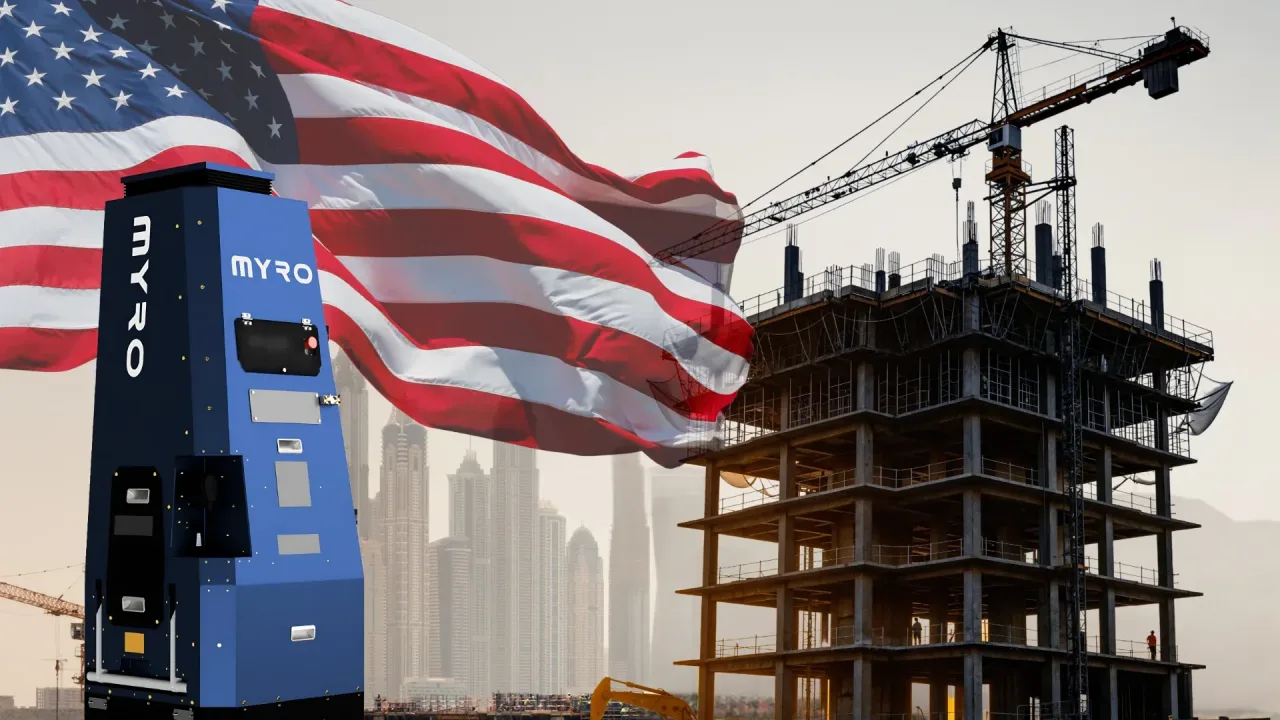

Across the world, construction sites are embracing automation - but nowhere is the opportunity as immense, and as ready, as the United States.
From labour shortages to safety standards, the American construction ecosystem is reaching a point where robotic painting isn’t just innovative - it’s inevitable.
As the global pioneer in autonomous wall painting, MYRO has closely observed how the U.S. market is aligning technologically, economically, and culturally to adopt large-scale robotic finishing solutions.
1. The Labour Shortage Is Pushing Automation Forward
The U.S. construction industry has been grappling with a deepening labour gap for years. According to the Associated Builders and Contractors (ABC), the sector needs more than half a million additional workers just to meet current demand. Skilled painters, in particular, are ageing out faster than replacements are joining.
This shortage has forced contractors to seek sustainable solutions - and robotics fills that gap perfectly.
Robotic painting doesn’t replace skill; it multiplies it. One trained operator can now handle what used to require an entire crew, maintaining quality and safety while drastically reducing time on site.
For an industry built on deadlines and margins, productivity through robotics is no longer optional - it’s essential.
2. A Market Obsessed with Safety and Consistency
In the U.S., safety compliance isn’t just encouraged - it’s enforced. From OSHA standards to state regulations, painting at heights or in confined spaces brings constant risk and liability.
By integrating robotic painting systems, contractors can remove workers from hazardous zones while achieving even better results.
Consistency is the other side of the coin. Commercial clients in the U.S. - from real estate developers to retail chains - demand uniform finishes across every project and site. Robotic painting delivers that precision through controlled motion, digital mapping, and AI-driven spray patterns, ensuring the same level of quality from New York to Nevada.
3. Emphasis on Sustainability and Material Efficiency
Sustainability has evolved from a buzzword to a business requirement. Green building certifications, such as LEED and WELL, are now baseline expectations in the U.S. real estate sector.
Traditional painting often results in significant material waste due to overspray, inconsistent thickness, and rework. MYRO’s robotic systems eliminate these inefficiencies through precise paint atomisation and optimised layer control, reducing paint waste by up to 25%.
For developers aiming for ESG compliance or LEED points, robotics offers a measurable contribution to environmental performance - a key differentiator in the modern construction bid.
4. The Culture of Early Tech Adoption
The United States has consistently led global waves of industrial transformation, from automotive robotics to 3D printing. Construction technology (“ConTech”) is the next frontier.
Over the last few years, the country has seen record venture capital funding for construction robotics and automation startups, alongside government-supported innovation programmes.
This climate of openness is perfect for a solution like MYRO. Contractors, general builders, and even architecture firms are already experimenting with robotic layout, autonomous surveying, and drone inspection. Adding robotic finishing is a natural next step - and one that directly impacts both productivity and visual quality.
5. Infrastructure Boom and Workforce Costs
The Bipartisan Infrastructure Law (BIL) and other large-scale federal initiatives are fueling an unprecedented volume of construction projects, including highways, airports, public buildings, and housing.
With project volumes climbing and wages rising, the need for scalable efficiency is greater than ever.
Unlike traditional equipment, robotic painting grows more efficient with scale. Whether it’s coating vast airport terminals or new housing developments, each MYRO unit can work continuously, unaffected by fatigue or scheduling gaps. This directly reduces downtime and brings predictable project timelines - a critical advantage in federally funded builds with tight delivery windows.
6. A Shift in Perception: Robots as Partners, Not Replacements
Perhaps the most encouraging sign in the U.S. is the cultural shift. Automation is no longer seen as a job-taker, but rather as a tool for advancement.
MYRO’s deployments demonstrate that painters transition into robot operators and finish supervisors, overseeing multiple systems with reduced physical strain and increased efficiency. This hybrid model aligns perfectly with the American emphasis on skill development and worker safety.
As vocational institutions and trade schools begin introducing robotics modules, the workforce is preparing for a future where human expertise and robotic precision work in tandem.
Conclusion: A Perfect Storm for Adoption
When you combine all these factors - labour challenges, safety standards, sustainability targets, and a tech-ready mindset - the conclusion is clear:
The U.S. is not just a potential market for robotic painting; it’s the next logical frontier.
MYRO’s intelligent painting ecosystem is designed for this exact environment, delivering the speed, consistency, and precision that modern construction demands, while aligning with the country’s broader push toward automation, safety, and green innovation.
The walls of tomorrow’s America will not just be built faster - they’ll be painted smarter.