
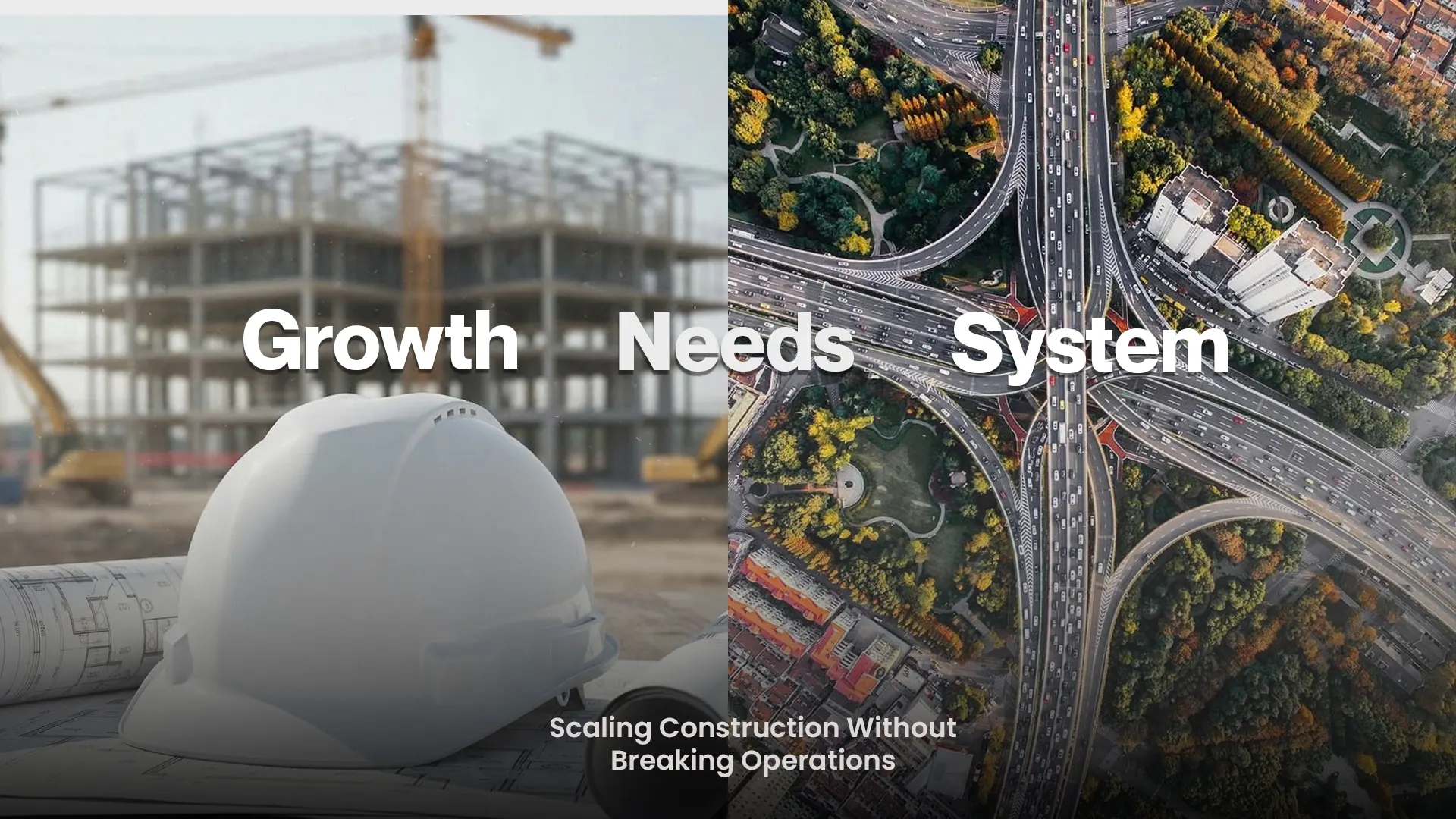

Construction growth has entered a new phase. Projects are larger, timelines are tighter, and the number of simultaneous commitments many firms are managing has doubled in less than three years. What looked like a pure expansion opportunity eighteen months ago now presents a different challenge: executing multiple complex projects concurrently without operational breakdown.
The question is no longer whether a company can win contracts. It’s whether they can deliver them predictably at scale.
The Coordination Problem Compounds With Scale
When a construction company moves from managing five projects to fifteen, the operational demands don’t triple; they multiply exponentially. Each additional project introduces new dependencies, communication channels, and potential failure points. A crew delayed on one site affects material deliveries on another. A permitting issue in one jurisdiction cascades into scheduling conflicts across three others.
This isn’t a temporary growing pain. It’s a structural reality of scale in an industry where execution depends on precise coordination across subcontractors, suppliers, inspectors, and internal teams. The complexity curve rises faster than revenue, and many companies discover this too late.
The breakdown typically manifests in predictable ways: timeline slippage becomes normal, profit margins compress despite higher revenue, and rework costs increase as quality control becomes harder to maintain across dispersed operations. Companies find themselves managing by exception rather than system, reacting to problems rather than preventing them.
Growth Exposes What Systems Mask
A well-run ten-project operation might feel efficient because the owner or senior project manager can maintain direct oversight of every moving piece. They know which crews are reliable, which suppliers deliver on time, and which inspectors need advance notice. This knowledge exists largely in their head, refined through years of experience.
That model breaks at twenty projects. No single person can maintain that level of operational awareness across that many concurrent variables. The informal systems that worked perfectly well at a smaller scale, text message coordination, weekly check-ins, veteran foremen making real-time decisions, start producing inconsistent outcomes.
This is where many construction companies make a critical choice. Some respond by hiring more project managers, essentially trying to replicate the old model at larger scale. Others recognise they’re facing a different problem: the absence of operational infrastructure that can function independently of any individual’s capacity.
The Infrastructure Response
Sophisticated construction operators are increasingly allocating capital toward systems that don’t show up on a job site but fundamentally change how projects get executed. This investment looks different from traditional construction spending; it’s not equipment, it’s not additional crews, and it’s not marketing to win more bids.
It’s the unglamorous work of building execution repeatability: standardised project initiation protocols, coordinated scheduling systems, documentation workflows that ensure nothing falls through communication gaps, and visibility mechanisms that surface problems before they become costly.
The logic is straightforward. If execution variability is the primary risk to margin and timeline performance, then reducing that variability becomes a capital allocation priority. Companies that build this infrastructure aren’t trying to eliminate judgment or expertise; they’re trying to ensure that expertise gets applied consistently across every project, regardless of which specific people are involved on any given day.
This shift represents operational maturity. It’s the recognition that sustainable growth requires building the layer between strategy and execution, the systems that translate intent into consistent outcomes.
Why Investors Should Pay Attention
From an investment perspective, this infrastructure focus signals something important about a company’s understanding of its own risks. Construction businesses that invest in operational systems acknowledge that their primary competitive moat isn’t just winning work, it’s executing work predictably.
Predictability changes the risk profile. When a construction company can demonstrate execution control across dozens of concurrent projects, it reduces downside scenarios. Investors aren’t just betting on continued contract wins; they’re investing in a business that has addressed the operational constraints that typically prevent construction companies from scaling profitably.
This matters particularly in construction because the industry’s historical pattern has been growth followed by margin compression. Companies expand rapidly, take on too much, lose operational control, and either contract or fail. The companies investing in infrastructure are attempting to break that pattern by building capacity that scales with project count.
Infrastructure businesses also align better with long-term capital. A company whose value depends primarily on crew size and equipment can be replicated relatively easily by competitors. A company whose value includes operational systems that enable consistent execution across complex projects has built something harder to copy and more durable through market cycles.
The calculus is different when evaluating these businesses. Traditional construction company valuation focuses heavily on backlog and contract pipeline. Infrastructure-focused companies add another dimension: their ability to convert backlog into profit without execution breakdown. That capability compounds over time.
Building for Durability
Myro operates within this operational infrastructure layer, built specifically for construction companies navigating the coordination challenges that come with scale.
The strongest construction businesses today are doing something that looks unremarkable in the short term but proves decisive over time: they’re building foundations before they build higher. They’re investing in the systems that won’t be visible to customers but will determine whether they can deliver on promises made.
This isn’t defensive positioning. It’s recognition that in an industry where execution complexity increases faster than revenue, operational infrastructure becomes the primary determinant of which companies can sustain growth without compromising performance.
The construction companies that emerge as durable businesses over the next decade won’t necessarily be the ones that grew fastest. They’ll be the ones who built the infrastructure to handle growth without breaking. That distinction matters more than any single project win, and it’s increasingly where capital allocation decisions separate serious operators from opportunistic players.