
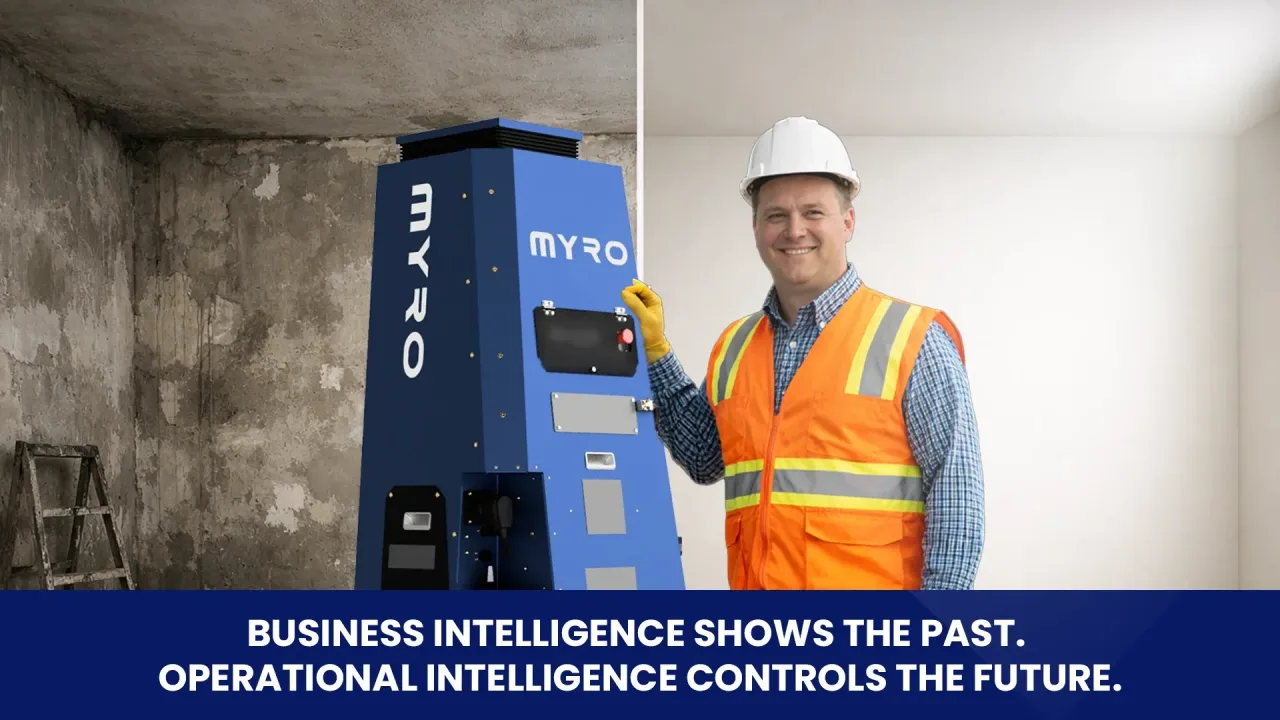

The enterprise software market just spent two decades perfecting the art of looking backwards.
Business intelligence platforms got incredibly sophisticated. We can slice data a thousand ways, build stunning visualisations, and surface insights about what happened. Entire companies became unicorns by helping executives understand their past.
But the value is shifting from understanding what happened to shaping what happens next.
This isn’t about better dashboards. It’s a fundamental category shift from business intelligence to operational intelligence, and it represents the largest unpriced opportunity in enterprise software today.
The BI Ceiling
Business intelligence hit a plateau that most companies haven’t noticed.
The reporting layer is solved. Data warehouses are commoditised. Visualisation tools are abundant. The marginal value of another analytics platform approaches zero.
More importantly, BI doesn’t change outcomes. It shows what happened, maybe explains why. But it doesn’t intervene to make things happen differently.
Think about how BI gets used: Build a dashboard. Review it weekly. If something looks wrong, schedule meetings, investigate, and eventually implement changes. Wait another cycle to see if it worked.
By the time BI surfaces a problem, the damage is done. The deal is lost, the shipment delayed, the customer churned.
Operational intelligence operates on a completely different axis.
What Operational Intelligence Actually Is
Operational intelligence intervenes in active processes, not analyses completed transactions.
Works at the workflow level. Observes processes as they unfold and acts when intervention would change outcomes.
Operates in real-time. Intelligence is embedded in workflow, not extracted after the fact.
Automates decisions. Handles what can be automated, escalates what needs human judgment with full context assembled.
Learns from operational patterns. Improves by understanding how work flows, the exceptions, workarounds, and unwritten rules that never make it into structured data.
The difference isn’t subtle. BI is a mirror. The OI is a nervous system.
Why This Matters Now
Three forces make operational intelligence not just valuable but necessary.
Business velocity has exceeded human coordination capacity. Companies operate across more channels, markets, and complexity than centralised decision-making can handle. Winners make good decisions at the edge, in the moment.
The cost of operational errors has multiplied. A failed payment damages customer relationships and acquisition economics. A delayed response triggers churn. The window for correction collapsed from days to minutes.
The tools to build OI have matured. Real-time data processing is standard. APIs expose operational systems. Modern platforms can act, not just observe.
But having technical capability doesn’t mean you’re building operational intelligence. Most “real-time” systems are BI mindsets with faster refresh rates.
The Architecture Difference
BI architectures pull data centrally for analysis. Everything flows to the data warehouse. Analytics happens in batches. Optimised for comprehensive views of complete data.
OI architectures push intelligence to where decisions happen. Intelligence lives alongside operational systems, observing and acting in context. Optimised for speed and specificity.
BI platforms can be bolted on, separate systems consuming data without changing how tools work. OI platforms must be embedded, becoming part of the operational fabric.
This makes OI harder to build but creates deeper moats. Once woven into workflows, removing it means re-architecting processes, not just switching vendors.
Where the Value Concentrates
Exception handling. Most operational work is routine. Value is in identifying the 5% needing human attention and handling the rest automatically.
Cross-system coordination. Customer data in CRM, orders in ERP, shipping in logistics. OI value concentrates on orchestrating across these boundaries.
Context assembly. OI reduces a 45-minute investigation to a 45-second decision by assembling relevant context automatically.
Organisational knowledge capture. Every company has unwritten rules about customer handling, vendor reliability, and escalation triggers. OI that codifies this becomes increasingly valuable.
The Market Timing
This category shift is happening whether incumbents acknowledge it or not.
BI budgets are flat or declining. Spending on automation, workflow orchestration, and intelligent process optimisation is accelerating. CFOs are reallocating to tools that change outcomes, not just measure them.
BI vendors are pivoting toward “predictive analytics” and “AI-powered insights.” But bolting prediction onto BI architecture doesn’t create operational intelligence. It creates better forecasts, not intervention.
Companies winning in OI aren’t from the BI category. They’re built from first principles around “what should happen next, and how do we make it happen automatically?”
What This Means for Investors
Category creation, not disruption. This isn’t the best BI tool. It’s a new category with different buyers, use cases, and economics. Category creation multiplies valuations.
Platform dynamics over point solutions. OI creates natural platform effects. Once embedded in workflows, it becomes the orchestration layer for other tools.
Defensive moats through operational embedding. BI tools compete on features. OI platforms become infrastructure. Switching costs are about re-training organisational muscle memory.
Expansion through depth, not breadth. BI expansion meant more users or data sources. OI expansion means more exception types, connected systems, automated decisions, and compounding value that’s harder to replicate.
The market hasn’t priced this yet. Companies positioning as “analytics” or “automation” are valued on SaaS multiples. Those articulating operational intelligence as a category should command platform premiums.
What Myro Is Building
We started with the operational intelligence thesis, not the automation thesis.
We’re not building BI dashboards with automation features. We’re building an operational nervous system that surfaces intelligence when humans need it.
Our architecture is embedded in workflows, not alongside them. We learn from operational patterns, not just historical data. We intervene in processes, not report on them afterwards.
Our customers don’t think of Myro as analytics. They think of it as how work gets done intelligently, how systems coordinate without manual intervention, exceptions get handled without escalation, and decisions happen at the right moment with the right context.
We’re not competing with BI platforms or workflow tools. We’re defining what operational intelligence looks like for complex enterprise environments.
The Opportunity Ahead
Business intelligence was a $30 billion market. Operational intelligence will be multiples of that.
OI doesn’t just serve analysts or executives; it serves every operational role. Every team coordinating work across systems, handling exceptions, or making time-sensitive decisions is an addressable market.
Organisations that act intelligently in real-time will outperform those that only analyse retrospectively. This isn’t a capability gap; it’s a competitive moat.
The winners will understand operational intelligence isn’t better BI. It’s a fundamentally different way of thinking about how intelligence creates value.
Not by helping people understand what happened, but by making what happens next actually better.
That’s what we’re building. That’s where the category is heading. And that’s where forward-looking investors should be paying attention.
Building operational intelligence for the modern enterprise. Want to discuss how real-time intervention creates more value than retrospective analysis? Let’s talk.