
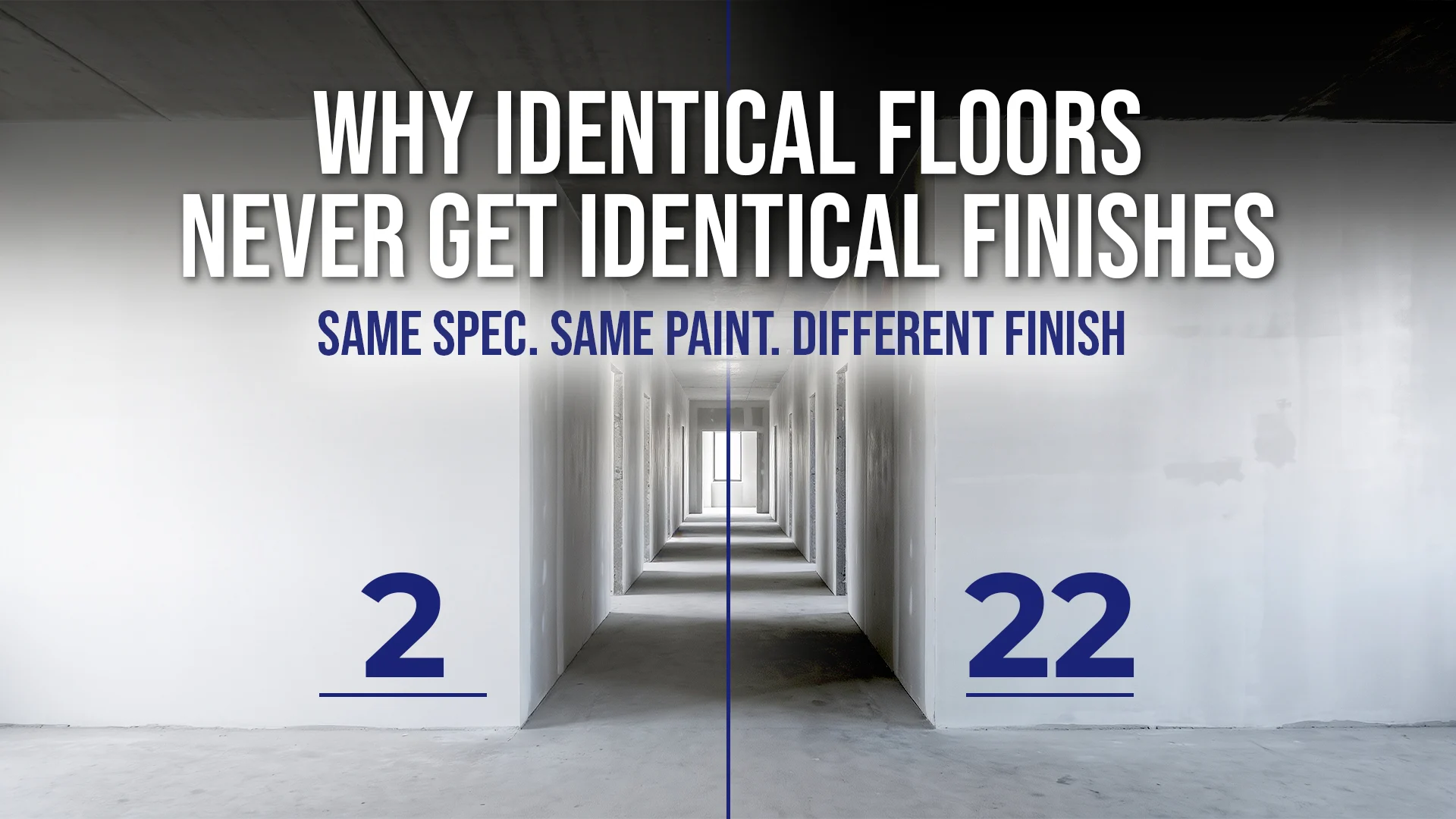

Architectural blueprints operate on the premise of perfect replication. A wall on the second floor is drawn with the exact same dimensions, material specifications, and coating requirements as the equivalent wall on the twenty-second floor.
But a handed-over building rarely reflects that mathematical perfection. When visual inspections begin, Floor 2 might pass without a comment, while Floor 22 triggers a cascade of defect notices. The paint used was identical. The substrate was the same. The variable that changed was the execution method over time.
The Physiology of Manual Variance
Commercial painting is an exercise in massive repetition. In manufacturing, repetition drives variability down. In manual construction trades, repetition drives variability up.
Human physiology is not built to operate in endless, perfect loops. As an eight-hour shift progresses, a painter experiences fatigue, leading to imperceptible shifts in application speed, spray pressure, and the distance maintained from the surface. These micro-variations compound across thousands of square feet, causing Wet Film Thickness (WFT) to drift. What begins as a calibrated process at the start of a shift gradually becomes an approximation as the hours accumulate. This is not a lack of craftsmanship; it is a structural flaw in expecting human hands to perform like mechatronic systems.
Algorithmic Parity
Replacing physiological drift with algorithmic guarantees requires removing the human hand from the repetitive motion entirely. The MYRO (MYRO.bot) platform addresses this by translating pre-programmed parameters directly into disciplined mechanical action.
Operating along pre-programmed paths, the system locks in a constant standoff distance, mechanically compensating for surface undulations up to 15mm in real time. Its onboard LiDAR sensor is dedicated solely to obstacle detection, detecting any obstacle in its path so the machine doesn’t break or collide with anything. Because the application speed and spray pressure are controlled programmatically, the coating applied to the last wall of the day is mathematically identical to the first. Commercial painting quality consistency is no longer a target; it is a programmed output.
Portfolio-Wide Standardization
For tier-1 real estate developers and general contractors, finishing inconsistencies carry a heavy financial penalty. Rework stalls the critical path, extends capital holding costs, and compromises the brand equity of luxury assets.
Achieving visual parity across multi-tower developments requires moving beyond manual scaling. Adding more personnel to a delayed project introduces more execution variables. Programmatic standardization, deployed at 100 square meters per hour, ensures that the aesthetic intent detailed in the architectural plans is protected across the entire portfolio footprint.
The Future of Handover
The traditional handover process relies on subjective visual inspections, where defects are caught after the fact and debated. Automated finishing shifts this paradigm from subjective observation to verified operational data.
As the mechatronic system operates, execution metrics are logged as a natural by-product of the workflow. Every pass, operating parameter, and square meter of coverage is documented. This provides contractors and capital providers with an auditable record of execution. The close-out phase of construction transforms from an unpredictable negotiation into a data-backed certainty.