
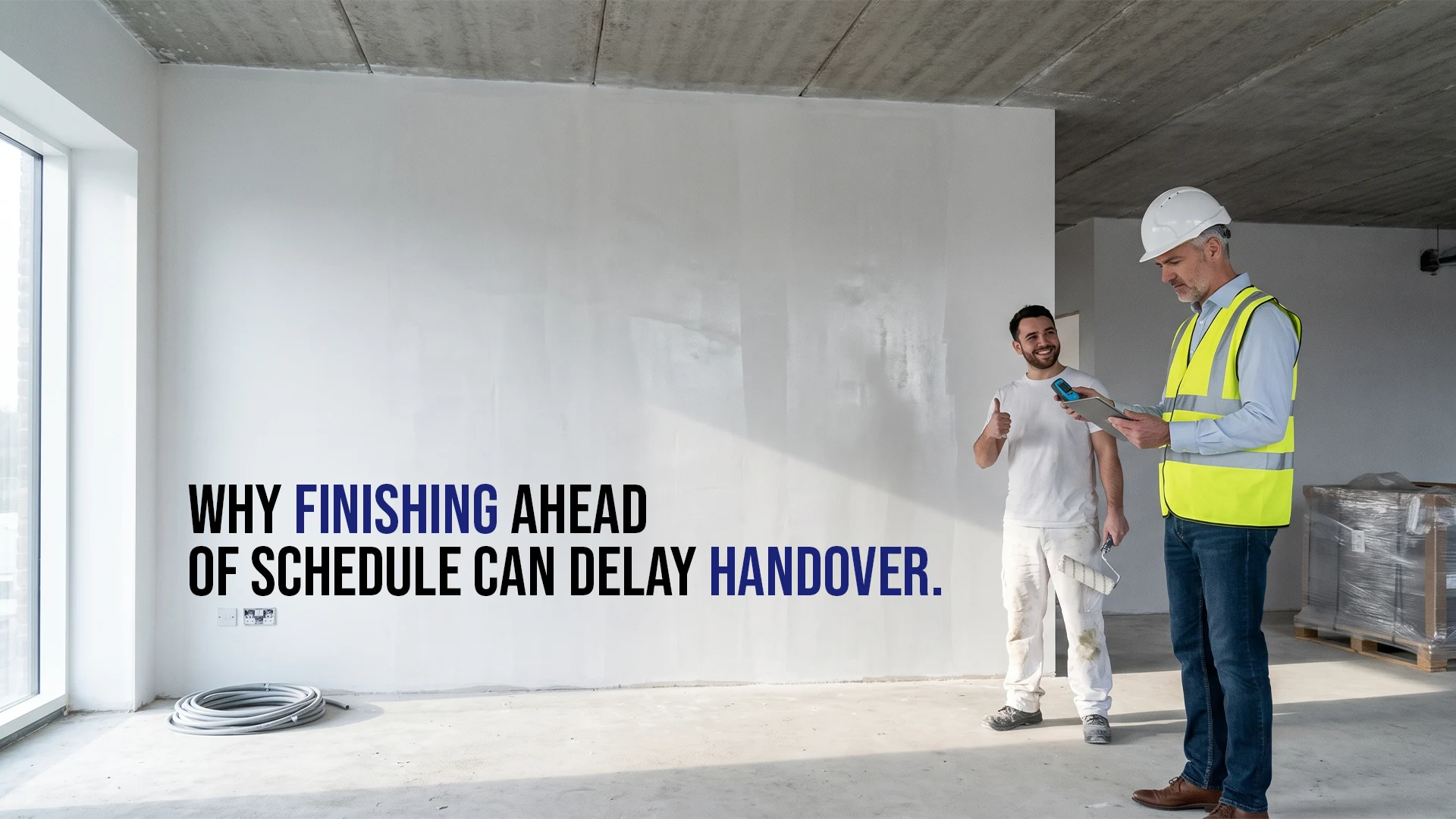

The painting crew packed their vans on Tuesday. The site manager checked the box for the finishing phase. Yet, handover was delayed by three more weeks.
In commercial construction, schedules often confuse application velocity with true project completion. When finishing trades are rushed to meet an artificial milestone, the illusion of speed quickly unravels into a compounding cycle of punch-list returns. In the end, finishing ahead of schedule is exactly what causes construction handover delays, finishing rework, and blown margins.
The Illusion of Site Velocity
Celebrating a fast rough-coat application often conceals multi-week liabilities. Human crews, pressured by tight critical paths, naturally optimize for surface area over edge precision. The walls are coated rapidly, the crew demobilizes, and the schedule appears to be on track.
However, this raw application speed is a trap. Missing proper Wet Film Thickness (WFT) consistency, leaving uneven edges around door frames, or failing to properly mask utility cuts creates a massive deficit of hidden defects. You haven’t actually finished the room; you have simply deferred the precision work to the end of the project.
The Secondary Trade Collision
The real damage to the critical path happens during the secondary trade collision. Once the painting crew clears out, the site is theoretically opened for Mechanical, Electrical, and Plumbing (MEP) installations, casework, and flooring.
When the inevitable punch-list of missed patches, overspray, and uneven coating is generated, the finishing crew must be called back. Now, painters are dragging ladders, hoses, and wet materials into spaces already occupied by sensitive flooring and complex MEP installations. This forces overlapping trades to pause, creating a logistical logjam that halts overall site progress.
The Cost of “Touch-Ups”
The industry often writes off punch-list items as standard “touch-ups,” but the financial reality is much steeper. The unbudgeted overhead of remobilization erodes gross margins at an alarming rate.
Every time a crew returns to a “completed” zone, the project absorbs the cost of:
- Remobilizing equipment and staging materials.
- Re-masking newly installed surfaces (like finished floors and electrical plates).
- Managing site friction and schedule clashes between competing subcontractors.
- Paying highly skilled labor for tedious, time-consuming corrective micro-tasks.
First-Pass Precision: The MYRO Advantage
Handover predictability requires eliminating the punch-list before it is created. This is where programmatic execution replaces manual inconsistency.
MYRO executes autonomous wall coating at 100 sqm/hr with 98% first-pass precision. Rather than relying on site-slowing manual masking or inconsistent edge work, MYRO skips door frames and window cuts programmatically.
MYRO follows strict, pre-programmed operational paths to execute its tasks. Its onboard LiDAR sensor is utilized for one specific, critical function: obstacle detection. If an unexpected obstacle or worker enters MYRO’s path, the sensor detects the obstacle immediately to stop the machine, ensuring it does not break or collide with anything and protecting overall site safety.
True Project Velocity
Construction efficiency isn’t measured by the volume of paint applied in a single day; it is measured by the predictability of the handover. True project velocity is determined not by how fast a crew can leave the room, but by whether they ever have to come back. By securing Wet Film Thickness and boundary edges on the first pass, MYRO eliminates the rework cycle, protects secondary trades, and keeps your critical path intact.