
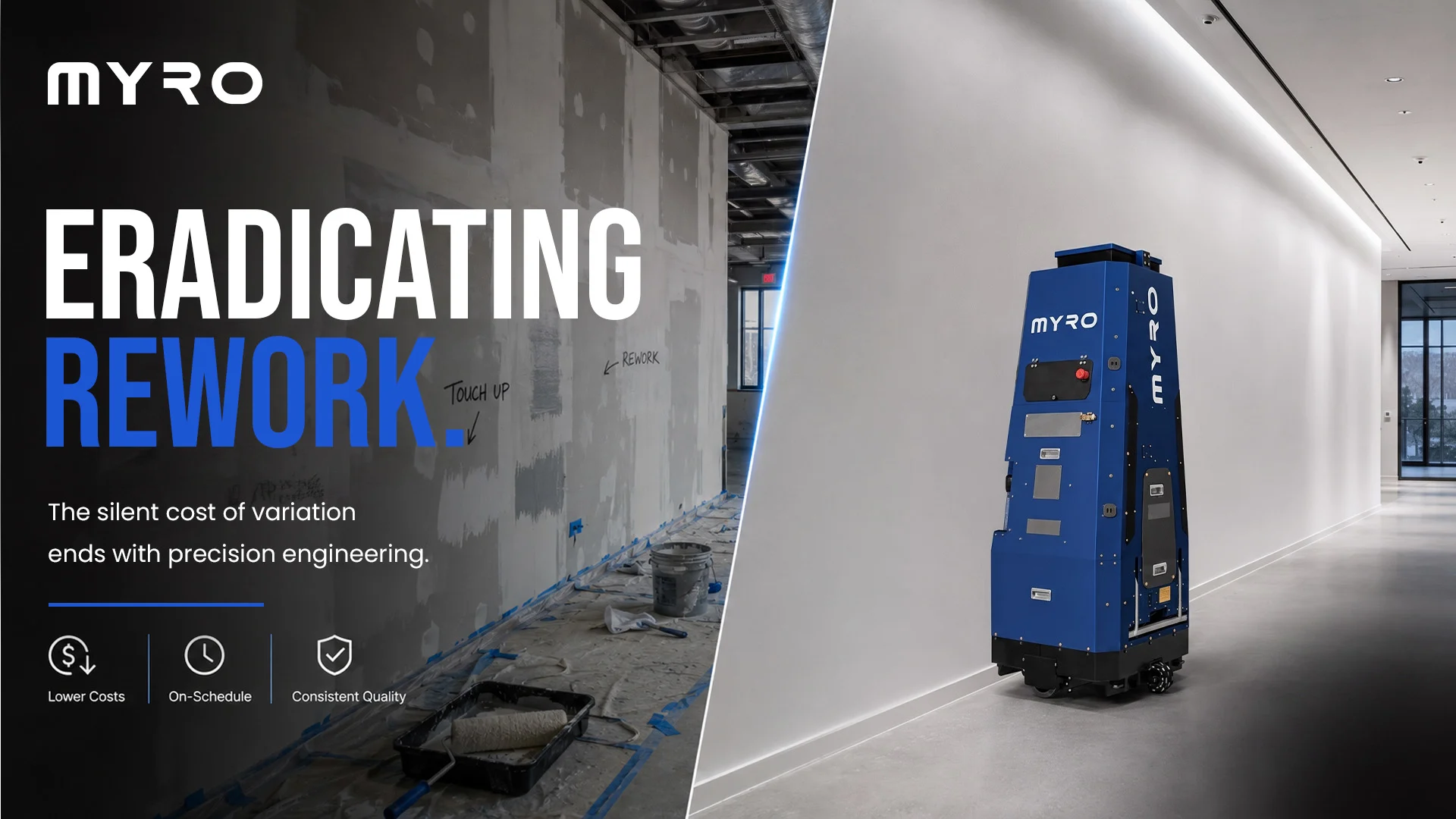

In large-scale construction, the most dangerous costs are the ones you don’t see coming. They don’t arrive as massive budget cuts or sudden supply chain halts. Instead, they bleed project margins slowly, quietly, and continuously.
Ask any experienced developer or quality manager where they lose the most money during the finishing phase, and they will all give you the exact same answer: rework.
The cost of doing things twice—setting up scaffolding again, buying extra paint, delaying the handover of a floor—is the silent margin-killer of the construction industry. But what actually causes this rework? It rarely comes down to bad paint or bad intentions. The true culprit is the unavoidable physical limitation of manual labor: variation.
To solve the industry’s rework crisis, we must first understand why it happens, and more importantly, how precision engineering is stepping in to eradicate it for good.
The Problem: The “Eight-Hour Fade” and WFT Variations
Interior wall painting is a game of microscopic margins. Paint manufacturers design their coatings to be applied at a highly specific Wet Film Thickness (WFT) to ensure proper curing, durability, and a flawless visual finish.
When a skilled human painter begins their shift at 8:00 AM, their technique is sharp. They hold the spray gun at the exact right distance from the wall, moving at a steady, consistent pace.
But a human arm is not a machine; it is a pendulum. By 3:00 PM, shoulder fatigue sets in. The painter’s arm naturally drops an inch or two further from the wall. Their sweeping motion speeds up or slows down. These microscopic variations in distance and speed create immediate inconsistencies in the Wet Film Thickness.
On a single wall, this might seem invisible. But in a 500-unit residential tower or a sprawling commercial complex, these daily variations compound.
Why Traditional Painting Slows Projects Down
When paint is applied unevenly, it dries unevenly. This creates “flashing” (inconsistent gloss), shadowing, or poor adhesion.
When the quality control manager walks the site a few days later, these inconsistencies mean the wall fails inspection. The consequences are immediate and expensive. The site must be prepped again. Scaffolding must be re-erected. Extra labor must be paid, and extra material must be consumed just to fix the mistakes of the previous week.
For capital providers and general contractors, this creates a ripple effect. If the painting phase stalls due to rework, the flooring teams can’t come in. The electricians can’t install the final fixtures. The entire project timeline collapses not because of a major disaster, but because a human arm simply got tired.
How Automation Changes Execution: Eliminating the Drift
To eradicate rework, we have to eliminate the physical drift that causes it. We cannot ask a human being to work like a machine for eight straight hours, but we can give them a machine that does the heavy lifting for them.
This is where MYRO completely changes the execution of the finishing phase.
MYRO was engineered specifically to solve the problem of application variance. Rather than relying on human endurance, MYRO utilizes an array of dynamic proximity sensors. When MYRO approaches a wall, these sensors calculate the exact topography of the surface. The robot locks in the perfect, manufacturer-specified spray standoff distance and maintains it with absolute mechanical rigidity.
If the wall curves, MYRO adjusts. If the robot moves across a massive corridor, its speed remains mathematically constant. There is no “3:00 PM fatigue.” The hundredth square meter of the day receives the exact same flawless, uniform coat of paint as the very first.
Why Consistency Matters at Scale
For the modern construction industry, this level of precision is no longer just a luxury—it is an economic necessity.
When a developer adopts MYRO, they aren’t just buying a faster way to paint; they are buying margin protection. By guaranteeing absolute Wet Film Thickness (WFT) compliance on every single pass, MYRO effectively drops the rework rate to near zero.
A Certified Robotic Operator manages the MYRO unit via a simple mobile app, setting the parameters and letting the machine execute the physical labor. The human provides the intelligence and quality control; the robot provides the tireless consistency.
For the people funding and managing these mega-projects, this means accurate forecasting. When you know a robot will reliably output perfectly coated walls at a predictable rate of 100 square meters per hour, your schedule transforms from a hopeful guess into a mathematical certainty. You know exactly how much paint you will use, exactly when the job will finish, and exactly what the quality will look like.
The Future of Construction: Absolute Compliance
We are moving past the point where the construction industry can afford to accept variation as just “the cost of doing business.” As buildings become more advanced and timelines grow tighter, the margin for human error continues to shrink.
The ultimate flex in modern construction isn’t just building faster. It is building with absolute, unshakeable certainty.
Predictability is the highest form of performance. The future of building relies on machine-driven compliance on every single pass, ensuring that we get it right the first time, every time. By letting robotics handle the precision and letting humans handle the strategy, we aren’t just eradicating rework—we are laying the foundation for a smarter, more profitable era of construction.
Stop paying for the same job twice. Learn more about MYRO’s automated painting solutions, or see how interior finishing dictates project handovers.