
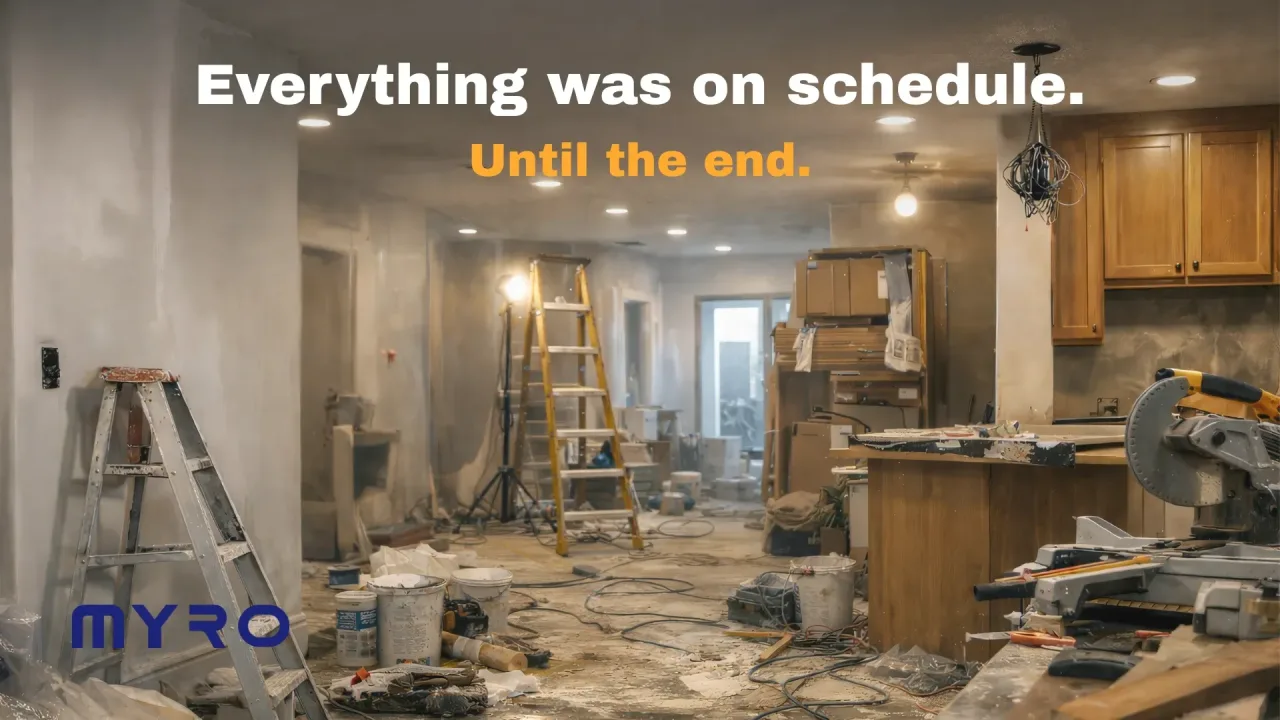

Every contractor has lived this nightmare: A project cruises along for months, seemingly on schedule. The foundation goes in on time. Framing wraps up as planned. Rough-ins proceed without major hitches. Then, suddenly, everything falls apart in the final phase. What was supposed to take six weeks stretched to ten, then twelve. The finish line that looked so close keeps moving further away.
This pattern is so typical it’s almost predictable. Projects that appear healthy until the very end somehow unravel when they should be wrapping up. Understanding why this happens and what it reveals about construction scheduling matters for anyone trying to deliver projects on time.
The Waiting Game Nobody Plans For
According to recent industry data analysing over 321,000 scheduled construction tasks, waiting for other trades to finish their work is the leading cause of construction delays. This problem becomes exponentially worse during the finishing phase, when trade density peaks.
Think about what happens after drywall. Painters need the trim carpenters done. Floor installers need the painters done. Cabinet installers need floors protected, but walls finished. HVAC needs to complete hookups, but can’t work around active painters. Electricians need to install fixtures after painting but before final inspections.
Every trade depends on the one before it, and any delay cascades through the rest of the schedule. What looked like parallel work streams during rough construction becomes a sequential bottleneck during finishes. The project hasn’t actually been “on track”; it’s been accumulating hidden dependencies that only become visible at the end.
The 80/20 Illusion
Here’s what project managers learn the hard way: a project that’s 80% physically complete is rarely 80% temporally complete. The final phase typically takes 4 to 8 weeks after drywall for interior and exterior finishes, but that estimate assumes everything goes perfectly. In reality, the last stages often consume as much time as everything that came before.
This happens because early phases involve fewer trades working in larger spaces with clearer handoffs. Framing doesn’t care what the electricians are doing next week. Foundation work doesn’t need to coordinate with plumbers. But finishing phases compress multiple specialised trades into finished spaces where mistakes are visible, and rework is expensive.
Painting perfectly illustrates this problem. Industry professionals emphasise that painting should only happen after all other trades have wrapped up drywall, electrical, plumbing, carpentry, flooring, and trim installation. But project pressure often forces painters to work early. When other trades continue working in painted spaces, the result is predictable: dust, damage, and complete repaints that weren’t in the original schedule.
The Hidden Cost of “Just a Small Change”
Design changes affect 38.8% of global projects, extending them by an average of 7.8 months and adding 12% to total costs. These changes hurt most when they arrive late.
A minor specification adjustment during finishes triggers modifications across multiple systems. Change the light fixtures, and you might need to repaint. Adjust the flooring material and the timing of installation shifts. Modify cabinet placement, and electrical, plumbing, and painting all need rework. Each change requires coordination among trades already working in close sequence.
Design problems plague 42% of Canadian projects and 44.8% globally. Poor design coordination alone causes rework, accounting for 9.82% of schedule growth and over 52% of cost growth. When these problems don’t surface until the finishing phase, which is common because that’s when all the systems finally come together, the schedule impact is severe.
Material Delays Hit Hardest at the End
Staffing shortages rank as the second most prominent cause of delay, while material and equipment issues rank third. During finishing phases, material delays become particularly damaging because lead times for finish materials often exceed those for rough materials.
Custom cabinetry might take 3 to 6 weeks from order to installation. Speciality tile could require weeks for delivery. Specific paint colours might need custom mixing. Light fixtures ship on their own schedules. Each delayed material stops not just one trade but often several that depend on that work being complete.
The impact multiplies because finishing materials are typically ordered later in the project, giving less buffer time to absorb delays. A two-week cabinet delay was discovered after drywall eliminates any remaining schedule cushion and pushing every subsequent trade backwards.
The Cash Flow Crunch
Recent industry research reveals a problem that public perception often misses: 25% of construction professionals list late payments as a major cause of delays. Among projects hit by payment issues, 76% lose at least a week, with 38% adding more than three weeks to timelines.
This problem intensifies during the finishing phases when costs accumulate rapidly. Painting contractors, flooring specialists, and other finishing trades typically operate on thin margins. When payment timing doesn’t align with work progress, these subcontractors face difficult choices: continue working while carrying the financial burden, slow down to manage cash flow, or stop until payment arrives.
More than half of subcontractors report turning down projects due to cash flow or payment risks. During finishing phases, when multiple specialised subcontractors need to work in rapid sequence, even a few days’ delay from payment issues can derail the entire schedule.
The Inspection Reality
Final inspections create another common delay point. After all interior finishes are complete, projects must pass inspections covering electrical, plumbing, HVAC, and building code compliance. Inspectors often find issues that weren’t apparent during rough-in inspections but become visible once finishes are in place.
Any inspection failure requires correction work, which means bringing trades back into finished spaces. This creates the exact scenario everyone tried to avoid: workers installing, repairing, or adjusting systems in spaces that were supposed to be complete. The result is often more paint touch-ups, floor protection challenges, and coordination headaches.
Why Weather Still Matters
Weather causes 3 to 5% of total project delays, and while weather affects all construction phases, it hits finishing work in specific ways. Exterior painting requires specific temperature and humidity ranges. Concrete for driveways and walkways needs appropriate weather for curing. Landscaping depends on seasonal conditions.
Forty-three per cent of construction professionals name unpredictable weather as a major cause of delays. The timing matters: exterior finishes typically happen late in the schedule, which means weather delays during this phase directly impact project completion with no remaining buffer time to absorb them.
What This Means for Project Planning
Understanding why timelines collapse at the end changes how smart contractors approach scheduling:
Build realistic finish-phase schedules. If your project timeline shows finishing taking the same time as earlier phases, it’s wrong. Plan for the sequential nature of finishing work and the coordination challenges it creates.
Protect completed work aggressively. The cost of bringing painters back for a second coat or refinishing damaged floors dwarfs the cost of proper protection and strict trade sequencing. Enforce finish schedules that keep trades separate rather than overlapping.
Order the finishing materials early. Long lead times for custom or speciality finish materials need to be on the critical path from project start, not afterthoughts once drywall is up.
Maintain payment discipline. Cash flow issues that cause subcontractors to slow down or stop work are entirely preventable. Timely payment keeps finish trades moving at full speed through the final phase.
Expect inspection issues. Build time into the schedule for inspection corrections. The inspector will find something, plan for it rather than treating it as an unexpected crisis.
The Bottom Line
Construction timelines don’t collapse at the end because of bad luck or poor estimation. They collapse because the final phase has fundamentally different characteristics from earlier phases: higher trade density, sequential dependencies, expensive materials with long lead times, and zero remaining schedule buffer to absorb problems.
Projects look “on track” early because early phases are simpler. They fall apart late because late phases are more complex. The contractors who consistently deliver on time aren’t lucky; they’re realistic about what the finishing phase actually requires and plan accordingly from day one.
The finish line isn’t where projects end. It’s where all the accumulated dependencies, deferred decisions, and hidden risks finally become visible. Plan for that reality, and your timelines stop collapsing.