

When venture capitalists ask me what separates a good automation investment from a great one, I tell them to look for what isn’t there.
Not the flashy dashboards. Not the robotic arms in promotional videos. Not the “AI-powered” label slapped on every feature description.
The winners? You won’t even notice they’re automation companies.
The Invisibility Principle
Think about the last time you ordered a ride, transferred money, or streamed a movie. Did you marvel at the automation orchestrating these experiences? Probably not. And that’s precisely the point.
The automation companies building genuine enterprise value aren’t selling automation; they’re selling outcomes. They’re embedding intelligence so deeply into existing workflows that their technology becomes indistinguishable from the process itself.
This isn’t just good product design. It’s a completely different business model with fundamentally different economics.
Why Embedded Automation Creates Defensive Moats
Traditional automation tools face a brutal reality: they’re replaceable. When your value proposition is “we automate X,” you’re in a constant arms race with competitors promising to automate X faster, cheaper, or with more features.
Embedded automation operates differently. When your solution becomes the workflow, when teams forget there was ever another way to work, you’re not just a vendor anymore. You’re infrastructure.
Consider what happens when automation becomes invisible:
Switching costs multiply organically. It’s one thing to swap out a tool. It’s entirely different to rebuild the muscle memory of an organisation. When your platform handles exceptions the way your customer’s business handles exceptions, when it speaks their language and reflects their logic, migration isn’t just expensive, it’s disruptive in ways that spreadsheets can’t capture.
Usage deepens without expansion of sales. Teams don’t “use” invisible automation; they work within it. This creates a different adoption curve. Instead of battling for seat expansion, you’re naturally expanding into adjacent processes because you already understand the context. Your system already has the data. The path of least resistance points toward deeper integration, not vendor diversification.
Value accrues in the relationships between systems. The real moat isn’t in any single capability. It’s in the connective tissue, the way your platform brokers information between departments, translates contexts, and maintains consistency across tools that were never designed to talk to each other. Rip out that middle layer, and you’re not just losing automation. You’re losing coherence.
The Enterprise Buying Pattern Shift
Here’s what’s changing in how enterprises evaluate automation investments, and why it matters for investors:
CFOs are done buying “automation platforms.” They’ve learned that lesson. The graveyard of enterprise software is full of solutions that looked impressive in demos but never made it past the pilot phase.
Instead, they’re buying solutions to specific problems. Revenue recognition. Compliance reporting. Customer onboarding. The automation is incidental, a means to an end, not the end itself.
This shift creates a counterintuitive opportunity. When you’re not selling automation, you’re not competing in the automation category. Your competition isn’t the other automation vendors. It’s the status quo, manual processes, and custom-built internal tools.
That’s a completely different sales motion with completely different economics. Lower customer acquisition costs. Shorter sales cycles. Higher initial contract values because you’re pricing on outcomes, not seats or API calls.
What This Means for Technology Architecture
The companies building toward invisibility make different architectural choices. These aren’t immediately obvious in pitch decks, but they’re visible in how the technology actually works.
They start with integration, not automation. Before optimising a process, they become fluent in the ecosystem in which it lives. What systems does it touch? Where does data originate? Who needs to be notified when something changes? The automation layer comes later, after they’ve established themselves as reliable connective tissue.
They embrace imperfect automation. The pursuit of 100% automation is a trap. The valuable play is identifying which 80% can be handled programmatically and building elegant escalation paths for the rest. This hybrid approach is actually stickier because it acknowledges reality: businesses are messy, exceptions are constant, and the company that handles edge cases well is the company that gets renewed.
They build for modification, not configuration. There’s a crucial difference. Configuration assumes you’ve anticipated every use case. Modification assumes you haven’t, and gives customers the primitives to adapt your system to their reality. This requires more sophisticated architecture, but it’s the difference between a tool and a platform.
The Market Timing Question
Why now? Why is embedded, invisible automation becoming the dominant model?
Three forces are converging:
First, enterprises finally have the infrastructure to support it. Cloud adoption isn’t a future state anymore; it’s the present. API-first architectures are table stakes. The technical prerequisites for deep integration are now standard, not exceptional.
Second, the cost of building custom automation has collapsed. With modern tooling, mid-sized companies can afford to build bespoke solutions for their unique workflows. This is terrible news for generic automation platforms. But it’s excellent news for companies that can embed themselves so deeply that they become the foundation other teams build on.
Third, the market has matured past the “automation for automation’s sake” phase. The early wave of RPA and workflow tools educated buyers about what automation can do. Now those same buyers are sophisticated enough to demand automation that actually fits how they work, not one that forces them to change.
What to Look for as an Investor
If you’re evaluating companies in this space, the traditional metrics only tell part of the story. Here’s what else to examine:
How do their customers describe them? If customers talk about the automation, that’s a red flag. If they talk about how they solve their problem and mention the platform almost as an afterthought, that’s the signal. The best products become synonymous with the outcome, not the mechanism.
What does their data gravity look like? Are they accumulating information that becomes more valuable over time? Are they building models that improve with usage? Data gravity is the invisible force that makes embedded platforms harder to displace. The longer they’re in place, the smarter they get about that specific environment.
Where does customisation happen? Is it all happening in the vendor’s codebase, or are customers building on top of the platform? The companies creating genuine platform value enable customer-driven innovation without needing to be in the loop for every use case.
What’s their relationship with legacy systems? The future of enterprise automation isn’t rip-and-replace. It’s an augmentation. Companies that position themselves as the intelligence layer between old systems and new requirements are building toward durability, not disruption.
The Invisibility Paradox
Here’s the challenge that makes this opportunity genuinely interesting: the better you are at becoming invisible, the harder it is to market.
How do you demonstrate value when your value is in how naturally your product fits? How do you showcase innovation when your innovation is in removing friction, not adding features?
This is why the best companies in this category tend to grow through customer references, not outbound sales. It’s why their case studies focus on business outcomes, not technical capabilities. It’s why they often struggle to articulate their differentiation in a pitch meeting but have customer retention rates that make investors’ eyes light up.
From an investment perspective, this creates a sorting mechanism. The companies that figure out how to communicate their invisibility without compromising it, that’s where the signal is.
The Long-Term Thesis
Automation as a category will continue to grow. That’s not in question. But the returns will be distributed unevenly.
The companies building visible, obvious automation tools will compete in an increasingly crowded market. They’ll fight over features, price on value metrics that commoditise, and struggle with churn as customers comparison-shop.
The companies building invisible, embedded automation will accumulate advantages quietly. They’ll expand within accounts without dedicated expansion teams. They’ll defend their position through integration depth, not contract terms. They’ll scale revenue with better unit economics because they’re not constantly re-selling their value proposition.
This isn’t a winner-take-all market. There’s room for multiple platforms to become essential infrastructure in different domains. But the platforms that win will share a common trait: their customers won’t think of them as automation companies.
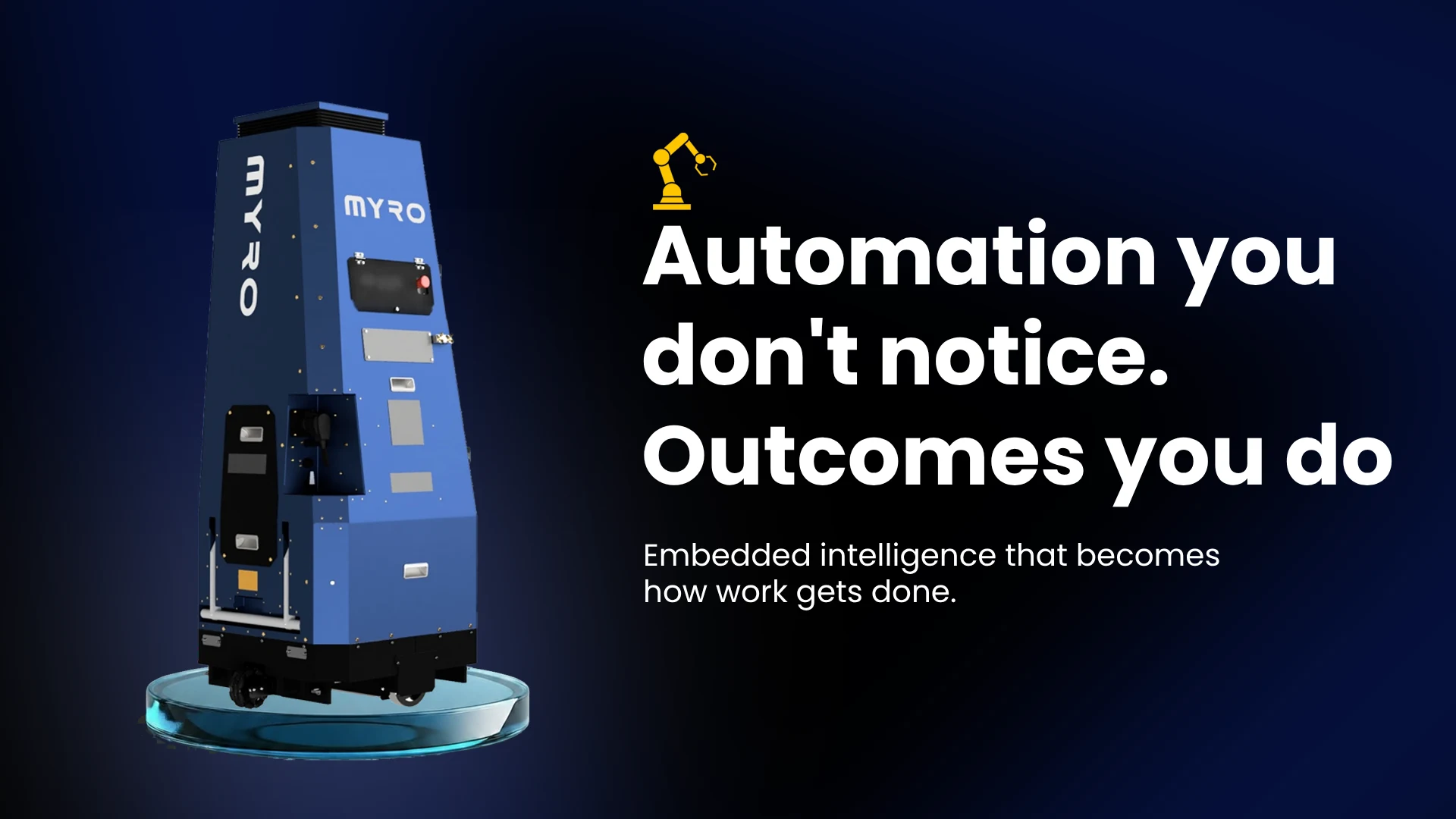
They’ll think of them as how work gets done.
What This Means for Myro
At Myro, we’ve built our entire strategy around this invisibility principle. We’re not trying to be the most visible automation platform in your stack. We’re trying to be the most essential.
That means:
- Integration before optimisation
- Workflow embedding over workflow replacement
- Outcome pricing instead of usage-based billing
- Platform thinking from day one, not as a future roadmap item
We understand that the companies generating genuine enterprise value in automation aren’t the ones with the flashiest demos. They’re the ones solving real problems so elegantly that the automation itself becomes unremarkable.
This approach requires patience. It requires resisting the urge to chase every feature request or market trend. It requires conviction that deep integration is worth more than broad adoption.
But it’s also where long-term value sits. Not in automation that announces itself, but in automation that simply works, so reliably and naturally that teams can’t imagine working any other way.
That’s the kind of company we’re building. That’s the kind of value we’re creating.
And that’s exactly where the future of enterprise automation is heading: toward solutions so good at what they do, you forget they’re there at all.
Interested in learning more about how Myro is redefining enterprise automation? Let’s talk about how invisible infrastructure creates irreplaceable value.