
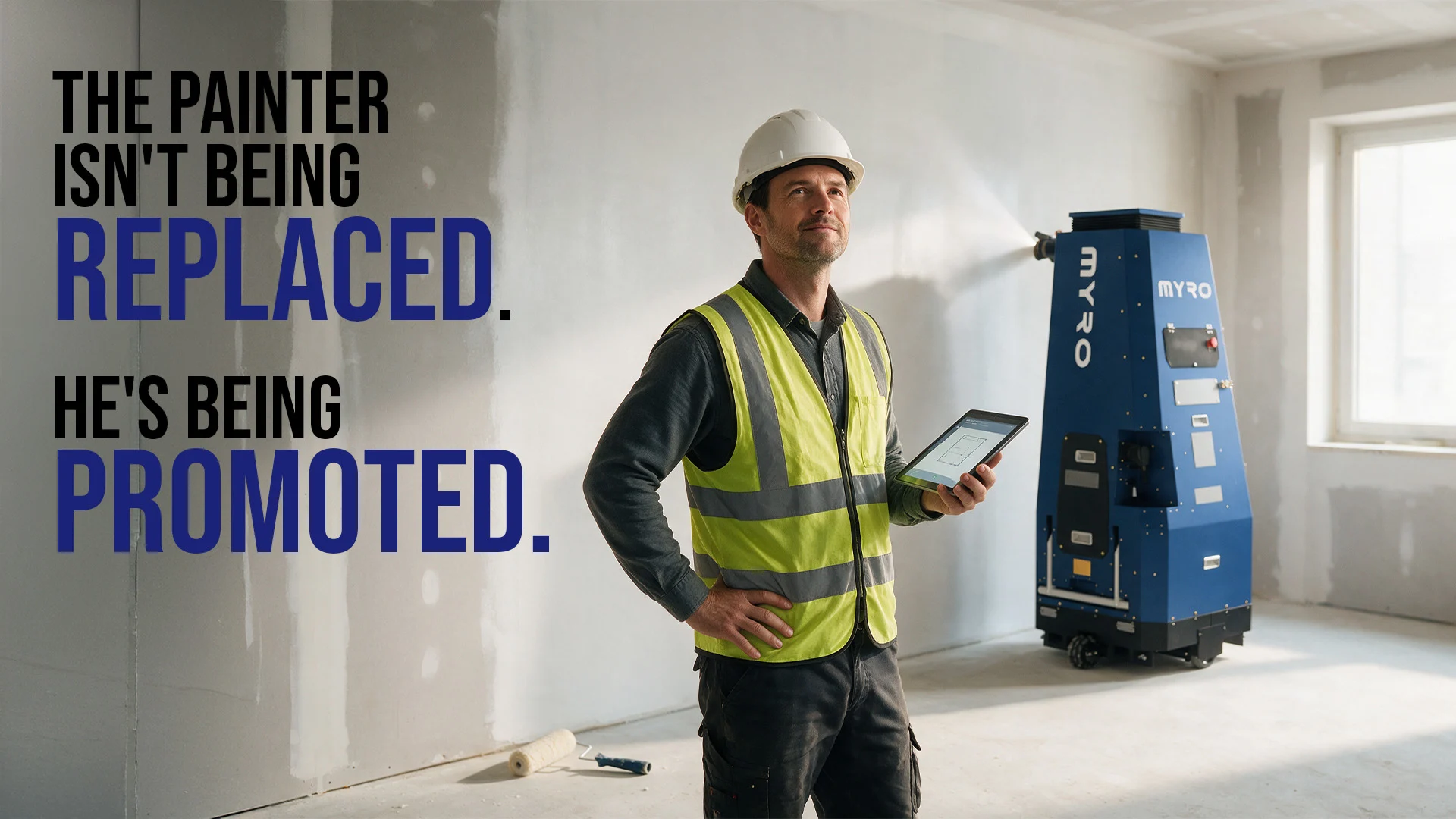

There is a persistent myth in the commercial construction sector: the arrival of robotics means the elimination of the tradesman. However, when we analyze actual operational data and the realities of the modern job site, a very different picture emerges. The future of the finishing phase is not about removing human expertise; it is about fundamentally optimizing it.
The construction industry is currently attempting to scale its output while relying on an execution model that physically exhausts its most valuable asset: its people. Here is a deeper look into why the next era of commercial finishing will be defined by human-robot collaboration, and why upskilling the workforce is the only sustainable path forward.
The Structural Talent Exodus
The construction industry is not merely facing a temporary hiring slump; it is facing a severe, structural infrastructure problem regarding labor. Industry data points to an unavoidable reality: 41% of the manual construction workforce is tracking toward retirement by 2031. At the same time, only 10% of the active workforce is under the age of 25.
General contractors are being forced to tender for increasingly complex, high-volume projects with a rapidly shrinking pool of experienced talent. The traditional strategy of simply throwing more manual painters at a delayed project is no longer mathematically or economically viable. The industry must evolve its infrastructure to meet demand.
The Misallocation of Human Craftsmanship
To understand the solution, we must first look at how we currently utilize the skilled painters we do have. Painting is a nuanced craft requiring a deep understanding of surface preparation, environmental variables, and detailing. Yet, we routinely ask highly skilled professionals to act like machines.
Painters are forced to exhaust their valuable expertise executing highly repetitive, broad, and straightforward wall applications. This physically demanding work inherently limits how much a single crew can accomplish before fatigue sets in. Furthermore, this archaic model introduces significant site safety risks. Workers are consistently exposed to high-elevation scaffolding hazards and prolonged inhalation of toxic VOC fumes in un-ventilated commercial layouts. We are not lacking workers; we are underutilizing their true expertise while exposing them to unnecessary physical risk.
Elevating the Trade Through Mechatronic Integration
The introduction of physical automation infrastructure does not empty the job site, it upgrades it. By deploying an autonomous platform like MYRO, contractors can hand over hazardous, large-scale, and repetitive wall applications to a mechatronic system.
Because the robot executes with algorithmic precision at a constant standoff distance, it programmatically reduces raw paint material waste by 30%. But the most profound transformation happens to the workforce.
Through construction workforce upskilling, a traditional manual painter transitions off precarious scaffolding and steps into the role of a Certified Operator. Utilizing an intuitive tablet-driven interface, these professionals now command advanced mechatronic arrays, manage digital path planning, and oversee real-time consumption metrics. Furthermore, with technology procurement shifting toward Robotics-as-a-Service (RaaS), contractors can access this execution power as a predictable operational expense, allowing them to invest more heavily in their teams rather than depreciating capital assets.
A Collaborative Execution Model
“The next generation of construction professionals doesn’t want a brush; they want an interface.”
The collaborative job site of the future operates on a clear division of labor based on capability. The robotic arm executes the heavy lifting covering vertical surfaces up to three meters high autonomously and safely from the ground.
Simultaneously, human judgment is refocused exactly where it matters most:
- Site-Specific Decisions: Assessing substrate readiness and environmental conditions.
- Complex Detailing: Executing intricate edge work, corners, and specialized finishes.
- Quality Assurance: Supervising the automated run and verifying final micron delivery.
By allowing machines to handle the volume and humans to handle the craft, we do not replace the painter. We create a safer, highly productive, and modernized career path that ensures commercial projects finish on schedule, within code, and under budget.