

The architectural and construction industries are undergoing a seismic shift, fuelled by advances in digital fabrication. As the global population is projected to rise over the coming decades**,** the demand for sustainable, efficient, and cost-effective building methods has never been greater. The answer? Fully automated production forms and processes.
Digital fabrication, a fusion of technology and creativity, is redefining how architects, designers, and construction professionals approach exploration, prototyping, mass production, and construction. What started with Computer-Aided Design (CAD) has evolved into an era where robots, CNC machines, and 3D printers are taking center stage in the built environment.
Digital Fabrication: Beyond CAD
Back in the 1980s, CAD revolutionised drafting, replacing traditional pen and paper with digital tools. But as revolutionary as it was, CAD remained passive, a tool to document ideas rather than shape them dynamically.
Fast forward to today, and parametric design, generative algorithms, and digital fabrication have taken center stage. Architects and engineers no longer just design, they program, iterate, and fabricate with real-time data, optimising materials, structural performance, and sustainability.
The latest trends indicate that automated construction will be the norm rather than the exception. What does this mean?
- Faster project completion
- Reduced material waste
- Unmatched precision
- Lower labour costs
- Enhanced sustainability
BIM: The Backbone of Digital Fabrication
Building Information Modelling (BIM) is a game-changer in construction. BIM is more than a 3D model, it is a collaborative platform integrating architecture, engineering, and construction into a single digital ecosystem.
When paired with digital fabrication, BIM ensures that design and fabrication seamlessly integrate, optimising every step from concept to completion. BIM allows for:
- Real-time collaboration across disciplines.
- Data-driven decision-making for material selection, structural integrity, and logistics.
- Minimisation of errors, risks, and costs by simulating construction before it even begins.
Incorporating BIM and digital fabrication together ensures that fabrication moves beyond theory, allowing for intricate, high-precision construction in real-world environments.
The Key Benefits of Digital Fabrication
Combining BIM and digital fabrication delivers several key benefits:
Improved design quality and innovation – Architects can explore highly complex and custom solutions.
Enhanced efficiency and productivity – Automated tools reduce manual labour dependency.
Significant cost and material savings – Digital fabrication optimises material use and minimises waste.
Increased safety and reliability – Robots handle repetitive, dangerous tasks, improving site safety.
MYRO: The Future of Robotic Digital Fabrication in Construction
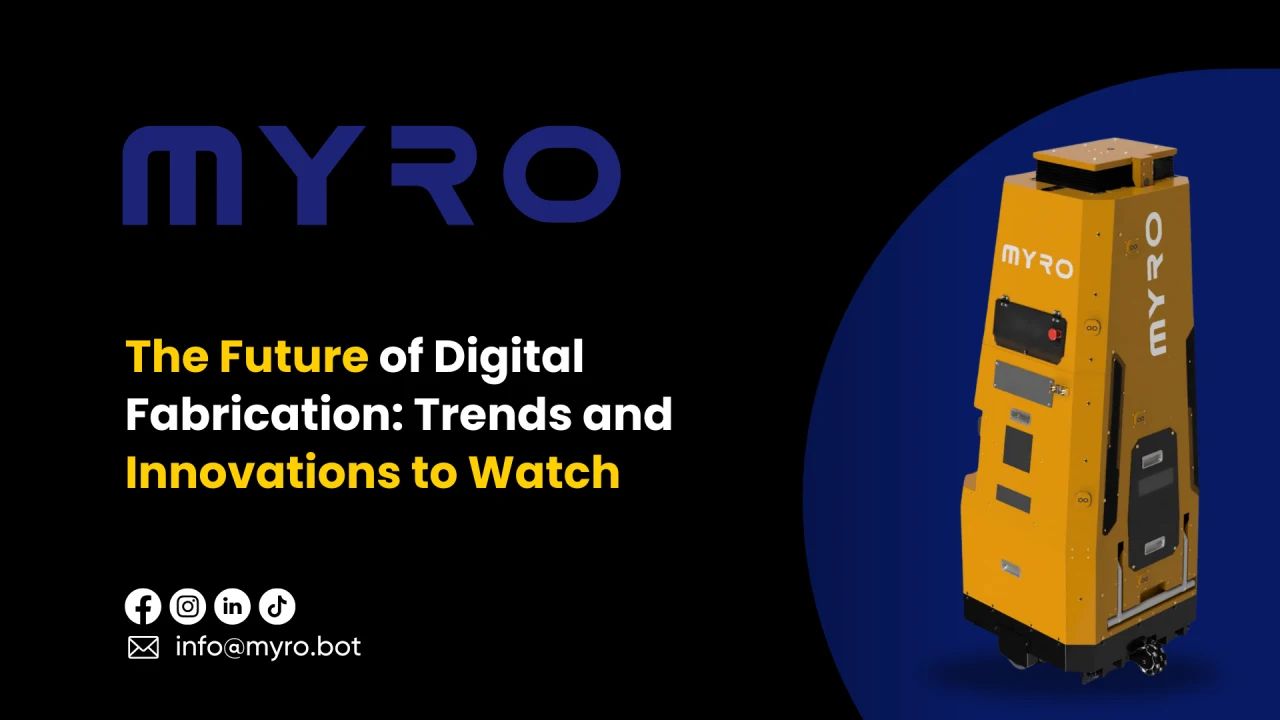
As we step into the future of construction, MYRO leads the way in automated digital fabrication. MYRO is an autonomous wall painting robot, designed to enhance efficiency, sustainability, and precision in the construction industry.
MYRO integrates cutting-edge robotics and automation, to streamline wall painting, addressing some of the biggest challenges in traditional construction:
10x Faster Painting Speed – 100 sqm/hr vs. 10 sqm/hr in traditional methods.
Cost Efficiency – Reduces operational costs by up to 70%.
Material Optimisation – Saves up to 30% of materials, reducing waste.
Labour Shortage Solution – One operator can manage MYRO, reducing reliance on a large workforce.
Enhanced Safety – Limits exposure to hazardous fumes and manual errors.
With an intuitive interface, remote monitoring, and real-time diagnostics, MYRO ensures maximum uptime and productivity.
The future of digital fabrication is bright, fast, and inevitable. As robots, AI, and BIM-powered workflows, we will soon enter an age of fully automated, data-driven, and highly efficient construction processes.
And at the forefront of this transformation? MYRO.