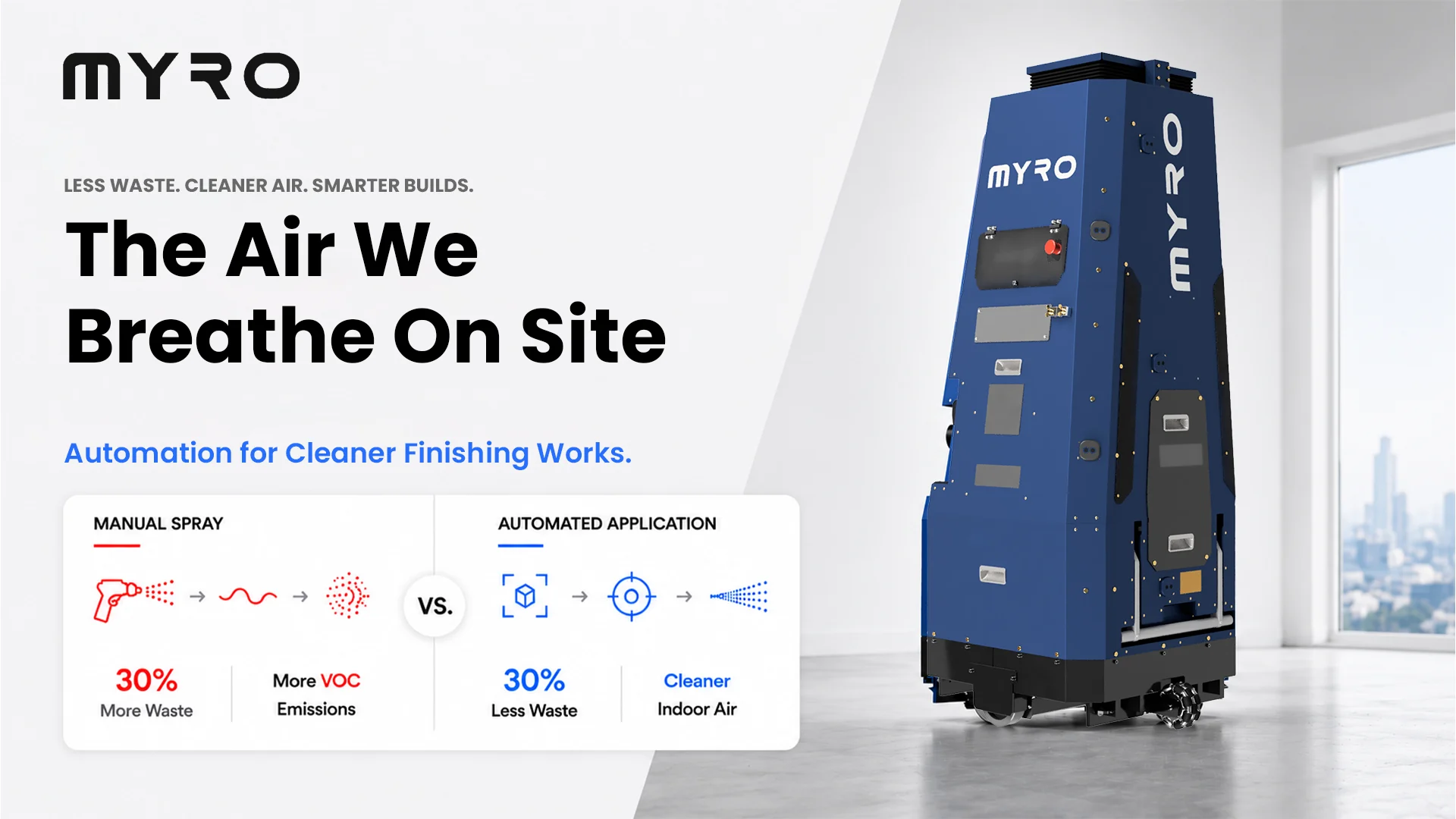
Manual Airless Spray Mix
High Pressure
Erratic Standoff
Over-Atomization
Result30% Material Waste + High VOC Airborne Clouds


Author: MYRO
Published on: 2026-06-23T00:00:00.000Z
5 min read
Modern real estate development operates under a dual pressure system. On one side stands the critical path schedule: the relentless financial pressure of compressed timelines, holding costs, and hard handover deadlines. On the other side stands the regulatory framework: the strict demands of green building certifications, carbon optimization, and occupant wellness mandates.
Historically, these two forces have been in direct opposition. Accelerating the finishing phase often meant sacrificing site control, producing extensive material waste, and compromising internal environmental quality.
Today, smart developers are recognizing that the path to true operational control relies on changing the workflow itself. The final stages of commercial interiors are shifting from an unpredictable variable into a clean, precise, and programmatic operation.
The interior finishing phase is a significant contributor to indoor environmental hazards on active commercial job sites. Traditional high-volume wall painting relies on manual airless spray systems operated under immense pressure. While fast, this method introduces a major operational challenge: over-atomization.
When a human operator maneuvers an airless spray gun, their standoff distance from the wall naturally drifts due to physical fatigue and layout changes. When the spray tip moves too far from the substrate, the high-pressure paint stream atomizes prematurely in mid-air. This creates massive airborne clouds of paint mist that settle on un-targeted areas, concrete slabs, and adjacent fixtures.
For commercial developers, this operational issue creates two distinct problems:
Green building frameworks, such as LEED (Leadership in Energy and Environmental Design) and BREEAM, do not simply evaluate a building once it is finished. They look closely at the methods, waste metrics, and air protection strategies utilized during the actual construction cycle.
Traditional interior painting slows down sustainable progress in two main ways:
Because manual application lacks absolute thickness control, projects regularly experience massive paint overspray. The construction industry historically budgets for a significant material loss factor during finishing—a quiet profit drain that actively undermines waste management scoring under green building rules.
To secure LEED indoor air quality credits, developers must often conduct extensive building “flush-outs,” running HVAC systems continuously to purge airborne contaminants before occupancy. When manual painting saturates structural substrates with thick, uneven coats and heavy overspray mist, the time required to flush out the building expands dramatically, pushing back final commissioning.
Automated construction technology solves these environmental challenges by replacing manual variance with programmatic control. When you introduce a robotic system like MYRO to the interior wall-painting workflow, the underlying physics of how paint hits the surface changes completely.
Using advanced LiDAR (Light Detection and Ranging) scanning arrays, an autonomous platform maps the room layout in three dimensions, automatically identifying structural columns and programmatically skipping over doors, window frames, and trim.
Because the mechanized arm maintains a perfect 90-degree angle and an exact, uniform standoff distance from the wall surface, the paint stream lands precisely where intended. The atomized paint particles bond directly with the substrate instead of escaping into the ambient air.
The immediate result is a 30% reduction in coating material waste. By eliminating the erratic overspray cloud at the source, site air quality remains remarkably clean, reducing chemical drift and creating a healthier environment for the entire workforce.
For institutional real estate developers and infrastructure investors, consistency is a form of risk mitigation. A single manual painting crew might deliver an excellent finish on the first floor, but capacity limitations, physical fatigue, and shift changes inevitably cause variations across a multi-story asset.
When operations are scaled across thousands of square feet, minor variations turn into expensive rework liabilities. If a field coating is applied too thickly, it traps moisture, leading to premature cracking, peeling, or color patchiness weeks after handover.
Robotic automation standardizes the execution. It tracks and adjusts for wall variations up to 15mm in real time, holding absolute compliance with the Wet Film Thickness (WFT) numbers specified by paint suppliers.
For project stakeholders, this level of consistency ensures:
The future of commercial development belongs to developers who view technology not as an administrative add-on, but as core physical infrastructure on the slab.
MYRO bridges the historic gap between digital intent and real-world construction execution. By operating at a steady speed of 100 square meters per hour, the platform provides a 10x velocity improvement over manual methods while operating quietly in the background.
On prominent enterprise deployments, such as Emaar’s premium Forte high-rise development in Downtown Dubai, traditional finishing tasks that normally absorbed 4 full man-days per residential unit were compressed into a 4-hour automated cycle.
This speed is achieved without overpromising or straining on-site assets. It is the logical outcome of a repeatable system that eliminates non-productive downtime and processes raw materials with maximum mathematical efficiency.
Building green is no longer a luxury branding choice or a passive marketing badge; it is a fundamental financial requirement demanded by global capital markets.
As institutional investors tie funding to strict environmental, social, and governance metrics, construction firms cannot afford to tolerate the unpredictability and high material waste of legacy finishing models.
The construction companies pulling ahead are not simply managing chaos more effectively; they are pricing variability out of the project design entirely. By treating interior finishing as a programmatic, sensor-driven operation, the industry is proving that extreme site efficiency and strict environmental stewardship can finally exist on the very same slab.
111 North Bridge Road
#07-11 Peninsula Plaza Singapore (179098)
7, 599- Jebel Ali Industrial First
Dubai, UAE- 507187
Contact Number: +971 54 995 4416
Email [email protected]
© All Rights Reserved MYRO International PTE 2026