
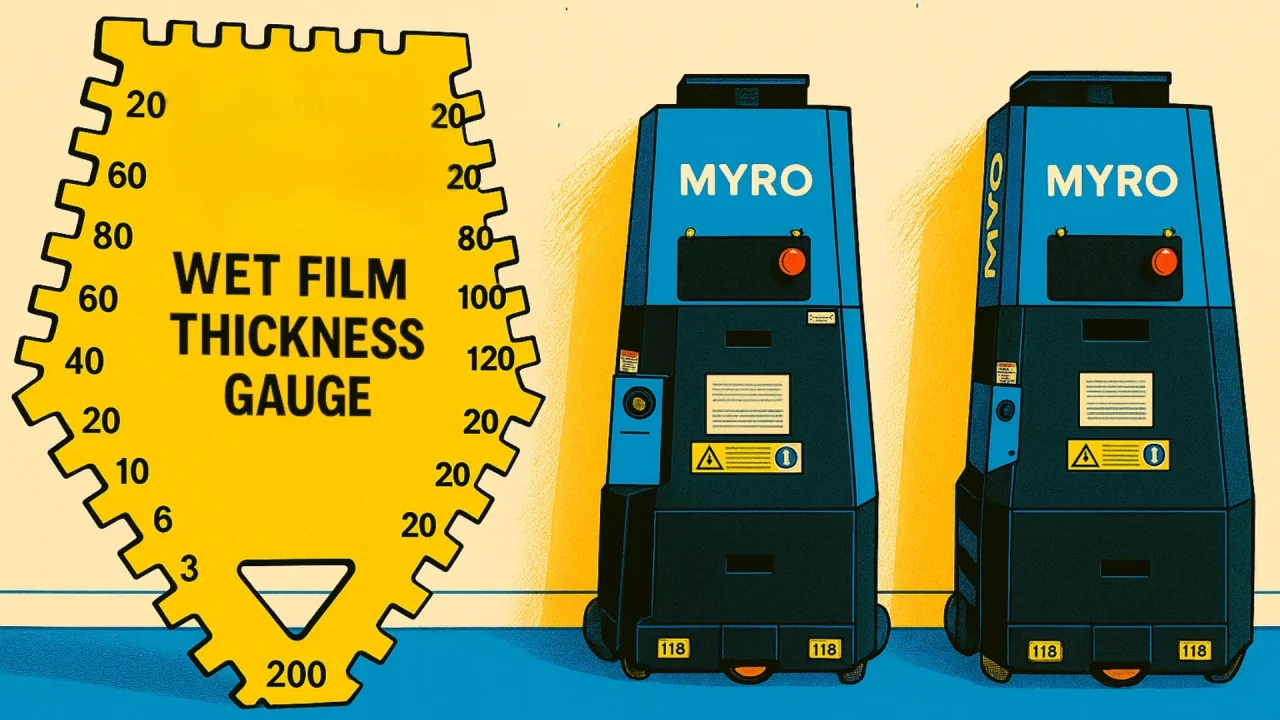

In the construction industry, precision in every aspect of a project is paramount, and painting is no exception. Understanding critical painting parameters such as Wet Film Thickness (WFT) and Dry Film Thickness (DFT) is essential for ensuring the longevity and aesthetic quality of a structure. This guide delves into these concepts, their measurement techniques, and introduces innovative solutions like the MYRO painting robot that are transforming the industry.
Wet Film Thickness (WFT)
Definition: WFT refers to the thickness of a paint or coating layer immediately after its application, while it is still wet. Accurate measurement of WFT is crucial as it predicts the Dry Film Thickness (DFT) once the coating has dried, ensuring the coating’s performance and durability.
Importance of Measuring WFT:
- Quality Assurance: Regular WFT measurements during application help maintain uniform coverage, preventing defects such as runs, sags, or insufficient protection.
- Material Efficiency: Monitoring WFT aids in optimizing paint usage, reducing waste, and ensuring cost-effective application.
- Performance Compliance: Achieving the specified WFT ensures that the dried coating meets the required thickness for optimal protective properties.
Tools for Measuring WFT:
- Notched Gauges (Comb Gauges): These tools have a series of notches at varying depths. When pressed into the wet coating, the deepest notch that gets coated indicates the WFT.
- Wet Film Wheels: Consisting of three discs, the center disc is offset. When rolled over the wet coating, the point where the coating touches the center disc indicates the WFT.
It’s imperative to measure WFT immediately after application to ensure accuracy, as delays can lead to solvent evaporation, resulting in misleading readings.
Dry Film Thickness (DFT)
Definition: DFT is the thickness of a coating layer after it has dried and cured. This measurement is critical as it directly impacts the coating’s protective capabilities and overall performance.
Calculating DFT:
The relationship between WFT and DFT is determined by the volume solids content of the paint. Volume solids refer to the percentage of the paint that remains on the surface after the solvent evaporates. The formula to calculate DFT is:
DFT=WFT×(100/Volume Solids (%))
For example, if a paint has 50% volume solids and is applied at a WFT of 100 microns, the resulting DFT would be 50 microns after drying.
Importance of DFT:
- Durability: Ensuring the correct DFT is vital for the coating to withstand environmental factors, wear, and corrosion.
- Regulatory Compliance: Many industry standards specify required DFT ranges for different applications. Adhering to these ensures compliance and optimal performance.
- Aesthetic Quality: Proper DFT contributes to the desired appearance and finish of the coated surface.
Measuring DFT:
- Magnetic Induction Gauges: Suitable for non-magnetic coatings on ferrous substrates, these gauges measure the magnetic flux density at the surface, which correlates to coating thickness.
- Eddy Current Gauges: Ideal for non-conductive coatings on non-ferrous metal substrates, these devices measure the impedance of an eddy current induced in the substrate.
- Ultrasonic Thickness Gauges: Used for non-metal substrates, these gauges employ ultrasonic pulses to determine coating thickness without damaging the coating.
Regular calibration of these instruments is essential to maintain measurement accuracy.
Relationship Between WFT and DFT
Understanding the interplay between WFT and DFT is vital for achieving the desired coating performance. Applying a coating at the correct WFT, considering the paint’s volume solids, ensures that the resulting DFT meets specification requirements. Regular monitoring and measurement during application can prevent defects and ensure consistency across the project.
Innovative Solutions in Painting: MYRO
Advancements in technology have introduced innovative solutions to the painting industry. One notable example is MYRO, the world’s first intelligent interior wall painting robot designed for the construction sector.
Key Features of MYRO:
- Efficiency: Capable of painting up to 100 square meters per hour, MYRO significantly outpaces traditional manual methods.
- Consistency: Delivers uniform application, reducing the risk of human error and ensuring a high-quality finish.
- Cost Savings: By automating the painting process, MYRO reduces labor costs and minimizes material waste, leading to overall project savings.
- Safety: Reduces human exposure to hazardous environments by minimizing the need for ladders and scaffolding.
Integrating such technology can revolutionize painting projects, offering enhanced productivity and quality.
Conclusion
For construction companies and project managers, mastering painting terminology like WFT and DFT is more than academic—it’s a practical necessity. Proper measurement and understanding of these parameters ensure that coatings are applied effectively, meet performance standards, and deliver both protective and aesthetic benefits. Embracing technological innovations like MYRO further enhances the efficiency and quality of painting projects, positioning companies at the forefront of industry advancements.