

Walk into the site office of any Tier-1 project at 7:00 AM, and the whiteboard tells the same story. It is a daily puzzle of overlapping trades, shrinking margins, and compressed schedules. For a Project Manager, the heaviest lift isn’t the engineering it is the constant choreography of moving parts. It often feels less like executing a master plan and more like managing organized chaos.
But as the demands on large-scale construction grow, the old ways of brute-forcing a project to the finish line are breaking down. The shift that needs to happen is fundamental: we must stop managing chaos and start managing systems.
The Bottleneck in the Final Mile
Nowhere is this chaos more evident than in the finishing phases. The final twenty percent of a build is historically where timelines go to die. Traditional painting and coating processes rely on deploying massive crews of manual labor into spaces where electricians, floorers, and carpenters are still trying to operate.
This creates immediate friction known as trade stacking. Coordinating manual painting means navigating constant clashes, managing the variable pacing of human workers, and dealing with the inevitable inconsistencies in application. When the drywall team runs late, the painting schedule compresses, and site managers are forced to throw more bodies into an already crowded room. The industry has long accepted this messy, labor-heavy workflow as just another cost of doing business.
The 3-Step System: Prep, Calibrate, Execute
The introduction of construction robotics changes the mechanics of execution, but it always prompts a very practical question from the field: “How does a robot actually fit into my messy, real-world job site without slowing down my other trades?”
The answer is seamless integration. Bringing a robotic system on-site isn’t a fragile science experiment; it is the deployment of a highly structured, repeatable workflow. It operates in three clean steps:
1. Prep: Automation doesn’t require a sterile lab environment. The site simply needs standard Level-4 drywall preparation. Once the taping and mudding meet conventional finishing standards, the space is ready. No complex site overhauls are required.
2. Calibrate: This is where the guesswork is eliminated. Using a rapid, 15-minute LiDAR calibration phase, the automated system instantly maps the spatial environment. It dynamically reads the real-world site identifying corners, cutouts, and ceiling heights with millimeter accuracy.
3. Execute: Once mapped, the system executes its task autonomously. Because its footprint is contained and predictable, other trades can work efficiently in adjacent spaces without the usual cross-trade friction. The machine delivers continuous throughput without fatigue.
The Power of Predictability at Scale
When executing at the scale of major infrastructure projects or multi-tower developments, consistency is the ultimate protector of profit margins. Managing the variability of manual labor across one floor is a daily headache; managing it across fifty floors is a massive financial risk.
By replacing the unpredictable pacing of manual crews with the calculable output of a robotic system, timelines transform from hopeful estimates into exact, mathematical certainties. A programmed system applies coatings at the exact same speed, with the same micron-level precision, on the first floor as it does on the fiftieth. This scalable execution dramatically reduces the dependency on fluctuating manual labor and standardizes the entire finishing process.
How Myro Fits Into the Active Pipeline
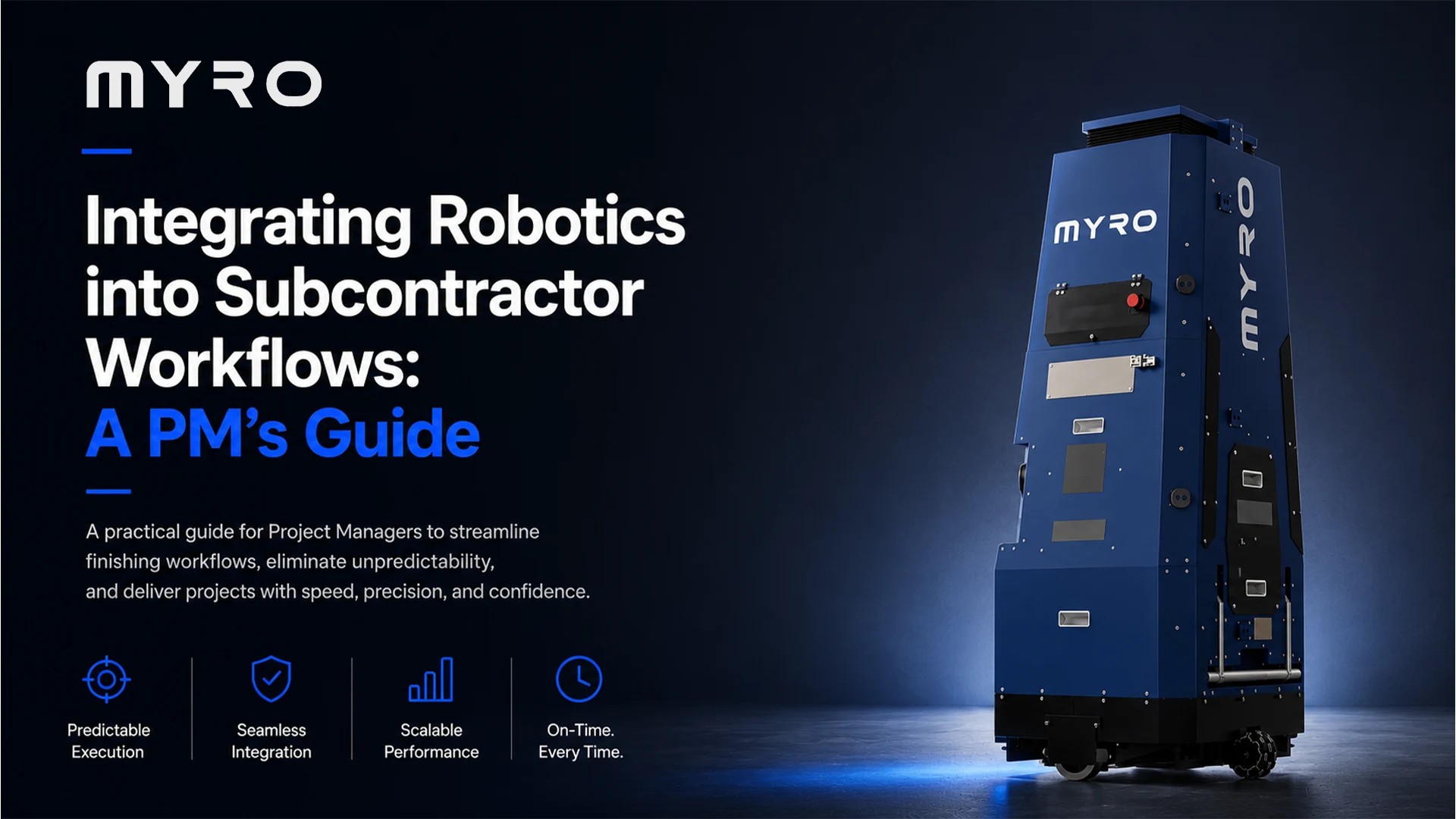
Myro was built specifically for the reality of the modern job site. It is a rugged, field-ready asset engineered to slide directly into existing subcontractor workflows. By standardizing the prep-to-paint pipeline, Myro turns one of the most unpredictable phases of construction into a controlled, continuous operation. It empowers project managers to stop putting out daily fires and start relying on a system that works precisely as programmed, every single time.
The Future of the Job Site
The narrative of the construction site is evolving. The most successful builders and developers of the next decade will not be defined by how large of a workforce they can mobilize at the last minute to fix schedule delays. They will be defined by how effectively they integrate automation to eliminate those delays in the first place. The future belongs to those who build intelligent systems underneath their operations, ensuring that every project is delivered with unprecedented speed, precision, and predictability.