

There’s a specific moment when the software industry pivoted, and most companies missed it.
For decades, the winning move was obvious: identify a manual process, automate it, sell it as a tool. Feature velocity was the metric. Product roadmaps were a competitive advantage.
This model created trillion-dollar companies.
But somewhere in the last five years, the equation flipped.
The companies generating the most durable value aren’t building the most sophisticated tools. They’re removing friction from systems that already exist. And this distinction changes everything about where enterprise value accumulates.
The Tool Saturation Point
The average company uses over 100 SaaS applications. Large enterprises use 300+. Every department has its preferred stack. Every workflow touches multiple systems.
The problem isn’t that businesses lack tools. They’re drowning in them.
Each tool was purchased to solve a specific problem. Individually, they often work well. But collectively, they’ve created a new problem: coordination friction.
Teams spend more time moving information between tools than using them. More time figuring out where information lives than analysing it. More time reconciling conflicting data than making decisions.
The marginal value of adding another tool has gone negative. Each new platform makes the coordination problem worse.
This is the saturation point. And it fundamentally changes what creates value.
What Friction Actually Costs
Friction isn’t just annoying. It’s expensive in ways that compound over time.
Velocity friction. Handoffs create delays. Manual data transfers waste time. Context switches reduce effectiveness.
Quality friction. Information gets lost. Data becomes inconsistent. Exceptions fall through gaps.
Coordination friction. Teams can’t collaborate when everyone’s in different systems. Meetings multiply. Decisions are delayed because assembling context requires six sources.
Innovation friction. Connecting systems is hard, so experimentation becomes expensive. Change means re-coordinating across platforms. Organisations become conservative not from lack of ambition but because their tool stack makes change prohibitively difficult.
Add this up: 20-30% productivity loss, not from bad tools, but from friction between good tools.
This is the opportunity.
The Shift from Tools to Platforms
The last decade rewarded best-in-class point solutions. The best project management tool. The best CRM. Competition was about feature depth within categories.
The next decade will reward companies that reduce friction across categories. The question isn’t “what’s the best tool for X?” It’s “what makes my existing tools work together seamlessly?”
This is a platform opportunity with fundamentally different economics.
Tools compete within categories. Switching is possible. Vendors are replaceable. Pricing power is limited by feature parity.
Platforms compete with friction itself. Not replacing existing tools, but making them work better together. Competition is the status quo of manual coordination. Value increases with every tool integrated.
Tools add to the stack. Another login, interface, and system to maintain. Additive cost.
Platforms multiply the stack’s value. They make existing investments work better. They increase ROI on tools already purchased. Multiplicative value.
This distinction matters enormously for unit economics and defensibility.
Why Integration Isn’t Enough
Integration connects systems and passes data. Necessary but not sufficient.
Friction removal requires intelligence about how systems should work together. Understanding organisational context, which exceptions matter, which workflows are standard, and which edge cases need special handling.
A Zap triggers when a deal closes and creates a project. But it can’t intelligently route based on deal size, customer type, team capacity, and historical patterns. It can’t handle exceptions. It can’t learn from how your organisation operates.
That gap between connection and coordination is where friction lives. And where the value opportunity sits.
What Friction Removal Actually Looks Like
Companies successfully removing friction aren’t building better tools. They’re building intelligence layers across tools.
They observe operations. How work actually happens. Exceptions, workarounds, unwritten rules.
They encode organisational logic. “When this customer type signs, route this way. When that exception occurs, escalate here.” Logic accumulates over time.
They coordinate across boundaries. Value isn’t in single integrations but in orchestrating across multiple systems simultaneously.
They make tools smarter without requiring them to change. Your CRM doesn’t need new features. The intelligence layer makes systems work together better than they could individually.
This is fundamentally different from traditional enterprise software. You’re selling coordination, not capabilities. Competing with friction, not other vendors.
Why This Creates Better Business Models
Expansion happens automatically. More system integrations and accumulated logic make you more valuable without active upsell.
Competitive moats deepen naturally. Intelligence about how a specific organisation operates can’t be replicated. Switching costs are about rebuilding organisational knowledge.
Pricing power increases with usage. You’re pricing on friction removed, not seats or features. As complexity grows, your value increases.
Market opportunity expands. Not competing in a defined category. Every company with multiple tools has friction.
Customer acquisition changes. You make existing products work better, not displace them. Selling with the incumbent stack, not against it.
These aren’t incremental advantages. They’re structural differences that compound over long horizons.
The Market Timing Signal
Tool fatigue is real. It is reducing vendor count. New purchases face scrutiny. Platforms making existing tools work better face less resistance.
AI expectations are rising. Organisations expect smart systems to handle decisions, routing exceptions, and learning patterns. Individual tools can’t deliver this across multi-platform workflows.
Operational complexity is accelerating. More distributed, dynamic, exception-driven. Intelligent coordination needs exceed manual building capacity.
Integration infrastructure is mature. APIs standard, data accessible, and prerequisites commoditised.
Companies recognising this shift capture disproportionate value. Those optimising for in-category feature velocity compete in crowded, commoditised markets.
What This Means for Myro
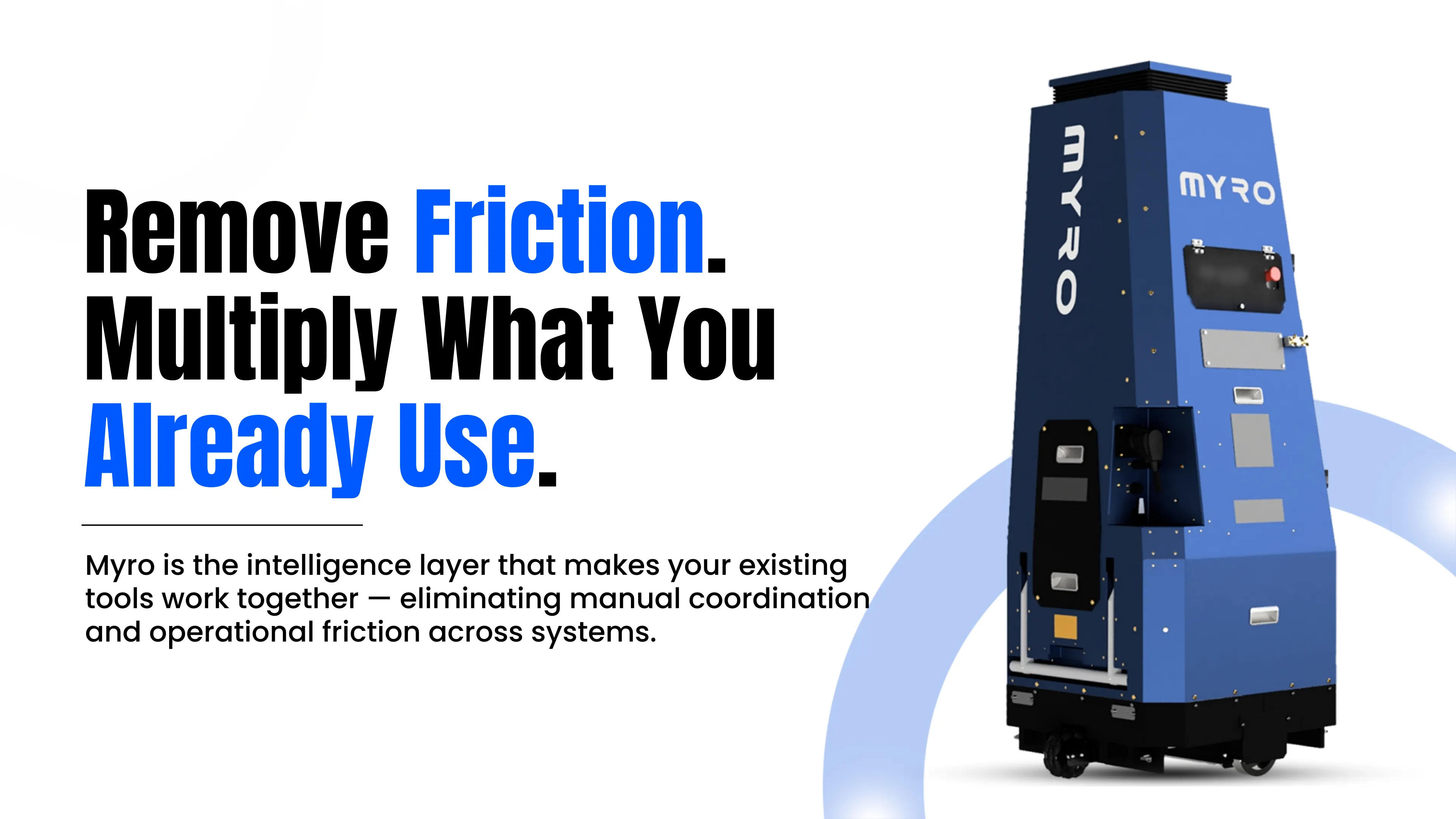
We designed Myro explicitly around friction removal, not tool creation.
We’re not building another automation platform with more features. We’re building the intelligence layer that makes existing systems coordinate seamlessly.
When you implement Myro, your existing tools don’t change. But how they work together does. Manual coordination, context switching, and information gaps that friction reduces systematically.
We’re not selling capabilities, we’re selling coordination. Not displacing systems, making them work together better.
The market is moving from “what tools do we need?” to “how do we make what we have actually work?” That’s not a feature question. It’s an architecture question.
The Investment Thesis
Industry growth rewards those who remove friction, not add tools.
This is observable in buying patterns, IT budgets, what gets renewed and what gets cut.
Companies positioned to capture this aren’t the ones with impressive feature roadmaps. They’re the ones reducing coordination costs, removing operational friction, and making existing systems more valuable.
That’s different economics, different defensibility, different long-term value creation.
It requires investors who can underwrite friction removal even when it doesn’t show as traditional SaaS metrics. Who understands platform effects compound differently than product features? Those who recognise the most valuable software might be the layer that makes other software work better.
That’s the opportunity. That’s what’s changed. And that’s where the next generation of enterprise infrastructure value will be created.