
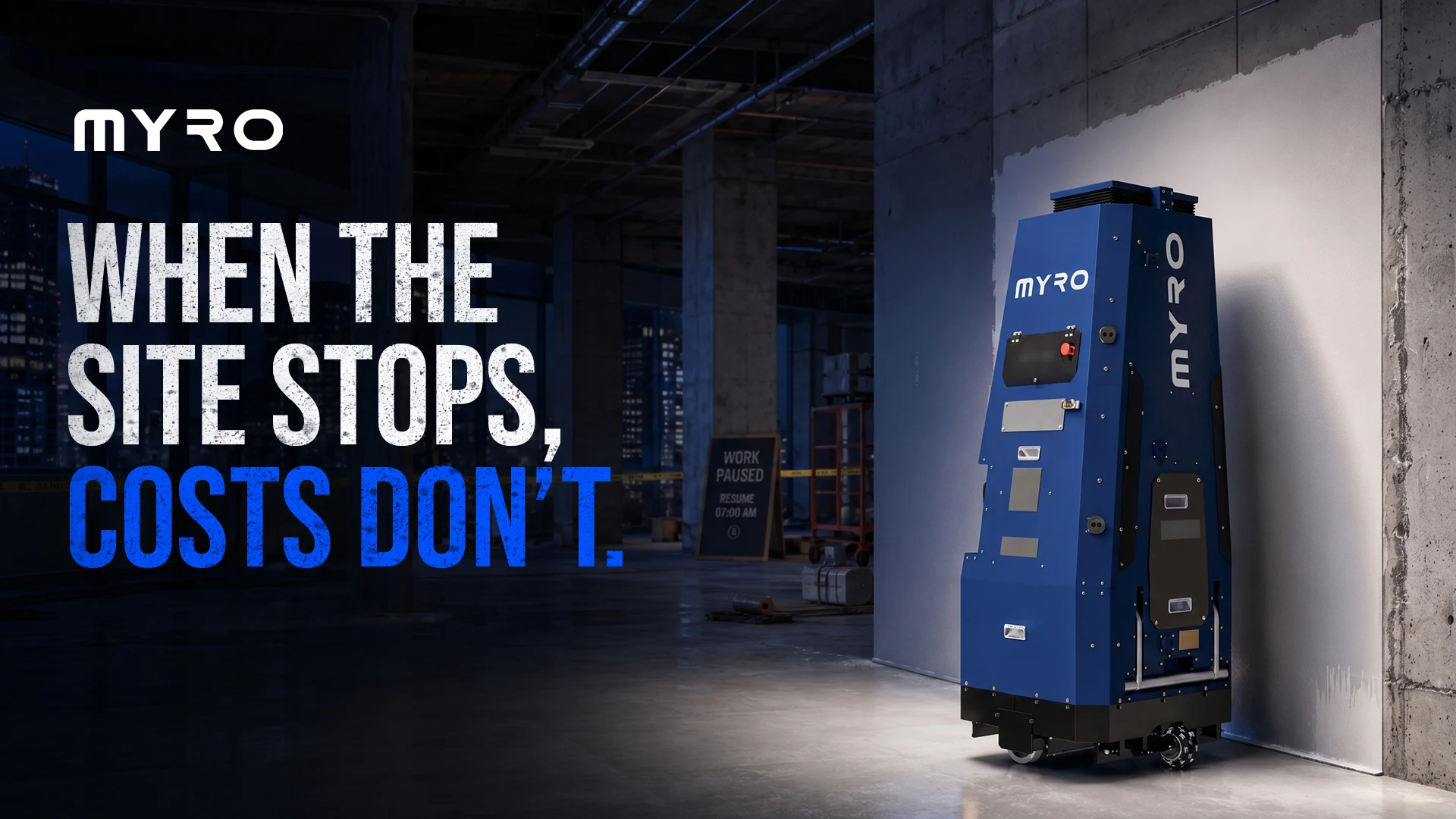

Walk a construction site at two in the afternoon on a Tuesday and you will see activity. Equipment moving. Materials being staged. Crews at work across multiple levels of a structure that is visibly growing.
Walk the same site at seven in the evening, and you will see something different entirely.
Stillness. Lights off. Surfaces that were being finished an hour ago now sitting untouched in an empty building. A project that costs money every single hour it exists, producing nothing.
Most people who observe this see a normal construction site after hours. Strategic players see something else. They see a loss that has been so thoroughly normalised that the industry stopped counting it a long time ago. And they are beginning to ask a question that the construction business has never seriously answered.
What is all that idle time actually costing?
The Accounting Gap Nobody Talks About
Construction project accounting is sophisticated in many ways. Material costs are tracked with precision. Labour hours are logged, categorised, and analysed. Equipment utilisation is measured. Overhead allocation is calculated down to the project percentage.
But idle time, the hours when the site exists and the costs continue and the output stops, rarely appears as its own line in the project cost analysis. It is absorbed into the general structure of how construction is financed and scheduled. It is treated as a condition of the industry rather than a cost of the model.
This is a significant accounting gap. And it persists because the industry has, for so long, had no practical alternative to the model that creates it.
When the only way to execute finishing work is through a crew that operates within a standard shift pattern, the hours outside that pattern are not really a choice. They are simply unavailable. And costs that feel unavoidable tend not to get interrogated with the same rigour as costs that feel discretionary.
Strategic players approach this differently. They are not satisfied with unavoidable as an answer. They want to understand what unavoidable is actually costing before they accept it as permanent.
What Idle Time Actually Represents
To evaluate idle time properly, it helps to be precise about what it actually contains.
There is the obvious component. Hours when no work is happening. No surface is being covered. No progress is being made against the programme. This is idle time in its most literal form and it is the easiest to visualise.
But idle time in construction has dimensions that are less visible and more consequential than the empty hours alone.
There is preparation idle time. The period between when a surface is ready to receive finishing work and when the crew is actually available to begin. On a project with tight sequencing, this gap can be measured in days. During those days, the prepared surface sits exposed. Conditions affect it. Dust settles. Adjacent trades work around it and sometimes damage it. What was ready becomes less ready. And the finishing process, when it finally begins, starts from a slightly compromised position.
There is recovery idle time. The period after a delay, when the programme has been compressed and the finishing phase is expected to absorb what earlier phases lost, but cannot begin its recovery until crew availability allows. The window to recover exists on paper. The capacity to use it does not.
There is sequential idle time. The waiting that downstream trades endure because the finishing phase has not completed its section of the handover sequence. A fit-out team ready to mobilise. An inspection that cannot be scheduled. A certification that cannot be issued. All of them waiting behind a finishing phase that is moving at the pace the labour model allows, not at the pace the programme requires.
Add these together across a large project and the idle time picture looks considerably different from the simple after-hours stillness that the evening site visit reveals.
Idle time in construction is not the gap between shifts. It is the gap between what a project requires and what the model can deliver. That gap is where the hidden loss lives.
How Strategic Players Think About Hidden Loss
The phrase hidden loss is precise in a way that matters for how strategic players approach this analysis.
Hidden does not mean unreal. It means unaccounted for in the way that visible costs are accounted for. And hidden losses have a particular quality that makes them more dangerous than visible ones. Because they do not appear clearly in the cost reporting, they do not generate the management attention, the process improvement effort, or the investment in solutions that visible losses reliably produce.
A project that spends an identifiable sum on rework gets a conversation about quality control. That conversation generates process changes, additional supervision, possibly a change in subcontractor. The loss is visible, so the response is structured.
A project that loses weeks of potential progress to idle time gaps in the finishing phase often generates no comparable conversation. The schedule slips. The programme adjusts. The delay gets absorbed into the general narrative of construction complexity. And the underlying cause, the structural gap between the hours available and the model capable of using them, continues unchanged into the next project.
Strategic players break this pattern by insisting on making the hidden visible. They want to know not just what the project cost, but what the project could have cost if the idle time had been productive. Not just how long the project took, but how long it would have taken if the finishing phase had operated through the windows that the programme needed but the labour model could not access.
That analysis changes the conversation about where investment is needed and where operational reform delivers the most concentrated return.
The Compounding Nature of Idle Time Losses
One of the characteristics of idle time that makes it particularly damaging at the project level is that its effects do not stay contained within the phase that generates them.
When the finishing phase loses days to idle time gaps, those days do not simply add to the finishing phase duration. They shift the handover date. The shifted handover date affects the fit-out contractor who planned mobilisation around the original timeline. That contractor’s delay affects the commissioning schedule. The commissioning delay affects the occupancy date. The occupancy delay has financial consequences for the building owner that were not in anyone’s original project budget.
This is how idle time in a single phase of construction becomes a loss that propagates across an entire project ecosystem. Each delay creates a downstream obligation that the next party in the sequence did not plan for and cannot absorb without cost.
Strategic players, particularly those who look at construction investment from an asset perspective rather than a pure contracting perspective, understand this propagation effect clearly. They are not simply evaluating the cost of idle time within the finishing phase. They are evaluating the total cost of the ripple it creates, measured all the way through to the revenue impact on the asset itself.
When the analysis is framed that way, idle time in finishing work stops looking like an operational inconvenience and starts looking like a significant drag on the return profile of the entire investment.
The Evaluation Framework Strategic Players Use
When strategic players assess a construction operation, they are looking at idle time through a specific evaluative lens that goes beyond what standard project reporting captures.
The first question is utilisation. Of the total hours available in the project timeline, what proportion produced measurable output? This is a simple ratio with significant implications. An operation that uses sixty percent of available time to complete its programme is structurally less efficient than one that uses eighty percent, regardless of what the individual shift-level productivity numbers show.
The second question is recoverability. When idle time occurs, due to weather, sequencing gaps, crew availability constraints, or any other cause, how quickly can the operation resume productive output? An operation that requires significant ramp-up time to remobilise after a pause loses compounding productivity in ways that are rarely captured in daily reporting.
The third question is programmability. Can the operation make credible, evidence-based commitments about when specific sections of work will be complete? Or are completion estimates based on averages and assumptions that the actual execution pattern does not consistently support? The gap between what an operation promises and what it delivers on finishing timelines is one of the most reliable indicators of idle time impact on the overall programme.
The fourth question is scalability. If the operation were asked to deliver the same finishing quality across twice the volume, on the same timeline, what would need to change? If the answer is more crews, and more crews means more of the same idle time pattern at larger scale, the operation is not scalable in the way that growth-oriented capital requires.
These four questions, applied honestly to a manual finishing operation, tend to produce answers that make the case for automation without the need for any further argument.
Where Automation Enters the Evaluation
Automation in construction finishing does not enter the strategic player’s evaluation as a technology conversation. It enters as an answer to an economic problem.
The economic problem is idle time. The source of idle time, at its root, is the mismatch between the hours that a construction project accumulates and the hours that a labour-dependent finishing model can productively use. Automation addresses this mismatch directly, not by improving what happens during working hours, but by expanding the definition of working hours to include the periods that the manual model treats as unavailable.
A finishing system that operates through the evening, through the weekend, through the windows that the programme needs but the crew cannot cover, does not simply add hours to the working day. It changes the utilisation ratio of the project. It changes the recoverability profile when delays occur. It changes the programmability of the finishing phase from estimate-based to data-based. And it changes the scalability equation from labour-constrained to system-constrained, which is a fundamentally more manageable and more investor-friendly operational model.
This is not a marginal improvement. It is a structural one. And strategic players, who are in the business of identifying structural improvements before they become obvious to the broader market, are paying attention to it with increasing seriousness.
What the Numbers Would Show If Anyone Were Counting
The absence of rigorous idle time accounting in construction is itself a signal that the industry has not yet fully reckoned with what this loss represents.
In most industries at a comparable level of maturity, utilisation metrics are standard. Manufacturing tracks machine uptime with precision. Logistics tracks vehicle and facility utilisation as a core operational key performance indicator. Aviation measures aircraft idle time in terms that connect directly to revenue impact.
Construction does not have an equivalent standard for site and finishing system utilisation. And the absence of that standard means that the loss it would reveal has remained invisible to the management attention that would otherwise be directed at reducing it.
As automated finishing systems enter wider deployment, they will generate the utilisation data that manual operations never produced. And when that data begins to circulate in project reporting, in investment analysis, and in the procurement conversations that precede major infrastructure awards, the comparison between operations that have addressed idle time structurally and those that have not will become visible in a way it currently is not.
That visibility will accelerate adoption. And the strategic players who understood the idle time problem before it was being reported in industry data will already be positioned on the right side of the shift.
The Position That Early Understanding Creates
Strategic players are not simply evaluating construction automation as an operational improvement. They are evaluating the timing of their understanding relative to the market’s.
An insight that is widely shared is not an advantage. It is a condition. The value in identifying that idle time in construction finishing represents a hidden, structural, compounding loss, and that automation is the mechanism for converting that loss into productive output, lies in recognising it at the stage when the market has not yet priced it.
That stage is now. The idle time problem is real and measurable. The solution is operational and proven. The market has not yet fully adjusted its assessment of construction operations to reflect the difference between those that have addressed it and those that have not.
The window in which that early understanding translates into a positioning advantage is open. It will not remain open as adoption builds and performance differentials become standard knowledge in project analysis and capital markets.
Strategic players who are evaluating idle time carefully are not doing so because they find the operational detail interesting.
They are doing so because they understand that the difference between a construction operation that loses thirty percent of its available time to idle gaps and one that does not is not an operational footnote.
It is a return differential. And return differentials, identified early, are what serious capital is always looking for.
Project Capital Intelligence · Execution Efficiency Analysis · All commentary reflects generalised industry observations and does not constitute financial or investment advice.