
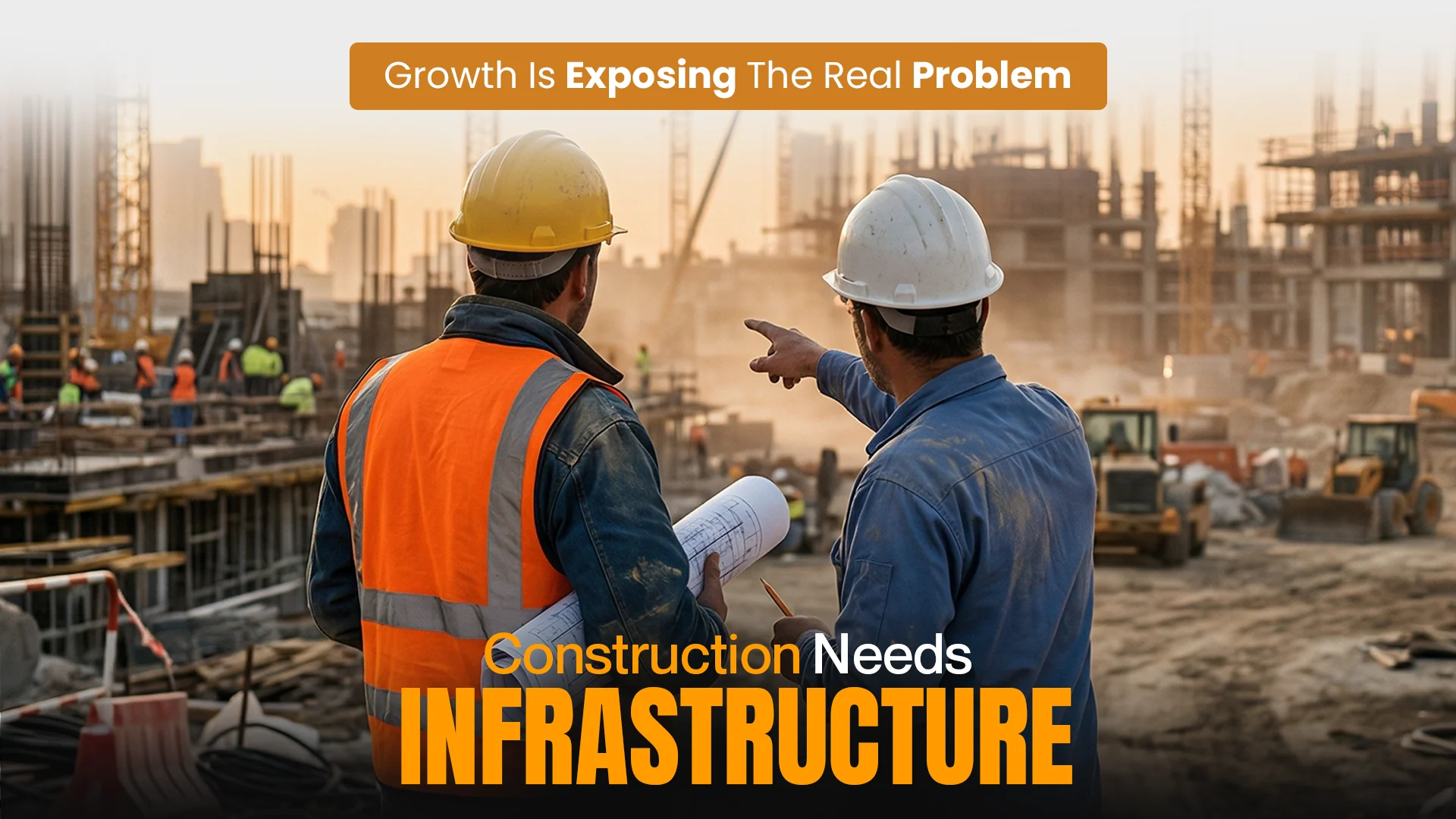

Project sizes are increasing. What once might have involved a single site now routinely spans multiple locations. Timelines continue to compress while coordination requirements expand. The construction industry isn’t just growing, it’s becoming structurally more complex.
This shift doesn’t announce itself. It emerges gradually through accumulated changes in how work gets planned, executed, and delivered. Larger general contractors manage more subcontractors. Multi-site projects demand tighter synchronisation. Quality expectations rise while margin for error narrows. The industry is experiencing growth, but growth of a particular kind: the type that fundamentally alters operational demands.
Growth Creates Structural Pressure
When an industry grows, the immediate focus falls on output, more projects, larger contracts, and expanded capacity. What receives less attention is how growth changes the underlying mechanics of execution.
Planning becomes more intricate. A single delayed delivery or miscommunication across dispersed teams can cascade through multiple project phases. What worked at a smaller scale, informal coordination, relationship-based oversight, and manual tracking, begins to strain under increased volume and geographic spread.
Execution pressures intensify. Maintaining consistent quality across multiple concurrent sites requires more than skilled labour. It demands reliable processes, clear accountability, and real-time visibility into what’s actually happening on the ground. When projects multiply, the cost of variability compounds.
Communication networks grow exponentially more complex. Information that once moved through direct conversations now needs to flow systematically across layers of contractors, suppliers, inspectors, and project managers. Gaps in information flow translate directly into execution risk.
Risk exposure doesn’t just increase; it diversifies. Weather delays, material shortages, labour availability, and regulatory compliance: each variable multiplies across sites and timelines. Managing this isn’t about eliminating risk. It’s about reducing unnecessary volatility in how work gets done.
These aren’t temporary growing pains. They’re structural characteristics of a maturing industry operating at increased scale and complexity.
Infrastructure as the Quiet Response
Mature industries respond to complexity by investing beneath the surface. Not in a more visible capacity, but in the systems that make capacity reliable.
This looks like building execution systems that don’t require constant intervention. Creating visibility into project status that doesn’t depend on phone calls and spreadsheets. Reducing variability through repeatable processes that can be deployed consistently regardless of location or team composition.
Infrastructure, in this context, isn’t about technology for its own sake. It’s about strengthening the operational foundation that allows growth to be sustained rather than chaotic. It’s the difference between scaling and simply doing more.
Industries that successfully navigate complexity do so by making their operations more systematic. They invest in what reduces friction, improves predictability, and compounds reliability over time. Construction is moving through this transition now, unevenly, but unmistakably.
The companies positioned to support this transition aren’t chasing trends. They’re building around the persistent structural needs that complexity creates: better coordination, clearer accountability, more consistent execution. These needs don’t disappear when growth slows. They intensify as standards mature.
Why This Creates Long-Term Investment Opportunities
Infrastructure businesses, those that strengthen operational foundations rather than simply participate in project volume, possess distinct characteristics that matter to long-term capital allocation.
They scale alongside industry growth rather than betting on it. As construction activity expands and complexity deepens, the value of reliable execution systems increases proportionally. The business model compounds with industry maturation rather than depending on continuous acceleration.
They benefit from complexity rather than suffering from it. Each additional site, each new coordination requirement, each tightening timeline increases the structural pressure that makes operational infrastructure more valuable. Complexity creates the conditions for durability.
They reduce downside volatility. Industries experience cycles. Project-dependent businesses rise and fall with activity levels. Infrastructure businesses that reduce execution friction and improve consistency become more essential during both expansion and contraction. Their relevance persists across market conditions.
They compound relevance over time. As processes get embedded, as reliability gets proven, as alternatives become comparatively riskier, the switching cost of operational infrastructure rises. This isn’t lock-in through contracts. It’s retention through demonstrated reduction of operational uncertainty.
From an investment perspective, this translates into structural resilience. The business logic doesn’t depend on market timing or sustained exponential growth. It depends on an industry becoming more complex and therefore requiring more systematic approaches to execution.
This is capital discipline applied to operational maturity: identifying where structural pressure points create lasting value rather than temporary opportunities.
The Infrastructure Layer
Companies like Myro operate within this infrastructure layer, building around the operational systems that make complex, multi-site execution more predictable and less dependent on informal coordination.
The positioning is deliberate. Not as participants in construction activity itself, but as strengtheners of the operational foundation that activity depends upon. The value proposition aligns with industry maturation rather than short-term growth curves.
Where Long-Term Value Actually Sits
Construction growth draws attention to the visible: project announcements, contract values, and development pipelines. These metrics capture activity. They don’t necessarily capture where value accrues over time.
Infrastructure determines longevity. The companies that reduce execution friction, that make complexity manageable, that turn variability into consistency, these are the ones that remain relevant as industries mature and standards rise.
Long-term value in construction increasingly sits beneath visible project activity. It sits in the operational systems that make large-scale, multi-site execution reliable rather than chaotic. It sits in the infrastructure that absorbs complexity so that growth can be sustained.
This isn’t where headlines focus. It’s where structural opportunities emerge, quietly, durably, and with increasing relevance as the industry continues to evolve.