
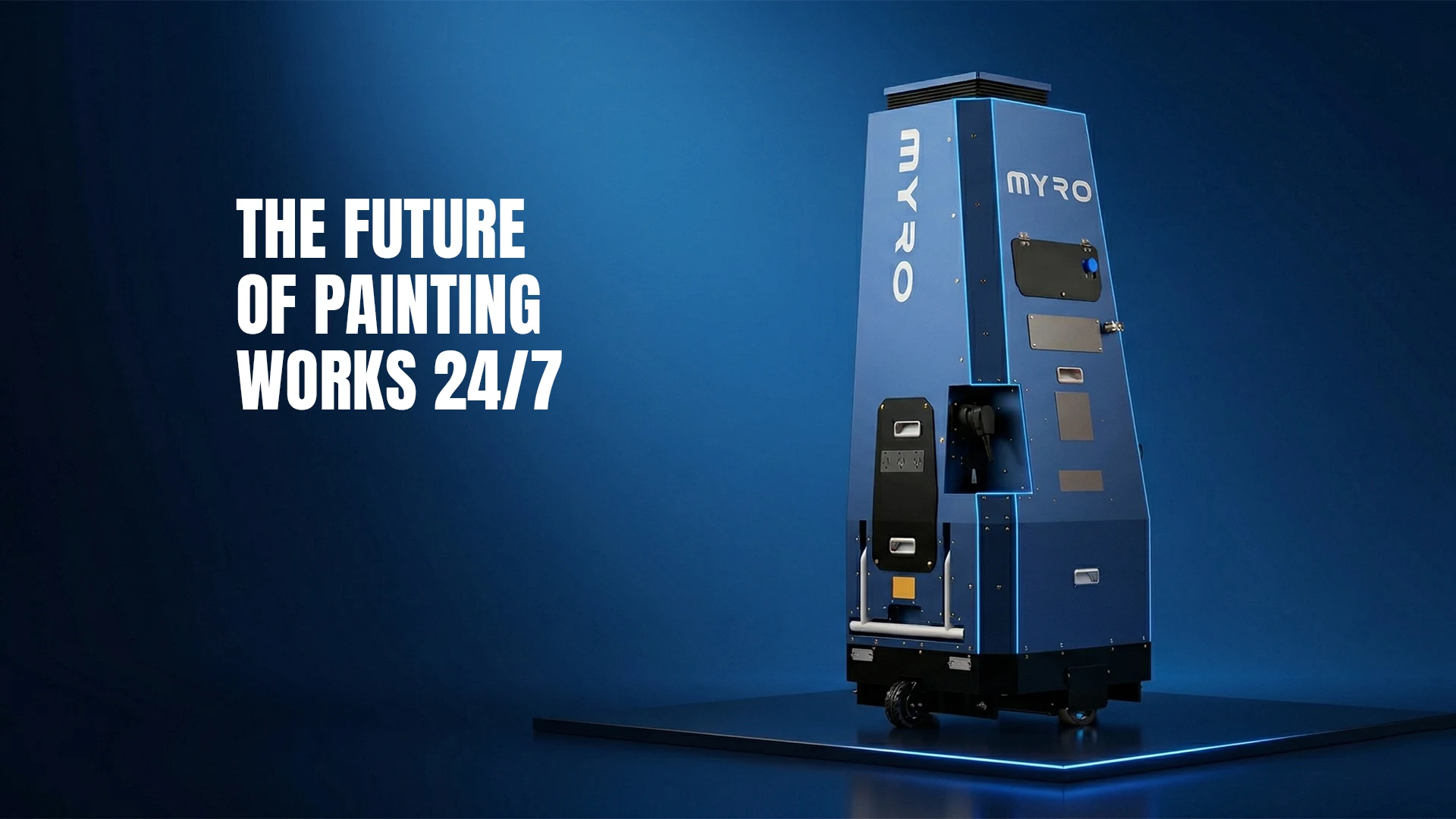

Not literally. Every finished building wears it. Every wall, every ceiling, every structural surface that gets handed to an occupant has been coated, covered, and finished by someone. But in the hierarchy of construction attention, where structural engineering gets the headlines, where mechanical and electrical systems get the scrutiny, where project management gets the investment in software and process, painting sits quietly in the background.
It is treated as the last step. The easy part. The thing that happens after the real work is done.
That assumption is beginning to cost the industry significantly. And the capital providers who have noticed the gap between what painting actually demands and how the industry has chosen to resource it are starting to draw a very different conclusion about where the next wave of construction technology value will emerge.
The Misunderstood Trade
There is a persistent misconception that painting is simple work. Repetitive, yes. Requiring minimal technical judgement, the assumption goes. Interchangeable in terms of who performs it.
None of this holds under examination.
Consistent surface finishing requires precise control of application rate, material viscosity, distance from the substrate, speed of movement, and environmental conditions , simultaneously, across surfaces that vary in texture, orientation, and accessibility. A ceiling is not a wall. A curved column is not a flat partition. A surface that has been poorly prepared responds differently from one that has been correctly primed. The variables are numerous, and they interact.
When these variables are managed well, the result is invisible in the best sense, a finish so consistent that no one notices it. When they are managed poorly, the evidence accumulates in patchy coverage, inconsistent sheen, premature failure of the coating, and the rework cycle that follows.
The trade is not simple. It has been under-resourced, under-systematised, and under-examined for so long that its complexity has become easy to overlook. That is precisely why it has remained inefficient for as long as it has, and precisely why it is now attracting serious attention from those looking at where automation can deliver measurable, repeatable improvement.
Repetition Without Consistency: The Core Contradiction
Here is what makes painting an unusual candidate for the attention it is now receiving.
It is among the most repetitive tasks in construction. The same motion, the same material, the same surface type, repeated across thousands of square metres on a single project. By any industrial logic, this should make it among the most consistent outputs on site. Repetition, in manufacturing and process industries, is what drives quality up and variability down.
In manual painting, the opposite tends to occur.
Repetition produces fatigue. Fatigue produces drift in application pressure, in movement speed, and in the distance maintained from the surface. What begins as a controlled, calibrated process at the start of a shift gradually becomes something less precise as the hours accumulate. The thousandth square metre does not receive the same application quality as the first. Not because the worker is careless. Because they are human.
This is the core contradiction at the heart of manual finishing work. The repetitive nature of the task, which should be its greatest asset in terms of standardisation, becomes its greatest liability in terms of consistency. The more of it there is to do, the more the output varies.
For capital providers evaluating construction operations, this contradiction matters. It means that scale does not automatically improve the quality of finishing work. It may worsen it. And any business model that relies on delivering consistent finishing quality across large volumes of work faces a structural challenge that more labour alone does not solve.
Automation does not get tired at metre five thousand. That is not a minor operational detail. It is a fundamental shift in what large-scale consistent finishing looks like.
What Automation Offers That Manual Cannot Replicate
The value proposition of automated finishing systems is not a single improvement. It is a set of interconnected advantages that, taken together, change the operational character of the finishing phase.
Application precision held constant. A system that controls its own application parameters does not drift between the first hour and the eighth. The coverage rate, the distance from the substrate, and the speed of traversal are maintained to specification continuously. The output at the end of a long run reflects the same standard as the beginning.
Surface data is a by-product of the operation. Automated systems generate a record of what was applied, where, when, and under what conditions. This does not exist in manual finishing. It cannot be reconstructed after the fact. For quality assurance, for client reporting, for dispute resolution, and for operational improvement across future projects, this data has real and growing value.
Deployability in adverse conditions. Painting is typically done in conditions that are manageable but not always comfortable, at height, in confined spaces, in environments with fume exposure and ventilation requirements. Automated systems change the human exposure profile of the task. The work still happens in those conditions. The people do not need to be in them for as long, or at all.
Programme reliability. A finishing system that operates to a predictable output rate , regardless of crew availability, shift patterns, or weekend constraints , allows the programme around it to be planned with genuine confidence. Downstream trades can mobilise on the basis of a real completion date, not an estimated one. This has value that extends well beyond the finishing phase itself.
The Capital Logic, Where the Return Lives
For capital providers evaluating opportunities in construction automation, painting presents a specific and underappreciated investment profile.
The market it addresses is enormous. Finishing work represents a substantial portion of total construction labour cost on most project types. The addressable volume is not a niche; it is a core component of how buildings are delivered across every segment of the market.
The problem it solves is structural, not cyclical. Labour availability in skilled finishing trades will not recover to historical levels. The demographic trend is established. The competitive pressures drawing younger workers toward other trades and industries are not easing. An automated system that reduces dependence on this labour pool is not solving a temporary shortage. It is solving a permanent structural constraint.
The differentiation it creates is durable. A finishing operation with consistent, auditable, programme-reliable output is not easily replicated by competitors who remain on manual processes. The advantage compounds across projects, in client relationships, in tender success rates, in the ability to take on volume that manual operations cannot confidently commit to.
The technology risk has reduced materially. Early-stage investment in construction robotics carried significant technology risk , systems that worked in controlled conditions but struggled in real site environments. That risk profile has changed. Systems are operating on live projects. The performance data is real. The gap between proof of concept and commercial deployment has narrowed to a point where the investment thesis rests on market adoption, not on whether the technology works.
This is the combination that experienced capital providers look for: a large, structurally constrained market; a solution with demonstrable performance; a competitive moat that strengthens with scale; and a technology risk profile that is measurably lower than it was at the start of the investment cycle.
Painting automation, quietly and without the fanfare that attaches to more visible construction technologies, has arrived at exactly that position.
A Different Kind of Certainty
Construction has always sold certainty it could not always deliver. Completion dates that became targets. Quality standards that became aspirations. Cost estimates that became starting points for conversations about overruns.
This is not a criticism of the people who make those commitments. It is a reflection of the tools they have had to work with. When the finishing phase depends on the availability and consistency of a manual workforce, certainty is genuinely difficult to engineer. The best operators manage it better than others. But even the best are working against structural variability that the model itself creates.
Automated painting systems do not eliminate every uncertainty in construction. But they remove a specific and significant source of it, one that sits at the end of the programme, where its effects are most concentrated and most damaging to final delivery.
For the clients who commission the work, that is a meaningful promise. For the contractors who want to make it, it is a meaningful tool. And for the capital providers who see that the combination of a large market, a structural problem, and a technically viable solution has arrived at the same moment,
It is a meaningful opportunity.
Construction Capital Intelligence · Finishing Systems Analysis · All commentary reflects generalised industry observations and does not constitute financial or investment advice.