
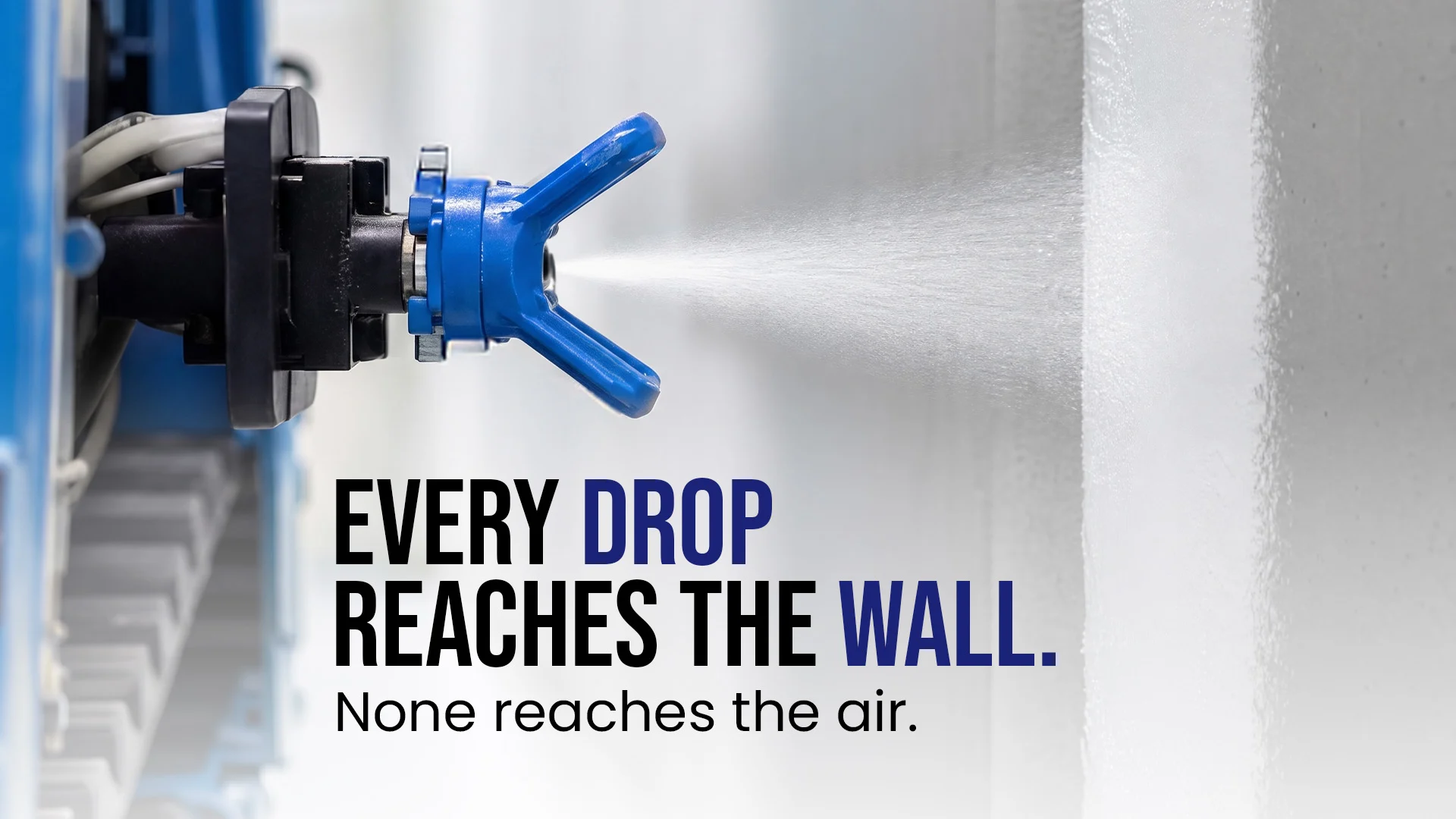

The global push for sustainable, green-certified infrastructure is fundamentally reshaping how developers plan their projects. We meticulously calculate the carbon footprint of our steel, the energy efficiency of our HVAC systems, and the chemical makeup of our materials.
Yet, when it comes to the finishing phase, the construction industry often relies on a legacy execution model that actively works against these environmental goals. The final coat of paint covers the vast majority of a building’s interior surface area, and how that paint is applied has a massive, often undocumented impact on a project’s environmental compliance.
The Environmental Hazard of Manual Application
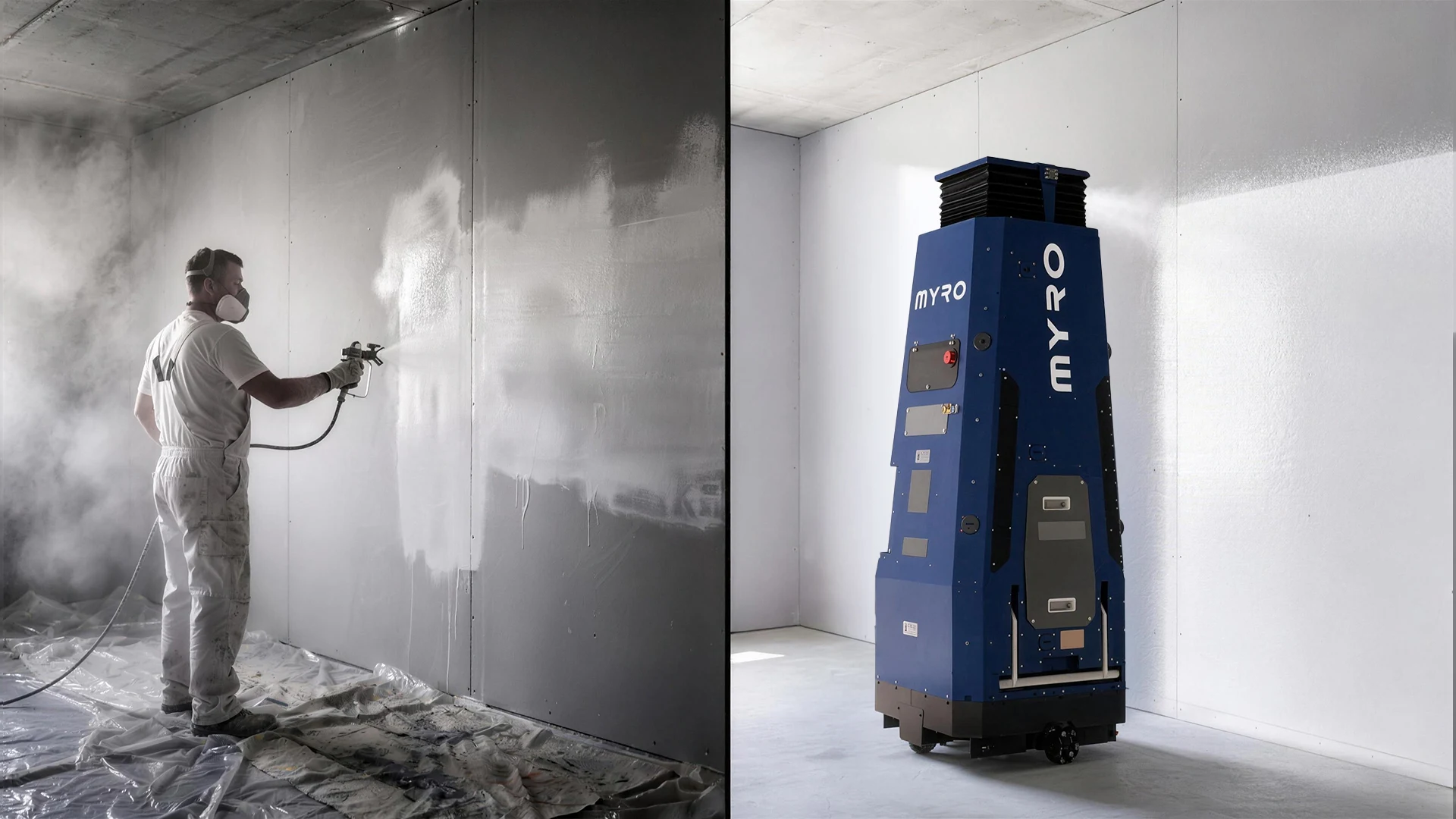
The core issue lies in the mechanics of traditional finishing. To achieve speed on large-scale commercial layouts, manual crews rely heavily on airless sprayers. While faster than rolling, manual airless spraying creates massive, atomized paint clouds.
When a human operator controls a high-pressure spray gun, maintaining a mathematically perfect standoff distance from the wall for an eight-hour shift is physiologically impossible. As fatigue sets in, the distance drifts, the angle tilts, and a significant portion of the coating never adheres to the substrate. Instead, it lingers in the air, exposing site workers to Volatile Organic Compounds (VOCs) and settling as toxic dust on floors and adjacent surfaces.
Why Traditional Finishing Slows Down Green Projects
This lack of control creates a dual problem for project managers: health hazards and material waste.
When atomized paint fills an enclosed commercial space, indoor air quality plummets. Other trades are forced to halt work or clear the area to avoid inhalation risks, inadvertently pausing the critical path of the project. Furthermore, the material inefficiency is staggering. In manual application, up to 30% of the raw material is lost to overspray and airborne drift. You are effectively paying for paint that ends up on the floor, in the ventilation system, or in the lungs of the workforce.
How Automation Changes Execution
To build healthier, more sustainable spaces, we have to engineer the variance out of the application process. MYRO approaches wall finishing not as a manual craft, but as a precise, mechatronic science.
By utilizing advanced proximity sensors and algorithmic fluid control, the MYRO platform maintains a perfect, programmatic standoff distance from the wall pass after pass, shift after shift. The paint is delivered exactly where it is specified, with precise liquid pressure that drastically reduces atomized clouding. The result is an immediate, measurable transformation of the site environment: more paint on the wall, less paint in the air, and a fundamentally safer breathing zone for all site personnel.
Why Consistency Matters at Scale
It is one thing to control overspray in a single room; it is another entirely to maintain that discipline across a 40-story commercial tower. At scale, the impact of automation compounds into massive operational and environmental savings.
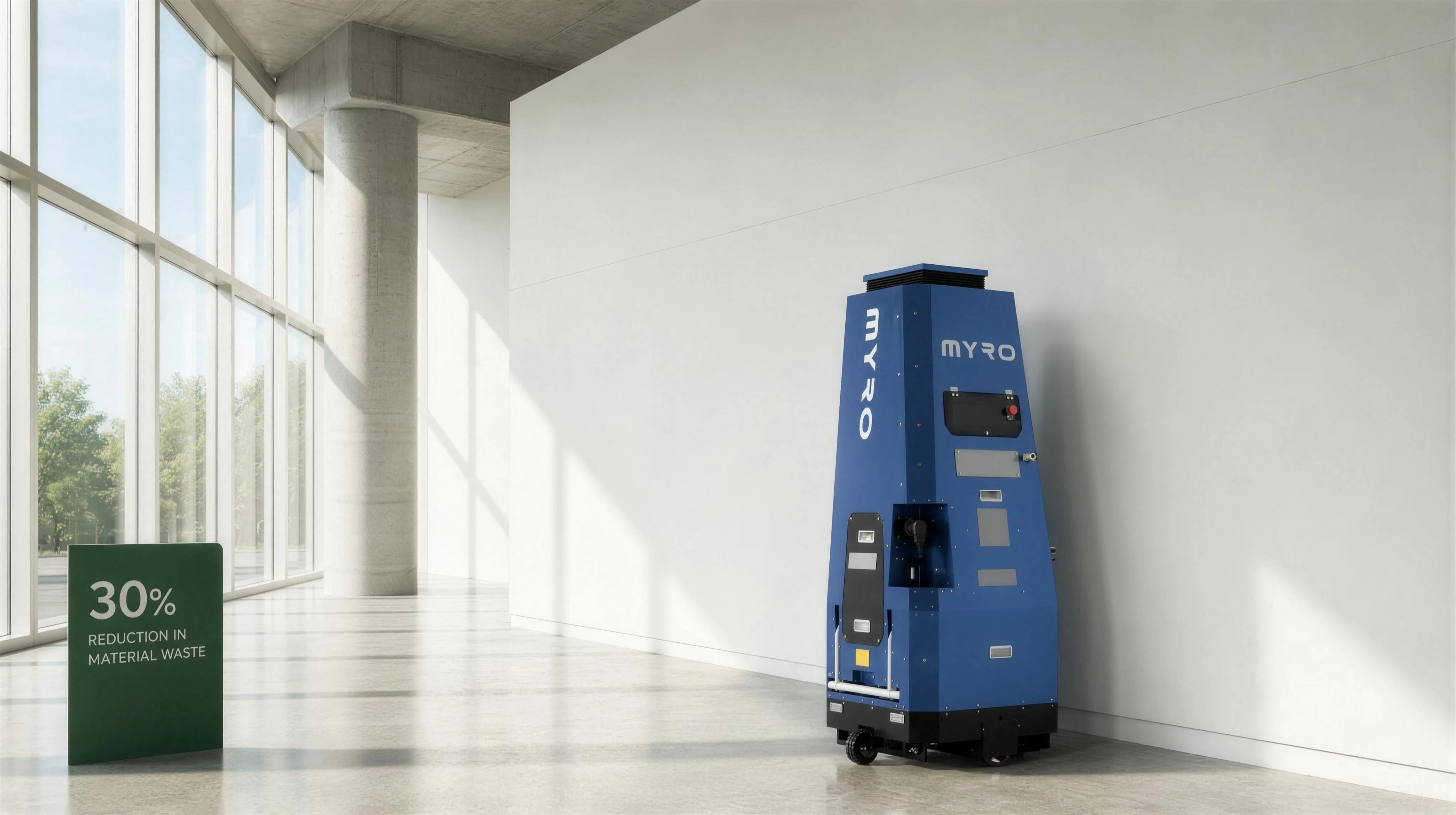
By eliminating the erratic application of manual spraying, MYRO programmatically reduces raw paint material waste by up to 30%. For developers, this translates to hundreds of gallons of unused chemicals kept out of the site ecosystem and thousands of dollars recovered directly to the bottom line.
A Quantifiable Path to LEED and BREEAM
Achieving prestigious green building certifications like LEED or BREEAM requires more than just utilizing low-VOC materials; it requires proving that your site practices minimize environmental impact.
Because MYRO operates digitally, it provides exact, trackable consumption metrics. Project managers are no longer forced to guess how much paint was wasted versus applied. You gain documented, data-driven proof of your material efficiency and your proactive measures to protect indoor environmental quality (IEQ) during construction. This turns a historically messy, undocumented trade into a streamlined, auditable asset for your certification goals.
Execution is the Ultimate Sustainability
Sustainability in construction is often treated as a material choice, but true sustainability is an execution strategy.
Specifying eco-friendly paint is only half the equation; deploying an autonomous system that applies it with zero waste, protects the health of the workforce, and operates seamlessly through the night is the standard of the future. By replacing human variability with robotic precision, forward-thinking developers are not just building greener assets they are building them smarter, safer, and with absolute certainty.