Manual Painting Cadence
Variable; drifts with shift fatigue and atmospheric conditions.


Author: MYRO
Published on: 2026-06-23T00:00:00.000Z
5 min read
The modern commercial interior is undergoing a quiet regulatory shift. For years, general contractors and developers measured project success using three primary metrics: speed, cost, and structural integrity. Today, a fourth pillar has arrived at the executive table: environmental performance.
With institutional investors increasingly prioritizing sustainable assets, certifications like LEED (Leadership in Energy and Environmental Design) and BREEAM have moved from premium marketing features to baseline commercial mandates. However, achieving these strict environmental benchmarks remains incredibly difficult on an active, traditional job site. The finishing phase, particularly interior wall coating, represents a major bottleneck where environmental goals and raw construction realities frequently collide.
On any major commercial build, indoor air quality is a primary metric for environmental compliance. The air quality during construction directly impacts both worker health and the ultimate timeline for safe asset handovers.
The core issue stems from the chemical composition of traditional commercial finishes. Volatile Organic Compounds (VOCs) and airborne particulate matter routinely spike during the final stages of a project, creating localized environmental challenges. When a site’s indoor air quality degrades, project managers are forced to stall consecutive trades, initiate extended ventilation cycles, and delay final inspections. For developers, these paused hours quickly translate into unpriced holding costs and program slippage.
The traditional approach to high-volume painting relies heavily on manual airless spray systems. While fast, manual spraying introduces high behavioral and physical variance to the job site.
The Atomization Problem: Manual airless spraying inherently creates massive, uncontrolled atomized paint clouds. These airborne mists carry high concentrations of VOCs and particulate matter throughout enclosed commercial layouts.
Erratic Material Waste: Human operators, battling natural fatigue over long shifts, cannot maintain a perfectly constant distance from the wall. This fluctuation leads to erratic film builds, localized overspray, and heavy paint spillage.
The Rework Loop: When manual application thickness drifts outside the parameters specified by material suppliers, it invites defects like cracking, running, or patchy coverage. Remediation requires sanding and repainting—doubling both the labor footprint and the site’s volatile emission profile.
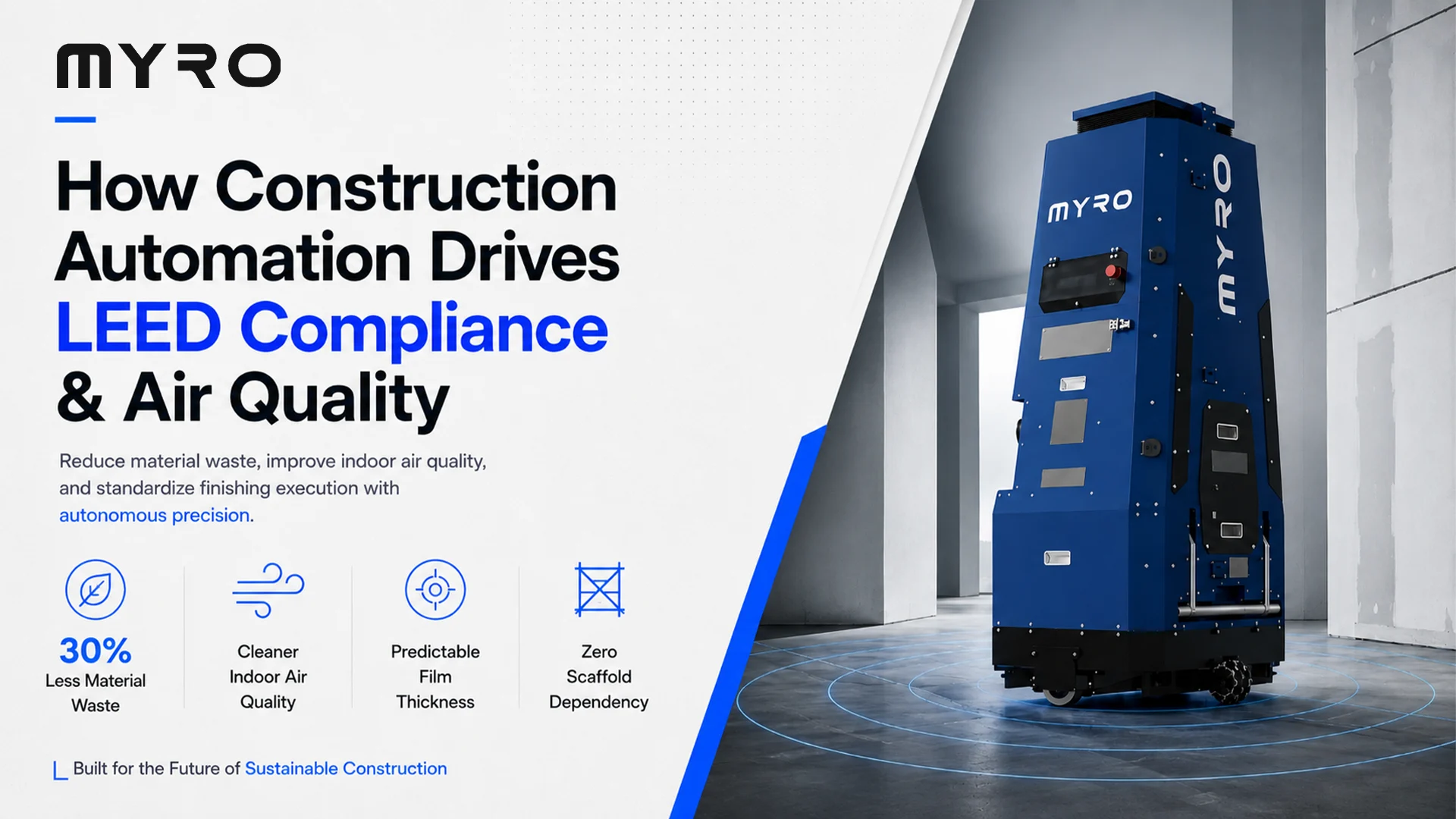
The operational cost of this manual model is high: traditional painting processes frequently generate up to 30% raw material waste, directly complicating a project’s waste management and environmental compliance path.
The Environmental Impact of Manual Spraying
“Manual airless spraying creates massive atomized paint clouds, exposing workers to VOCs and wasting raw material. Standard finishing budgets often plan for material waste as an inevitable variable, but in a carbon-conscious market, erratic material waste is a structural liability.”
True construction automation solves this issue by taking a programmatic approach to material application. Rather than attempting to manage human variance on site, advanced robotic systems eliminate the problem at the hardware layer.
By utilizing high-resolution LiDAR scanning arrays and autonomous path-planning software, robotic painting platforms map out raw commercial environments in three dimensions. Once the layout is calibrated via an intuitive interface, the system executes paint delivery with a fixed precision margin.
The critical breakthrough lies in programmatic standoff distance. The system holds the spray nozzle at an absolute, unvarying distance and angle relative to the substrate throughout the entire execution. Because the velocity and distance remain completely standardized, the paint adheres cleanly to the vertical surface rather than scattering into the ambient environment. This mechanical discipline achieves a 30% reduction in raw material waste while keeping the air clear of atomized chemical clouds.
For developers and investors managing multi-tower portfolios or expansive commercial layouts, consistency is the ultimate form of risk mitigation.
When paint application is automated, the thickness of every layer—measured as Wet Film Thickness (WFT) and Dry Film Thickness (DFT)—is mathematically controlled. This granular accuracy ensures full compliance with the strict technical data sheets provided by coating manufacturers.
Variable; drifts with shift fatigue and atmospheric conditions.
Holds 100 sqm/hr steadily across 24-hour cycles.
Up to 30% waste through overspray and spills.
Standardizing the application process yields clear operational benefits:
The broader value of construction automation is its ability to seamlessly connect the office to the physical job site. Modern project management heavily utilizes Building Information Modeling (BIM) platforms to simulate and plan builds digitally. However, that intelligent data often gets lost when translated manually on the structural concrete floor.
Autonomous field robotics bridge this gap. By converting architectural plans directly into physical execution paths, they turn digital designs into real-world site efficiency.
Furthermore, this automated infrastructure addresses the industry’s critical skilled labor deficit. Instead of replacing human workers, these systems allow companies to upgrade their existing crews. Manual painters are upskilled into Certified Operators who manage advanced technical systems via simple tablet controls. This removes human workers from hazardous scaffolding and prolonged chemical exposure, creating a significantly safer, more modern site environment.
As green building mandates tighten globally, the developers who pull ahead will be those who replace volatile manual variables with predictable, standardized processes.
This operational shift is exactly where MYRO fits into the future of construction infrastructure. As an autonomous, mobile interior wall-painting platform, MYRO applies coatings with a precision margin of just 2 cm, covering 100 square meters per hour—a 10x speed multiplier over traditional manual methods.
By maintaining a continuous, programmatic standoff distance, MYRO delivers more paint to the wall and less to the air, resulting in cleaner indoor air quality, a 30% reduction in coating material waste, and an easier path to your project’s LEED or BREEAM building certifications.
The future of commercial construction belongs to automated, data-driven workflows. Environmental stewardship and high site efficiency are no longer opposing priorities; they are deeply connected metrics of corporate performance.
By decoupling finishing timelines from manual capacity constraints and standardizing material execution, forward-thinking contractors are protecting both their project margins and their corporate ESG targets. In an industry where schedules are unforgiving and sustainability is mandatory, mechatronic precision is no longer just an innovative alternative—it is becoming the baseline infrastructure for building at scale.
Ready to optimize your next project’s critical path?
111 North Bridge Road
#07-11 Peninsula Plaza Singapore (179098)
7, 599- Jebel Ali Industrial First
Dubai, UAE- 507187
Contact Number: +971 54 995 4416
Email [email protected]
© All Rights Reserved MYRO International PTE 2026