

The construction industry has a complicated relationship with technology.
It adopts it. It integrates it into existing workflows. It uses it to do what it was already doing, slightly faster, slightly cheaper, slightly more documented. And then it describes the result as innovation.
This is not innovation. It is optimisation. And there is nothing wrong with optimisation. It has genuine value. It moves metrics in the right direction. It satisfies procurement requirements, marketing narratives and the technology budget conversations that happen at the start of every financial year.
But optimisation operates within a model. It improves what the model does without questioning what the model is. And when the model itself is the problem, optimisation is not just insufficient. It is a distraction from the change that actually needs to happen.
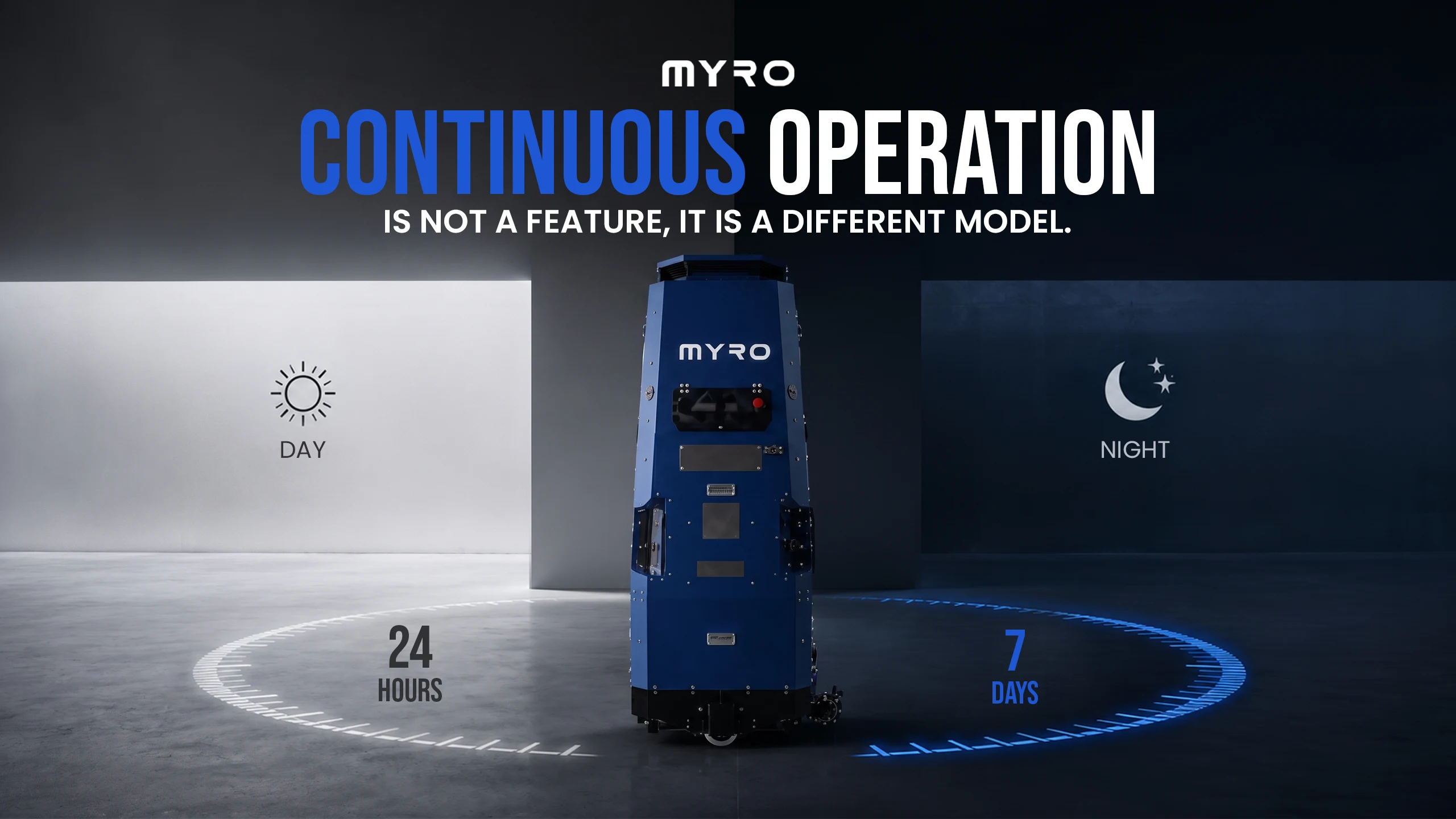
Continuous operation in construction finishing is not an optimisation. It is not a feature that makes the existing model perform better. It is a different model. And understanding why that distinction matters, for contractors, for capital providers, and for anyone trying to read where construction execution is heading, requires being precise about what a model actually is and what changes when it changes.
What a Model Is, and Why Features Cannot Replace One
A model is not a collection of capabilities. It is the underlying logic that determines how a system behaves, what constraints it operates within, and what outcomes it is structurally capable of producing.
The traditional construction finishing model has a logic. It is built around human availability. Work happens when crews are present. Output is determined by the number of people on shift, the hours they can sustain, and the conditions under which they are working. Quality is a function of individual skill applied consistently enough across a long enough period under good enough conditions to produce an acceptable result.
Every piece of technology that has been layered onto this model over the past several decades has improved specific aspects of its performance without touching that underlying logic. Better application equipment delivers better coverage rates. Improved material formulations reduce drying time and improve durability. Project management software provides better visibility into progress and sequencing. Inspection tools catch defects earlier.
All of these are genuine improvements. None of them changes the model. The work still happens when the crew is present. The output is still determined by human availability. The quality is still a function of individual execution sustained across conditions that inevitably vary.
The model remains intact. And the model’s constraints remain intact with it.
Continuous operation removes the foundational constraint of the entire model. It severs the connection between human availability and productive output. When that connection is severed, the logic of the model does not bend or stretch to accommodate the new capability. It breaks. And something structurally different takes its place.
The Execution Cycle That Traditional Construction Built Around
To understand what changes when continuous operation replaces the traditional model, it is worth being precise about what the traditional execution cycle actually looks like.
A finishing phase in conventional construction runs in discrete bursts. The crew arrives. The work begins. The shift progresses through its productive window. The shift ends. The crew leaves. The site enters a period of complete operational stillness that lasts until the next shift begins.
Within this cycle, the productive window is the smaller portion of the total time available. The stillness is the larger portion. Not slightly larger. In many project configurations, it is significantly larger. Evenings, nights, weekends, public holidays, weather-related stoppages, and sequencing gaps between phases. The calendar days available to a project are not equivalent to the productive hours it can extract from them.
This gap between calendar time and productive time is not a bug in the traditional model. It is a structural feature of it. The model was designed around human working patterns because it had no alternative. And because it had no alternative, the gap was treated as a condition of construction rather than a cost of the model.
Around this cycle, everything else in construction execution is organised. Programme schedules are built around it. Client expectations are calibrated to it. Contractual completion timelines incorporate it. Downstream trade sequencing is planned around it. The entire ecosystem of construction delivery has been structured to work within a model defined by its own productive limitations.
That is what changes when the model changes. Not just the hours of operation. The entire execution cycle that the industry built around those hours.
Changing a feature changes what the model produces. Changing the model changes what is possible. These are not the same thing, and treating them as the same thing is how industries miss the most significant shifts happening within them.
Why Continuous Operation Cannot Be Understood as a Feature
When contractors and project managers first encounter robotic finishing systems, the framing they typically apply is feature framing. The system works longer hours. That is a useful capability. It can help recover the schedule in a crunch. It can reduce overtime costs on tight programmes. It is a good tool to have available when the situation calls for it.
This framing is understandable. It is also wrong. And the wrongness matters because it leads to decisions about adoption, integration, and investment that undervalue what is actually being offered.
A feature is something you activate when you need it and set aside when you do not. It sits within your existing operational logic. It serves your existing model. Its value is additive, not structural.
Continuous operation is not additive to the traditional finishing model. It is incompatible with its core constraint. The traditional model is built on the assumption that productive time is bounded by human availability. Continuous operation removes that assumption entirely. You cannot add it to the traditional model like a new tool in the equipment inventory. You have to replace the model with one whose logic reflects what continuous operation makes possible.
That replacement is not a technology upgrade. It is an operational redesign. And operational redesigns do not produce incremental improvements in performance metrics. They produce step changes in what the operation is capable of delivering.
The contractors who understand this are not evaluating continuous operation robotic finishing as a situational tool. They are evaluating it as the foundation of a fundamentally different way of running a finishing operation. The ones who evaluate it as a feature will extract a fraction of the available value. The ones who treat it as a model change will build a different business.
The Execution Cycle That Continuous Operation Creates
Where the traditional model runs in discrete bursts separated by extended stillness, continuous operation creates a finishing execution cycle that looks structurally different in almost every dimension.
Output becomes a function of time, not availability. When the system operates consistently across the hours that matter to the programme, not just the hours that the labour model permits, the relationship between elapsed calendar time and completed surface area changes fundamentally. A week on the calendar translates into a very different volume of finished work than the same week under the traditional model. Not because the system is faster during working hours. Because it uses the hours that the traditional model discards.
The programme structure becomes genuinely flexible. When the finishing phase is no longer constrained to the output that a standard shift pattern can produce, the sequencing options available to project planners expand significantly. Overlapping phases that were previously impossible without prohibitive labour costs become viable. Recovery windows that previously existed only as optimistic notations on a Gantt chart become operational realities. The programme can be designed around what the project needs rather than what the labour model allows.
Quality becomes a specification rather than an outcome. When the application parameters are held constant across a continuous operational cycle, quality stops being something that emerges from the interaction of skill, conditions, and consistency. It becomes something that is set at the beginning of the process and maintained throughout it. The finish at the end of the weekend reflects the same standard as the finish at the beginning of the week. The specification is the output, not the aspiration.
Data becomes a structural asset. A finishing system operating continuously across a project generates an operational record that manual finishing cannot produce. Every hour, every surface, every parameter, documented in real time. That record has value in quality assurance. It has value in client reporting. It has value in the regulatory and warranty contexts that are becoming more demanding in most serious construction markets. And it has compounding value across multiple projects, as the operational intelligence it generates is applied to the refinement of future execution.
What This Means for the Contractors Who Get It First
Industries in structural transition do not reward everyone who eventually adopts the new model. They reward the ones who adopt it at a point when the advantage it creates is still a differentiator rather than a baseline expectation.
The contractors who understand continuous operation as a model change, not a feature upgrade, and who build their finishing operations around that understanding now, are not simply going to perform better on individual projects. They are going to establish a delivery standard that the market around them will take time to match.
That standard shows up in client relationships. A finishing operation that can commit to programme dates based on consistent output rather than estimated availability, and then deliver on those commitments repeatedly, builds a client relationship profile that manual operations cannot replicate, regardless of how well they manage their crews. Trust in construction is built on evidence, not assurance. Continuous operation creates the evidence.
It shows up in tender positioning. When the differentiator between two finishing operations is not just price but the demonstrable difference between a programme-reliable system and a labour-dependent estimate, the conversation with sophisticated clients and principal contractors changes. The question is no longer who can do it cheapest. It is who can do it with genuine certainty. That is a different competition, and it is one that rewards the model change rather than the feature upgrade.
It shows up in the investment profile of the business itself. A finishing operation whose output does not depend on the availability of a contracting labour pool, whose quality does not vary with fatigue and conditions, whose programme commitments are based on operational data rather than historical averages, and whose capacity scales through system deployment rather than workforce expansion, is a structurally different business from a manual finishing operation of equivalent current size. It carries different risks. It has different growth characteristics. It attracts different capital, on different terms.
The Position Myro Takes in This Shift
Among the emerging category of robotic finishing systems designed for live construction environments, the ones that matter are not the ones that offer better tools for the existing model. They are the ones built around the recognition that the model itself needs to change.
Myro approaches construction finishing from exactly this position. The design intent is not to improve painting. It is to change the execution cycle. The system is not built to work faster during the hours that manual crews occupy. It is built to operate through the hours that manual crews cannot, converting the idle time that the traditional model treats as unavoidable into productive finishing output that the programme can rely on.
This is a meaningful distinction from systems that offer robotic capability as an enhancement to existing operations. Myro is not an enhancement. It is a replacement of the model that has defined construction finishing for as long as the industry has existed.
The contractors and capital providers evaluating Myro are not evaluating a piece of equipment. They are evaluating access to a different operational logic, one where the execution cycle is defined by what the project requires rather than what the labour model permits, where quality is a structural output rather than a managed variable, and where the business built around that logic has a growth and risk profile that the traditional model cannot match.
The Market Does Not Wait for Consensus
Structural shifts in industrial models do not announce themselves with industry-wide agreement and coordinated transition timelines. They happen project by project, operation by operation, contract by contract, as the performance differential between the old model and the new one becomes impossible to ignore.
The finishing operations that are building their programmes around continuous robotic execution now are not waiting for the market to validate the model change. They are creating the validation through the project track records they are establishing. Each delivery is on a tight programme. Each defect list that comes back is shorter than the client expected. Each handover documentation package that demonstrates a level of quality evidence the client has not previously received from a finishing contractor.
That validation accumulates. It becomes the market signal that shifts procurement conversations, that changes what sophisticated clients specify, and that moves capital toward the operations that have made the model change and away from those that are still optimising within the model that is being left behind.
The contractors and investors who understand this dynamic are not watching it develop from a comfortable distance.
They are in it. Building the track record. Establishing the standard. And widening the gap between the model that construction finishing was and the model that it is becoming.
Construction Execution Intelligence · Operational Systems Analysis · All commentary reflects generalised industry observations and does not constitute financial or investment advice.